
基金

Search documents
金湖国金股权投资基金招GP
FOFWEEKLY· 2026-02-26 10:05
Group 1 - The core viewpoint of the article is the announcement of the Jinhu Guojin Equity Investment Fund's initiative to attract social capital for industrial development in Jinhu County, with a total fund size of 1 billion RMB and a duration of 15 years [1] - The fund aims to operate under market principles, emphasizing "market operation, scientific decision-making, and risk prevention" through partnerships with social capital to establish sub-funds [1] - The sub-funds will primarily focus on high-quality enterprises and major projects in sectors such as intelligent equipment manufacturing, new materials, and health [2] Group 2 - Each sub-fund is required to have a minimum subscription size of 100 million RMB, with investment in any single enterprise not exceeding 30% of the post-investment total equity and not being the largest shareholder [2] - The investment amount in a single enterprise must not exceed 20% of the total subscription size of the sub-fund [2]


510亿,央企母基金出资了
FOFWEEKLY· 2026-02-26 10:05
Core Viewpoint - The article highlights the recent positive developments in the venture capital sector, particularly the launch of a significant 51 billion yuan central enterprise fund aimed at boosting strategic emerging industries and fostering innovation [4][8]. Group 1: Fund Launch and Objectives - On February 26, the National New Fund announced the selection of fund management institutions for its strategic emerging industries development fund, which aims to enhance the quality and efficiency of strategic emerging industries [6]. - The fund, initiated by the State-owned Assets Supervision and Administration Commission (SASAC), has a total scale of 51 billion yuan, with the first phase involving an investment of approximately 15 billion yuan from China Reform Holdings [8]. - The fund will focus on sectors such as artificial intelligence, aerospace, high-end equipment, quantum technology, and future industries like energy and information [8]. Group 2: Active Participation of Patient Capital - The establishment of the National New Fund is part of a broader trend where patient capital, represented by state-owned enterprises and social security funds, is becoming increasingly active in the market [10]. - In 2025, the China Reform Holdings led the establishment of the Cheng Tong Science and Technology Investment Fund, with a planned total scale of 30 billion yuan, focusing on new materials and advanced manufacturing [10]. - The National Social Security Fund has also signed agreements for provincial-level science and technology funds, totaling approximately 160 billion yuan, indicating a significant commitment to long-term investments [10]. Group 3: Market Recovery Indicators - Data shows a notable increase in institutional LP investment activity, with a 14.7% month-on-month growth and a 31.8% year-on-year increase as of November 2025 [11]. - The number of new registered private equity and venture capital funds has also risen, with a 2.5% month-on-month increase and a 29.5% year-on-year increase [11]. - The number of financing events in the domestic primary market reached 6,462, marking a 7.25% year-on-year increase, indicating a recovery in investment activity [12]. Group 4: Positive Exit Signals - In 2025, the number of Chinese companies listed domestically and internationally reached 247, a 26.7% year-on-year increase, with total financing amounting to approximately 326.63 billion yuan, a 126.4% increase [12]. - The extension of fund durations for strategic emerging industries to 15-20 years, with some regions having no set duration, reflects a shift towards more flexible investment mechanisms [12]. - The current environment is seen as a critical window for national-level funds to address market funding gaps, potentially leading to the emergence of new general partners (GPs) [12].

沪指震荡整理,AI硬件概念活跃,节后两市成交额持续放大 | 华宝3A日报(2026.2.26)
Xin Lang Cai Jing· 2026-02-26 09:52
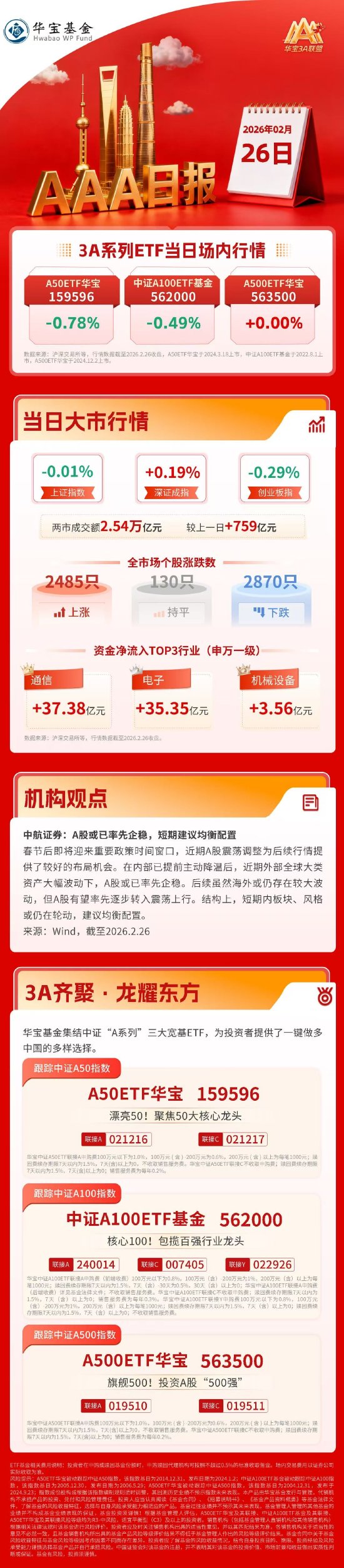
Group 1 - The core viewpoint indicates that the A-share market may have stabilized ahead of others, providing a good opportunity for layout after recent fluctuations [2][5] - The total trading volume in the market reached 2.54 trillion yuan, an increase of 759 billion yuan compared to the previous day [5] - The top three industries with net capital inflow were electronics (+35.35 billion yuan), machinery equipment (+37.38 billion yuan), and communications (+3.56 billion yuan) [5] Group 2 - Huabao Fund has launched three major broad-based ETFs tracking the China A50, A100, and A500 indices, offering investors diverse options for exposure to the Chinese market [2][5] - The A50 ETF was listed on March 18, 2024, the A100 ETF on August 1, 2022, and the A500 ETF on December 2, 2024 [2] - The market is expected to experience structural rotation among sectors and styles in the short term, suggesting a balanced allocation strategy [2][5]
全网刷屏!已到账
Xin Lang Cai Jing· 2026-02-26 09:47
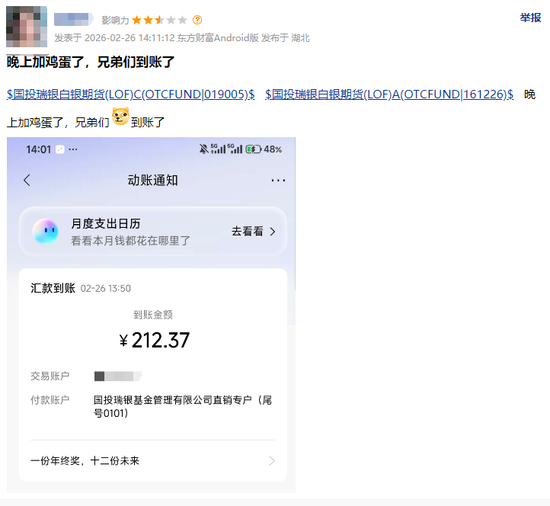
Core Viewpoint - The article discusses the compensation scheme for investors affected by the valuation adjustment of the Guotou Ruijin Silver Fund, highlighting the reasons why certain investors are not eligible for compensation [1][11]. Group 1: Compensation Scheme Details - The compensation scheme applies only to individual investors who submitted redemption requests between January 30, 2026, 3 PM and February 2, 2026, 3 PM [5]. - Investors who did not redeem their shares are considered to have only experienced "paper fluctuations," and thus are not eligible for compensation [4][14]. - The cumulative net asset value return for the silver LOF fund on February 2 and 3 was -29.23%, closely matching the 29.34% decline in silver futures, indicating that non-redeeming investors were not significantly impacted by the valuation adjustment [6][16]. Group 2: Market Expert Insights - Market experts emphasize the distinction between "realized losses" for redeeming investors and "unrealized paper losses" for those who held their investments [5][15]. - The different trading mechanisms between on-market trading and off-market redemption mean that on-market investors are not covered by the compensation scheme, as their transaction prices reflect real-time market conditions [8][18]. - The valuation adjustment process was initiated to maintain fair valuation and prevent "first redemption advantage" behaviors during extreme market conditions, which protects the interests of all investors [8][19]. Group 3: Future Recommendations - Experts suggest that the asset management industry should improve its emergency response mechanisms and enhance the timeliness of information disclosure to better protect investor interests during market volatility [9][19].
[2月25日]指数估值数据(大盘继续上涨,回到3.7星;到高估的指数,要止盈吗)
银行螺丝钉· 2026-02-26 09:10
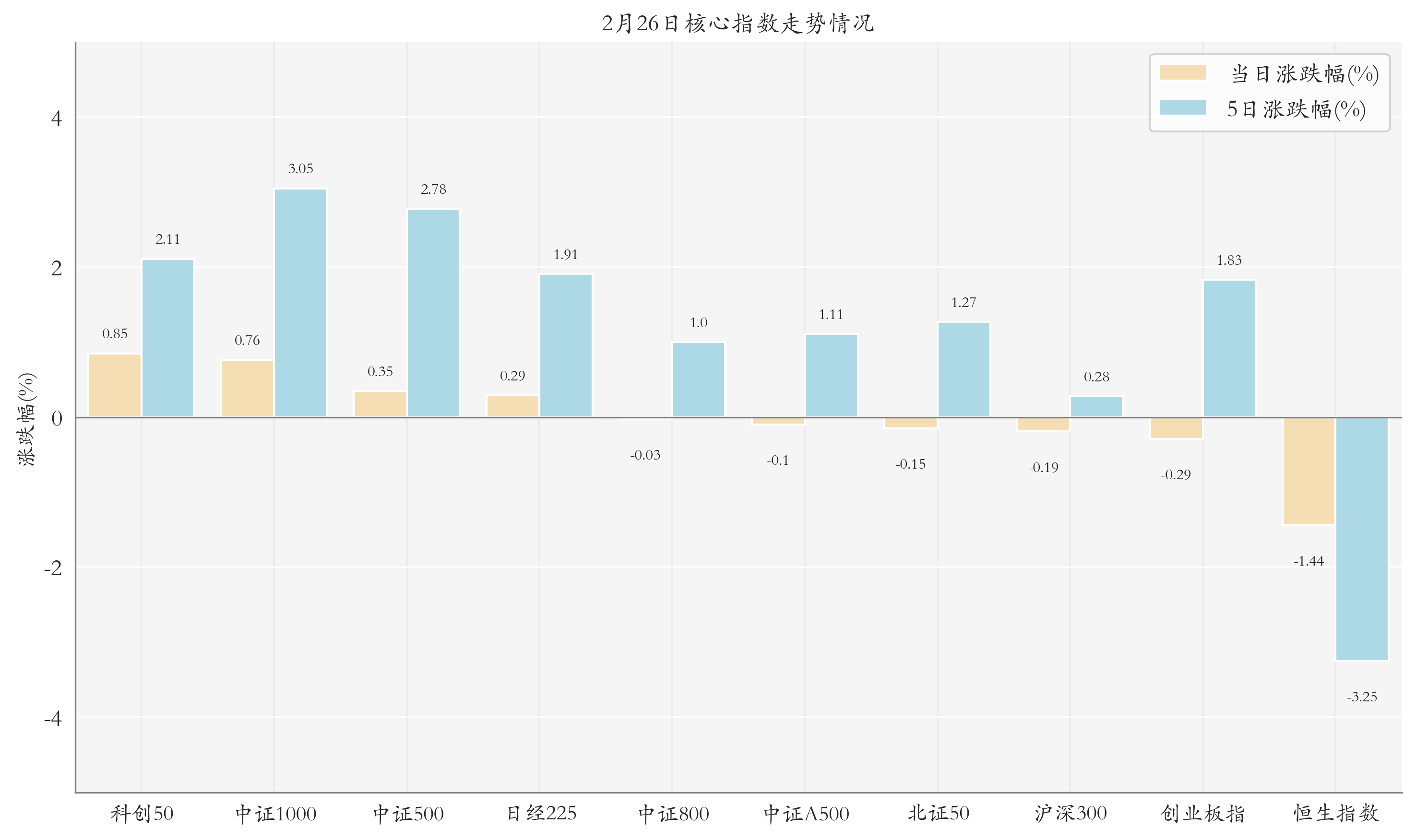
Core Viewpoint - The article discusses the current market trends, highlighting the performance of various indices and the strategies for profit-taking in a high valuation environment. It emphasizes the importance of adapting investment strategies based on market conditions and the cyclical nature of market styles. Market Performance - The overall market continues to rise, maintaining a positive start to the year, with a closing rating of 3.7 stars [2] - All market caps (large, mid, and small) have seen increases, with mid and small-cap indices like CSI 500 and CSI 1000 showing slightly higher gains [3] - Value and growth styles have both risen, with cash flow and dividend indices performing particularly well recently [3] Style Shifts and Valuation - A market style switch is expected in early 2026, with value styles, including dividends, beginning to catch up after a period of underperformance [4] - The CSI 500 and other indices have reached high valuation levels, indicating a potential for profit-taking strategies [6] - The current bull market is characterized by small-cap growth stocks leading the way, contrasting with the previous bull market where large-cap growth stocks dominated [12] Profit-Taking Strategies - The article suggests a systematic approach to profit-taking by gradually selling portions of holdings when indices reach high valuations, recommending a strategy of selling in ten parts over ten weeks [7][11] - Historical examples are provided, illustrating successful profit-taking during previous market peaks [11][18] - Investors are encouraged to remain patient and wait for the next high valuation opportunity if they miss selling at current peaks [23][26] New Book Release - A new book titled "Dividend Index Fund Investment Guide" has been released, aimed at helping investors understand dividend index funds better [32] - The book has achieved significant sales success upon release, indicating strong interest in dividend investment strategies [32] Performance of Advisory Portfolios - The advisory portfolio has reportedly helped investors achieve a cumulative profit of 2.72 billion yuan, with over 90% of holders making a profit, significantly higher than average fund performance [34]
通信板块ETF走高;恒生科技ETF近半年吸金超千亿丨ETF晚报
2 1 Shi Ji Jing Ji Bao Dao· 2026-02-26 09:09
ETF Industry News - The three major indices showed mixed performance today, with the Shanghai Composite Index down 0.01%, the Shenzhen Component Index up 0.19%, and the ChiNext Index down 0.29. Communication sector ETFs saw gains, with 5G ETF Bosera (159811.SZ) up 3.41%, Communication ETF Jiashi (159695.SZ) up 2.78%, and Communication ETF Guangfa (159507.SZ) up 2.73% [1] - In contrast, several ETFs in the power equipment sector declined, including Lithium Battery ETF (561160.SH) down 2.34%, Battery ETF Jiashi (562880.SH) down 2.30%, and Battery ETF (561910.SH) down 2.23% [1] Fund Flows - The Hang Seng Technology ETF attracted over 100 billion yuan in net subscriptions over the past six months, with a net inflow of 34.25 billion yuan in the current year, indicating a "buy the dip" trend [2] Market Overview - The A-share market and major overseas indices showed varied performance today, with the Shanghai Composite Index closing at 4146.63 points, the Shenzhen Component Index at 14503.79 points, and the ChiNext Index at 3344.98 points [3] - The top-performing sectors included communication, electronics, and defense, with daily gains of 2.84%, 1.98%, and 1.52% respectively [6] ETF Performance - Stock-style ETFs performed the best today, with an average gain of 0.48%, while cross-border ETFs had the worst performance with an average decline of 1.56% [9] - The top three stock ETFs by performance were Guozheng 2000 ETF Bosera (159505.SZ) at 5.04%, 5G ETF Bosera (159811.SZ) at 3.41%, and Sci-Tech Machinery ETF Jiashi (588850.SH) at 3.31% [12] Trading Volume - The top three stock ETFs by trading volume were A500 ETF Fund (512050.SH) with 10.705 billion yuan, A500 ETF Huatai-PB (563360.SH) with 7.747 billion yuan, and A500 ETF Southern (159352.SZ) with 7.660 billion yuan [16]
合肥再出大招:三大百亿基金群,容忍度最高80%
母基金研究中心· 2026-02-26 08:58
Core Viewpoint - Hefei is actively promoting innovation and entrepreneurship through the establishment of three major theme fund clusters, each with a scale of 10 billion yuan, aimed at different fields such as technology innovation incubation, emerging industry development, and future industry cultivation, with a maximum duration of 20 years and a tolerance level of up to 80% [2][4]. Group 1: Patience Capital - The measures taken by Hefei represent a vivid practice of building patience capital, which is characterized by stability and long-term support, capable of withstanding cycles and being tolerant of risks and failures [3]. - The investment themes in the venture capital circle have shifted towards hard technology, necessitating a longer investment horizon, which has led to a trend of investing earlier and in smaller amounts [3][4]. - The establishment of long-term funds, with many new mother funds and direct investment funds having durations of 15 to 20 years, reflects a growing trend towards patience in investment [4]. Group 2: Government Investment and Policy - Hefei's policies align with national guidelines that emphasize the importance of a fault-tolerant mechanism and a performance evaluation system that encourages innovation and tolerates failure [5]. - The government is actively working to optimize the management of venture capital funds and improve the accountability mechanisms for government-funded investment funds [5]. - Hefei's approach to venture capital has been recognized as a model, with the government leveraging fiscal funds to attract more social capital for industrial cultivation [6][7]. Group 3: Investment Ecosystem - The "Investment City Plan 2.0" launched by Hefei aims to create a comprehensive resource platform that connects various stakeholders, including private funds, government funds, and research institutions, to enhance the investment ecosystem [6][7]. - By October 2025, the platform had attracted over 300 "investment ecosystem partners" and linked more than 200 funds, with a total fund scale reaching 400 billion yuan, facilitating the connection of 1,868 industrial projects [7]. - Hefei is becoming a hub for multi-level investment matrices, with various provincial and municipal mother funds established to support the growth of leading fund management institutions [8][9].

求稳优选!国泰鑫享稳健十问十答
Xin Lang Cai Jing· 2026-02-26 08:50
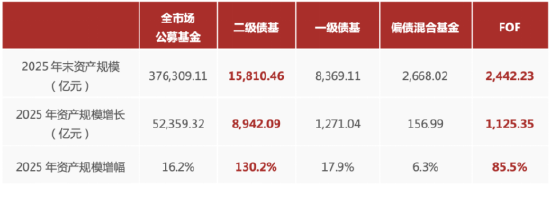
Group 1 - A significant wave of over 50 trillion yuan in resident fixed-term deposits is set to mature in 2026, creating a dilemma for investors in a low-interest environment [1][30] - Investors are hesitant to move funds into the stock market due to volatility, leading to increased interest in "fixed income +" products among conservative investors [1][30] - The growth in the scale of rights-based bond funds and FOFs in 2025 indicates a market preference for diversified asset allocation to achieve stable returns [2][30] Group 2 - By the end of 2025, the total asset scale of public funds reached 376,309.11 billion yuan, with a growth of 52,359.32 billion yuan, marking a 16.2% increase [3][31] - Over 95% of rights-based bond funds achieved positive returns in 2025, highlighting "fixed income +" as a core strategy for low-risk capital seeking stable enhancement [3][31] Group 3 - The "fixed income +" strategy is characterized by using bonds as a "shield" for stable coupon income while capturing market growth opportunities through equities [4][32] - The "Guotai Xinxiang Stable" product is positioned as a low-volatility "fixed income +" fund, with at least 80% in bonds and a maximum of 20% in stocks [5][33] Group 4 - The historical performance of "Guotai Xinxiang Stable A" shows a cumulative return of 13.88% since manager Mao Liwei took over, outperforming the average of similar funds [11][39] - The maximum drawdown after strategy adjustments in May 2025 was only -0.47%, significantly lower than the average of similar funds at -1.66% [12][40] Group 5 - The fund manager, Mao Liwei, has 13 years of experience in securities and 10 years in investment management, focusing on risk-return balance and comprehensive asset allocation [15][43] - The fund's six-month rolling holding period is designed to enhance operational efficiency and investment experience for both managers and investors [16][44] Group 6 - The market outlook suggests slight fluctuations in the bond market, with stable funding support, while the equity market may see opportunities in the AI sector [17][46] - The fund's risk control measures include a multi-dimensional risk management system, focusing on high-grade credit bonds and diversified equity holdings [19][47] Group 7 - The "Guotai Xinxiang Stable" product is suitable for investors with idle funds seeking stable returns above money market funds and bank wealth management products [20][48] - It is also appropriate for risk-averse investors who cannot tolerate significant equity market fluctuations and prioritize capital preservation [21][49]
亏钱一起扛,赔钱分三六九等:国投瑞银伤了大户的心
Sou Hu Cai Jing· 2026-02-26 08:47
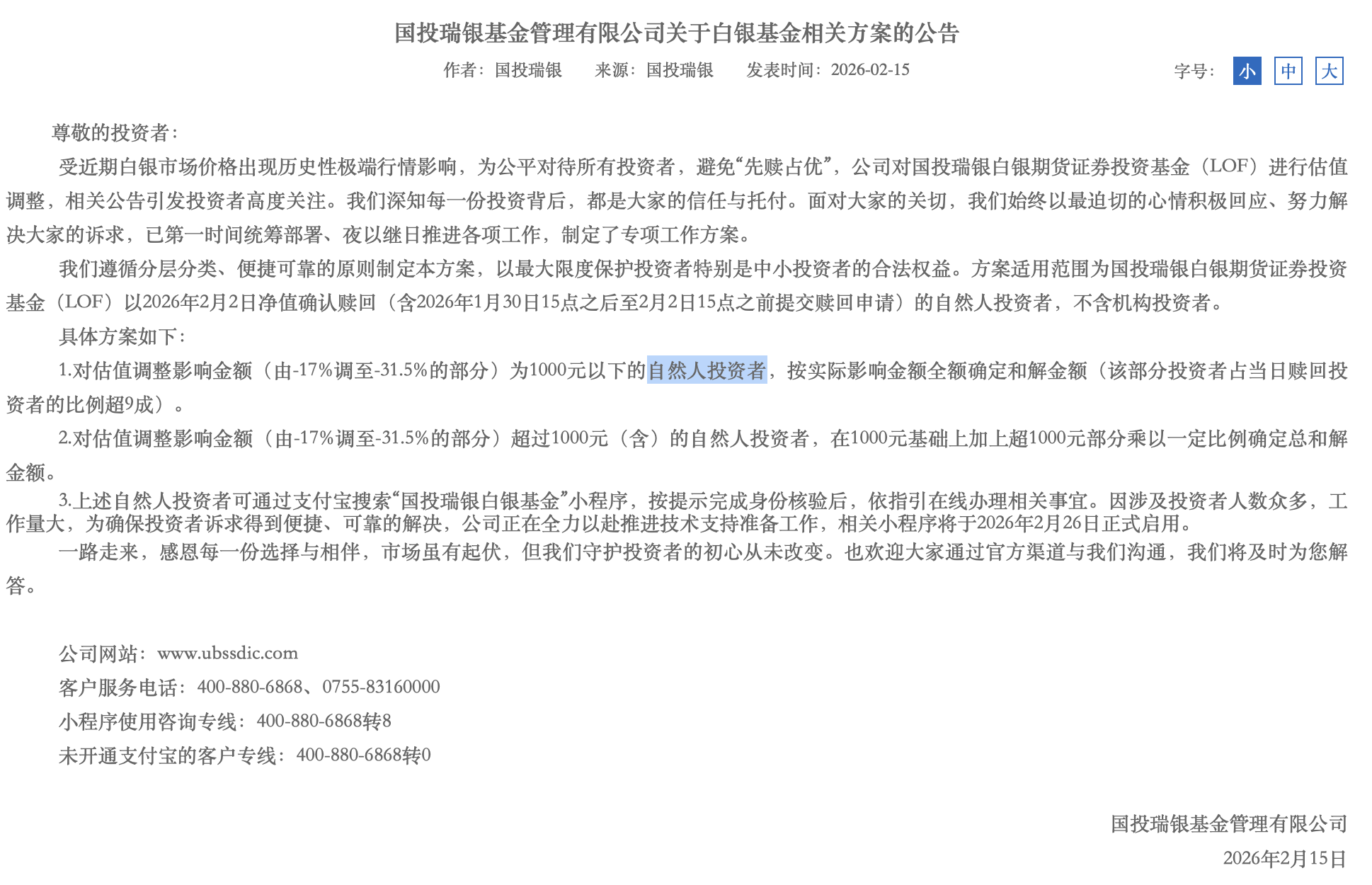
Core Viewpoint - The announcement by Guotou Ruijin Fund Management Co., Ltd. regarding a compensation plan for investors affected by the valuation adjustment of its silver LOF fund has sparked ongoing discussions about fairness and treatment of different investor classes, particularly between individual and institutional investors [1][2][5]. Group 1: Compensation Plan Details - The compensation plan includes full reimbursement for individual investors whose valuation adjustment impact is below 1,000 yuan, while those exceeding this amount will receive compensation based on a tiered percentage system [1][9]. - The compensation is limited to individual investors, excluding institutional investors, and the online processing system for claims will be available starting February 26 [2][5]. - The compensation model is designed to cover 92.4% of the investors who redeemed their shares, primarily benefiting small retail investors [9][12]. Group 2: Market Reaction and Controversy - The market turmoil began on January 30, when international silver prices plummeted, leading to a significant drop in the domestic silver LOF fund's net asset value due to a change in valuation methodology [3][4]. - The abrupt change in valuation method, which shifted from domestic to international pricing, resulted in a record single-day drop of 31.5% for the fund, causing widespread distress among investors [4][5]. - The compensation plan has faced criticism for its perceived inequity, particularly regarding the treatment of larger investors who face disproportionately higher losses compared to smaller investors who receive full compensation [12][15]. Group 3: Implications for the Industry - This incident marks a precedent in the public fund industry for proactive compensation in response to valuation disputes, raising questions about future expectations from investors during extreme market conditions [15]. - The disparity in compensation between small and large investors highlights a potential risk for fund companies, as larger investors express dissatisfaction and concern over their treatment [12][15]. - The situation reflects broader challenges within the public fund industry regarding investor relations and the management of expectations in volatile market environments [15].
1 Unstoppable Vanguard ETF to Buy and Hold for the Next Decade
The Motley Fool· 2026-02-26 08:30
Core Insights - The Vanguard Mega Cap Growth ETF (MGK) is highlighted as a strong investment option that could potentially turn small monthly contributions into significant wealth over time [2][4][11] Group 1: ETF Performance and Characteristics - The Vanguard Mega Cap Growth ETF holds 60 mega-cap stocks, defined as companies with a market cap of at least $200 billion, making it a solid choice for investors seeking exposure to large growth stocks [4][5] - Over the last 10 years, the ETF has delivered total returns of approximately 403%, significantly outperforming the S&P 500's 258% return during the same period [8] - The ETF has an average annual return of 18.83% over the past decade, which is notably higher than the market average of around 10% [10] Group 2: Investment Potential - If an investor contributes $250 per month, potential future portfolio values could reach approximately $71,000 after 10 years, $183,000 after 20 years, and $2.37 million after 30 years, assuming an 18% average annual return [10] - The ETF's focus on large growth stocks positions it for potentially lucrative returns in the future, reinforcing its appeal as a long-term investment option [11]