
偏债混合基金

Search documents
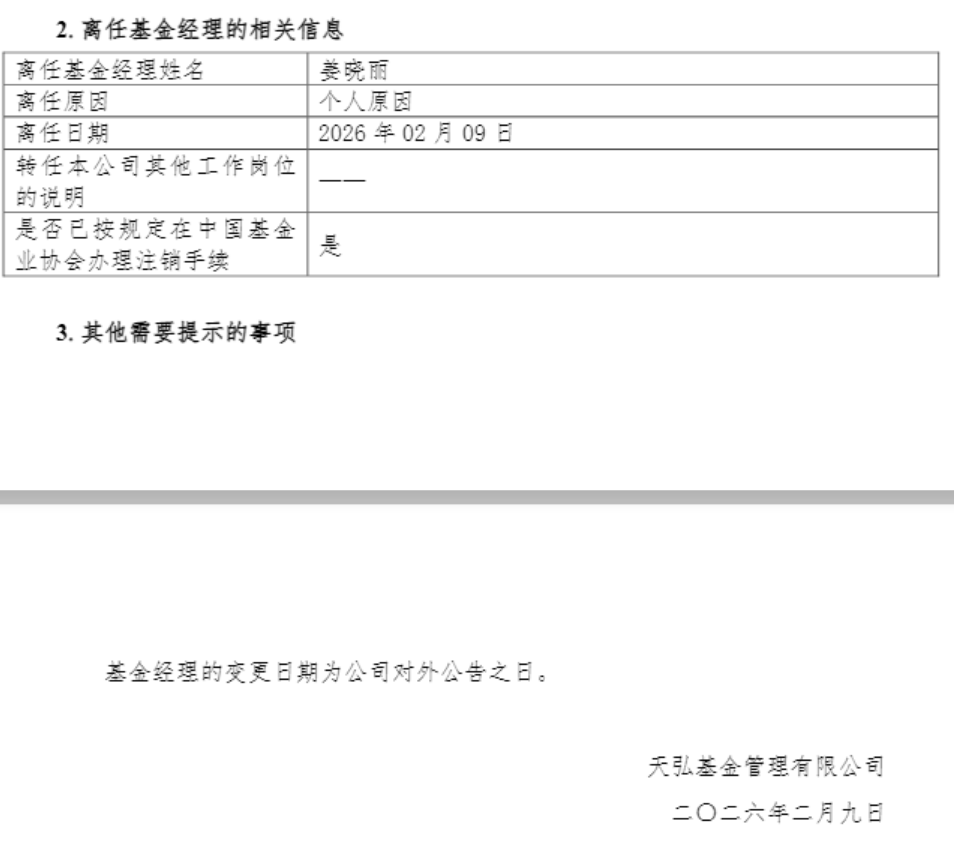
又现“清仓式”卸任,基金经理称几乎没有时间顾及家庭
Guo Ji Jin Rong Bao· 2026-02-14 04:11
Core Insights - The departure of Jiang Xiaoli, a fund manager at Tianhong Fund, has drawn attention due to her significant management experience and the scale of funds she oversaw [1][3][6] - Jiang's resignation is part of a broader trend in the industry, with 44 fund managers having left since the beginning of the year, indicating an increase compared to the same period last year [6][9] Company Overview - Tianhong Fund, established over 21 years ago, primarily relies on fixed-income products to drive its public fund growth, managing a total of 13,130.28 billion yuan as of the end of last year [9] - The fund's assets include over 8,200 billion yuan in money market funds, accounting for more than 60% of its total assets, and over 2,400 billion yuan in bond funds, which rank second [9] Fund Management Changes - Jiang Xiaoli managed 10 public funds with a total scale of 350.24 billion yuan before her departure, with her highest management scale reaching 781.94 billion yuan in the first quarter of 2022 [6][9] - The company has adopted a multi-manager co-management model for its "fixed income+" business, ensuring stability in product strategy and continuity in investment goals despite Jiang's departure [6][7] Industry Trends - The trend of fund manager departures has become common in the public fund industry, with 17 fund managers leaving Tianhong Fund in the past five years, averaging at least three departures per year [8][9] - As of February 13, 2025, over 500 fund managers have left the market, highlighting a significant turnover rate within the industry [9]

固收-基金如何应对大资管分工趋势
2026-02-10 03:24
Summary of Key Points from the Conference Call Industry Overview - The conference call discusses the fixed income plus (固收加) fund market in China, focusing on its performance, growth, and strategies for different investor segments [1][2][3]. Core Insights and Arguments - **Performance and Growth**: The fixed income plus fund market is expected to see significant excess returns from 2023 to 2025, particularly when equity benchmarks rise. The total market size is projected to grow by nearly 1 trillion RMB, reaching 2.735 trillion RMB by 2025, with net subscriptions concentrated in a few star products [1][4][2]. - **Investor Preferences**: Institutional investors favor products with high Sharpe ratios and strong position control. The flexibility and risk management capabilities of primary bond funds are highlighted as superior to standalone equity or bond investments [1][6]. - **High Net Worth Client Behavior**: High net worth clients show low participation in public fixed income plus funds, preferring private products due to their flexible strategies. In contrast, middle to high net worth clients have decreased their engagement with public fixed income plus funds since 2022 [1][9]. - **K-Shaped Demand Trend**: The fixed income plus asset management ecosystem is expected to exhibit a K-shaped demand trend, with public funds primarily targeting next-high net worth clients while traditional savings clients invest in low-volatility products [1][10]. - **Regulatory Impact**: Regulatory policies are pushing public fixed income plus products towards yield-enhancing strategies, which will motivate B-end clients to invest more in these funds [1][12]. Important but Overlooked Content - **Star Products and Managers**: The influence of star products and managers is significant, with a notable concentration of funds flowing to key account managers. The top ten managers now hold 48.1% of the market share, indicating a shift in rankings [1][5]. - **Market Dynamics**: The behavior of different institutional investors varies, with primary bond funds primarily attracting bank proprietary investments, while secondary bond funds see more interest from wealth management, insurance, and trust companies [1][8]. - **Future Strategies**: Recommendations for B-end clients include growth-oriented, high-elasticity growth, and barbell strategies, while C-end clients are advised to consider low-volatility products and macro-timing strategies [1][20][21]. Conclusion - The fixed income plus fund market is poised for growth, driven by regulatory changes and evolving investor preferences. Strategies must be tailored to meet the distinct needs of B-end and C-end clients, with a focus on risk management and yield enhancement to attract more investments [1][22].
基金转债持仓季度点评:25Q4,二级债基规模高增2500+亿
HUAXI Securities· 2026-01-28 07:21
Performance Overview - In Q4 2025, convertible bond funds achieved a median return of 1.09%, outperforming first-level bond funds (0.6%), second-level bond funds (0.44%), and mixed bond funds (0.31%) [1] - For the entire year of 2025, the median return for convertible bond funds was 22.43%, significantly higher than first-level bond funds (2.06%), second-level bond funds (4.66%), and mixed bond funds (5.49%) [1] Fund Scale and Demand - In Q4 2025, the scale of second-level bond funds increased by 2506 billion CNY to reach 15535 billion CNY, while first-level bond funds and mixed bond funds saw decreases of 142.5 billion CNY and 7 billion CNY, respectively [1] - The net subscription for second-level bond funds in Q4 2025 was 2344 billion units, while first-level bond funds faced a net redemption of 186 billion units [19] Convertible Bond Holdings - In Q4 2025, the convertible bond holdings of first-level bond funds increased by 0.32 percentage points to 7.97%, while second-level bond funds and mixed bond funds saw declines of 1.07 and 0.88 percentage points, respectively [33] - Public funds focused on increasing holdings in bank bonds, as well as in sectors like new energy, cyclical stocks, and military-related bonds [40] Investment Strategy Insights - The demand for fixed-income plus funds is robust, with second-level bond funds becoming the primary vehicle for this demand, while first-level bond and convertible bond fund scales have marginally declined [3] - Institutions with equity allocation permissions are shifting their demand from first-level bond funds to second-level bond and mixed bond products due to the high valuation of convertible bonds [3]
每日钉一下(哪些品种是固收+基金,我们该如何选择呢?)
银行螺丝钉· 2025-11-28 14:07
Group 1 - The article emphasizes the importance of diversifying investments across different asset classes, including both RMB and foreign currency assets, as well as stocks and bonds [2] - It introduces a free course that systematically covers investment knowledge related to US dollar bond funds, indicating a growing interest in this area among investors [2] - The article highlights the rapid growth of "fixed income +" products in recent years, driven by declining deposit rates and increasing investor attention [7] Group 2 - "Fixed income +" funds typically add a small amount of stocks or convertible bonds to a pure bond base, leveraging the negative correlation between stocks and bonds to achieve stable returns while reducing volatility risk [5] - Traditional "fixed income +" products include primary bond funds, secondary bond funds, and mixed bond funds, with secondary bond funds and mixed bond funds being the most classic types [5] - The broader category of "fixed income +" also encompasses hedge funds and all-weather strategy funds, which may not hold a high proportion of bonds but use strategies to control volatility risk [5][7]

「固收+」的收益风险特征如何,适合哪些投资者?
银行螺丝钉· 2025-11-24 14:04
Core Viewpoint - The article discusses the characteristics of "Fixed Income +" products, which combine low-risk bond assets for defense and higher-risk assets like stocks for potential returns, making them suitable for various types of investors [1][3]. Summary by Sections Characteristics of "Fixed Income +" - "Fixed Income +" consists of two parts: a defensive low-risk bond component and an offensive higher-risk component to enhance returns [1]. - The long-term returns of "Fixed Income +" products are significantly higher than those of pure bond funds, with a 20-year annualized return of approximately 7.77% compared to 4.33% for pure bond funds [3][5]. - The maximum drawdown for "Fixed Income +" products is about -12.02%, which is lower than that of equity funds, indicating a moderate risk profile [3][5]. Suitable Investor Types - **First Type: Steady Growth Seekers** Investors with moderate risk tolerance seeking steady asset growth find "Fixed Income +" appealing as it balances risk and return [7][9]. - **Second Type: Asset Allocators** Investors looking to balance stock and bond allocations can use the "100-age" rule for distribution, with "Fixed Income +" suitable for the bond portion [10]. - **Third Type: Alternatives to Savings and Wealth Management** With declining deposit rates and the end of guaranteed returns in bank wealth management, "Fixed Income +" serves as an ideal alternative for those willing to accept some volatility for higher returns [11][12][13]. - **Fourth Type: Transitional Investors** Investors optimistic about the stock market but wary of short-term corrections can use "Fixed Income +" to maintain exposure to equities with reduced volatility [17][18]. - **Fifth Type: Short to Medium-Term Fund Managers** Investors needing access to funds within one to three years can consider "Fixed Income +" as it offers better returns than traditional savings or money market funds [19][20][21]. Conclusion - "Fixed Income +" products are suitable for various investor needs, providing a balanced approach to risk and return [22][23].

「固收+」火了:哪些品种是固收+基金呢?
银行螺丝钉· 2025-11-19 13:56
Group 1 - The core concept of "Fixed Income +" is to combine fixed income assets with a small portion of higher-risk assets like stocks and convertible bonds to enhance returns while maintaining stability [2][10][15] - "Fixed Income +" typically consists of two parts: the fixed income portion, which includes low-risk bond assets for defensive purposes, and the "+" portion, which includes stocks and convertible bonds for offensive growth [2][15] - The performance of "Fixed Income +" products is influenced by the negative correlation between stocks and bonds, which helps to reduce volatility risk [3][15] Group 2 - Different stock-bond ratios significantly impact the returns and risks of "Fixed Income +" products, with higher stock allocations leading to greater long-term returns but also increased volatility risk [5][6] - Classic "Fixed Income +" products include primary bond funds, secondary bond funds, and mixed bond funds, with secondary bond funds and mixed bond funds being the most representative [10][15] - Broader definitions of "Fixed Income +" also encompass hedge funds and all-weather strategy funds, which may not have a high proportion of bonds but use strategies to control volatility risk [12][15] Group 3 - The increasing attention on "Fixed Income +" products is attributed to the decline in deposit interest rates, leading to rapid growth in this investment category [15] - For investors seeking a more convenient way to invest in "Fixed Income +", products like "Monthly Salary Treasure" are recommended, with a low initial investment threshold of 200 yuan [15]

攻守兼备 量化赋能,这种基金为稳健投资者提供更多选择
Sou Hu Cai Jing· 2025-11-07 01:09
Core Viewpoint - The article discusses the rising popularity and performance of hybrid bond funds, which combine fixed income and equity investments, providing a balanced approach for investors seeking both stability and potential returns in a fluctuating market [2][3][4]. Group 1: Performance of Hybrid Bond Funds - As of October 28, the hybrid bond fund index has achieved a one-year growth of 6.32%, indicating a strengthening performance amid a recovering capital market [2]. - The hybrid bond funds are seen as a crucial choice for conservative investors, especially as the one-year fixed deposit rate falls below 1% and the 10-year government bond yield hovers around 1.75% [3][4]. Group 2: Investment Strategy and Characteristics - Hybrid bond funds are characterized by a lower volatility compared to stock funds, while offering a more diverse investment category than pure bond funds, effectively mitigating single market risks [4]. - The strategy of these funds aims to balance stability and flexibility, making them appealing to investors looking for a middle ground between pure bond and equity funds [4]. Group 3: Management and Selection Criteria - Selecting hybrid bond funds requires attention to the fund company's research capabilities, the experience of fund managers, historical performance, and risk management strategies [4][8]. - The management of hybrid bond funds demands a comprehensive understanding of macroeconomic trends, credit bond markets, and stock market dynamics, highlighting the need for versatile fund managers [4]. Group 4: Case Study of ICBC Credit Suisse Fund - ICBC Credit Suisse Fund has demonstrated strong performance through its focus on research capabilities, ranking third among 13 large equity fund companies over the past three, five, and seven years [5][9]. - The ICBC Credit Suisse hybrid fund, specifically the ICBC Joyful Mixed Fund A, reported a one-year net value growth of 33.25%, significantly outperforming its benchmark of 6.95% [6][9]. Group 5: Market Context and Future Outlook - In the current environment of declining interest rates and emerging structural opportunities in the equity market, hybrid bond funds are positioned as essential tools for balancing risk and return [7][8]. - The key to success for these funds lies in the ability of fund managers to enhance their skills and navigate market complexities to achieve stable value growth [7].

三季度资金“撤离”债基 “固收+”逆市获净申购
Shang Hai Zheng Quan Bao· 2025-11-02 14:37
Core Viewpoint - In the third quarter of this year, actively managed bond funds experienced significant redemptions amid market volatility, with pure bond funds seeing the most substantial decline, while "fixed income +" funds that can invest in convertible bonds and stocks saw an increase in scale [1][2]. Group 1: Fund Performance - As of the end of the third quarter, the total management scale of actively managed bond funds reached 9.32 trillion yuan, a decrease of 218.63 billion yuan, or 2.29% quarter-on-quarter [1]. - The scale of pure bond funds decreased by 711.99 billion yuan, a decline of 9.66% [1]. - In the third quarter, the total subscription amount for bond funds was 2.31 trillion units, while total redemptions reached 2.81 trillion units, resulting in a net redemption of over 500 billion units [1]. Group 2: Market Outlook - Fund managers generally hold a cautiously optimistic view on the bond market, suggesting that the recent market adjustments are a correction of previous excessive pessimism [2][3]. - There is a potential for further interest rate cuts and reserve requirement ratio reductions, which could lead to lower yields, especially in the medium and short-term [3]. - Many fund managers express caution regarding convertible bonds, indicating that their current cost-effectiveness is lower than that of stocks, and recommend maintaining a low allocation to convertible bonds in portfolios [3].
4000点的A股让人跃跃欲试?揭秘理财固收+掘金权益市场
Di Yi Cai Jing Zi Xun· 2025-10-29 13:31
Core Viewpoint - The A-share market is experiencing renewed interest as the Shanghai Composite Index returns to the 4000-point mark after 10 years, prompting investors to seek better yield alternatives amid declining deposit rates and improving equity market performance [1] Group 1: Market Trends - The issuance scale of mixed financial products has shown a significant expansion trend this year, with some products offering annualized returns of over 5% to 7% [1] - The "fixed income +" products are increasingly focusing on equity assets, with a notable rise in the performance of mixed products compared to the previous year [2][3] - The average annualized return of "fixed income +" products from Everbright Wealth is above 3%, with some products achieving returns over 5% [3] Group 2: Asset Allocation - The typical allocation model for "fixed income +" products consists of 70%-90% fixed income assets (such as government bonds and high-grade credit bonds) and 10%-30% equity/alternative assets (like stocks and REITs) [4] - The "plus" portion of "fixed income +" products has been expanded to include REITs, quantitative strategies, and derivatives, which have shown positive results [3][4] Group 3: Investment Strategies - Financial institutions are increasingly collaborating with external managers to gain alpha returns from equity assets and diversify their portfolios [6] - The regulatory environment is encouraging financial companies to participate in equity markets, with recent policies allowing them to engage in IPOs and private placements [6][7] - The focus on equity investments is seen as a market trend, with firms needing to enhance their research capabilities to manage risks effectively [8] Group 4: Future Outlook - There is potential for further expansion in the "plus" segment of "fixed income +" products, particularly in cross-border assets and derivatives [10] - The industry is cautiously optimistic about the upward potential of "fixed income +" yields, with current yields being 30-50 basis points higher than pure fixed income products [11] - The overall yield environment for various financial products has been declining, with recent reports indicating a drop in annualized yields for open and closed fixed income products [11]
以长期主义为锚 践行高质量发展使命
Zhong Guo Zheng Quan Bao· 2025-10-12 20:53
Core Viewpoint - The public fund industry is transitioning from a scale-oriented approach to a quality-oriented one, with a focus on long-term value creation and sustainable returns for investors [1][3][9] Industry Overview - The public fund industry has seen significant growth, with total managed assets reaching 36.25 trillion yuan by August 2025, up from 8 trillion yuan in 2015, highlighting its importance in the capital market [1] - The release of the "Action Plan for Promoting High-Quality Development of Public Funds" in May 2025 aims to correct the industry's scale orientation and emphasize return-oriented strategies [2][3] Key Initiatives - The action plan includes optimizing assessment mechanisms, enhancing research capabilities, and promoting fee reforms to align fund management with performance [2] - Fund companies are required to establish assessment systems focused on investment returns, with a minimum weight of 50% on investment performance [2] Company Strategy - The company, as a pioneer in public fund operations under an insurance asset management framework, emphasizes "long-termism" as a strategic pillar [1][3] - The company aims to create long-term sustainable returns for investors through a systematic and professional approach [3][4] Research and Investment Framework - The company's investment research system is built on deep research, value investment principles, and risk control, aiming for diversified investment styles and stable returns [4] - A platform-based investment research model is established to ensure efficient execution of long-term strategies while reducing reliance on individual fund managers [4] Technological Innovation - The company has developed a forward-looking quantitative investment system, including a proprietary multi-strategy Alpha model that aligns with long-term value investment [4][5] Professional Team Development - The company has built a specialized investment research team with over 70 members, each averaging more than 8 years of experience in finance, ensuring effective collaboration across various investment departments [5] Product Innovation - The company has diversified its product offerings, including various types of funds such as money market, bond, mixed, and thematic ETFs, aligning with national strategic directions [6] - Specific products have been developed to cater to long-term investment needs in areas like pension finance and technology innovation [6] Investor Engagement - The company prioritizes investor trust and education, conducting various activities to enhance financial literacy and provide investment support [7][8] - Initiatives include community outreach programs aimed at educating elderly investors on financial planning and risk management [8] Performance and Recognition - As of June 2025, the company manages approximately 140 billion yuan, serving over 19 million clients and generating over 20 billion yuan in returns for investors [9] - The company's commitment to long-termism is recognized as essential for both its survival and its role in supporting national strategies and safeguarding residents' wealth [9]