
混合二级债基

Search documents
低利率环境下从基金配债行为寻找机会:“固收+”基金如何配纯债?
Shenwan Hongyuan Securities· 2026-03-12 08:30
Core Insights - The report highlights a significant shift in fund allocation preferences, with traditional pure bond funds losing dominance as "fixed income +" funds and index bond funds expand in size and popularity [3][14][33] - The "fixed income +" funds are seen as more attractive due to their ability to provide both bond base and equity flexibility, especially in a low-interest-rate environment where the appeal of pure bond funds diminishes [19][23][32] Fund Allocation Behavior Analysis - In 2025, pure bond funds experienced negative growth, while "fixed income +" funds and index bond funds saw substantial growth, indicating a market preference for diversified and tool-based products [3][14][33] - The allocation preferences have shifted, with "fixed income +" funds increasing their market share from 14% in Q4 2024 to 23% in Q4 2025, while pure bond funds decreased from 76% to 61% during the same period [14][33] - The report identifies that the marginal changes in bond allocation preferences within "fixed income +" products can influence market liquidity and credit spreads, providing valuable insights for bond fund managers and investors [33] Market Structure and Trends - The overall market for "fixed income +" funds saw a net increase of 86 products and a scale increase of 10,443 billion yuan in 2025, contrasting with a decline of 1,901 billion yuan in the previous year [46] - The report notes that the mixed secondary bond funds are leading in both product count and scale growth, with a significant increase in their market presence [46] - The asset allocation overview indicates a rebalancing towards interest rate bonds and equities, while reducing exposure to credit bonds and convertible bonds [52][56] Risk-Return Assessment - The report assesses that the return elasticity of "fixed income +" funds has improved, with defensive attributes being enhanced, while pure bond funds have seen a decline in return rates and increased volatility [23][26] - The performance of various fund types in 2025 shows a divergence in risk-return profiles, with stock and mixed funds performing better compared to pure bond funds, which have struggled in a low-interest-rate environment [23][26]
又现“清仓式”卸任,基金经理称几乎没有时间顾及家庭
Guo Ji Jin Rong Bao· 2026-02-14 04:11
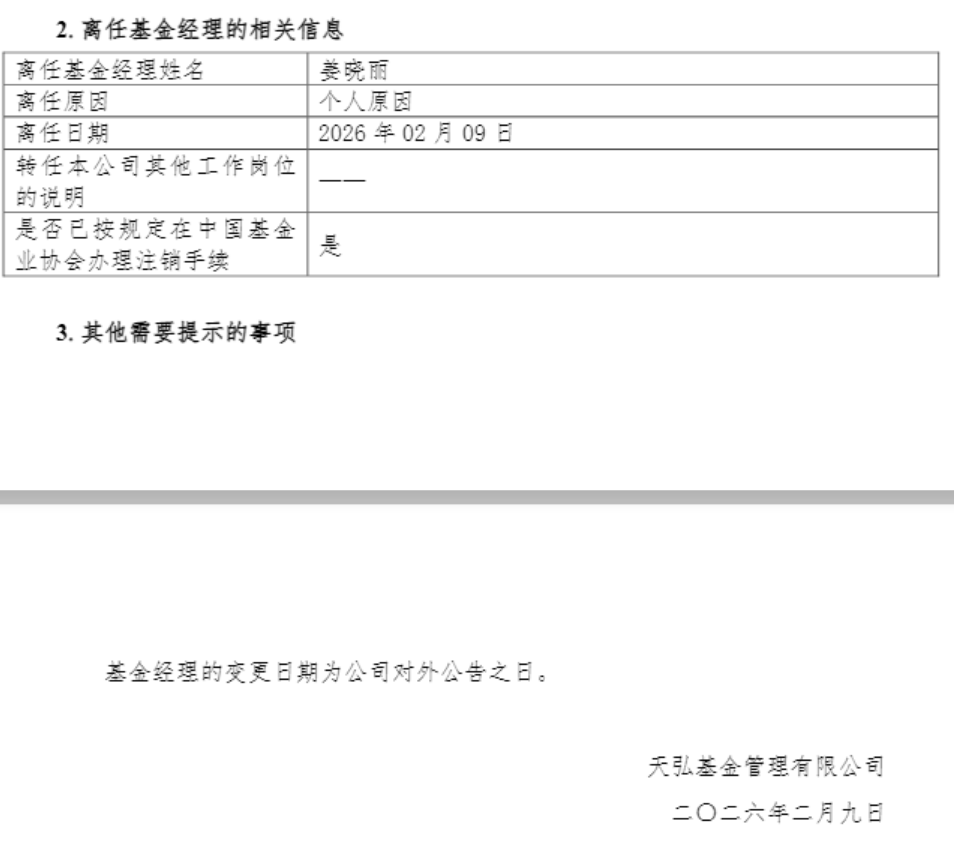
Core Insights - The departure of Jiang Xiaoli, a fund manager at Tianhong Fund, has drawn attention due to her significant management experience and the scale of funds she oversaw [1][3][6] - Jiang's resignation is part of a broader trend in the industry, with 44 fund managers having left since the beginning of the year, indicating an increase compared to the same period last year [6][9] Company Overview - Tianhong Fund, established over 21 years ago, primarily relies on fixed-income products to drive its public fund growth, managing a total of 13,130.28 billion yuan as of the end of last year [9] - The fund's assets include over 8,200 billion yuan in money market funds, accounting for more than 60% of its total assets, and over 2,400 billion yuan in bond funds, which rank second [9] Fund Management Changes - Jiang Xiaoli managed 10 public funds with a total scale of 350.24 billion yuan before her departure, with her highest management scale reaching 781.94 billion yuan in the first quarter of 2022 [6][9] - The company has adopted a multi-manager co-management model for its "fixed income+" business, ensuring stability in product strategy and continuity in investment goals despite Jiang's departure [6][7] Industry Trends - The trend of fund manager departures has become common in the public fund industry, with 17 fund managers leaving Tianhong Fund in the past five years, averaging at least three departures per year [8][9] - As of February 13, 2025, over 500 fund managers have left the market, highlighting a significant turnover rate within the industry [9]

二级债基规模增幅较大,权益端增持非银金融和通信
Ping An Securities· 2026-01-28 01:32
1. Report Industry Investment Rating - Not provided in the given content. 2. Core Viewpoints of the Report - As of the end of Q4 2025, the total number of active bond - type funds (excluding amortized cost method funds) was 3,399, a 1.5% increase from the previous quarter, and the fund scale was 7.80 trillion yuan, a 1.6% increase [2][5][7]. - In Q4 2025, 93 active bond - type funds were issued, 18 more than the previous quarter, a 24.0% increase. The total issuance scale was 62.49 billion yuan, a 24% increase [2][9][10]. - In Q4 2025, the performance of medium - and long - term pure bond funds was better than that of short - term pure bond funds. Affected by the equity market, the performance of secondary bond funds was slightly weaker [2][14][16]. - Different types of active bond funds had different changes in leverage, duration, and asset allocation. For example, medium - and long - term pure bond funds' heavy - position bond duration decreased, while short - term bond funds' leverage ratio slightly increased [2][19][34]. - The mixed secondary bond funds reduced their stock positions and increased their holdings in non - banking finance and communication sectors [2][54][61]. 3. Summary According to the Table of Contents 3.1 Active Bond - type Fund Scale and Issuance - **Scale Change**: The total number of active bond - type funds increased by 1.5% to 3,399. The scale increased by 1.6% to 7.80 trillion yuan. The number of medium - and long - term pure bond funds, short - term pure bond funds, and mixed secondary bond funds increased by 0.6%, 0.6%, and 5.8% respectively, while the number of mixed primary bond funds decreased by 0.2%. The scale of medium - and long - term pure bond funds and mixed primary bond funds decreased by 4.0% and 2.1% respectively, and the scale of short - term pure bond funds and mixed secondary bond funds increased by 6.2% and 19.7% respectively [2][5][7]. - **Fund Issuance**: In Q4 2025, 93 active bond - type funds were issued, an increase of 18 from the previous quarter. Among them, 52 were mixed secondary bond funds. The total issuance scale was 62.49 billion yuan, a 24% increase. The issuance scale of medium - and long - term pure bond funds and mixed primary bond funds decreased by 21.0% and 79.9% respectively, while the issuance scale of mixed secondary bond funds increased by 117.2% [2][9][10]. 3.2 Active Bond - type Fund Performance - **Performance of Pure Bond Funds**: In Q4 2025, the yields of medium - and long - term pure bond funds were better than those of short - term pure bond funds. The yields of short - term and medium - and long - term pure bond fund indexes were 0.47% and 0.54% respectively [2][14]. - **Performance of Secondary Bond Funds**: Affected by the equity market, the performance of secondary bond funds was slightly weaker. The yields of mixed primary and secondary bond fund indexes were 0.55% and 0.38% respectively, and the maximum drawdowns were - 0.51% and - 1.04% respectively [2][16]. 3.3 Active Bond Fund Position Analysis - **Medium - and Long - term Pure Bond Funds**: The leverage ratio of closed - end medium - and long - term pure bond funds increased, while that of open - end ones decreased. The bond position of closed - end funds increased, while that of open - end funds decreased. Closed - end funds increased their holdings of credit bonds and reduced their holdings of interest - rate bonds, and vice versa for open - end funds. Both types of funds reduced their holdings of financial bonds. The weighted duration of the top five heavy - position bonds of both types of funds decreased [19][22][31]. - **Short - term Bond Funds**: The median leverage ratio increased by 1.5pct to 110.1%. The median bond position increased by 1.2pct to 106.7%. They reduced their holdings of credit bonds and increased their holdings of interest - rate bonds, and the median financial bond position increased by 2.1pct. The weighted duration of the top five heavy - position bonds increased slightly by 0.01 year [34][36][40]. - **Mixed Primary Bond Funds**: The median leverage ratio and bond position increased by 3.1pct and 4.1pct respectively. They increased their holdings of credit and interest - rate bonds, the median financial bond position increased slightly, the median convertible bond position increased by 0.64pct, and the weighted duration of the top five heavy - position bonds decreased by 0.21 year [42][45][49]. - **Mixed Secondary Bond Funds**: The median leverage ratio decreased slightly by 0.3pct to 107.5%. The stock position decreased by 0.80pct to 13.85%, and the bond position increased by 0.40pct to 87.85%. The median convertible bond position decreased by 0.97pct. The weighted duration of the top five heavy - position bonds decreased by 0.08 year. They increased their holdings in non - banking finance, communication, and non - ferrous metals sectors, and reduced their holdings in pharmaceutical biology, media, and electronics sectors. Zijin Mining was the largest heavy - position stock, and the heavy - position holding scale of Zijin Mining, Zhongji Innolight, and Ping An of China increased by more than 2 billion yuan [51][54][64].
银行业理财登2025年报解读:规模高增&收益承压,“存款+基金”成配置主线
KAIYUAN SECURITIES· 2026-01-26 10:24
Investment Rating - The industry investment rating is "Positive" (maintained) [1] Core Insights - The total scale of wealth management reached 33.29 trillion yuan by the end of 2025, with an annual increase of 3.34 trillion yuan, year-on-year growth of 11.15% [14][16] - The narrative of "deposit migration" remains stronger than fluctuations in the bond market and stock market diversion, indicating resilience in growth [14] - The average yield of wealth management products fell below 2% for the first time, averaging 1.98% in 2025, but the fundraising enthusiasm did not diminish [36][40] Summary by Sections Liability Side - The scale of wealth management increased to 33.29 trillion yuan, with a growth slightly higher than in 2024 [14] - Non-managed open-ended products remain the main growth driver, with a significant increase in closed-end products [24] - The average yield of wealth management products decreased to 1.98%, but the fundraising volume remained stable [36] Asset Side - By the end of 2025, deposits and public funds reached historical highs, with deposits at 10.06 trillion yuan, accounting for 28.2% [46] - The allocation strategy has shifted towards a mix of cash management and various funds, with a notable increase in public funds [46][50] - The proportion of credit bonds held in wealth management decreased slightly, indicating a cautious approach to duration amid market volatility [51] Institutional Side - The scale of non-licensed wealth management continues to shrink, with no new licenses issued in 2025 [7] - The expectation for the "clearing" of non-licensed banks is strong, but specific timelines and requirements remain unclear [7]
本周43只新基金启动募集,权益类仍为主力军
Xin Lang Cai Jing· 2026-01-26 03:54
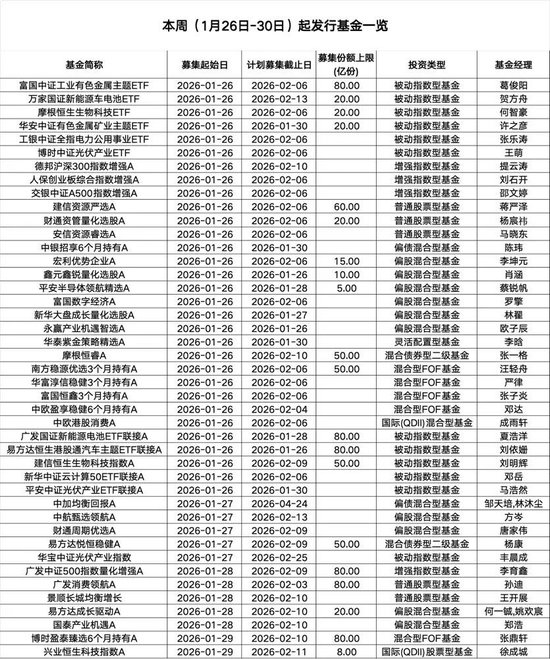
Core Viewpoint - The new fund issuance in China continues to thrive, with 43 new funds launched in the last week of January 2026, primarily driven by equity funds, while FOF and "fixed income+" products also show positive trends [1][10]. Fund Issuance Overview - A total of 43 new funds were launched during the week from January 26 to January 30, 2026, with a significant concentration on January 26, where 31 funds were issued, accounting for over 70% of the total [2][11]. - The average subscription period for new funds was 12.84 days, with the longest being around three months for the "Zhongjia Balanced Return" fund [2][11]. Fund Types and Goals - Among the 43 new funds, 20 specified their fundraising targets, with 11 aiming for over 5 billion units. Notably, six funds, including "Guotai Consumer Leadership" and "Boshi Yingtai Zhenxuan," targeted 8 billion units each [3][12]. - Equity funds remain the dominant category, with 18 active equity funds launched, representing over 40% of the new offerings. This includes 5 stock funds and 13 mixed funds, primarily focused on equity [4][13]. Specific Fund Highlights - The new funds cover a variety of themes, including resources, cycles, consumption, semiconductors, and digital economy, with notable products like "Guotai Consumer Leadership" and "Boshi Digital Economy" [4][13]. - Five new FOF products were introduced, focusing on target risk strategies with holding periods of 3 to 6 months [5][14]. - Two new QDII funds were launched, focusing on the Hong Kong stock market, namely "Zhongou Hong Kong Consumer" and "Xingye Hang Seng Technology Index" [6][15]. Market Trends - The bond market continues to show a lack of profitability, leading to a decline in bond fund issuance. However, "fixed income+" funds are still being introduced, with two mixed secondary bond funds making their debut this week [6][16].
股债震荡“固收+”热度攀升,红利、港股科技成增强主线
第一财经· 2026-01-20 13:32
Core Viewpoint - The article highlights the increasing interest in "fixed income +" products among investors, driven by the desire for stable returns amid a low-interest-rate environment and market volatility [3][5]. Group 1: Market Trends - The bond market has been under pressure, with the 10-year government bond yield fluctuating above 1.8%, impacting pure bond funds significantly [4]. - As of January 19, 2026, the average return for pure bond funds since the beginning of the year was only 0.11%, with some funds experiencing losses of over 5% [4]. - In contrast, the equity market has shown activity, with the Shanghai Composite Index breaking through 4000 and 4100 points [4]. Group 2: "Fixed Income +" Product Characteristics - "Fixed income +" products are characterized by a strategy of "bonds as a foundation, equities as an offensive," aiming to balance risk and return [5][9]. - The market size for "fixed income +" funds has increased significantly, from 1.6 trillion yuan at the end of Q4 2024 to 2.5 trillion yuan by the end of Q3 2025, marking a 52% growth [5][6]. Group 3: Investor Sentiment - Investors are increasingly cautious yet optimistic, seeking products that offer both stability and potential for higher returns, which "fixed income +" products provide [5][10]. - The demand for these products is reflected in the inflow of funds, with a notable increase in the scale of secondary bond funds [6]. Group 4: Future Outlook - The bond market is expected to remain volatile, while the equity market may present structural opportunities, making "fixed income +" funds a key focus for wealth reallocation [9][10]. - The industry is anticipated to emphasize strategy differentiation, with a clearer gradient from low to high volatility products [10].

2026年理财资产配置展望:2026钱往何处:理财真净值化时代的攻守之道
KAIYUAN SECURITIES· 2026-01-08 06:31
Investment Rating - The industry investment rating is "Positive" (maintained) [1] Core Viewpoints - The report anticipates steady growth in wealth management, estimating an increase of 3.8 trillion yuan in 2026, driven by the gradual maturity of residents' "excess savings" [4][17] - The report highlights a seasonal pattern in wealth management growth, with Q1 typically showing lower figures due to seasonal adjustments, while Q2 to Q4 exhibit stronger growth [22][27] - The report emphasizes the importance of short-term products, particularly those with a minimum holding period of 1 month, which are expected to be the main growth drivers in the wealth management sector [30] Summary by Sections 1. Liability Side - Growth is assured, with "deposit migration" as the main catalyst, leading to an expected wealth management growth of 3.8 trillion yuan in 2026 [4][17] - The proportion of residents' fixed deposits peaked at 85.57% in mid-2023, but is projected to decline to 55.33% by the end of 2023 and 48.14% by the end of 2024, indicating potential for further decreases [4][17] 2. Product Side - Short-term products, particularly those with a minimum holding period of 1 month, are the fastest-growing segments, with annualized yields close to 3-year fixed deposit rates [5][30] - The report notes that the liquidity and yield of these products make them attractive to wealth management clients, with non-managed daily opening and short-term products showing significant growth [5][30] 3. Asset Side - Deposits serve as the main base for wealth management, but their ability to contribute excess returns is limited as high-interest agreements mature [6][17] - The report suggests that credit bonds are becoming more attractive due to a steepening yield curve, with a focus on finding relatively high-yielding assets [6][17] - The report indicates that the allocation to equity products remains low, with a focus on "fixed income plus" strategies, reflecting clients' risk preferences [7][20] 4. Investment Recommendations - In a low-interest environment, wealth management subsidiaries with diverse product lines, strong research capabilities, and extensive distribution channels are expected to have a competitive advantage. Recommended banks include CITIC Bank and China Everbright Bank, with beneficiaries including Shanghai Pudong Development Bank, Hangzhou Bank, and Beijing Bank [8][16]


债券基金周度数据观察:基金费率新规落地如何影响债市-20260104
GUOTAI HAITONG SECURITIES· 2026-01-04 01:34
Report Industry Investment Rating No relevant content provided. Core View - Short-term negative factors are repaired, but medium-term structural optimization is not yet complete. The new regulations on fund fees have a positive impact on the bond market in the short term, and the sentiment in the bond market is expected to recover. Medium and long-term credit bonds and Tier 2 capital bonds are expected to benefit, while the benefits for short-term bond funds are limited, and bond ETFs may expand in scale but shorten in duration. [1][3][9] Summary by Directory 1. Redemption Fee Regulations Change: Partial Exemption for Bond and Index Funds, Transition Period Extended to 12 Months - On December 31, 2025, the China Securities Regulatory Commission revised and issued the "Regulations on the Administration of Sales Fees of Publicly Offered Securities Investment Funds," which came into effect on January 1, 2026. Compared with the draft for comments, the official version gives partial exemption for the redemption fees of bond funds and index funds. For individual investors who hold index funds and bond funds for 7 days or more, and institutional investors who hold bond funds for 30 days or more, fund managers can negotiate the redemption fee standards separately. The transition period for adjusting non-compliant existing funds is set to 12 months, which is more lenient and eases potential market disruptions. [7] 2. Impact of the New Redemption Regulations on the Bond Market: Short-term Negative Factors Repaired, Medium-term Structural Optimization Incomplete 2.1 Short-term Benefits: Uncertainty of the Impact of the New Regulations on the Bond Market Resolved, Market Sentiment Expected to Recover - The new regulations were implemented in a more moderate way, significantly reducing the short-term passive redemption pressure on bond funds and providing support for the bond market at the liability end. If the central bank accelerates treasury bond trading and insurance funds enter the market for allocation in the future, ultra-long bonds will be supported to some extent, and certificate of deposit rates are expected to decline slowly. [9] 2.2 Medium and Long-term Credit Bonds/Tier 2 Capital Bonds Benefit: More Obvious Repair of Liability End Stability - The enhanced stability of the liability end of bond funds is beneficial to medium and high-grade medium and long-term, highly liquid credit bonds and Tier 2 capital bonds. After the new regulations, the benefits to the liability end are more obvious compared to interest rate bonds and short-term credit bonds, and the spreads caused by previous fluctuations are expected to recover. [10] 2.3 Limited Benefits for Short-term Bond Funds, Bond ETFs May Expand in Scale but Shorten in Duration - The exemption threshold for institutional investors of short-term bond funds has been raised from 7 days to 30 days, weakening their liquidity advantage. Funds may flow to money market funds or bond ETFs. However, the current characteristics of the ETF market, such as "expanding scale, shortening duration, and concentrating on the short end," may continue, and long-duration credit bond/Science and Technology Innovation Bond ETFs may face more instability. [11] 3. Weekly Data Overview of Bond Funds - The ETF market shows the characteristics of "shortening duration and concentrating on the short end." The PCF duration of various ETFs generally shortens slowly. At the same time, the scale of medium and short-term varieties has expanded, and funds have gradually flowed into short-term treasury bond and credit bond varieties. The overall trading volume in the market has decreased in the past week, and trading activity has converged. [12]
主动债券型基金2025年三季报:降杠杆减久期,二级债基权益端增持科技和新能源板块
Ping An Securities· 2025-11-05 05:17
Report Industry Investment Rating No relevant content provided. Core Viewpoints - As of the end of Q3 2025, the total number of active bond funds increased by 1.4% quarter-on-quarter, while the total fund size decreased by 3.5% quarter-on-quarter. Among them, the scale of hybrid secondary bond funds increased significantly by 61.1% [2][5][6]. - In Q3 2025, the yield of Treasury bonds increased, and the performance of short-term pure bond funds was better than that of medium and long-term pure bond funds. Driven by equity assets, secondary bond funds performed better [2][15][17]. - In terms of positions, medium and long-term pure bond funds, short-term bond funds, and hybrid primary bond funds all reduced leverage and duration. The bond positions of medium and long-term pure bond funds and short-term bond funds decreased, while the convertible bond positions of hybrid primary bond funds increased. Hybrid secondary bond funds increased their stock positions and decreased their bond positions, and increased their positions in sectors such as electronics, power equipment, and media [2]. Summary by Directory 1. Scale and Issuance of Active Bond Funds - **Scale Change**: As of the end of Q3 2025, the number of active bond funds was 3,349 (excluding amortized cost method funds), a quarter-on-quarter increase of 1.4%. The total fund size was 7.68 trillion yuan, a quarter-on-quarter decrease of 3.5%. Among them, the number of medium and long-term pure bond funds, hybrid primary bond funds, and hybrid secondary bond funds increased by 0.8%, 1.7%, and 3.8% respectively quarter-on-quarter, while the number of short-term pure bond funds decreased by 0.3% quarter-on-quarter. The scale of medium and long-term pure bond funds, short-term pure bond funds, and hybrid primary bond funds decreased by 11.1%, 18.0%, and 1.0% respectively, while the scale of hybrid secondary bond funds increased significantly by 61.1% quarter-on-quarter [5][6]. - **Fund Issuance**: In Q3 2025, 75 active bond funds were issued, an increase of 11 from the previous quarter, a growth rate of 17.2%. The total issuance scale was 50.41 billion yuan, a quarter-on-quarter decrease of 39%. Among them, the issuance scale of medium and long-term pure bond funds and short-term pure bond funds decreased compared with the previous quarter, while the issuance scale of hybrid primary bond funds and hybrid secondary bond funds increased by 37.8% and 39.5% respectively quarter-on-quarter [10][12]. 2. Performance of Active Bond Funds - **Treasury Yield Increase**: In Q3 2025, the yields of 1-year, 3-year, 5-year, 7-year, 10-year, and 30-year Treasury bonds increased by 3bp, 12bp, 10bp, 16bp, 22bp, and 39bp respectively. Against the background of rising interest rates, the performance of medium and long-term pure bond funds was poor. The yield of the short-term pure bond fund index was 0.16%, and the yield of the medium and long-term pure bond fund index was -0.37% [15]. - **Better Performance of Equity-Containing Products**: Driven by equity assets in Q3 2025, secondary bond funds performed better. The yield of the hybrid primary bond fund index was 0.64%, with a maximum drawdown of -0.50%; the yield of the hybrid secondary bond fund index was 3.18%, with a maximum drawdown of -0.73% [17]. 3. Position Analysis of Active Bond Funds - **Medium and Long-Term Pure Bond Funds**: Reduced leverage and duration, and bond positions generally decreased. Both closed - end and open - end medium and long-term pure bond funds reduced their positions in interest rate bonds, credit bonds, and financial bonds [20][26][28]. - **Short-Term Bond Funds**: Reduced leverage and duration, and the financial bond position decreased. The bond position and the weighted duration of the top five heavy - held bonds also decreased [35][37][42]. - **Hybrid Primary Bond Funds**: Reduced leverage and duration, and the convertible bond position increased. The leverage ratio and bond position decreased, while the convertible bond position increased [44][46][48]. - **Hybrid Secondary Bond Funds**: - **Asset Allocation**: The bond position decreased, and the stock position increased. The median convertible bond position decreased compared with the end of the previous quarter [56][58]. - **Industry Distribution of Heavy - Held Stocks**: In Q3, sectors such as electronics, power equipment, and media were increased, while sectors such as banks, public utilities, and transportation were reduced [63]. - **Heavy - Held Stocks**: Zijin Mining was the largest heavy - held stock, and the heavy - held scale of the top ten heavy - held stocks increased. Stocks such as CATL and Alibaba - W were increased significantly, while stocks such as Yangtze Power and China Merchants Bank were reduced [67][68].
净值、资金、发行三线升温,债基回暖带动配置热潮
Di Yi Cai Jing· 2025-06-17 11:08
Group 1 - The bond market has shown significant recovery since June, leading to increased investment in bond funds, with 99% of bond funds achieving positive returns in the month [1][2] - Over three trading days, 2448 bond fund products reached historical net value highs, representing over 60% of the total, with 76% of bond funds achieving this milestone within the month [3] - The inflow of funds into bond ETFs has accelerated, with a net inflow of 319.79 billion yuan in the first half of June, surpassing the total inflow for April [5] Group 2 - The demand for bond funds has improved, with many funds initiating purchase limits due to increased interest, as at least 127 bond funds announced restrictions on large purchases [3][5] - Fund companies are focusing on marketing bond funds, particularly pure bond products, to meet their semi-annual scale targets [5] - The current market sentiment is favorable for bonds, with expectations of continued low interest rates and potential opportunities for buying if short-term rates rise due to concerns about bank liabilities [6][7]