
保险业

Search documents
“银进个退”底层账簿:压垮中小公司个险的最后一根稻草
Xin Lang Cai Jing· 2025-12-22 10:40
来源:今日保 越来越多的中小公司正在放弃在个险上的布局和努力,而发力银保。 事实上,整个寿险行业都出现了"银进个退"现象,更有人把银保称为 "C"位渠道。 这背后的原因其实是发展个险的成本高昂,无以为继。如果叠加会计准则切换与"报行合一"全覆盖,成 本问题更加突出。这对中小公司来说直接就是"致命"的。 苦战银保成为中小公司不得已而为之的选择。 而对于大公司来说,银保带来的快速流转的资金也能极大缓解在流动性方面的压力与挑战,自然成为重 要阵地。 所以,看上去,银保的确"C"了,而背后,是资产负债、投入产出、生死存亡的精细考量。 关键原因 下滑的"750曲线" 将极大改变太多机构的经营策略 作为保险公司的准备金负债评估折现率乃至寿险产品定价的重要基准 ,"750日移动平均国债收益率曲 线"的不断下行,对行业影响巨大,尤其是正在击穿中小寿险公司维持生存的平衡线。 "750曲线"在2020年后持续、明显地加速下降,被认为是寿险业面临的最大挑战,也是行业转型中最为 显著的外部压力。这个看上去具有很强专业性的词汇,成为直接关乎行业、甚至近乎能决定一众公司生 死存亡的关键词。 当然,无论是"750曲线"的变化与在保险业的影 ...


当利率下行成为常态,如何为财富寻找“压舱石”与“新引擎”?
Bei Jing Shang Bao· 2025-12-22 10:20
曾几何时,风口、机会与短期的高收益是人们茶余饭后的谈资;如今,安稳、存续与如何构筑家庭财务的"压舱石",成了更普遍的关切。当六大行相继调整 中长期定期存款产品,市场传递出的信号愈发清晰:利率中枢下行或成长期趋势,传统储蓄方式的保值效能正在经受考验。在波动成为常态的环境里,何处 才能寻得一份兼具安全性与成长性的长久依靠? 在低利率成为新常态的今天,寻找既能守护本金安全、又能分享经济增长成果的财富管理工具,已成为众多家庭的迫切需求。分红型保险产品,因其"保证 +分红"的独特结构,正成为连接"安全"与"成长"的优选桥梁。 鑫如意(臻享版)终身寿险(分红型) ①精准定位于此,以"终身保障"为确定性底色,以"分红机制"为参与市场提供助力,聚焦"保障+财富增长"的双重价 值,旨在为客户提供覆盖全生命周期的周全守护。 这款产品的设计,紧紧围绕三个核心特点展开:"终身增""享分红""多选择"。所谓"终身增",意味着保单的有效保险金额自第二个年度起,每年按上一年的 1.0175倍稳健递增。这份增长白纸黑字写入合同,独立于市场短期波动,如同为家庭资产安装了一台稳定运转的"复利引擎"筑牢"底仓"。 在这一背景下,平衡"确定"与"可 ...
重点改革稳步推进 2025年保险业向“质”而行
Jin Rong Shi Bao· 2025-12-22 09:43
Core Insights - The insurance industry in China is entering a critical year in 2025, focusing on high-quality development and internal reforms despite a complex external environment [1] Group 1: Life Insurance Sector - The life insurance industry is transitioning from reliance on interest rate spreads to a new cycle of value growth, emphasizing risk management and marketing reforms [2] - A dynamic adjustment mechanism for the predetermined interest rate was implemented, with the minimum guaranteed rates set at 2.0% for ordinary products, 1.75% for participating products, and 1.0% for universal insurance [2] - The insurance agent workforce is being upgraded, with a shift towards professional roles such as "health wealth planners" and "insurance wellness consultants" [3] Group 2: Property Insurance Sector - The property insurance sector is addressing challenges such as the difficulty in insuring new energy vehicles and enhancing management of non-auto insurance [4] - The "Good Insurance for Cars" platform was launched, involving 37 property insurance companies and providing coverage for over 1.1 million vehicles, with a total insured amount of 1.1 trillion yuan [5] - Non-auto insurance is undergoing stricter regulation, with a focus on improving compliance and quality, as outlined in the new regulatory framework [5] Group 3: Insurance Capital - Insurance capital is increasingly being utilized as patient capital, with total investment exceeding 37 trillion yuan, a 16.5% year-on-year increase [6] - Policies supporting insurance capital investment have been strengthened, including adjustments to asset allocation ratios and long-term investment assessments [7] - The scale of long-term investment pilot programs has expanded, with a total of 222 billion yuan approved for participation from various insurance companies [8]
“茅台系”寿险公司再获批增资6亿!年内人身险机构补充资本超1144亿元
Xin Lang Cai Jing· 2025-12-22 09:15
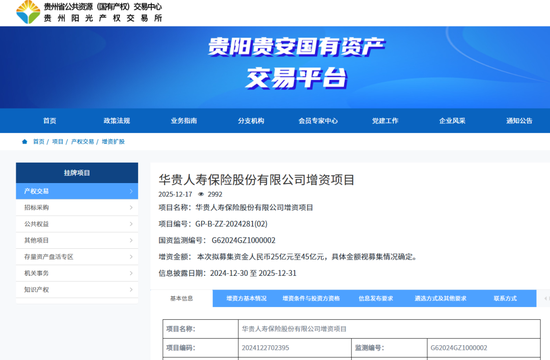
Core Viewpoint - Huagui Life Insurance has received approval from the Guizhou Financial Regulatory Bureau to increase its registered capital by 615 million yuan, raising it from 2 billion yuan to 2.615 billion yuan, as part of a larger fundraising plan aimed at enhancing its solvency and capital adequacy in response to regulatory requirements [1][9][10] Capital Increase and Fundraising Plans - The company plans to initiate a significant fundraising effort of 2.5 to 4.5 billion yuan by the end of 2024, which will increase its registered capital to between 4.5 billion and 6.5 billion yuan [1][9][10] - This recent capital increase follows a previous 1 billion yuan increase completed in April 2023, with participation from major shareholders including the Moutai Group [2][10] Financial Performance - For the first three quarters of 2025, Huagui Life Insurance reported an insurance business revenue of 4.523 billion yuan, a year-on-year increase of 31.03%, and a net profit of 183 million yuan, marking a return to profitability [1][5][13] - The company's investment yield was 4.28%, ranking 14th in the life insurance industry, while the comprehensive investment yield was 5.23%, ranking 8th [1][5][13] - Total assets reached 25.541 billion yuan, reflecting a growth of 17.45% from the beginning of the year, and net assets increased by 68.83% to 883 million yuan [5][13] Solvency and Regulatory Compliance - The core solvency adequacy ratio was reported at 118.8% and the comprehensive solvency adequacy ratio at 133.8% as of the end of the third quarter of 2025, indicating a slight improvement from the previous quarter [4][12] - The company is proactively addressing the upcoming "Solvency II Phase II" regulatory requirements, which mandate higher capital adequacy standards by the end of 2025 [3][11] Industry Context - As of December 15, 2025, the insurance industry has collectively supplemented capital by approximately 114.4 billion yuan, with life insurance companies being the primary contributors [7][15] - The trend in the industry shows a shift towards regular capital supplementation, with a significant portion of the capital coming from debt issuance and strategic equity increases [15][16]
张伟:数字金融创新成效显著|金融与科技
清华金融评论· 2025-12-22 09:08
Core Viewpoint - Digital finance encompasses both technology-driven financial innovation and the digital transformation of the financial system, which is crucial for deepening financial reforms and promoting the integration of the digital economy with the real economy in China [3][4][8]. Group 1: Digital Transformation in Finance - The financial industry has made significant progress in digital transformation during the 14th Five-Year Plan period, enhancing the efficiency of financial products and services [4]. - Policies such as the "Financial Technology Development Plan (2022-2025)" and guidelines for the digital transformation of banking and insurance sectors have accelerated the pace of digital transformation in financial institutions [5]. - Financial institutions are leveraging technologies like artificial intelligence, big data, and blockchain to improve risk control, marketing, investment advisory, and operational management [5]. Group 2: Support for Digital Economy - The core industries of the digital economy are expected to account for about 10% of GDP by 2024, with significant improvements in digital innovation capabilities [6]. - The People's Bank of China and other departments have launched initiatives to accelerate digital financial innovation, supporting the development of core industries in the digital economy [6]. - The loan balance for core industries of the digital economy reached 8.2 trillion yuan, with a year-on-year growth of 13.0%, indicating a faster growth rate compared to other loan categories [6]. Group 3: Future Development of Digital Finance - The expansion of the digital economy necessitates the development of digital finance to seize opportunities presented by technological revolutions and industrial transformations [7]. - The integration of data, algorithms, and resources is accelerating the construction of a national data center system, providing foundational support for the development of digital finance [7]. - Financial institutions are required to adapt to new demands from the digital economy, enhancing their understanding of market needs and optimizing financial products and risk control models [7]. Group 4: Strategies for High-Quality Development - Strengthening policy guidance and activating new momentum for the digital economy is essential, including the formulation of a development plan for digital finance during the 15th Five-Year Plan period [8]. - A comprehensive legal and regulatory framework is needed to support digital financial governance, focusing on data security, personal information protection, and algorithm ethics [8]. - Enhancing infrastructure and technological support is crucial, with an emphasis on advancing computing power and applying technologies like cloud computing and artificial intelligence [8].

资金面继续保持宽松,债市延续暖意
Dong Fang Jin Cheng· 2025-12-22 08:26
1. Report Industry Investment Rating - Not provided in the content. 2. Core Viewpoints of the Report - On December 19, the liquidity remained loose, the bond market continued to be bullish, the convertible bond market followed the equity market and continued to rise, most convertible bond issues increased, yields on US Treasuries of various maturities generally increased, and 10-year government bond yields in major European economies generally rose [2]. 3. Summary by Relevant Catalogs 3.1 Bond Market News 3.1.1 Domestic News - The State Council executive meeting arranged the implementation of the decisions and deployments of the Central Economic Work Conference, emphasizing that all departments should implement the work to consolidate and expand the positive economic trend [4]. - The Shanghai and Shenzhen Stock Exchanges, together with China Securities Depository and Clearing Corporation Limited, issued notices to support overseas institutional investors in conducting bond repurchase business to deepen the opening-up of the exchange bond market [5]. - The National Financial Regulatory Administration released a draft for comments on the Asset-Liability Management Measures for Insurance Companies to strengthen supervision of the insurance industry's asset-liability [5]. - In November 2025, cross-border payments remained active, and securities investment fund flows became more stable, with a net inflow of $17.8 billion in cross-border funds from non-bank sectors [6]. 3.1.2 International News - The Bank of Japan raised interest rates by 25 basis points to 0.75%, the highest since 1995, and may continue to raise rates depending on economic and price conditions [7]. - New York Fed President John Williams said there is no urgency to cut rates further, strengthening the market's expectation of a short-term pause in rate cuts [8]. 3.1.3 Commodities - On December 19, international crude oil futures prices continued to rise, and international natural gas prices turned up. WTI January crude oil futures rose 0.91% to $56.66 per barrel, Brent February crude oil futures rose 1.09% to $60.47 per barrel, COMEX February gold futures rose 0.52% to $4,387.3 per ounce, and NYMEX natural gas prices rose 2.05% to $4.026 per ounce [9][10]. 3.2 Liquidity 3.2.1 Open Market Operations - On December 19, the central bank conducted 7-day reverse repurchase operations worth 56.2 billion yuan at an interest rate of 1.40% and 14-day reverse repurchase operations worth 100 billion yuan. With 120.5 billion yuan of reverse repurchases maturing, the net capital injection was 35.7 billion yuan [12]. 3.2.2 Funding Rates - On December 19, the liquidity remained loose. DR001 fell 0.11bp to 1.271%, and DR007 rose 0.21bp to 1.441% [13]. 3.3 Bond Market Dynamics 3.3.1 Interest Rate Bonds - **Spot Bond Yield Trends**: On December 19, boosted by LPR rate cut expectations, the bond market continued to be bullish. By 20:00, the yield on the 10-year Treasury bond active issue 250016 fell 0.70bp to 1.8350%, and the yield on the 10-year CDB bond active issue 250215 fell 1.55bp to 1.8920% [15]. - **Bond Tendering**: The issuance scale of the 3-year and 5-year Treasury bonds was 97 billion yuan and 99 billion yuan respectively, with corresponding winning yields of 1.3554% and 1.5603% [17]. 3.3.2 Credit Bonds - **Secondary Market Trading Anomalies**: On December 19, the trading prices of two industrial bonds deviated by more than 10%. "19 Shanghai Shimao MTN001" and "20 Shanghai Shimao MTN001" rose by more than 26% [17]. - **Credit Bond Events**: Multiple companies had events such as debt restructuring, being listed as an executor, being criticized for violations, and canceling bond issuances [20]. 3.3.3 Convertible Bonds - **Equity and Convertible Bond Indexes**: On December 19, the three major A-share indexes rose, and the convertible bond market followed the equity market. The CSI Convertible Bond Index, Shanghai Convertible Bond Index, and Shenzhen Convertible Bond Index rose 0.38%, 0.27%, and 0.52% respectively. Most convertible bond issues rose [19]. - **Convertible Bond Tracking**: On December 19, Changgao Electric's convertible bond issuance was approved, some convertible bonds proposed to lower the conversion price or were about to meet the conditions, and some were about to be redeemed early or met the early redemption conditions [24]. 3.3.4 Overseas Bond Markets - **US Bond Market**: On December 19, yields on US Treasuries of various maturities generally rose. The 2-year and 10-year yields rose 2bp and 4bp to 3.48% and 4.16% respectively. The 2/10-year yield spread widened 2bp to 68bp, and the 5/30-year yield spread narrowed 2bp to 112bp. The 10-year TIPS break-even inflation rate remained unchanged at 2.24% [22][23][25]. - **European Bond Market**: On December 19, 10-year government bond yields in major European economies generally rose. German, French, Italian, Spanish, and British 10-year yields rose 4bp, 5bp, 4bp, 5bp, and 5bp respectively [26]. - **Daily Price Changes of Chinese Dollar Bonds**: As of the close on December 19, some Chinese dollar bonds had significant price changes, with some rising and some falling [28].
《保险业健康服务管理白皮书》:养老行业人才供给缺口约550万人
Zhi Tong Cai Jing· 2025-12-22 05:10
关键词阅读:养老 保险业 责任编辑:栎树 近日,在由中国太保与复旦大学联合主办的长三角"双阳杯"养老社区艺术节总汇演暨"守护记忆·守护 爱"认知健康公益行活动上,复旦大学保险应用创新研究院、复旦大学公共卫生学院与太保养老投资公 司三方联合编撰的《保险业健康服务管理白皮书》发布。《白皮书》显示,比如,养老行业人才存在缺 口,人才总量供给不足、人才结构与岗位需求不匹配;行业需要复合型人才,但供给侧存在断层。养老 行业人才供给缺口约550万人,新增从业人员流失率约40%至50%,机构缺乏从业人员占比约85.6%。 ...
高峰预警:数据治理滞后失灵已成金融系统性风险诱因,“智治”转型刻不容缓
Jing Ji Guan Cha Bao· 2025-12-22 03:54
Core Insights - The failure of data governance has been recognized as a systemic risk factor in the financial industry, necessitating a transition from traditional human-driven governance to AI-driven governance [1][2] Group 1: Current State of Data Governance - In 2024, the volume of AI-generated data in the global banking sector is expected to surge by 470% compared to 2021, encompassing dynamic and real-time information streams [2] - Many financial institutions still rely on outdated data governance models based on manual input and static compliance, which are inadequate for modern high-speed trading and risk management needs [2] - The financial regulatory authority has officially included "data governance failure" in its systemic risk assessment criteria, indicating that insufficient governance capabilities could trigger industry-wide risks [2] Group 2: Challenges and Structural Issues - There is a significant imbalance between investment in data governance and its returns, with state-owned banks investing over 2 billion yuan annually but achieving only a 1.5x return on investment [2] - Traditional data governance practices are facing structural challenges, as resources are often wasted on repetitive tasks without translating into business value [2] Group 3: Transition to AI-Driven Governance - The financial industry must undergo three fundamental shifts: from "humans finding data" to "data finding humans," from static compliance to dynamic value creation, and from "data-driven governance" to "AI-driven governance" [3] - AI is reshaping the data ecosystem, with examples of banks and insurance companies significantly improving their operations through AI technologies [3][4] Group 4: New Governance Paradigms - The governance model is evolving from "human-led, AI-assisted" to "AI-executed, human-supervised," expanding the governance scope to include all data modalities [4] - The emergence of "Data Governance Agents" (DGA) represents a shift towards autonomous governance engines capable of decision-making and execution [4] Group 5: Strategies for Intelligent Governance - Five major challenges in intelligent data governance include technical adaptation, ownership clarification, increased privacy risks, algorithmic bias, and long ROI cycles [5] - Six strategies proposed for overcoming these challenges include building agile technology architectures, establishing clear ownership mechanisms, creating robust security frameworks, ensuring ethical governance, developing hybrid talent, and planning long-term resource investments [6]
L3级自动驾驶试点开闸 专属智驾保险待填补
Shang Hai Zheng Quan Bao· 2025-12-22 03:38
Core Viewpoint - The introduction of L3-level autonomous driving vehicles marks a significant step towards commercialization in China, presenting new opportunities and challenges for the insurance industry [1][2]. Group 1: Current Market Situation - The intelligent driving insurance market is still in its early stages, with a notable gap in dedicated products; only a few automakers have partnered with insurance companies to offer customized coverage [2][3]. - Companies like NIO and Xiaomi have launched related services, but these are not standalone insurance products and primarily serve as supplementary coverage [2][3]. - The insurance offerings currently available are often framed as value-added services rather than independent insurance policies, indicating a lack of comprehensive coverage [3]. Group 2: Industry Challenges and Needs - The insurance industry is urged to develop dedicated intelligent driving insurance products to fill the existing market void, as current offerings do not adequately address the unique risks associated with autonomous driving [3][4]. - The shift towards L3-level autonomous driving is expected to drive a new wave of demand in the automotive insurance market, necessitating customized insurance products that reflect the characteristics of autonomous vehicles [3][4]. Group 3: Evolving Risk Landscape - The transition to intelligent driving is reshaping the risk landscape, extending coverage needs beyond drivers to include automakers, software, and component suppliers [5][6]. - Traditional insurance models may not be suitable for the new risks introduced by autonomous driving, such as liability issues arising from software failures or accidents involving driverless vehicles [6][7]. - The complexity of liability distribution among drivers, manufacturers, and software providers under L3-level driving necessitates a reevaluation of existing insurance products and legal frameworks [6][7]. Group 4: Recommendations for the Insurance Industry - Insurance companies are encouraged to collaborate with automakers, technology firms, and regulatory bodies to establish standards and clarify liability issues, which will aid in developing appropriate insurance products [7]. - Utilizing technologies like blockchain and AI can enhance data security and improve claims processing efficiency, ensuring clear compensation standards and reducing disputes [7].
资讯早班车-2025-12-22-20251222
Bao Cheng Qi Huo· 2025-12-22 03:05
1. Report Industry Investment Rating No relevant content provided. 2. Core Views of the Report - The overall operation of China's commodity market in 2025 was stable, with obvious characteristics of new and old kinetic energy conversion. The average value of the China Commodity Price Index was expected to be 112.1 points, a decrease of 0.1% compared to the previous year [4]. - The Chinese bond market showed a positive trend, with the yields of interest - rate bonds declining. The year - end bond market might continue to fluctuate, and the market was cautious about the overall space of the bond market next year [26]. - A - share market entered a critical window for cross - year layout, and structural opportunities would focus on the tracks where policy orientation and industrial prosperity resonated, with the subsequent spring market worth looking forward to [36]. 3. Summary by Directory 3.1 Macro Data Overview - GDP growth in Q3 2025 was 4.8% year - on - year, slightly lower than the previous quarter's 5.2% but higher than the same period last year's 4.6% [1]. - In November 2025, the manufacturing PMI was 49.2%, and the non - manufacturing PMI for business activities was 49.5%, both showing a certain decline [1]. - Social financing scale in November 2025 increased compared to the same period last year, and M0, M1, and M2 growth rates showed different trends [1]. 3.2 Commodity Investment Reference 3.2.1 Comprehensive - Guangzhou Futures Exchange restricted the daily opening volume of lithium carbonate futures contracts [2]. - Dalian Commodity Exchange adjusted the premium and discount of designated delivery warehouses for coking coal futures [2]. - Shanghai International Energy Trading Center planned to revise the standard contract of the Container Shipping Index (European Line) futures [3]. - The Ministry of Commerce launched a final review investigation on anti - dumping measures for imported ethylene - propylene - diene monomer rubber from the US, South Korea, and the EU [3]. 3.2.2 Metals - Platinum prices soared in 2025, with a year - to - date increase of over 110%, far exceeding that of gold [6]. - Gold and silver prices rose under the new round of interest - rate cuts, with silver prices increasing by over 130% this year [6]. - There was an obvious surplus of refined copper in the first ten months of 2025 [6]. 3.2.3 Coal, Coke, Steel, and Minerals - Dalian Commodity Exchange adjusted the premium and discount of designated delivery warehouses for coking coal futures [2][9]. - China's steel consumption in 2025 was expected to be 8.08 billion tons, a year - on - year decrease of 5.4%, and the global steel consumption was expected to be 17.19 billion tons, a year - on - year decrease of 1.8% [9]. - Indonesia proposed to significantly reduce nickel ore production in 2026 [11]. 3.2.4 Energy and Chemicals - Bohai Oilfield's cumulative production of oil and gas equivalent in 2025 exceeded 40 million tons, reaching a record high [12]. - China's energy key projects in 2025 were expected to complete an investment of 3.54 trillion yuan, a year - on - year increase of 11% [12]. - The price of polysilicon increased, but there was a situation of "high price but no market" [13]. 3.2.5 Agricultural Products - Manzhouli Port achieved a "zero breakthrough" in importing Russian agricultural products [15]. - The Philippines extended the import ban on sugar until December 2026 [15]. 3.3 Financial News Compilation 3.3.1 Open Market - This week, 4575 billion yuan of reverse repurchases in the central bank's open market were due, along with 1200 billion yuan of treasury cash fixed - term deposits and 3000 billion yuan of MLF [16]. - On December 19, the central bank conducted 562 billion yuan of 7 - day reverse repurchases and 1000 billion yuan of 14 - day reverse repurchases, with a net investment of 357 billion yuan on that day [16][17]. 3.3.2 Important News and Information - The market generally expected that the LPR in December would remain stable [18]. - The State Council Executive Meeting arranged the implementation of the decisions and deployments of the Central Economic Work Conference [18]. - The General Administration of Market Regulation revised the "Regulations on Prohibiting Monopoly Agreements" [18]. 3.3.3 Bond Market Summary - The yields of interest - rate bonds in the Chinese bond market declined, and the 30 - year active bond "25 Super Long Special Treasury Bond 06" performed prominently [26]. - Most of Vanke's bonds rose in the exchange bond market [26]. 3.3.4 Foreign Exchange Market Express - The on - shore RMB against the US dollar closed at 7.041 on December 22, up 9 basis points from the previous trading day [30]. - The US dollar index rose 0.28% in late New York trading, and most non - US currencies fell [30]. 3.3.5 Research Report Highlights - CITIC Securities believed that the factors driving the RMB appreciation were increasing, and investors should adapt to asset allocation in a RMB - appreciating environment [32]. - CITIC Securities thought that Japan's benign inflation cycle was stable, and the Bank of Japan was about to raise interest rates again [32]. - CITIC Construction Investment considered that the concentrated release of pessimistic sentiment at the end of the year brought potential space for financial bonds [32]. 3.4 Stock Market Important News - A - share market was in a high - level oscillation state near the end of the year, and the Shanghai Composite Index turned positive last week [36]. - As of December 19, the net inflow of subscription and redemption funds of CSI A500 exceeded that of CSI 300 in December, with the net inflow scale exceeding 46 billion yuan [36]. - By December 18, more than 454 listed companies had received institutional research in December, and the hard - tech track became the main focus [37].