
军工

Search documents
美国突袭委内瑞拉后,这些个股推动欧股创下历史新高
第一财经· 2026-01-06 02:07
Core Viewpoint - The article discusses the impact of U.S. military actions in Venezuela on European markets, highlighting a strong performance in defense stocks and limited reactions in the energy sector, indicating a complex geopolitical landscape and its implications for investment strategies [3][8]. Group 1: Market Reactions - European stock indices saw significant gains, with the Stoxx 600 index rising by 0.94% to 601.76 points, marking a historical high [3]. - The German DAX index increased by 1.34% to 24868.69 points, also reaching a record level [3]. - The UK FTSE 100 index rose by 0.54% to 10004.57 points, the first time it closed above 10,000 points [3]. Group 2: Defense Sector Performance - The defense and aerospace sector emerged as the biggest winner in the European market, driven by heightened expectations for increased defense spending due to geopolitical tensions [7]. - Major defense companies saw substantial stock price increases, with Rheinmetall up 9.4%, Leonardo up 6.3%, and Thales up 4.7% [7]. - Analysts suggest that the recent escalation in Venezuela reinforces the "security premium" logic, indicating a long-term trend of increased military spending in Europe [7][8]. Group 3: Energy Market Response - The energy market's reaction was more subdued, with Brent and WTI crude oil prices rising by 1.7% to $61.76 and $58.32 per barrel, respectively, but without significant volatility [9]. - Capital Economics noted that Venezuela's current oil production and export capacity have significantly declined, limiting the potential impact on global oil supply [9]. - The European energy sector showed cautious performance, with some stocks even declining, reflecting investor skepticism about Venezuela's influence on European energy companies' profitability [10]. Group 4: Natural Gas Market - The natural gas market in Europe remained stable, as Venezuela is not a major player in global gas supply, thus limiting its direct impact [11]. - Current European gas prices are influenced more by seasonal demand and global LNG flows rather than Venezuelan political changes [11]. - The resilience of Europe's energy structure has improved, allowing better handling of sudden supply shocks [11].

道指创历史新高
财联社· 2026-01-06 00:26
Evercore ISI政策分析师Matthew Aks在报告中写道:"这无疑是一项重大的地缘政治事件,但短期内不太可能成为推动市场大幅波动的核 心因素。我们的直觉判断是,特朗普并不热衷于他长期以来所批评的、类似伊拉克和阿富汗战争那样的大规模地面部队介入式政权更迭。" 标普500能源板块指数上涨2.7%,其中权重股埃克森美孚和雪佛龙均大幅上扬。在美国采取军事行动的背景下,军工股同样走高。洛克希 德·马丁和通用动力股价上涨约3%,推动标普500航空航天与国防指数升至历史新高。 美国银行财富管理公司高级投资策略师Rob Haworth表示:"能源股正从市场预期中显著受益。投资者认为,特朗普有意推动美国能源企业 进入委内瑞拉,加大投资力度,并最终提升企业盈利能力。" 他补充称:"由于不存在永久性地面部队部署,也没有长期军事介入的迹象,更广泛的股票市场得以暂时忽略对长期军事冲突的担忧。" Interactive Brokers首席市场分析师Steve Sosnick表示:"近期市场情绪明显偏向金融板块。在投资者逐步将注意力从科技股转移之际, 金融股正成为重要的配置方向。" 经济数据显示,美国12月制造业活动萎缩程度超 ...

大爆发!美国油气股暴涨,高盛、小摩股价创历史新高,中概股上演反转行情
第一财经· 2026-01-05 23:31
2026.01. 06 美国合众银行财富管理部高级投资策略师哈沃斯(Rob Haworth)表示:"能源股的大涨,主要是市 场预期特朗普总统将推动美国企业加大对委内瑞拉的投资,最终实现盈利增长。"他补充道,"美国并 未计划在当地长期驻军,也不会开展持续性军事介入,这意味着整体股市可以不必担忧局势演变为长 期冲突,从而消除了一大潜在顾虑。" 标普500航空航天与国防指数创下历史新高。军工巨头通用动力和洛克希德・马丁的股价也获得提 振,分别上涨3.5%和2.9%。有分析认为,特朗普此次的行动表明,快速军事打击将成为其应对地缘 政治问题的核心政策手段。 本文字数:1912,阅读时长大约3分钟 作者 | 第一财经 樊志菁 尽管美国上周末对委内瑞拉采取军事行动,但受原油价格上涨以及投资者押注此举不会引发冲击市场 的 大 规 模 地 缘 政 治 冲 突 影 响 , 美 股 周 一 上 涨 。 截 至 收 盘 , 道 指 涨 594.79 点 , 涨 幅 1.23% , 报 48977.18点,盘中首次突破49000点创下历史新高,纳指涨0.69%,报23395.82点,标普500指数涨 0.64%,报6902.05点。 ...



大爆发!美国油气股暴涨 高盛、小摩股价创历史新高 中概股低开高走上演反转行情
Di Yi Cai Jing· 2026-01-05 23:03
Market Overview - The three major U.S. stock indices opened higher, with the S&P 500 recovering to 6900 points, driven by rising oil prices and investor optimism that recent military actions in Venezuela would not lead to significant geopolitical conflict [1] - The Dow Jones Industrial Average rose by 594.79 points, or 1.23%, closing at 48977.18 points, marking its first intraday breach of 49000 points [1] - The 10-year U.S. Treasury yield fell to 4.16%, indicating a shift in investor sentiment towards riskier assets [1][5] Sector Performance - The energy sector saw significant gains, with Chevron rising by 5.1% and ExxonMobil by 2.2%, as companies are expected to benefit from the reconstruction of Venezuela's oil infrastructure [2] - Oilfield service companies like Halliburton and Schlumberger also performed well, increasing by 7.8% and nearly 9%, respectively [2] - The S&P 500 Aerospace and Defense Index reached a new all-time high, with major defense contractors General Dynamics and Lockheed Martin seeing stock increases of 3.5% and 2.9% [2] Financial Sector Insights - The S&P 500 Financial Index surged as investors anticipated a 6.7% year-over-year profit growth for the financial sector in the last quarter of the previous year [3] - Goldman Sachs and JPMorgan Chase both reached historical highs, with stock increases of 3.8% and 2.6%, respectively [3] Economic Indicators - The manufacturing sector in the U.S. is experiencing a contraction, with the ISM Manufacturing PMI dropping from 48.2 in November to 47.9, marking the lowest level in 14 months [5] - The market is closely watching the upcoming non-farm payroll report, which could influence the Federal Reserve's monetary policy for 2026 [5] Commodity Performance - International oil prices rose, with WTI crude oil increasing by 1.74% to $58.32 per barrel and Brent crude oil by 1.66% to $61.76 per barrel [6] - Precious metals saw significant price increases, with COMEX gold futures rising by 2.84% to $4436.90 per ounce and silver futures up by 7.95% to $76.15 per ounce [6]


道指创历史新高,美股能源板块普涨!纽约期银涨超7%,现货铂金、钯金大涨!美国将发布重要数据
Sou Hu Cai Jing· 2026-01-05 22:57
Market Performance - Major U.S. stock indices closed higher, with the Dow Jones reaching a record high, driven by strong gains in financial stocks [1][3] - The Dow rose by 594.79 points, or 1.23%, closing at 48,977.18 points; the Nasdaq increased by 160.19 points, or 0.69%, to 23,395.82 points; and the S&P 500 gained 43.58 points, or 0.64%, ending at 6,902.05 points [3] Sector Performance - The S&P 500 energy sector index rose by 2.7%, with major stocks like ExxonMobil and Chevron seeing significant increases due to military actions in Venezuela [5] - The S&P 500 financial sector index increased by 2.2%, with Goldman Sachs and JPMorgan both rising over 3% and reaching historical highs [6] Technology Stocks - Most large-cap tech stocks saw gains, with Tesla up 3.10%, Amazon up 2.90%, and Meta up 1.29%. However, Microsoft fell by 0.02%, Nvidia dropped by 0.39%, and Apple decreased by 1.38% [3][4] Cryptocurrency and Related Stocks - Bitcoin prices reached a three-week high, leading to a general rise in cryptocurrency-related stocks, with Strategy up nearly 5% and Coinbase soaring by 7.8% [6] Chinese Stocks - The Nasdaq Golden Dragon China Index rose by 0.49%, with notable gains in stocks like Beike up over 6% and Bilibili and Tencent Music up over 3% [6]
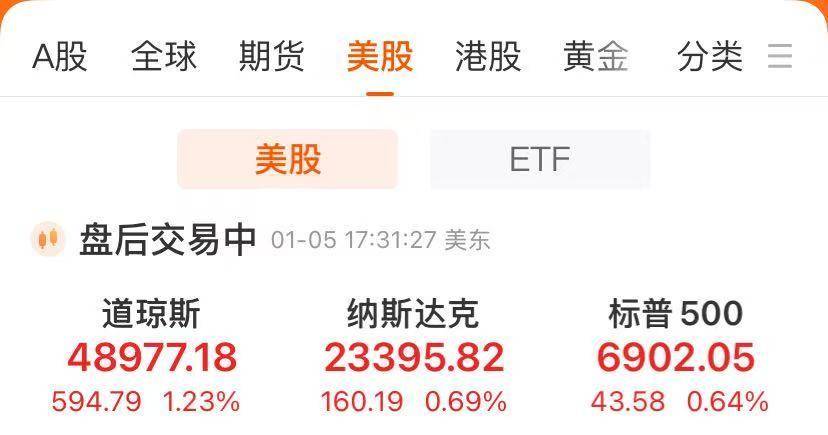
美股齐涨道指创历史新高,美委局势提振能源板块,中概股多数上涨
Feng Huang Wang· 2026-01-05 22:53
Market Dynamics - Major U.S. stock indices closed higher, with the Dow Jones reaching a record high, driven by strong gains in financial stocks [1] - The S&P 500 energy sector index rose by 2.7%, with significant increases in major stocks like ExxonMobil and Chevron [1] - The S&P 500 financial sector index increased by 2.2%, as investors shifted focus from tech stocks to financials [3] - Bitcoin prices reached a three-week high, leading to a rise in cryptocurrency-related stocks [3] - The Nasdaq China Golden Dragon Index rose by 0.49%, with several Chinese concept stocks experiencing gains [3] Company News - Novo Nordisk launched the world's first oral GLP-1 weight loss medication in the U.S., priced between $149 and $299 per month, addressing high costs in the weight loss drug market [5][6] - The U.S. government announced $2.7 billion in grants to Centrus Energy and two other nuclear fuel manufacturers to restart domestic nuclear fuel production, with Centrus's stock rising over 10% [6] - Disney's "Zootopia 2" became the highest-grossing Hollywood film in China, earning approximately 4.25 billion yuan (about $610 million) [7] - OpenAI-backed household robot Neo, set to be delivered to U.S. consumers in 2026, signifies a new era in home automation [8]
流动性&交易拥挤度&投资者温度计周报:杠杆资金&股票型ETF净流入大幅收缩-20260105
Huachuang Securities· 2026-01-05 13:12
Report Industry Investment Rating - Not provided in the report Core Viewpoints of the Report - **Funding liquidity**: Both the supply and demand sides have contracted. On the supply side, the new issuance scale of equity - focused public funds has declined, margin trading funds and stock - type ETFs have shown a significant contraction and turned into net outflows, and the repurchase amount remains at a historical low. On the demand side, equity financing and net industrial capital reduction have contracted to historical median levels, and south - bound funds have turned into net outflows [2][6] - **Trading congestion**: Using the ratio of the trading volume in the past four weeks to the market value (compared to the whole A - share market) as an indicator, the trading heat percentile of central state - owned enterprises, home appliances, and photovoltaic industries has increased, while that of machinery, banking, and medical services has decreased [2] - **Investor sentiment thermometer**: The market rebounded last week with the Shanghai Composite Index achieving an 11 - day consecutive increase and a moderate increase in trading volume. Affected by holidays, the self - media search popularity of A - shares decreased. The trend of public fund clustering has weakened, with a preference for value - style and financial and consumer industries. The net inflow of retail funds in the Shanghai and Shenzhen A - share markets has decreased [2] Summary by Relevant Catalogs 1. Funding liquidity 1.1 Public equity new issuance scale - The newly established share of public equity funds last week was 57.9 billion shares, a decrease from the previous value of 94.4 billion shares. Among them, actively managed funds issued 13.9 billion shares, and passive index funds issued 44.0 billion shares [8] 1.2 Margin trading funds - **Overall situation**: The latest margin trading balance decreased, with the balance accounting for 2.58% of the market value of tradable shares, at the 96% percentile in the past three years. The net inflow of margin trading funds last week was about - 19.7 billion yuan, a significant decrease from the previous value, at the 35% percentile in the past three years. The trading volume accounted for 10.6% of the total A - share trading volume, a 0.5 - percentage - point decrease from the previous value, with the participation rate at the 88% percentile in the past three years. The turnover rate of margin trading decreased, while the number of individual investors participating in margin trading increased [12][13] - **Industry situation**: The net inflow was mainly in the military industry (51.8 billion yuan), home appliances (12.3 billion yuan), and public utilities (12.2 billion yuan), while the net outflow was in electronics (- 29.1 billion yuan), non - banking finance (- 23.4 billion yuan), and power equipment (- 15.6 billion yuan) [16][17] 1.3 Stock - type ETFs - The net inflow of stock - type ETFs last week was - 39.5 billion yuan, a decrease from the previous value, at the 31.1% percentile in the past three years [18] 1.4 Listed company repurchases - The repurchase amount of listed companies last week was 5.2 billion yuan, a decrease from the previous value, at the 6% percentile in the past three years [21] 1.5 Equity financing - The equity financing amount last week was 143.1 billion yuan, at the 63% percentile in the past three years, including 64.5 billion yuan from IPOs and 78.6 billion yuan from refinancing [23] 1.6 Industrial capital - **Overall situation**: The net reduction of industrial capital last week was - 49.4 billion yuan, a decrease in scale compared to the previous value, at the 59% percentile in the past three years [25] - **Industry situation**: The net increase was mainly in the petrochemical (2.6 billion yuan) and food and beverage (0.1 billion yuan) industries, while the net reduction was in the military industry (- 9.1 billion yuan), electronics (- 7.3 billion yuan), and machinery (- 7.1 billion yuan) industries [28][29] 1.7 Restricted - share lifting - The market value of restricted shares lifted last week was 571.7 billion yuan, a decrease from the previous value, at the 53% percentile in the past three years. The expected market value of restricted shares to be lifted this week is 1632.8 billion yuan [31] 1.8 South - bound and north - bound funds - The net inflow of south - bound funds last week was - 34.3 billion yuan, a decrease from the previous week, at the 5% percentile in the past three years. The trading volume of north - bound funds accounted for 6.0% of the Shanghai and Shenzhen A - share trading volume, a 3.0 - percentage - point increase from the previous value affected by seasonality, with the participation rate at the 14% percentile in the past three years [34][37] 2. Trading congestion 2.1 Growth - themed industries - The trading heat percentile of the medical service industry decreased by 6 percentage points to 32% [42] 2.2 Value - themed industries - The trading heat percentile of central state - owned enterprises increased by 18 percentage points to 57%, and that of the home appliance industry increased by 7 percentage points to 52% [47] 2.3 Cyclical - themed industries - The trading heat percentile of the non - ferrous metals industry increased by 4 percentage points to 27%, while that of the machinery industry decreased by 10 percentage points to 7% [52][55] 2.4 TMT - themed industries - The trading heat percentile of the media industry decreased by 5 percentage points to 31%, and that of the electronics industry decreased by 4 percentage points to 40% [60] 3. Investor sentiment thermometer 3.1 Self - media - Affected by holidays, the self - media search popularity of A - shares decreased despite the market's rebound and the Shanghai Composite Index's 11 - day consecutive increase [65] 3.2 Douyin users - The proportion of users in high - level cities watching "A - share" content on Douyin decreased, while the proportion of young people under 23 years old increased [67] 3.3 Kuaishou - The number of "A - share" works on Kuaishou decreased by 89, the playback volume increased by 44,000 times, and the interaction volume decreased by 10,000 times compared to the previous period [71] 3.4 Weibo sentiment - The overall sentiment on Weibo was stable last week. The 11 - day consecutive increase of the Shanghai Composite Index led to a significant increase in positive and surprised emotions [73] 3.5 Fund style - The clustering trend of public funds weakened last week, with a preference for value - style and financial and consumer industries [76] 3.6 Retail funds - The net inflow of retail funds in the Shanghai and Shenzhen A - share markets was 91.61 billion yuan, a decrease of 11.82 billion yuan from the previous value, at the 42.3% percentile in the past five years [82] 3.7 Retail entry channels - The cumulative download volume of Flush reached 168,000 times, an increase of 34,000 times from the previous value, while the download volume of Eastmoney was 74,000 times, a decrease of 4,000 times from the previous value. The number of five - star reviews of Flush decreased by 1,510 times [84]
A股破纪录,接下来怎么做?
Jin Rong Jie· 2026-01-05 12:50
Group 1: Investment Opportunities - The commercial aerospace sector is highlighted as a significant investment opportunity, with 16 stocks hitting the daily limit up, indicating strong short-term profit potential [1] - The brain-computer interface sector also shows promise, with 27 stocks reaching the daily limit up, although it requires sustained performance to maintain investor interest [1] - The domestic chip industry is expected to have potential, particularly with developments from companies like Yizhongtian and Zhongweihong, which may indicate a promising niche within this sector [1] Group 2: Market Performance - The Shanghai Composite Index has achieved a record 12 consecutive days of gains, the longest streak since March 1992, with 107 stocks hitting the daily limit up, suggesting a strong market momentum [2] - Investors are advised not to focus on the exact number of consecutive gains, as each market adjustment presents a buying opportunity, reinforcing confidence in holding stocks [2] - The stronger the market performance, the more determined the investors will be to enter during corrections, indicating a robust market sentiment [2]
委内瑞拉变局倒逼欧洲加强防务 欧股军工板块全线大涨
Ge Long Hui A P P· 2026-01-05 12:47
格隆汇1月5日|摩根士丹利分析师在报告中指出,美军在委内瑞拉的军事行动可能会强化欧洲提升自身 安全责任的必要性,并促使其增加国防开支。分析师表示,此次干预行动表明特朗普政府的注意力已转 向更贴近本土的事务,这为摩根士丹利对欧洲国防板块的"超配"评级提供了支撑。报告指出,尽管美国 国防股在很大程度上消化了近期加勒比海地区的冲突,但罢黜马杜罗标志着局势可能出现重大升级。截 至周一,美国国防股尚未充分定价委内瑞拉局势进一步恶化的风险。受此预期推动,欧洲军工巨头集体 走强:莱茵金属上涨7.3%,莱昂纳多上涨6.25%,英国航太系统上涨5%,泰雷兹上涨4.8%。 ...
火炬电子(603678.SH)拟出资2亿元参与设立产业投资基金
智通财经网· 2026-01-05 11:17
Core Viewpoint - Torch Electronics (603678.SH) announced its participation in establishing the Quanzhou Fuchuang Industrial Investment Partnership, focusing on growth industries aligned with national policy directions [1] Group 1: Investment Details - The company, as a limited partner, committed a capital contribution of 200 million yuan, representing 40% of the total investment [1] - The wholly-owned subsidiary, Quanzhou Zihua Investment Co., Ltd., acts as the general partner with a capital contribution of 1.75 million yuan, accounting for 0.35% of the total investment [1] Group 2: Investment Focus - The fund will invest in sectors such as new materials, new energy, military industry, electronic components, high-end equipment manufacturing, and health-related products that align with national policy [1] - The investment strategy is oriented towards industrial mergers and acquisitions, targeting equity investments in primary or secondary market entities that meet the acquisition criteria for listed companies in relevant fields [1]
