
家电制造

Search documents
54岁马化腾财富攀升至4650亿元,年增1500亿元涨幅48%,排名稳居第三
Xin Lang Zheng Quan· 2025-10-28 07:14
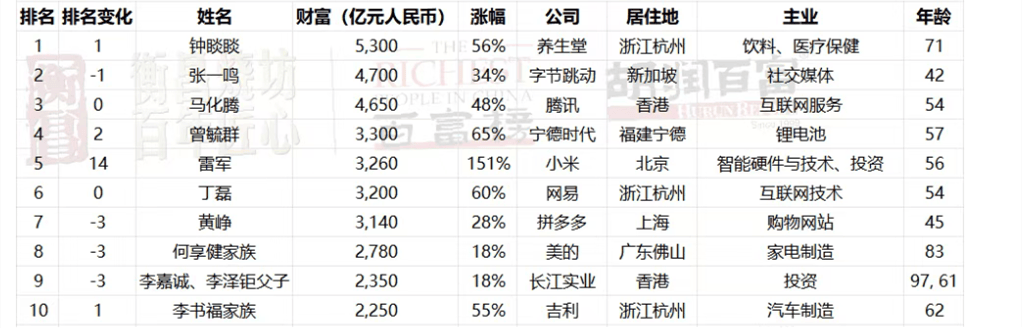
Core Insights - The 2025 Hurun Rich List shows that Tencent's founder, Ma Huateng, has a net worth of 465 billion RMB, an increase of approximately 150 billion RMB from the previous year, representing a growth rate of 48% [1][2] Company Overview - Ma Huateng, aged 54, remains in the 3rd position on the list, with Tencent's main business focusing on internet services, including social media, gaming, and fintech [1][2] - Tencent's wealth growth is attributed to its diverse portfolio in internet services, which has seen significant performance improvements over the past year [1][2] Wealth Ranking - Ma Huateng's wealth increased from 315 billion RMB in 2024 to 465 billion RMB in 2025, maintaining his ranking from the previous year [2] - The top three positions in the 2025 Hurun Rich List are held by: 1. Zhong Teng Teng - 530 billion RMB 2. ByteDance's founder - 470 billion RMB 3. Ma Huateng - 465 billion RMB [2]


2025胡润百富榜发布:钟睒睒5300亿四度蝉联中国首富,雷军财富暴涨1960亿成“增长王”
Guan Cha Zhe Wang· 2025-10-28 07:06
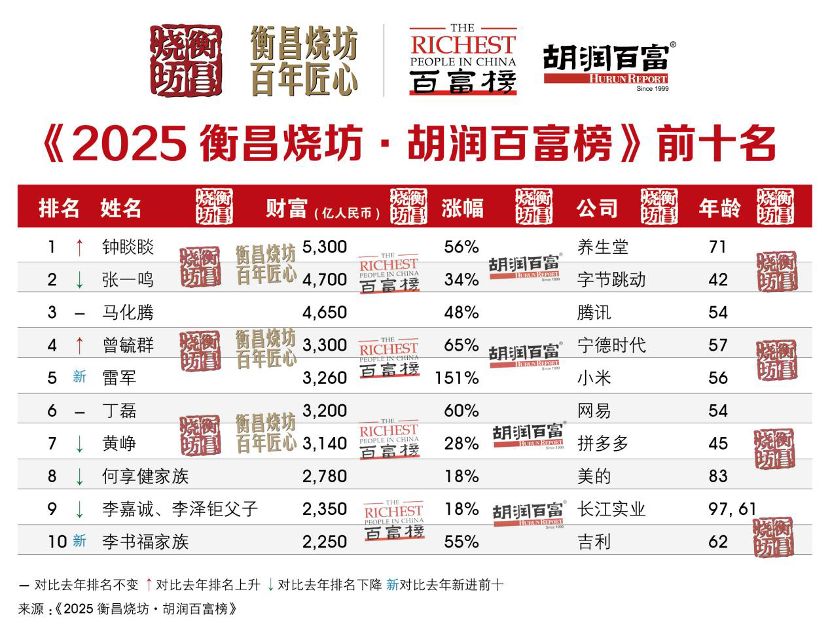
Core Insights - The 2025 Hurun China Rich List reveals significant wealth growth among top entrepreneurs, with the founder of Nongfu Spring, Zhong Shanshan, topping the list for the fourth time with a net worth of 530 billion RMB, marking a record high [1][4] - ByteDance's Zhang Yiming, last year's richest, saw his wealth increase by 120 billion RMB, placing him second with 470 billion RMB, while Tencent's Ma Huateng ranked third with a wealth increase of 150 billion RMB, totaling 465 billion RMB [1][3] - The list indicates a total of 1,434 individuals with wealth exceeding 5 billion RMB, a 31% increase from last year, and a total wealth close to 30 trillion RMB, reflecting a 42% growth [3][6] Group 1: Wealth Growth and Rankings - Zhong Shanshan's wealth increased by 190 billion RMB, while Zhang Yiming's grew by 120 billion RMB, and Ma Huateng's by 150 billion RMB [1][3] - The threshold for the top ten increased by 60 billion RMB to 225 billion RMB, with an average age of 62 years, which is three years younger than last year [3][4] - New entrants in the top ten include Lei Jun of Xiaomi and the Li Shufu family of Geely, with Lei Jun's wealth increasing by 196 billion RMB, marking a 151% growth [3][7] Group 2: Industry Insights - The food and beverage sector, represented by Zhong Shanshan, showed strong performance, with Nongfu Spring's stock price rising by 80% over the past year [6][7] - The technology sector also saw significant contributions, with Xiaomi's stock surging by 177%, contributing to Lei Jun's wealth increase [7] - The report highlights a shift in wealth concentration, with a notable decline in real estate entrepreneurs, indicating a changing landscape in the Chinese economy [6][8]
2025胡润百富榜发布!71岁钟睒睒反超张一鸣,以5300亿元第四次登顶
Sou Hu Cai Jing· 2025-10-28 05:40
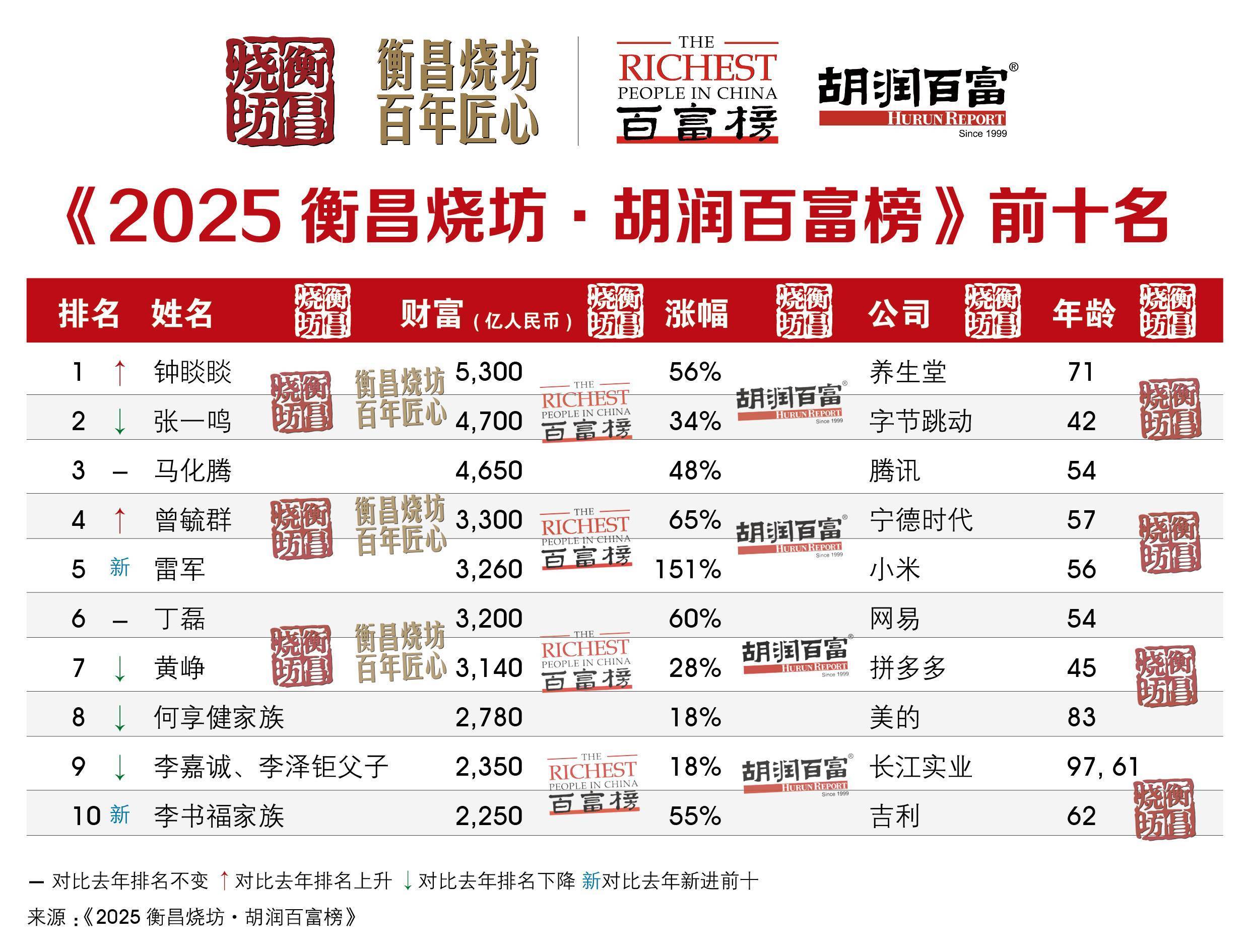
Core Insights - The 2025 Hurun Rich List was released by Hurun Research Institute, marking the 27th consecutive year since its inception in 1999, with the wealth calculation deadline set for September 1, 2025 [1] - The list shows that Zhong Shanshan of Nongfu Spring, Zhang Yiming of ByteDance, and Ma Huateng of Tencent occupy the top three positions [1] Group 1: Wealth Rankings - Zhong Shanshan ranks first with a wealth of 530 billion RMB, marking a 56% increase [2] - Zhang Yiming is second with 470 billion RMB, experiencing a 34% increase [2] - Ma Huateng holds the third position with 465 billion RMB, reflecting a 48% increase [2] - The threshold for the top ten increased by 60 billion RMB to 225 billion RMB [3] Group 2: Wealth Growth - Zhong Shanshan's wealth increased by 190 billion RMB, setting a new record for the wealth of a Chinese billionaire [3] - Zhang Yiming's wealth grew by 120 billion RMB, driven by advancements in AI business [6] - Ma Huateng's wealth rose by 150 billion RMB, supported by growth in gaming, advertising, and fintech sectors [10] - Lei Jun of Xiaomi saw the largest increase in wealth, up by 196 billion RMB, attributed to the explosive growth of Xiaomi's automotive business [12][14] Group 3: New Entrants and Trends - The list features 1,434 individuals with wealth exceeding 5 billion RMB, a 31% increase from the previous year [3] - There are 41 billionaires with wealth exceeding 100 billion RMB, an increase of 15 individuals [3] - The average age of the top ten billionaires is 62, which is three years younger than last year [3] - The number of new entrants to the list reached 376, seven times higher than the previous year [14]
睿远均衡价值三年持有混合:三季度适度增持了龙头互联网公司和家电公司
Zheng Quan Shi Bao Wang· 2025-10-28 05:05
Core Insights - The report indicates that the fund made slight adjustments to its portfolio in the third quarter, focusing on leading internet companies that are at the forefront of AI investment and application, as well as undervalued home appliance companies with stable profit growth prospects [1] Group 1 - The fund increased its holdings in internet companies that are leaders in AI investment and application [1] - The fund also invested in home appliance companies that are considered very undervalued but have stable profit growth outlooks [1]
胡润百富榜公布!41名企业家资产超千亿元 | 名单
Sou Hu Cai Jing· 2025-10-28 04:38
Core Insights - The 2025 Hurun Rich List was released, marking the 27th edition since its inception in 1999, with wealth calculations as of September 1, 2025 [1] - A total of 1434 individuals with wealth exceeding 5 billion RMB were included, representing a 31% increase from the previous year [1] - The number of billionaires increased by 268 to reach 1021, while the number of billionaires worth over 100 billion RMB rose by 15 to 41 [1] Group 1: Top Billionaires - The threshold for the top ten increased by 60 billion RMB to 2250 billion RMB, with an average age of 62, which is 3 years younger than last year [1] - New entrants in the top ten include Lei Jun from Xiaomi and Li Shufu from Geely [1] - Jack Ma dropped to 11th place, while the late Li Ka-shing's sons ranked 44th [1] Group 2: Notable Wealth Increases - Zhong Shanshan's wealth grew by 190 billion RMB (+56%) to 530 billion RMB, making him the richest person in China for the fourth time [5] - Zhang Yiming's wealth increased by 120 billion RMB (+34%) to 470 billion RMB, placing him second [6] - Ma Huateng's wealth rose by 150 billion RMB (+48%) to 465 billion RMB, maintaining third place [6] Group 3: Industry Performance - Zhong Shanshan's company, Nongfu Spring, continues to lead the Chinese bottled water market with sales exceeding 25 billion RMB in the first half of the year, a 15% increase year-on-year [5] - ByteDance, led by Zhang Yiming, reported revenues exceeding 650 billion RMB in the first half of the year, a 25% increase, with AI business driving valuation growth [6] - NIO's stock surged, contributing to a 65% increase in the wealth of its founder, Zeng Yuqun, who ranked fourth with 330 billion RMB [7] Group 4: Regional Representation - Zhejiang entrepreneurs dominated the list with four representatives, including Zhong Shanshan and Ding Lei [1] - Guangdong entrepreneurs accounted for three spots, including Ma Huateng and He Xiangjian [1] - Fujian and Hunan also had notable representations with Zhang Yiming and Zhang Hongchao, respectively [1][10]
押注失误,巨亏爆表,广发百亿基金6只倒数产品
Sou Hu Cai Jing· 2025-10-28 04:16
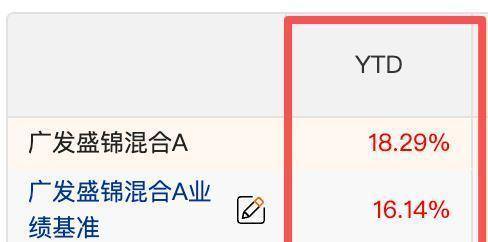
Core Insights - The performance of Wang Mingxu's funds has significantly declined, with a year-to-date return of -12.69%, ranking last among 1522 fund managers [1][10] - A systemic issue is evident as six out of seven equity products managed by Wang have consistently underperformed, with declines mostly in double digits [2][4] - The concentrated investment strategy, heavily weighted in traditional value stocks, has led to increased risk and poor performance, especially as market styles shift [3][6] Performance Analysis - Wang's funds were primarily established during market peaks in 2020-2021, leading to a disadvantage as market preferences shifted towards growth and technology sectors [3] - The contrasting performance of the Guangfa Shengjin Mixed Fund, which achieved an 18.29% positive return, highlights the importance of a diversified investment approach [3] - The management scale of Wang has decreased from over 300 billion to around 100 billion, indicating a loss of market confidence [6] Market Sentiment - Investor dissatisfaction is growing due to the significant gap between expectations and actual performance, exacerbated by long-term underperformance [4][8] - The second quarter saw Wang reduce holdings in real estate and brokerage sectors while increasing positions in banks and consumer electronics, which did not align with market trends [4] - The upcoming quarterly report will be crucial in determining whether there will be substantial adjustments in fund positions and risk management strategies [8] Fund Performance Metrics - Specific funds managed by Wang have shown substantial losses, with the Guangfa Value Advantage Mixed Fund down 17.40% and the Guangfa Value Preferred Mixed Fund down 15.36% year-to-date [9] - The performance of these funds is significantly lagging behind the benchmark index, the CSI 300, which has gained 17.06% [9][10] Strategic Recommendations - The need for timely adjustments and clear communication from the fund management is critical to restore investor trust and improve performance [8][10] - Enhancing portfolio diversity and risk management execution will be essential for future recovery, as the market may not remain forgiving [10]
2025年1-8月中国家用电冰箱(家用冷冻冷藏箱)产量为7018.9万台 累计增长1.9%
Chan Ye Xin Xi Wang· 2025-10-28 03:17
Core Viewpoint - The report highlights the growth trends in China's home refrigerator market, projecting a production increase and providing insights into key industry players and market dynamics [1] Group 1: Industry Overview - In August 2025, China's production of home refrigerators is expected to reach 9.45 million units, reflecting a year-on-year growth of 2.5% [1] - From January to August 2025, the cumulative production of home refrigerators is projected to be 70.189 million units, with a cumulative growth rate of 1.9% [1] Group 2: Key Players - Major companies in the home refrigerator market include Midea Group, Haier Smart Home, Gree Electric Appliances, Hisense Home Appliances, Whirlpool, Skyworth Digital, TCL Technology, Shenzhen Konka A, and Changhong Meiling [1] Group 3: Research and Insights - The report is based on data from the National Bureau of Statistics and is compiled by Zhiyan Consulting, a leading industry consulting firm in China, which specializes in providing in-depth industry research and market insights [1]

朝闻国盛:二十届四中全会公报点评
GOLDEN SUN SECURITIES· 2025-10-28 00:30
Group 1: Macro and Policy Insights - The central bank's resumption of government bond trading reflects strengthened coordination between fiscal and monetary policies, aiding in stabilizing interest rates and expectations [4][6][7] - The anticipated scale of bond purchases may exceed expectations due to liquidity gaps from government bond issuance and maturing MLF and reverse repos [4][6] - The bond market is expected to experience a trend of recovery in Q4, with a recommendation for a barbell strategy focusing on long-term bonds [7] Group 2: Company-Specific Insights - Sinopec Engineering (02386.HK) is recognized for its strong competitive position and high dividend yield, with projected net profits of 2.56 billion, 2.91 billion, and 3.27 billion yuan for 2025-2027, reflecting growth rates of 4%, 14%, and 12% respectively [9] - Rongxin Culture (301231.SZ) shows significant improvement in performance, with net profits expected to reach 0.14 billion, 0.38 billion, and 0.59 billion yuan for 2025-2027, indicating growth rates of 132.1%, 167.4%, and 54.2% respectively [10] - Kingsoft Office (688111.SH) reported a revenue of 1.52 billion yuan for Q3 2025, a year-on-year increase of 25.33%, with net profits of 0.43 billion yuan, up 35.42% [12] - Jiufeng Energy (605090.SH) anticipates a recovery in LNG and LPG business in Q4, with projected net profits of 1.75 billion, 1.98 billion, and 2.14 billion yuan for 2025-2027 [14][15] - Weiming Environmental (603568.SH) is expected to see net profits of 3.05 billion, 3.60 billion, and 4.02 billion yuan for 2025-2027, driven by stable cash flow from waste incineration projects [16] Group 3: Industry Performance - The coal industry showed a 10.9% increase in January, 11.5% in March, but a decline of 1.4% over the year, indicating volatility [2] - The non-ferrous metals sector experienced a significant annual growth of 61.6%, reflecting strong demand and pricing [2] - The textile and apparel industry, represented by companies like Xin'ao Co. (603889.SH), is expected to benefit from rising wool prices, with projected net profits of 0.455 billion, 0.541 billion, and 0.609 billion yuan for 2025-2027 [11]
接续奋斗向未来(学习贯彻党的二十届四中全会精神)
Ren Min Ri Bao· 2025-10-27 22:38
Group 1 - The "14th Five-Year Plan" period is marked by significant achievements in China's economic and social development, with a focus on technological innovation and modernization [2][3][4] - The construction of Zhangjiang Science City aims to establish it as a globally influential technology innovation center by 2030, emphasizing high-level self-reliance in technology [2] - The agricultural sector in Jilin Province has seen a substantial increase in protective farming techniques, enhancing soil quality and agricultural productivity [4] Group 2 - The "15th Five-Year Plan" period is crucial for advancing major projects in Xiong'an New Area, with a focus on high-level modernization and urban development [5] - The emphasis on high-quality development and effective governance is highlighted as essential for economic and social progress during the "15th Five-Year Plan" [5] - The construction of the Pinglu Canal is expected to enhance connectivity between inland ports and coastal areas, supporting the new development pattern and high-level opening up [8] Group 3 - The Hainan Free Trade Port is preparing for its operational launch, focusing on institutional innovation and policy implementation to ensure smooth operations [9] - The forestry sector in Fujian Province is exploring sustainable economic practices, promoting ecological development while enhancing local incomes [10] - The Xinjiang Production and Construction Corps is committed to promoting common prosperity through the integration of agricultural practices and cultural heritage [11]
接续奋斗向未来 ——各地干部群众在四中全会精神指引下奋力拼搏谱新篇
Jing Ji Ri Bao· 2025-10-27 22:37
Group 1 - The "14th Five-Year Plan" period is marked by significant achievements in China's development, with a focus on economic strength, technological advancement, and comprehensive national power [2][3][4] - The construction of Zhangjiang Science City aims to become a globally influential technology innovation center by 2030, emphasizing high-level technological self-reliance [2] - The agricultural sector in Jilin Province has seen a substantial increase in protective farming techniques, enhancing soil quality and agricultural productivity [4] Group 2 - The "15th Five-Year Plan" period is crucial for advancing modernization and economic development, with a strong emphasis on high-quality growth and comprehensive reform [5][9] - The establishment of the Xiong'an New Area is a key project for modern urban development, focusing on intelligent manufacturing capabilities [5] - The cultural tourism sector in Sichuan is being developed to enhance cultural consumption and economic growth, leveraging historical sites like the Sanxingdui Museum [6] Group 3 - The energy sector in Shanxi is transitioning towards green development, focusing on energy transformation and industrial upgrading [5] - The construction of the Pinglu Canal is expected to enhance connectivity between inland ports and coastal areas, supporting high-level foreign trade [8] - The agricultural modernization efforts in Yunnan aim to promote highland specialty agriculture, contributing to rural revitalization [7]