地产开发

Search documents
2026年度金融市场展望策略会
2025-12-10 01:57
Summary of Key Points from Conference Call Records Industry Overview - The global economy is experiencing a bifurcation between new and traditional economies, with new economies driving stock markets and traditional economies supporting bond markets. This relationship should not be viewed in isolation [1][3] - The U.S. is facing "three highs" pressures: high inflation, high interest rates, and high wages, which are squeezing corporate profits and leading to a cooling job market and low consumer confidence. In contrast, the AI sector remains relatively stable [1][6] - China's economy also shows a similar bifurcation, with rapid growth in new economies but traditional economies still dominating. The real estate downturn is dragging down overall economic performance [1][10] Stock Market Insights - The U.S. stock market's recent rise is primarily driven by leading AI companies, with a clear divergence between AI and non-AI sectors in terms of performance and profitability [1][8] - The risk premium in the U.S. stock market is approaching zero, indicating a high risk appetite among investors. However, caution is advised regarding the long-term stability of this market, as the current rally is concentrated among a few leading firms [1][13] - In 2026, stock market opportunities will depend on capital return rates, external funding for the real economy, and government fiscal support. A high trade surplus and increased fiscal support in 2025 have positively impacted capital returns [4][17] Economic Challenges - The U.S. economy is under significant pressure from high inflation, high interest rates, and high wages, which are negatively impacting corporate profits. The job market is cooling, and consumer confidence is at a historical low [6][7] - The AI sector's contribution to U.S. GDP is increasing, while investment demand in non-AI sectors is weak or contracting. This structural change may continue to affect the overall economic performance in the U.S. [7][9] China’s Economic Dynamics - China's new economy is growing rapidly, supported by government policies, but traditional sectors still account for a significant portion of the economy, with real estate and infrastructure facing challenges [10][11] - Manufacturing is becoming the core driver of China's current and future development, but high investment growth is leading to overcapacity issues [11][12] - The "K-shaped" divergence in China's economy is evident, with emerging industries like IT and AI growing rapidly, while traditional sectors like construction are struggling [12][20] Fiscal and Monetary Policy Implications - Fiscal policy is crucial for economic and stock market performance, with a noted shift from monetary policy influence to fiscal policy impact since 2017 [21][27] - High trade surpluses are a double-edged sword for China, as they can lead to increased trade friction and potential economic challenges [22][25] - The anticipated fiscal policy for 2026 is expected to be similar to 2025, with marginal effects slowing down due to a focus on debt resolution rather than direct investment [27][28] Market Predictions - The bond market is expected to benefit from a declining interest rate environment, particularly in the first half of 2026, despite potential rate increases towards the end of the year [46] - Credit risk in 2026 will be influenced by the disappearance of floating profits and reduced liquidity management tools, which may affect demand for short- to medium-term credit bonds [57][58] Investment Strategies - Investors are advised to look for opportunities in high-quality state-owned enterprises in the real estate sector amidst ongoing market volatility [51][64] - The development of financial products and their management strategies will play a significant role in shaping the credit bond market dynamics in the coming years [55][56] This summary encapsulates the critical insights and forecasts from the conference call, highlighting the ongoing economic bifurcation, market dynamics, and strategic investment considerations.
拍卖竞得徐翔家族所持15.78%股权 杭州金帝入主宁波中百
Shang Hai Zheng Quan Bao· 2025-12-09 18:53
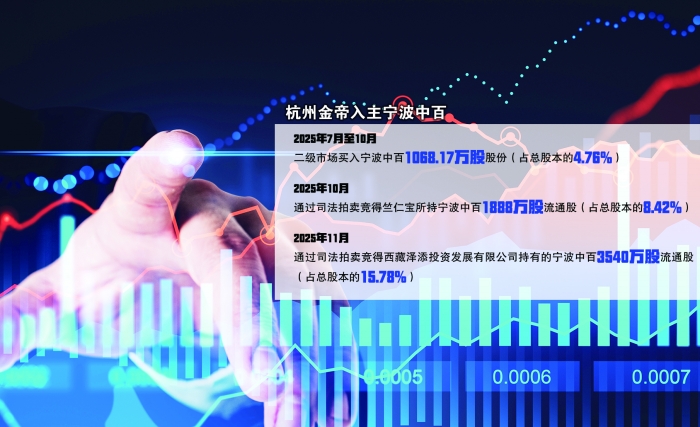
Group 1 - A long-established department store company, Ningbo Zhongbai, has undergone a change in actual control after a decade of capital entanglements, with Zhejiang Energy Real Estate giant, Hangzhou Jindi, becoming the new controlling shareholder [2][3] - Hangzhou Jindi acquired a total of 28.96% of Ningbo Zhongbai's shares through judicial auctions and secondary market purchases, marking a significant shift in ownership [2][3] - The change in control ends the Xu Xiang family's decade-long actual control over Ningbo Zhongbai, which began in 2014 when they first intervened through a judicial auction [2][4] Group 2 - Hangzhou Jindi's acquisition strategy included buying 10.68 million shares in the secondary market from July to October 2025, representing approximately 4.76% of the total share capital, at a cost of about 151 million yuan [3] - The company also won two rounds of judicial auctions, acquiring 18.88 million shares (8.42% of total shares) and 35.40 million shares (15.78% of total shares) from previous major shareholders [2][3] - The new controlling shareholders are Lu Sikan and Kong Lielan, with Hangzhou Jindi committing to not change the main business or restructure the company for at least 18 months following the acquisition [5] Group 3 - Hangzhou Jindi, established in 2019, is a wholly-owned subsidiary of Zhejiang Jindi Real Estate Group, which operates in various sectors including oil and gas exploration, real estate development, and commercial management [5][6] - The company has previously attempted to acquire other A-share shell resources, indicating a strategic interest in expanding its presence in the capital market [5][6] - Despite the overall contraction in the private real estate sector, Hangzhou Jindi's aggressive expansion and high leverage raise concerns about financial risks, as evidenced by a significant drop in revenue and profit from 2022 to 2024 [7]


智通ADR统计 | 12月9日
智通财经网· 2025-12-08 22:22
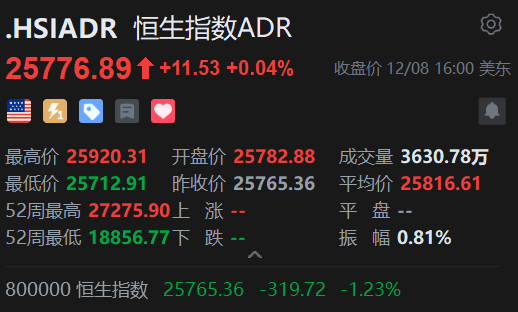
Market Overview - The Hang Seng Index (HSI) closed at 25,776.89, up by 11.53 points or 0.04% as of December 8, 16:00 Eastern Time [1] - The index reached a high of 25,920.31 and a low of 25,712.91 during the trading session, with a trading volume of 36.3078 million [1] - The 52-week high for the index is 27,275.90, while the 52-week low is 18,856.77, indicating a trading range of 0.81% for the day [1] Blue-Chip Stocks Performance - HSBC Holdings closed at 110.515 HKD, an increase of 1.30% compared to the Hong Kong closing price [2] - Tencent Holdings closed at 605.092 HKD, showing a slight increase of 0.02% from the Hong Kong closing price [2] - Alibaba Group (W) closed at 153.400 HKD, down by 1.03% [3] - China Ping An saw an increase of 2.15%, closing at 61.750 HKD [3] Notable Stock Movements - Tencent Holdings experienced a decrease of 0.82%, closing at 605.000 HKD [3] - Alibaba Group (W) decreased by 1.03%, closing at 153.400 HKD [3] - HSBC Holdings decreased by 1.71%, closing at 109.100 HKD [3] - China International Capital Corporation (CICC) saw a decline of 4.01%, closing at 7.660 HKD [3] - Meituan (W) increased by 0.45%, closing at 99.500 HKD [3]




跨界布局搁浅 这家公司重大资产重组终止
Zhong Guo Zheng Quan Bao· 2025-12-05 14:15
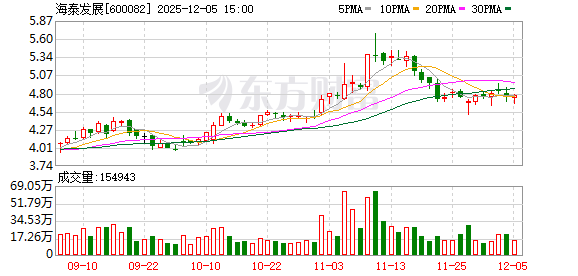
Core Viewpoint - Haitai Development has decided to terminate the cash acquisition of controlling shares in Zhixueyun Technology after failing to reach an agreement on key transaction terms, putting its plans to enter the education technology sector on hold [2][3]. Group 1: Company Announcement - Haitai Development announced on December 5 that it would not proceed with the acquisition of Zhixueyun due to a lack of consensus on transaction price and method [2]. - The company committed to not planning any major asset restructuring for at least one month following this decision [2]. - The termination of this transaction is not expected to adversely affect the company's normal business operations [2]. Group 2: Financial Performance - For the first three quarters of 2025, Haitai Development reported a revenue of 445 million yuan, representing a year-on-year increase of 1256.49%, primarily driven by a significant rise in real estate sales [3]. - The net profit attributable to shareholders was 2.42 million yuan, with a non-recurring net profit of 522,800 yuan, largely influenced by real estate sales and gains from the disposal of subsidiary equity [3]. Group 3: Background on Zhixueyun - Zhixueyun, established in 2013, focuses on providing digital learning solutions for government and enterprise clients through its proprietary low-code PaaS platform and AI Agent platform [3]. - The company has been recognized as a "specialized and innovative" small and medium-sized enterprise in Beijing for two consecutive years from 2021 to 2022 [3]. Group 4: Strategic Intent - The acquisition of Zhixueyun was intended to align with the State-owned Assets Supervision and Administration Commission's reform requirements and the Tianjin government's policy initiatives, aiming to inject educational technology assets into Haitai Development and create a new business segment [3]. Group 5: Stock Performance - Haitai Development's stock price has seen a significant increase, rising 62.2% from April 9 to June 5, reaching 4.12 yuan per share, with a total increase of over 87% from April 9 to December 5 [4].

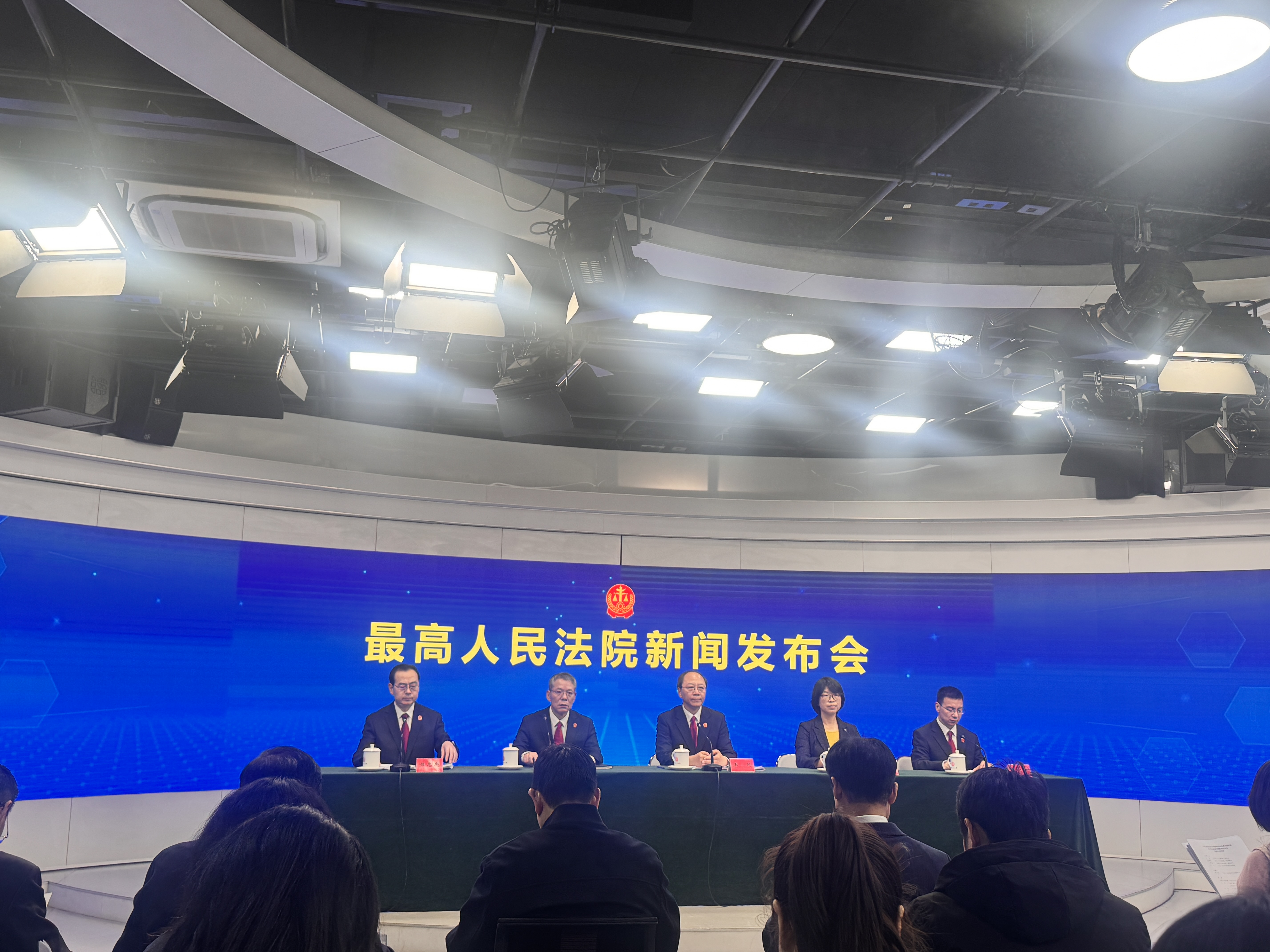
最高法发布7大典型案例 银行违规收取“融资承诺费”位列第一
Zheng Quan Ri Bao Wang· 2025-12-04 03:56
Core Viewpoint - The private economy is a driving force for China's modernization and a crucial foundation for high-quality development. The Supreme People's Court has released seven typical civil and commercial cases that demonstrate the equal legal protection of private enterprises' legitimate rights and interests [1]. Group 1: Legal Protection of Private Enterprises - The seven typical cases cover various aspects, including optimizing the financing environment, activating limited liability for shareholders, addressing historical issues, and protecting the reputation and credit of enterprises [4]. - The cases reflect the latest progress made by the courts in legally protecting the legitimate rights and interests of private enterprises [4]. Group 2: Financing Challenges - The courts aim to address the financing difficulties faced by private enterprises by regulating financial institutions' behaviors, which is essential for ensuring the survival and development of these enterprises [5]. - Through the adjudication of financial loan disputes, the courts enforce national financial regulatory policies and promote the optimization of inclusive financial services [5]. Group 3: Equal Protection of Rights - The principle of non-retroactivity is upheld to ensure equal protection of the legitimate rights of both state-owned and private enterprises [9]. - The courts consider the complexities of enterprise restructuring while balancing the interests of all parties involved, ensuring that enterprises do not evade debts through restructuring [10]. Group 4: Shareholder Limited Liability - The courts maintain the independence of corporate assets and the separation of responsibilities between shareholders and companies, which is vital for enhancing the confidence of private enterprises and entrepreneurs [11]. - Legal responsibilities are enforced against controlling shareholders and actual controllers who misuse their positions, ensuring the protection of honest shareholders' rights [11]. Group 5: Maintaining Enterprise Credit - The courts innovate execution measures to protect the credit of private enterprises, ensuring that enforcement actions do not disrupt their operational management or financial flows [12]. - In a specific case, the courts implemented measures that allowed for the efficient resolution of disputes while safeguarding the financial stability and reputation of the involved enterprises [12].
从香港大火看A股注册制的前景
Xin Lang Cai Jing· 2025-12-03 13:20
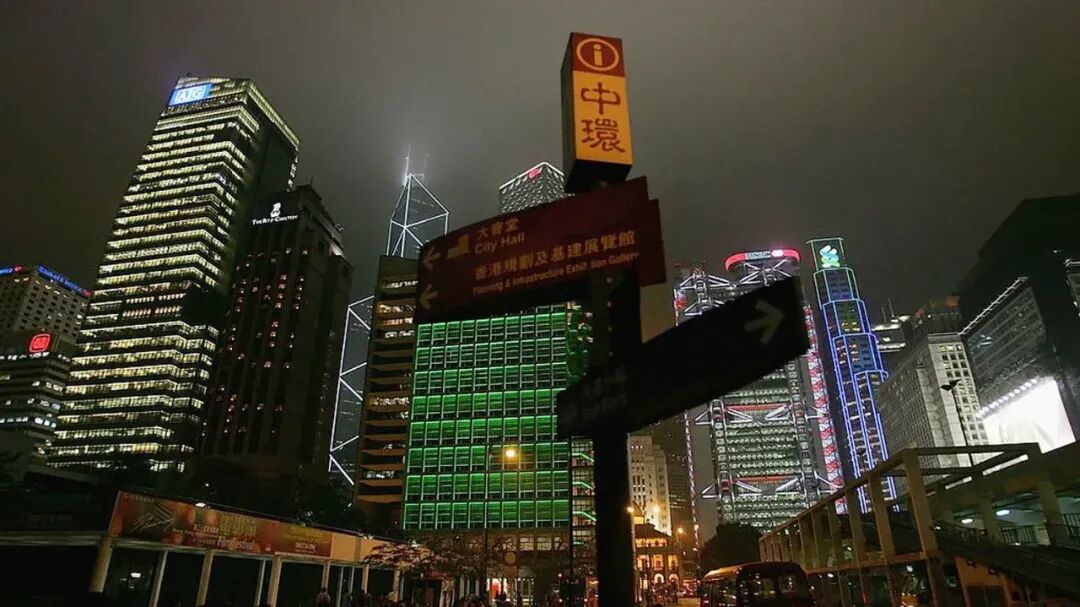
Group 1 - The core issue of housing difficulties in Hong Kong has persisted for a long time, with average living conditions being significantly lower than in mainland cities, as evidenced by a median living area of 172 square feet (approximately 16 square meters) compared to 46 square meters in mainland cities [4][24] - The "85,000 Housing Plan" proposed in 1997 aimed to supply at least 85,000 housing units annually to address the severe housing shortage in Hong Kong, but it ultimately failed due to structural issues and external shocks like the Asian financial crisis [5][25] - The plan's interruption was exacerbated by the influence of powerful real estate interests, which resisted policies that threatened their profits, leading to significant political and economic pressure on the government [6][26] Group 2 - The A-share market has faced challenges with new stock issuance, characterized by a pattern of rapid bull markets followed by prolonged bear markets, resulting in significant losses for retail investors while benefiting major shareholders [9][28] - The lack of a truly market-oriented system for stock issuance and delisting has hindered the development of a healthy investment environment, with regulatory practices that favor established companies over potentially high-growth firms [10][29] - The introduction of the IPO registration system has been slow and met with resistance, as the market's capacity to absorb new listings is insufficient, leading to a scarcity of new companies and inflated valuations for existing stocks [11][30] Group 3 - Both the "85,000 Housing Plan" and the A-share IPO registration system share a common theme of ambitious reform goals that are mismatched with the system's capacity to implement them effectively, leading to similar failures [12][31] - External shocks, such as the Asian financial crisis and recent global liquidity tightening, have reversed the progress of both housing and capital market reforms, causing significant setbacks [13][32] - The entrenched interests in both sectors have created structural resistance to reform, with real estate developers and financial institutions opposing policies that threaten their established profit models [14][33] Group 4 - Public pressure and political risks have forced both the housing plan and the IPO registration system to be scaled back, as negative market reactions and public protests have led to a prioritization of stability over reform [15][34] - Historical experiences suggest that temporary measures like halting IPOs do not address the underlying issues in the market, and a more sustainable approach is needed to foster long-term growth [16][35] - The need for a transparent and well-communicated reform strategy is critical to maintaining public trust and ensuring the successful implementation of policies in both housing and capital markets [19][38]
A股低开高走,科创50涨超1%,锂矿领涨,地产股续跌,港股指数表现分化,消费强势,多只万科债临停
Hua Er Jie Jian Wen· 2025-11-28 13:40
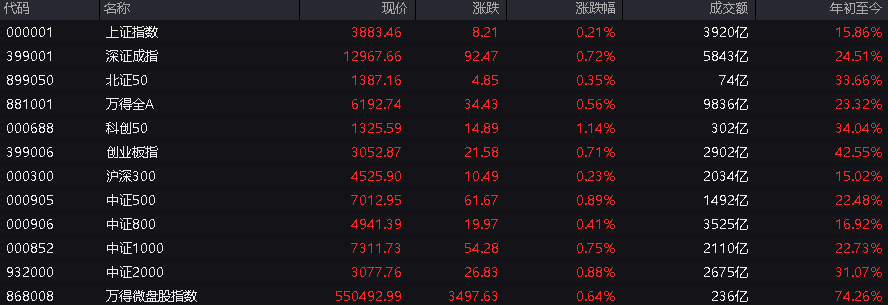
Market Performance - A-shares opened lower but rebounded, with the Shanghai Composite Index rising by 0.21% to close at 3883.46 points [1] - The Shenzhen Component Index increased by 0.72%, closing at 12967.66 points [2] - The ChiNext Index rose by 0.71%, ending at 3052.87 points [3] - The CSI 300 Index saw a modest gain of 0.23%, closing at 4525.90 points [4] - The STAR 50 Index experienced a notable increase of 1.14%, closing at 1325.59 points [5] - The CSI 500 Index rose by 0.89%, closing at 7012.95 points [6] - The CSI 1000 Index increased by 0.75%, closing at 7311.73 points [7] Sector Performance - The titanium dioxide, lithium mining, Hainan Free Trade Zone, and commercial aerospace sectors led the gains [1] - The pharmaceutical, banking, gaming, and tourism sectors experienced declines [1] - Notable stocks included Qian Zhao Guangdian, which hit the daily limit, and Hai Xin Food, which saw significant gains [1] Trading Volume - The total trading volume for the morning session reached 983.7 billion [1] - Over 3500 stocks in the Shanghai and Shenzhen markets were in the green [1] Debt Market - Vanke's bonds saw significant fluctuations, with a 20 billion yuan bond extension adding uncertainty to its future debt repayment outlook [13] - Some of Vanke's domestic bonds rebounded sharply, with "22 Vanke 02" rising by 120% and "21 Vanke 06" increasing by 107.8% [13] Analyst Insights - JPMorgan strategists indicated a higher probability of significant gains in the Chinese stock market next year compared to risks of a major downturn, upgrading A-shares to "overweight" [8]

一则消息!地产龙头跳水大跌,股债双杀!发生了什么?利好不断,固态电池掀起涨停潮...
雪球· 2025-11-27 08:06
Market Overview - The market experienced a mixed performance with the Shanghai Composite Index rising by 0.29% while the Shenzhen Component and ChiNext Index fell by 0.25% and 0.44% respectively. The total trading volume in the Shanghai and Shenzhen markets was 1.71 trillion yuan, a decrease of 73.6 billion yuan compared to the previous trading day [2] - Over 2,700 stocks in the market saw an increase, with sectors such as organic silicon, batteries, and consumer electronics leading the gains, while sectors like Hainan, film and television, and AI applications faced declines [2] Real Estate Sector - Vanke A experienced a significant decline, with its stock price dropping by 7.13% to 5.47 yuan, resulting in a total market capitalization of 65.2 billion yuan [6] - In the bond market, Vanke's bonds also suffered, with "21 Vanke 02" dropping over 70%, "21 Vanke 06" down over 23%, and "23 Vanke 01" down over 32% [9] - Vanke announced a creditors' meeting to discuss the extension of its "22 Vanke MTN004" notes, scheduled for December 10 [9] Technology Sector - The technology sector showed strong performance, particularly in the semiconductor, consumer electronics, and computing power industries [10] - The consumer electronics sector saw a boost following Huawei's product launch event, which introduced several new devices [14] - The AI-driven consumer electronics sector reported a 19% year-on-year increase in revenue for Q3, with a 26.5% quarter-on-quarter growth, and a 26% increase in net profit year-on-year [14] Battery Industry - The lithium battery sector experienced a surge, particularly in solid-state batteries, with companies like Yishitong and Haike New Energy hitting the 20% daily limit [17][19] - Recent reports highlighted advancements in solid-state battery production, with expectations for global shipments to reach 614 GWh by 2030, and significant growth in the Chinese market anticipated [20] - The industrialization of solid-state batteries is accelerating, with large-scale production expected to begin around 2030 [20]

港股26日涨0.13% 收报25928.08点
Xin Hua Wang· 2025-11-26 10:27
Core Viewpoint - The Hong Kong Hang Seng Index experienced a slight increase of 33.53 points, or 0.13%, closing at 25,928.08 points, with a total turnover of HKD 2,070.78 billion on November 26 [1] Group 1: Index Performance - The Hang Seng Index rose by 33.53 points, closing at 25,928.08 points, reflecting a gain of 0.13% [1] - The National Enterprises Index increased by 4.06 points, closing at 9,162.37 points, with a gain of 0.04% [1] - The Hang Seng Technology Index saw an increase of 6.33 points, closing at 5,618.36 points, representing a rise of 0.11% [1] Group 2: Blue-Chip Stocks - Tencent Holdings fell by 0.88%, closing at HKD 619.5 [1] - Hong Kong Exchanges and Clearing decreased by 0.53%, closing at HKD 413.2 [1] - China Mobile increased by 0.11%, closing at HKD 87.35 [1] - HSBC Holdings rose by 0.75%, closing at HKD 107.6 [1] Group 3: Local Hong Kong Stocks - Cheung Kong Holdings increased by 1.16%, closing at HKD 40.12 [1] - Sun Hung Kai Properties rose by 0.46%, closing at HKD 98.25 [1] - Henderson Land Development increased by 0.54%, closing at HKD 29.88 [1] Group 4: Chinese Financial Stocks - Bank of China remained unchanged, closing at HKD 4.75 [1] - China Construction Bank decreased by 0.12%, closing at HKD 8.21 [1] - Industrial and Commercial Bank of China remained unchanged, closing at HKD 6.5 [1] - Ping An Insurance fell by 0.35%, closing at HKD 57.35 [1] - China Life Insurance increased by 0.15%, closing at HKD 26.74 [1] Group 5: Oil and Petrochemical Stocks - China Petroleum & Chemical Corporation rose by 0.23%, closing at HKD 4.42 [1] - China National Petroleum Corporation increased by 0.12%, closing at HKD 8.7 [1] - CNOOC Limited fell by 0.85%, closing at HKD 21.06 [1]
土地市场月度跟踪报告(2025年10月):加速聚焦核心,1-10月核心6城土拍总价占比近半-20251124
EBSCN· 2025-11-24 05:31
Investment Rating - The industry is rated as "Overweight" [5] Core Insights - In the first ten months of 2025, the total area of residential land transactions in 100 cities decreased by 9% year-on-year, while the average floor price increased by 15% [1][51] - The top three companies in terms of new land reserve value from January to October 2025 are China Overseas Land & Investment (119.9 billion), China Merchants Shekou (103.4 billion), and Greentown China (65.1 billion) [2][87] - The core 30 cities saw a cumulative year-on-year decrease of 3% in residential land transaction area, but a 22% increase in average price [2][3] Summary by Sections Land Supply and Demand - In the first ten months of 2025, the total land supply in 100 cities was 1.113 billion square meters, a year-on-year decrease of 12.7%, while the total land transaction area was 946 million square meters, down 7% [8] - The supply of residential land in 100 cities for the same period was 239 million square meters, a decrease of 19.1% year-on-year, with a transaction area of 184 million square meters, down 9.3% [18] Land Transaction Prices - The average floor price of residential land in 100 cities for the first ten months of 2025 was 6,597 yuan per square meter, reflecting a year-on-year increase of 14.9% [51][62] - In the core 30 cities, the average floor price for residential land transactions was 11,423 yuan per square meter, up 21.8% year-on-year [3][95] Top 50 Real Estate Companies' Land Acquisition - The top 50 real estate companies saw a 55% year-on-year increase in new land reserve value, totaling 908.4 billion yuan from January to October 2025 [78] - The top three companies by new land reserve area are China Overseas Land & Investment (4.15 million square meters), Poly Developments (3.51 million square meters), and China Merchants Shekou (3.07 million square meters) [2][87] Core 30 Cities Land Transaction Situation - In October 2025, the core 30 cities recorded 133 residential land transactions, with a total area of 855 million square meters, down 43% year-on-year [92] - The cumulative total land transaction price in the core 30 cities from January to October 2025 was 946.5 billion yuan, an increase of 17.8% year-on-year [95][102] Investment Recommendations - Focus on companies with strong brand reputation and sales performance in core cities, such as Poly Developments and China Merchants Shekou [4][118] - Consider companies with rich existing resources and operational brand competitiveness, like China Resources Land and Shanghai Lingang [4][118] - Look for long-term growth potential in property services, recommending companies like China Merchants Jinling and Greentown Services [4][118]