
汽车零售

Search documents
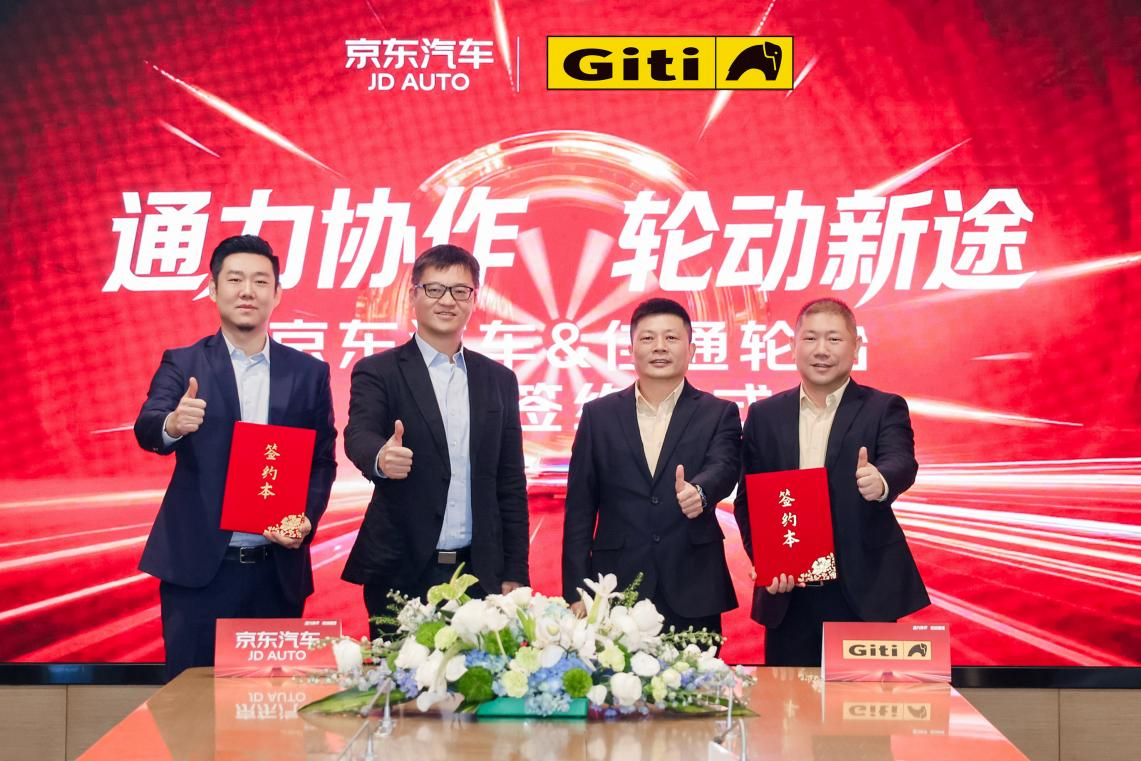
京东汽车与佳通轮胎战略合作升级 共推轮胎即买即装新体验
Yang Guang Wang· 2025-11-19 07:56
Core Viewpoint - JD Auto and Giti Tire have signed a strategic cooperation agreement to enhance their collaboration in the tire industry, focusing on digitalization, efficiency, and low-carbon development to improve consumer experience and service quality [1][9]. Group 1: Partnership Overview - The cooperation covers both passenger and commercial vehicle tires, leveraging JD's supply chain capabilities and Giti's expertise in tire research and manufacturing [1][3]. - The partnership aims to create a seamless experience for consumers, from online selection to offline installation, enhancing overall operational efficiency in the tire industry [3]. Group 2: Commercial Vehicle Collaboration - JD Auto and Giti Tire will collaborate on commercial vehicle tires and logistics, aiming to develop a comprehensive solution that integrates intelligent products, specialized services, and digital management [5]. - The focus will be on improving tire efficiency and lifespan while optimizing fleet management and operational costs, supporting the logistics sector in cost reduction and green transformation [5]. Group 3: Role of JD Yanche - JD Yanche, a professional automotive service brand under JD Group, will play a crucial role in this partnership by providing a wide range of services, including maintenance and tire replacement [7]. - The collaboration will explore innovative models like "instant retail + fast delivery," enhancing service efficiency and response speed for tire purchasing and installation [7]. Group 4: Future Directions - The partnership will continue to deepen, focusing on integrating products, services, supply chains, and green low-carbon initiatives to elevate the overall value of the industry chain [9].


从流量高地到零售长坡:二十年后,汽车之家完成时代转身
36氪· 2025-11-15 09:07
Core Viewpoint - The article discusses the evolution of Autohome, a 20-year-old automotive platform, as it transitions from a media platform to an e-commerce platform, emphasizing the importance of "new retail" in reshaping the automotive industry amidst structural changes like electrification and intelligence [2][3][24]. Group 1: New Retail Concept - The concept of "new retail" has evolved from mere online and offline channel integration to a comprehensive restructuring of the entire industry, driven by AI and O2O [2][3]. - Autohome's entry into e-commerce with the launch of Autohome Mall marks a significant shift, allowing it to partner with 15 brands, including established and emerging players [3][13]. Group 2: Automotive Consumption Changes - The automotive consumption chain has fundamentally changed, with a rise in direct-to-consumer (DTC) models that redefine relationships between brands and users [3][10]. - The traditional retail system has become a structural constraint for manufacturers, making it difficult to understand user needs and leading to inventory issues [14][20]. Group 3: User Experience and Trust - The transition to online purchasing is slow due to the high-value nature of cars, which require trust and real experience [8][10]. - Autohome aims to enhance user experience by integrating content, data, and services, creating a seamless purchasing journey [11][15]. Group 4: E-commerce Platform Features - Autohome Mall is designed to drive user decisions through professional content and real user reviews, facilitating immediate transactions [15][16]. - The platform ensures post-purchase support, addressing issues like vehicle damage or warranty disputes, thus enhancing trust [18][30]. Group 5: Strategic Partnerships - Autohome's collaboration with Haier enhances its service network, allowing for better delivery and customer service through Haier's extensive offline presence [26][29]. - The integration of Haier's resources into Autohome's ecosystem aims to improve the overall purchasing experience, especially in areas lacking traditional dealerships [29][30].


CHEVALIER INT‘L拟出售加拿大佳士拿汽车代理业务及相关资产及物业
Zhi Tong Cai Jing· 2025-11-12 11:32
Core Viewpoint - Chevalier International (00025) has announced the conditional sale of its automotive business, which includes the sale and leasing of new and used OEM vehicles, maintenance services, and the sale of OEM parts, due to significant challenges in the Canadian automotive industry [1][2] Group 1: Business Context - The Canadian automotive industry has faced major challenges in recent years, including rising interest rates and increased costs of new vehicles, which have suppressed consumer demand for new cars [1] - The business has reported net losses before and after tax for the past two fiscal years, exacerbated by the global trade war [1] Group 2: Strategic Decision - The board of directors decided to exit the Canadian automotive agency market and put the business, along with its related assets and properties, up for sale due to increasing consolidation in the Canadian automotive retail market [1] - The company has not received any committed purchase offers, leading to the decision to ultimately close the business to mitigate further losses [1] Group 3: Buyer Interest - The buyer, a group already engaged in automotive agency business in Ontario, has expressed interest in continuing operations at the relevant properties or running the Chevalier automotive agency business [2] - The board views this sale as a strategic opportunity to bundle the business with its related assets and properties to reduce losses and realize the investment value of the related properties [2] - Upon completion of the sale, the company will cease operations of this business in Canada [2]
Q3每股收益低于预期 Carvana(CVNA.US)大跌超10%
Zhi Tong Cai Jing· 2025-10-30 15:10
Core Insights - Carvana's stock dropped over 10% to a four-month low of $317.22 following its third-quarter earnings report [1] Financial Performance - The company's total revenue for Q3 increased by 54.5% year-over-year to $5.65 billion, surpassing analyst expectations of $5.08 billion [1] - Earnings per share (EPS) were reported at $1.03, which fell short of the analyst forecast of $1.30 [1] Sales and Projections - Retail sales reached a record high of 156,000 units, reflecting a year-over-year growth of 44% [1] - For Q4, the company anticipates retail sales to exceed 150,000 units and expects adjusted EBITDA for the year to reach or exceed the previously announced upper limit of $2 billion to $2.2 billion [1]

美股异动 | Q3每股收益低于预期 Carvana(CVNA.US)大跌超10%
智通财经网· 2025-10-30 15:05
Core Viewpoint - Carvana's stock experienced a significant drop of over 10%, reaching a four-month low of $317.22, despite reporting strong revenue growth in Q3 [1] Financial Performance - The company's Q3 total revenue increased by 54.5% year-over-year to $5.65 billion, surpassing analysts' average expectation of $5.08 billion [1] - Earnings per share (EPS) were reported at $1.03, which fell short of analysts' expectations of $1.30 [1] Sales and Projections - Retail sales reached a record high of 156,000 units, reflecting a year-over-year growth of 44% [1] - For Q4, the company anticipates retail sales to exceed 150,000 units and expects adjusted EBITDA for the year to reach or exceed the upper limit of the previously announced range of $2 billion to $2.2 billion [1]
中金:通胀温和支持美联储继续降息
中金点睛· 2025-10-26 23:39
Core Viewpoint - The inflation data for September in the U.S. is relatively mild, supporting the Federal Reserve's potential interest rate cuts in October and December, with expectations of a 25 basis point reduction in each month [2][5]. Inflation Data Summary - The overall CPI in September increased by 0.3% month-on-month and reached a year-on-year growth of 3.0%, while the core CPI rose by 0.2% month-on-month and also increased by 3.0% year-on-year, which is below market expectations [2][6]. - The energy price index adjusted for seasonality rose by 1.5% month-on-month, primarily driven by a 4.1% increase in gasoline prices, although global oil and gasoline prices have shown a downward trend since October [2][6]. Core CPI Components - The core CPI year-on-year growth of 3% in September slightly decreased from 3.1% in August, with rent and used car prices showing significant weakness, indicating a decline in demand [3][5]. - Owner's equivalent rent (OER) increased by only 0.1% month-on-month, the lowest monthly increase since January 2021, while primary residence rent rose by 0.2% [3][9]. Impact of Tariffs - Prices of goods affected by tariffs showed mixed results, with clothing (+0.7%), furniture (+0.9%), appliances (+0.8%), and entertainment items (+0.4%) increasing, indicating that the market is gradually absorbing tariff costs [4][5]. - However, electronic devices, particularly mobile phones, saw a significant price drop of 2.2%. The overall core goods prices increased by 0.2% month-on-month, maintaining a year-on-year growth rate of 1.5% [4][5]. Service Inflation - Service inflation remains robust, with the core services price excluding rent rising by 0.4% month-on-month, and the three-month annualized growth rate increasing to 4.7% [5][11]. - Airfare prices increased by 2.7%, reflecting improved demand for air travel, while other services such as medical (+0.3%), entertainment (+0.4%), and childcare (+1.7%) also maintained price stability [5][11]. Long-term Inflation Outlook - In the medium term, inflation is expected to stabilize around 3%, showing stronger persistence compared to the significant increases seen in 2021. Despite the September inflation data being below market expectations, both core and overall CPI year-on-year growth rates have returned to above 3% [6][8].

京东汽车 名称官宣
Zhong Guo Ji Jin Bao· 2025-10-23 09:33
Core Viewpoint - JD Auto's auction of the "National Good Car" model 001 attracted significant attention, culminating in a final bid of 78.19 million yuan, far exceeding the starting price of 1 yuan, indicating strong market interest and engagement in the automotive sector [4][6]. Group 1: Auction Details - The auction for the JD 001 car took place on October 22, with over 260,000 participants, resulting in a final bid of 78.19 million yuan [4]. - JD Auto announced that participants who bid would receive a 399 yuan "National Good Car" gift package upon purchasing a vehicle, and the closest bidder to the final price would win a car [2][3]. Group 2: Vehicle Specifications and Launch - The new model, named "Aion UT Super," was officially announced on October 23, in collaboration with CATL and GAC Group [7]. - The vehicle features a range of 500 kilometers and a wheelbase of 2750mm, and it is the first to include the "GAC Huawei Cloud Car Machine" technology [8]. Group 3: Market Strategy and Insights - JD's strategy includes providing consumer insights and exclusive sales for the new vehicle, while not directly engaging in manufacturing [11]. - The estimated price range for the new car is between 100,000 to 120,000 yuan, targeting a broad consumer base [11]. Group 4: Company Developments - JD has registered multiple trademarks related to its automotive business, indicating a strategic move into the automotive sector [11]. - The company is actively hiring for various positions within its automotive retail division, with salaries reaching up to one million yuan for certain roles [11].


Carvana Co. (CVNA): A Bear Case Theory
Yahoo Finance· 2025-10-22 21:00
Core Viewpoint - Carvana Co. is facing significant challenges due to its controversial financial history, governance issues, and increasing regulatory scrutiny, which could lead to substantial downside risks for investors [2][4]. Financial Performance - As of October 9th, Carvana's share price was $360.03, with trailing and forward P/E ratios of 98.19 and 60.61 respectively [1]. - The company has over $4.5 billion in debt maturing over the next decade, indicating potential financial strain [3]. Governance and Management - The Garcia family's history of financial misconduct raises concerns about the governance of Carvana, particularly with the audit committee chairman having longstanding ties to the Garcias [3][4]. - The aggressive financial strategies employed by the company, including subprime auto lending and complex related-party transactions, have been criticized for inflating reported sales and earnings [2][3]. Regulatory Environment - Carvana is under increasing regulatory scrutiny, with the SEC issuing a subpoena and investors pursuing lawsuits related to alleged pump-and-dump schemes [4]. - The combination of aggressive financial engineering and governance risks suggests that Carvana is vulnerable to market and regulatory pressures [4]. Market Position and Strategy - Despite the challenges, Carvana's vertically integrated e-commerce platform and operational efficiencies have been highlighted as strengths, contributing to a 12.4% appreciation in stock price since previous bullish coverage [5]. - The company's reliance on the volatile subprime lending market continues to underpin its profitability, but this also exposes it to significant risks [4].
CHEVALIER INT‘L:结束在加拿大的本田汽车代理业务
Zhi Tong Cai Jing· 2025-10-10 10:30
Core Viewpoint - Chevalier International (00025) has decided to exit the Honda automobile agency market in Canada due to significant challenges in the automotive industry and declining profit margins, and is seeking potential buyers for this business [1] Group 1: Company Actions - The asset purchase agreement's conditions have been fulfilled, and the settlement was finalized on September 26, 2025 [1] - The board has recognized the strong trend of consolidation in the Canadian automotive retail market and has decided to bundle the Honda agency business with related properties for sale to an independent third party [1] - The buyer, a group already engaged in various automotive agency businesses, has shown strong interest in continuing the Honda agency operations at the properties [1] Group 2: Market Context - The Canadian automotive industry has faced significant challenges, leading to a continuous decline in the profit margins of the Honda agency business [1] - The value of the Honda agency business, defined as goodwill in the announcement, is relatively low due to shrinking profit margins, with the sale price primarily based on the value of the properties [1] - The pricing was determined considering past market valuations and the macroeconomic trends in Ontario and Canada [1]
CHEVALIER INT‘L(00025):结束在加拿大的本田汽车代理业务
智通财经网· 2025-10-10 10:26
Core Viewpoint - CHEVALIER INT'L has decided to exit the Honda automobile agency market in Canada due to significant challenges in the automotive industry and declining profit margins, seeking potential buyers for the business [1] Group 1: Company Actions - The company has completed all conditions of the asset purchase agreement, with the settlement taking place on September 26, 2025 [1] - The board believes that selling the Honda agency business is a strategic opportunity, especially given the strong interest from a buyer already engaged in automotive agency operations [1] - The sale will bundle the Honda agency business with related properties to realize the value of the group's investments [1] Group 2: Industry Context - The Canadian automotive industry has faced major challenges, leading to a trend of consolidation in the retail market [1] - The profit margins of the Honda agency business have been shrinking, prompting the decision to divest [1] - The valuation of the business is primarily based on the value of the properties involved, considering past market assessments and macroeconomic trends in Ontario and Canada [1]