
肉类加工

Search documents
守护大湾区“肉盘子”餐桌,珠海国企携手做强粤港澳现代化肉类加工产业园
Nan Fang Nong Cun Bao· 2025-12-19 14:00
Core Viewpoint - The collaboration between Zhuhai Agricultural Control Group, China Resources Wufeng, and Zhuhai Jinhang Industrial Investment Group aims to establish a modern meat processing industrial park in the Guangdong-Hong Kong-Macao Greater Bay Area, enhancing the region's meat supply chain and ensuring food safety for residents [10][13][36]. Group 1: Project Overview - The project involves the construction of a comprehensive industrial base that integrates slaughtering, processing, cold chain storage, and distribution [20][21]. - The modern meat processing industrial park is expected to improve the standardization and supply efficiency of meat products, addressing the growing demand for high-quality meat in the Greater Bay Area [22][23]. Group 2: Strategic Importance - The establishment of this industrial park will strengthen Zhuhai's role as a key city in the Greater Bay Area, enhancing its connectivity with Hong Kong and the mainland [24][25]. - The project is seen as a significant step in promoting agricultural modernization and ensuring food security in the region, contributing to the high-quality development of the Greater Bay Area [31][36]. Group 3: Collaborative Efforts - The three parties involved are committed to establishing an efficient collaboration mechanism to focus on project approval, construction, and operation [38]. - The project is positioned as a vital public welfare initiative that goes beyond mere business cooperation, aiming to reinforce the food safety framework in the Greater Bay Area [36][40].


唐人神:12月19日召开董事会会议
Mei Ri Jing Ji Xin Wen· 2025-12-19 10:15
(记者 王晓波) 每经AI快讯,唐人神(SZ 002567,收盘价:4.43元)12月19日晚间发布公告称,公司第十届第八次董 事会会议于2025年12月19日在湖南省株洲市国家高新技术产业开发区栗雨工业园公司总部会议室以通讯 方式召开。会议审议了《关于制定<银行间债券市场债务融资工具信息披露管理制度>的议案》等文 件。 每经头条(nbdtoutiao)——海南封关首日直击:为中国探路,全球最大自贸港如何重塑开放边界? 2025年1至6月份,唐人神的营业收入构成为:饲料产业占比60.25%,猪种苗产业占比34.1%,肉类产业 占比5.58%,动保业占比0.06%。 截至发稿,唐人神市值为63亿元。 ...

定州市峰宏肉类食品加工厂(个体工商户)成立 注册资本10万人民币
Sou Hu Cai Jing· 2025-12-15 22:11
天眼查App显示,近日,定州市峰宏肉类食品加工厂(个体工商户)成立,法定代表人为张宏昌,注册 资本10万人民币,经营范围为许可项目:食品小作坊经营;食品销售(依法须经批准的项目,经相关部 门批准后方可开展经营活动,具体经营项目以相关部门批准文件或许可证件为准) 一般项目:食品互 联网销售(仅销售预包装食品);鲜肉批发;鲜肉零售;农副产品销售;食用农产品初加工(除依法须 经批准的项目外,凭营业执照依法自主开展经营活动)。 ...
顺鑫农业:12月12日召开董事会会议
Mei Ri Jing Ji Xin Wen· 2025-12-12 15:00
截至发稿,顺鑫农业市值为111亿元。 每经头条(nbdtoutiao)——实施城乡居民增收计划、降准降息等工具灵活高效运用、增加普通高中学 位……深度解读中央经济工作会议 (记者 曾健辉) 每经AI快讯,顺鑫农业(SZ 000860,收盘价:14.9元)12月12日晚间发布公告称,公司第九届第二十 五次董事会会议于2025年12月12日在顺鑫国际商务中心12层会议室召开。会议审议了《关于修订 <董事 会议事规则> 的议案》等文件。 2025年1至6月份,顺鑫农业的营业收入构成为:白酒业占比78.51%,肉类加工业占比17.02%,其他占 比4.47%。 ...

践行金融为民,担当主力先锋|工行四川省分行“十四五”高质量发展纪实
Xin Lang Cai Jing· 2025-12-12 03:50
Core Viewpoint - During the "14th Five-Year Plan" period, the Industrial and Commercial Bank of China Sichuan Branch has aligned its strategies with national and local development, focusing on serving the real economy, rural revitalization, technological innovation, and improving people's livelihoods, thereby injecting financial support into Sichuan's economic and social development [1] Group 1: Empowering the Real Economy - The bank has actively supported local enterprises, such as the Honglong Meat Products Company, by providing timely financial assistance through specialized loans, enabling the company to upgrade its production capacity and expand its market reach [3] - In Mianyang, the bank facilitated the construction of a new soy sauce production line by providing a loan of 160 million yuan and assisting with government subsidies, thus reducing financing costs for the company [4] - Over the past five years, the bank has focused on six key industries in Sichuan, with manufacturing loans exceeding 120 billion yuan and loans to technology enterprises surpassing 80 billion yuan, achieving a financing coverage rate of nearly 60% for national-level specialized and innovative "little giant" enterprises [4] Group 2: Deepening Rural Revitalization - The bank has introduced innovative loan products like "Cherry Loan" to support local cherry farmers in Ya'an, enabling them to upgrade irrigation systems and increase productivity, benefiting over 200 local households [6] - In Liangshan Prefecture, the bank provided a quick loan of 3 million yuan to an agricultural company, facilitating its entry into the Southeast Asian market and addressing seasonal funding shortages [7] - The bank's agricultural loan balance exceeded 240 billion yuan by September 2025, demonstrating its commitment to rural revitalization and financial support for farmers [8] Group 3: Technological Empowerment for Livelihood Improvement - The bank has implemented a smart dining solution in community canteens, allowing elderly citizens to use facial recognition for meal subsidies, enhancing convenience and respect for their payment preferences [9] - The bank has supported the integration of high-frequency social security services across provinces, improving efficiency in payment processes for over 11 million elderly customers [11] - The bank's initiatives have contributed to the high-quality development of Sichuan, with a focus on technology finance, green finance, inclusive finance, elderly finance, and digital finance [11]


海关总署暂停2家肉企输华;21家美国猪肉禽肉厂成功注册!
Sou Hu Cai Jing· 2025-12-10 04:21
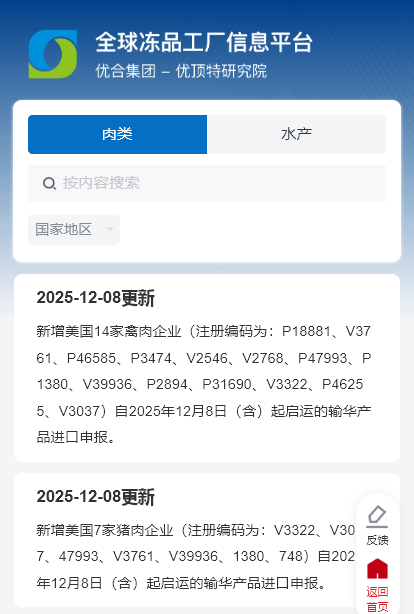
暂停受理俄罗斯注册编号为RU-054/PF13794企业自2025年12月8日(含)启运的 输华禽肉申报; 暂停受理巴基斯坦注册编号为02/AQD/ZA企业自2025年12月9日(含)起启运的输华牛肉产品进口申 报。 21家美国猪肉禽肉厂成功注册! 海关总署暂停2家肉企输华 海关总署更新进口食品境外生产企业注册信息: 信息来源:海关总署、优顶特研究院 2025年12月8日,海关总署更新进口食品境外生产企业注册信息,新增美国21家肉类产品企业输华注 册。其中: 新增7家猪肉产品企业输华注册(注册编码为:1380,V39936,V3037,V3322,47993,V3761, 748)。 新增14家禽肉产品企业输华注册( 注册编码为:P18881,V2546,V2768,V3761,P3474,P47993, P1380,P46585,V39936,P2894,P46255,P31690,V3037,V3322)。 ...
涉及新兴领域、交通运输和环境保护!一批重要国家标准发布
Yang Shi Xin Wen Ke Hu Duan· 2025-12-10 02:41
Emerging Fields - The release of five national standards related to cybersecurity aims to strengthen national cybersecurity defenses and promote healthy development of the digital economy [1] - Seven national standards in information technology will ensure interoperability and security of information systems through unified technical application specifications [1] - Three national standards for artificial intelligence social experiments support the healthy and orderly development of intelligent societies [1] - Seven national standards for nanotechnology will assist in unifying relevant technical characterization and testing specifications [1] Transportation and Environmental Protection - A total of 44 national standards covering automotive steering systems, vehicle brake fluids, railway construction machinery, rail transit vehicles, shore power for ships, containers, and aerospace components will aid in building a strong transportation nation [1] - Ten energy-saving and environmental protection standards related to industrial boiler economic operation, meat processing, food processing, alcoholic beverages, and lead-zinc will contribute to pollution prevention efforts [1] Safety Production - National standards for assessing combustible dust explosion risks and guidelines for gas protection station construction in chemical parks will enhance safety management in hazardous chemical production [2] - Five emergency management national standards, including guidelines for emergency drills and scenario construction methods, will improve emergency response capabilities [2] - Eleven mandatory national standards for fire trucks will ensure technological advancement in fire truck products and enhance the operational capabilities of firefighting teams [2] Public Services - Three national standards for educational service management and seven guidelines for standardized education course construction in logistics, elderly care, automation, and the Internet of Things will lay the foundation for cultivating versatile talents and promoting education integration [2] - Guidelines for the usability of home health care products and services will support the development of an age-friendly society [2] - Four national standards related to digital asset management, including digital maturity and cultural digital asset valuation, will enhance the digitalization level of asset management and improve transparency and security in digital asset transactions [2] Daily Life - National standards for smart textiles will guide the standardized development of smart textile products [3] - The introduction of national standards for biodegradable plastic shopping bags will promote resource recycling [3] - Two national standards for testing methods related to formaldehyde content in leather and short-chain chlorinated paraffins will improve detection of harmful substance limits [3] - Eight national standards for surgical implants and sterilization of medical products will enhance the quality and safety of medical devices [3] - Additional national standards were released for rice, navel oranges, rural toilets, and oil drilling equipment [3]
鑫海肉食品有限公司董事长贾树华:希望把苏尼特羊带到全国百姓餐桌
Jing Ji Wang· 2025-12-09 08:52
作为2025企业家博鳌论坛平行论坛,由瞭望周刊社主办,瞭望智库承办,瞭望东方周刊、环球杂 志、瞭望时代传媒协办的"新趋势 新生态 新机遇——2025食品与健康智库论坛",12月3日在海南博鳌举 行。来自政产学研相关领域的百余位嘉宾围绕"十五五"时期加快建设健康中国、推动食品与健康产业高 质量,从多个角度深入研讨、交流。 贾树华首先阐述了苏尼特羊肉的卓越品质根基。其稀缺性与高品质源于三方面:一是独特的优良品 种;二是生长于锡林郭勒大草原纯净无污染的天然环境,自由采食数百种药食同源的牧草;三是传统生 态养殖方式,确保了肉质的自然风味与高营养价值。 编辑:侯隽 据了解,苏尼特羊是在特定生态环境中,经过长期的自然选择和人工精心培育而形成的地方良种, 作为元明清三朝皇家贡品,素有"草原熊猫羊"的美称。此外,苏尼特羊肉早在2010年就被列入国家级畜 禽遗传资源保护名录,2019年入选第四批全国名特优新农产品名录,2024年成功入选国家地理标志保护 工程项目,是目前内蒙古唯一获批的国家地理标志保护工程项目。而苏尼特左旗,正是这一珍稀品种的 核心产区。 作为扎根苏尼特羊核心产区的企业,贾树华表示,鑫海肉食品在政府的大力支持下 ...
泰森关厂冲击波,美国牛肉75年危机,如何波及中国餐桌?
Sou Hu Cai Jing· 2025-12-09 08:37
Core Insights - Tyson Foods announced the closure of its beef processing plant in Lexington, Nebraska, and significant capacity reductions in Texas, resulting in approximately 1,700 job losses and a 4.8% decrease in U.S. beef slaughter volume [1][3] Industry Challenges - Tyson's beef segment has faced increasing losses, with a reported loss of $648 million in FY2023 and projected losses of $291 million in FY2024 and $426 million in FY2025 [3] - The U.S. cattle herd has declined to its lowest level since 1950, with over 100,000 family farms disappearing in the past decade, complicating the beef supply situation [3][5] - The outbreak of screw-worm fly in Mexico has further impacted cattle survival rates, exacerbating the supply issues [5] - Rising costs for live cattle, feed, and agricultural equipment have compressed profit margins across the industry, affecting not only Tyson but also other major players like JBS and Cargill [5] Tyson's Position in China - Tyson has established a strong presence in China since 2001, with significant investments in production facilities and a comprehensive supply chain from cattle farming to processing [7] - The company operates four R&D centers and numerous farms in China, producing 12,000 tons of beef patties annually and maintaining a herd of 30,000 cattle [7] - Tyson's sales strategy includes B2B partnerships with major brands like Haidilao and Starbucks, as well as retail sales through large supermarkets, generating annual e-commerce sales of 1.5 billion yuan [7] Impact of U.S. Plant Closures on China - The closure of Tyson's U.S. plants is not expected to significantly impact the Chinese market, as 85% of the beef sold in China is locally produced, with only 12% coming from U.S. imports [11] - China's beef imports from the U.S. have historically been low, accounting for just 3.2% of total imports in the first eight months of 2025, with Brazil and Argentina being the primary suppliers [11] China's Beef Industry Landscape - China's beef consumption is projected to reach 9.8 million tons by 2024, but domestic production only meets 70% of demand, leading to reliance on imports [14] - Rising prices for imported beef have resulted in increased retail prices domestically, with high-end beef products primarily sourced from Australia and Japan [14] - The Chinese government is investing 5 billion yuan in initiatives to increase beef production and improve breeding efficiency through advanced technologies [14][16] Strategic Responses - Chinese companies are investing in processing facilities in Brazil and Argentina to secure supply chains and mitigate import risks [16] - The introduction of beef futures on the Dalian Commodity Exchange allows companies to hedge against price volatility [16] - Efforts to improve domestic beef quality include the introduction of Australian Angus cattle, resulting in a 30% improvement in the quality of domestic snowflake beef [16] Conclusion - Tyson's plant closures reflect broader cyclical adjustments in the global beef industry influenced by geopolitical factors, highlighting the need for China to develop a balanced beef supply system that combines imports, self-sufficiency, and technological control [16]

特朗普 最新签署!
Zheng Quan Shi Bao· 2025-12-08 05:14
Core Viewpoint - The executive order signed by President Trump aims to establish working groups to investigate price monopolies and anti-competitive behaviors in the food supply chain, particularly focusing on foreign-controlled companies [1] Group 1: Executive Order and Working Groups - The executive order mandates the Department of Justice and the Federal Trade Commission to form working groups dedicated to investigating price monopolies and anti-competitive practices [1] - The working groups are authorized to take enforcement actions and develop new rules to combat anti-competitive behavior [1] - A report on the progress of the investigations and recommendations for Congressional action is required one year after the issuance of the executive order [1] Group 2: Economic Context - The U.S. Consumer Price Index (CPI) has seen a rise from 2.3% in April to 3% in September year-on-year [1] - In September, prices for beef, coffee, and tea increased by over 10% compared to the previous year [1] - Households in the U.S. are now spending an additional $208 per month to purchase the same goods and services as in September of the previous year, according to a report by Moody's [1] Group 3: Specific Industry Concerns - President Trump has called for an investigation into major U.S. meat processing companies, accusing foreign-controlled firms of potential collusion, price manipulation, and monopolistic practices that have led to rising beef prices [1]