水产养殖

Search documents
Mowi’s acquisition of Nova Sea approved by EU Commission
Globenewswire· 2025-10-17 18:32
Core Points - Mowi has received approval from the EU Commission for its acquisition of a controlling stake in Nova Sea AS [1] - The acquisition will increase Mowi's ownership share in Nova Sea AS from 49% to 95% [1] - Only the approval from the Norwegian competition authority is pending before the transaction can be finalized [1]


@吃货们 汕尾“海鲜天团”在深圳食博会等你来品
Nan Fang Nong Cun Bao· 2025-10-17 14:05
Core Viewpoint - The article highlights the participation of the "Seafood Team" from Shanwei at the 2025 Global High-end Food and Quality Agricultural Products Expo in Shenzhen, showcasing the region's seafood and agricultural products, particularly the Shanwei Three Delicacies [2][5][58]. Group 1: Event Overview - The expo will take place from October 22 to 24 at the Shenzhen Convention and Exhibition Center, featuring a dedicated Shanwei exhibition area [3][57]. - The exhibition will present a variety of high-quality marine and agricultural products, including sweet potatoes, rice, and other local specialties [4][5]. Group 2: Featured Products - The "Seafood Team" will consist of five leading aquaculture companies, prominently featuring the Shanwei Sea Bass, known for its high nutritional and medicinal value [6][10][11]. - The Shanwei Sea Bass is highlighted as the main attraction, with its protein content comparable to grouper and rich in essential amino acids and unsaturated fatty acids [10][11][12]. Group 3: Company Highlights - The core supplier of the Shanwei Sea Bass is Guotai Marine Ranch Development Co., Ltd., which operates a significant aquaculture base with a production capacity of 7,000 tons of seafood annually, generating an output value of 140 million yuan [21][22][24]. - The company has established a modern aquaculture facility covering 48 hectares and has invested in advanced technologies to ensure product quality [22][23][26]. Group 4: Industry Development - Shanwei is recognized as a pilot area for modern marine ranching and has initiated 19 modern marine ranch projects with a total investment of approximately 8.3 billion yuan [41][52]. - The region is focusing on integrating fisheries with cultural tourism, promoting activities like fishing festivals and marine ranch tours to enhance its "blue economy" [53][54].

獐子岛前三季度亏损2900万至3500万 非经常性损益吞噬盈利
Xin Lang Cai Jing· 2025-10-17 10:13
Core Viewpoint - The company, Zhangzidao, is expected to report a net loss attributable to shareholders of between 29 million to 35 million yuan for the first three quarters of 2025, representing a year-on-year decline of 17.16% to 41.40% compared to the same period last year [1] Group 1: Financial Performance - The significant disparity in performance is attributed to non-recurring factors, including tax payments totaling 21.54 million yuan due to non-compliance with a policy, which directly reduced net profit by 12.49 million yuan [2] - The company also made provisions for asset impairment of 2.90 million yuan and wrote off 8.00 million yuan in damaged fixed assets, collectively impacting net profit by 10.73 million yuan [2] - In the first half of the year, the company experienced a profit window, achieving a net profit of 10.15 million yuan, a year-on-year increase of 146.39% due to tight supply and rising prices of scallops [2] Group 2: Industry Challenges - The scallop farming business is highly dependent on market cycles, and the company has not been able to convert price advantages into long-term benefits, while the sea cucumber business faces structural challenges [3] - Financial pressure is severe, with a debt-to-asset ratio of 95.16% as of June, and financial expenses reaching 20.31 million yuan, indicating ongoing liquidity issues [3] - The company has experienced frequent performance fluctuations, with a projected net loss of 21.91 million yuan for 2024, a year-on-year decline of 354.69%, and continued losses expected in the first quarter of 2025 [3]

海南文昌冯家湾探索“上楼养殖” 推动近海渔业现代化转型
Zhong Guo Xin Wen Wang· 2025-10-17 04:08
Core Viewpoint - The Wenchang Fengjiawan Modern Fishery Industrial Park in Hainan has developed a new model for coastal fishery transformation and upgrading, integrating multi-layer factory aquaculture, centralized deep-sea water extraction, ecological retirement, and seed industry integration [1][2]. Group 1: Industrial Model and Innovations - The park is the largest factory-style "vertical farming" facility in the country, covering an area of 6,408 acres, promoting the transition from traditional fishing to large-scale multi-layer aquaculture [1][2]. - It has achieved the first nationwide implementation of centralized deep-sea water extraction and tail water treatment, ensuring high-quality seawater for aquaculture while minimizing ecological damage [1][2]. - The tail water purification process includes four stages: pre-treatment by farming entities, ecological interception ditches, purification by aquatic organisms, and solidified microbial enhancement, achieving "zero wastewater" discharge [1][2]. Group 2: Policy and Financial Support - The park has introduced the first national operational guidelines for the transfer of state-owned agricultural land and ownership registration for facilities on such land, enhancing land resource allocation and asset revitalization efficiency [2]. - Financial cooperation through "government-bank-guarantee" models, specialized insurance for aquaculture breeding, and incentives for park entry help farmers mitigate risks and reduce burdens [2]. Group 3: Research and Development - The establishment of the Hainan (Wenchang) Fishery Innovation Research Center aims to bridge the gap between technological breakthroughs and industrial applications, involving collaboration among academicians, research institutions, enterprises, cooperatives, and farmers [2]. - Since 2020, the park has launched 40 projects with a total investment of 2.632 billion yuan, increasing land utilization for aquaculture facilities from 50% to over 85% and achieving a survival rate of over 90% for fish and shrimp seedlings [2]. Group 4: Future Development Plans - The park plans to enhance infrastructure and industrial chains, leveraging technology to achieve green and sustainable development in the fishery industry, aiming to create a complete chain of "technology research and development + results transformation + industrial application" [3].
“天目粮仓”一田双收全国出圈
Mei Ri Shang Bao· 2025-10-16 23:20
Core Insights - The "Tianmu Granary" project in Lin'an is successfully implementing an ecological agriculture model through the integration of rice and shrimp farming, enhancing economic benefits and promoting rural prosperity [1][5]. Group 1: Agricultural Practices - The "Tianmu Granary" is a collaborative effort between Hangzhou Supply and Marketing Cooperative and local government, focusing on a "rice-shrimp symbiosis" model to improve agricultural efficiency [1]. - The project has seen a significant increase in shrimp yield, with over 2,000 pounds harvested by mid-October, representing a nearly 30% increase compared to the previous year [2]. - The ecological rice variety "Peach Liangyou 67" yielded a total of 20,000 pounds, with sales showing a notable increase [2]. Group 2: Product Quality and Market Expansion - The quality of the shrimp and rice has garnered positive feedback, with customers noting the unique flavor and texture, leading to repeat purchases [3]. - The products have expanded from local sales to national markets, with shrimp being shipped to cities like Guizhou and Beijing, and receiving long-term orders from restaurants in Shanghai and Guangzhou [4]. Group 3: Community and Economic Impact - The project includes a profit-sharing mechanism where 25% of the earnings are distributed to local villagers, promoting community wealth [5]. - The overall goal of the "Tianmu Granary" is to revitalize the land and increase the income of local farmers, aligning with the broader objectives of rural revitalization [5].
黄河口、微山湖抢滩“蟹战”,济南一市场能日销十万斤
Qi Lu Wan Bao Wang· 2025-10-16 15:49
Core Insights - The crab market is experiencing a bountiful harvest this year, with prices being more affordable compared to previous years, allowing consumers to enjoy "crab freedom" [1][2][15] - The peak season for crabs has started earlier this year due to the lunar calendar, with significant sales expected during the Mid-Autumn Festival and National Day [3][11] Market Dynamics - In Jinan's seafood market, the demand for crabs is high, with daily sales reaching up to 100 to 15,000 pounds during peak times, and the overall market potentially exceeding 100,000 pounds daily [2][3] - The market features various types of crabs, including Yangcheng Lake crabs, Jiangsu Xinghua crabs, and Yellow River crabs, creating a competitive environment [4][6] Pricing Trends - The price of crabs this year ranges from 50 to 80 yuan per pound, which is lower than last year's prices due to increased supply from improved breeding techniques [2][15] - Specific prices include 60 yuan per pound for 3-tael female crabs and 77 yuan for 4-tael female crabs, with larger male crabs priced higher [2][4] Regional Highlights - Yellow River crabs are gaining popularity due to their unique taste and earlier market entry, with a projected annual production of 150,000 pounds in 2024 and 160,000 pounds in 2025 [11][12] - The micro-lake crabs are also entering the market with reduced prices, making them more accessible to consumers [12][13] Consumer Behavior - Consumers are increasingly cautious with spending, impacting the overall demand for crabs, which are considered a luxury food item [12] - The trend of purchasing crabs as gifts during the festive season is expected to continue, with significant sales spikes around holidays [3][11]
活动回顾丨跨界聚力·共创未来:社会企业、影响力投资与龙头企业共探食品农业可持续发展新路径
Sou Hu Cai Jing· 2025-10-16 12:03
Core Insights - The event "New Opportunities in Food and Agriculture Industry Development - Innovative Cooperation among Social Enterprises, Impact Investment, and Industry Leaders" was successfully held in Beijing, focusing on exploring industrial innovation and achieving a win-win situation between social and commercial values [2][5]. Group 1: Event Overview - The event was co-hosted by multiple organizations, including Beijing Social Organization Construction Promotion Center and Plug and Play China, gathering over 50 representatives from social enterprises, industry leaders, and impact investment institutions [2][5]. - The venue, AI Origin Community, is highlighted as a hub for AI technology and talent, featuring institutions like Tsinghua University's AI Institute [7][9]. Group 2: Key Themes and Discussions - The urgency of transformation in the food and agriculture industry was emphasized, driven by factors such as food security, climate change, and evolving consumer demands, with technology innovation identified as the core support for this transformation [14]. - The collaboration among social enterprises, industry leaders, and impact investors is crucial, with social enterprises providing innovative technologies, industry leaders offering practical scenarios and brand support, and impact investors filling funding gaps for early-stage projects [14]. Group 3: Case Studies and Innovations - Several innovative cross-industry collaborations were showcased, including: - Kangfen Bio's transformation of food processing by-products into high-value organic fertilizers and alternative feed through unique biotechnology [16]. - Zhi Nuo Technology's development of natural microbial pigments using synthetic biology, successfully applied in leading cashmere enterprises [17]. - Meicai's direct sourcing and smart logistics system that enhances farmer income while reducing costs for restaurant clients [17]. Group 4: Collaborative Discussions - A "World Café" session facilitated deep discussions among over 50 participants from various sectors, focusing on four core topics: - Innovative cooperation models between social enterprises and industry leaders [24]. - Scaling agricultural technology through partnerships [26]. - Diverse funding sources and innovative financing methods beyond impact investment [29]. - Building an ecosystem connecting enterprises, technology providers, research institutions, and funding sources [31]. Group 5: Innovative Solutions Presentation - Five social enterprises presented their sustainable value chain innovations, including: - Gengsheng New Materials' development of standardized planting soil from solid waste, significantly reducing soil restoration time [34]. - Qingyu Hall's use of IoT to enhance efficiency in the aquaculture industry [36]. - Huaxia Zhihui's active oxygen technology for plant disease control, utilizing only water and electricity [38]. - Zhongnong Chuangfa's biodegradable film technology for rice cultivation, addressing plastic pollution [40]. - Algae Chen's focus on commercializing microalgae for nutritional applications [42]. Group 6: Conclusion and Future Engagement - The event concluded with a call for continued engagement in upcoming initiatives, including the "Xiangguang Annual Meeting" and a closed-door seminar on rural revitalization [45]. - The collaborative efforts aim to inject new momentum into the green, inclusive, and sustainable development of the food and agriculture industry, emphasizing the importance of resilient partnerships in uncertain economic environments [45].

公司热点|獐子岛子公司补税逾2150万元,预计减少今年净利1249万元
Sou Hu Cai Jing· 2025-10-16 11:29
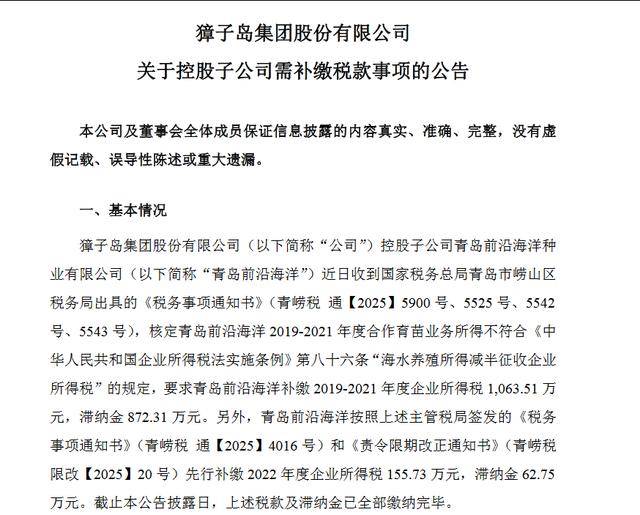
Core Points - The company Zhanzi Island announced that its subsidiary Qingdao Frontier Marine Seed Industry Co., Ltd. is required to pay back taxes and penalties totaling 21.54 million yuan, which is expected to directly reduce the net profit attributable to the parent company by 12.49 million yuan in 2025 [1][2] Group 1: Tax Issues - Qingdao Frontier Marine received multiple tax notices from the tax authority, indicating that its cooperative seedling business from 2019 to 2021 did not comply with tax regulations, necessitating a corporate income tax repayment of 10.6351 million yuan and late fees of 872,310 yuan [2] - The company has already paid the corporate income tax for 2022 amounting to 1.5573 million yuan and late fees of 627,500 yuan as required by the tax authority [2] - All tax payments and penalties have been settled as of the announcement date, and the tax repayment will be fully accounted for in the 2025 financial results without retrospective adjustments to previous financial statements [2] Group 2: Financial Performance - Zhanzi Island reported a loss of 22 million yuan for 2024, while its revenue for the first half of the year was 772 million yuan, a year-on-year decrease of 0.77% [3] - The net profit attributable to the parent company for the same period was 10.1491 million yuan, reflecting a year-on-year increase of 146.39% [3] Group 3: Stock Market Reaction - On October 16, the company's stock opened down by 1.8%, fluctuated throughout the day, and ultimately closed down by 0.6% at 3.97 yuan per share, with a total market capitalization of approximately 3.8 billion yuan [4]
【百姓身边的“十四五”】人均粮食占有量1000斤,变化从田间到舌尖
Zhong Guo Jing Ji Wang· 2025-10-16 09:52
Core Points - Since the "14th Five-Year Plan," China's grain production has reached new heights, establishing a diversified food supply system that ensures not only sufficient food but also improved nutrition and health for residents [2][4] - The annual grain production is stable at over 1.3 trillion jin (approximately 650 million tons), with a target to reach 1.4 trillion jin by 2024 [4][6] - Per capita grain availability exceeds the internationally recognized safety line of 400 kilograms, reaching 500 kilograms [6] Group 1 - The self-sufficiency rate for soybeans has increased by 4 percentage points, while the self-sufficiency rate for edible vegetable oil has risen by nearly 5 percentage points [6] - Total production of meat, eggs, and milk is projected to reach 175 million tons by 2024, an 18.8% increase from 2020 [6] - Per capita annual consumption of meat is 72 kilograms, which is above the world average, with egg consumption at 25 kilograms and milk consumption at 40.5 kilograms, an increase of 2.3 kilograms since 2020 [7] Group 2 - The total production of aquatic products, including fish, shrimp, and crabs, is expected to reach 73.58 million tons by 2024, a 12.3% increase from 2020 [7] - During the "14th Five-Year Plan" period, the annual production of facility vegetables has exceeded 200 million tons, achieving year-round balanced supply [7] - The quality safety monitoring pass rate for agricultural products has remained stable at over 97.5% [7][9] Group 3 - New and revised standards for pesticide residue limits have increased by nearly 40% compared to the end of the "13th Five-Year Plan," with a total of 3,782 items [9] - High-toxicity pesticides have been eliminated from field agricultural production, enhancing safety measures [9] - A comprehensive regulatory system has been established, including a certification system for agricultural products, ensuring traceability and accountability [9]

獐子岛下跌近7%,前三季度预亏2900万元—3500万元
Xin Lang Cai Jing· 2025-10-16 07:27
Core Viewpoint - Zhuangzi Island (002069.SZ) reported a significant decline in stock price following the announcement of its Q3 earnings forecast, indicating a projected net loss of 29 million to 35 million yuan, a year-on-year decrease of 17.16% to 41.4% [1] Financial Performance - The company expects a net profit of -29 million to -35 million yuan for the first three quarters, compared to -24.75 million yuan in the same period last year, reflecting a year-on-year decline [1] - The expected non-recurring net profit is projected to be -22 million to -28 million yuan, compared to -30.15 million yuan in the previous year, with a year-on-year change of 27.04% to 7.15% [1] Reasons for Loss - The loss is attributed to the subsidiary Qingdao Frontier Marine Seed Industry Co., Ltd. needing to pay back taxes and penalties from previous years, which will reduce current profits [1] - The market for fresh aquatic products has seen a decline in both price and volume, leading to decreased gross margins in the scallop business [1] - Structural changes in the consumer market have resulted in lower-than-expected sales of seaweed processing products, contributing to an overall decline in profitability [1] Tax Issues - Qingdao Frontier Marine Seed Industry Co., Ltd. was required to repay 10.6351 million yuan in corporate income tax and 872,310 yuan in late fees for the years 2019 to 2021 due to non-compliance with tax regulations [2] - The company has already paid the required taxes and late fees, and these amounts will impact the net profit attributable to shareholders in 2025 by approximately 12.4949 million yuan [2] Corporate Changes - In November 2024, the controlling shareholder of Zhuangzi Island changed to Dalian Salt Chemical Group Co., Ltd., while the actual controller remains the Dalian State-owned Assets Supervision and Administration Commission [4] - Dalian is in the process of establishing a marine development group, with plans to enhance Zhuangzi Island into a leading enterprise in the industry [4]