锂电

Search documents
扩内需促消费政策显效 2025年物价呈温和回升态势
Shang Hai Zheng Quan Bao· 2026-01-09 18:39
Group 1 - The core viewpoint of the articles indicates that the Consumer Price Index (CPI) has shown a moderate recovery, with a year-on-year increase of 0.8% in December 2025, marking the highest level since March 2023 [2][6][7] - The increase in CPI is significantly driven by food prices, particularly fresh vegetables and fruits, which saw year-on-year price increases of 18.2% and 4.4%, respectively [2][3] - The Producer Price Index (PPI) has shown a narrowing year-on-year decline of 1.9% in December, indicating positive changes in certain industries due to improved market competition [4][5] Group 2 - The core CPI, excluding food and energy, rose by 1.2%, maintaining a growth rate above 1% for four consecutive months, reflecting a stable recovery in demand [3][6] - The overall price stability in 2025, with CPI remaining flat year-on-year and PPI declining by 2.6%, suggests that market supply and demand relationships are improving [6][7] - Experts predict that in 2026, with more proactive macroeconomic policies, CPI is expected to rise steadily, supported by recovering consumer demand and structural adjustments in the economy [7][8]
碳酸锂行情日报:雪中悍刀行,烽火戏诸侯
鑫椤锂电· 2026-01-09 09:33
Market Overview - As of January 9, the spot settlement guidance price for battery-grade lithium carbonate (99.5%) is 142,000 CNY/ton, unchanged from the previous working day, while some traders have slightly raised their quotes [1] - The settlement guidance price for battery-grade lithium hydroxide (56.5% coarse particles) is 120,000 CNY/ton, also unchanged from the previous working day [1] - On the futures market, lithium carbonate futures opened lower but closed higher, with the main contract price at 143,420 CNY/ton, an increase of 20 CNY from the previous day, although the position volume has decreased [1] Price Trends - The January 9 prices for various lithium products are as follows: - Lithium concentrate: 1,920 CNY/ton, up 20 CNY from January 8 - Battery-grade lithium carbonate: 142,000 CNY/ton, unchanged - Lithium hydroxide: 120,000 CNY/ton, unchanged - Lithium iron phosphate: 5.08 CNY/kg, unchanged - Ternary materials: 18 CNY/kg, unchanged [2] Market Sentiment - The sentiment index for the lithium carbonate market is at 53.6, indicating a generally optimistic outlook, although it has slightly declined from earlier in the week [5] - Some downstream companies believe that 150,000 CNY/ton is a peak price, and a price correction is expected, while others remain confident in the upward trend despite inventory increases [5] Industry Developments - Rio Tinto, the world's third-largest lithium miner, is reportedly in talks with Glencore regarding a potential merger that could involve part or all of their businesses [7] - Tianqi Lithium has announced an increase in its commodity futures hedging business limit to no more than 300 million CNY [7] - The total bidding scale for energy storage in 2025 is projected to be 447.5 GWh, a year-on-year increase of 113.2%, with non-collective procurement projects expected to reach 371.7 GWh, up 179.9% year-on-year [7] Market Outlook - The lithium carbonate market is at a crossroads, with manufacturers debating whether to hold their positions or reduce production. The impact of other commodity price adjustments and the recent inventory increases on market sentiment remains to be seen [8] - The short-term outlook for the lithium carbonate market is expected to remain strong with fluctuations [8]

四大证券报精华摘要:1月9日
Zhong Guo Jin Rong Xin Xi Wang· 2026-01-09 00:50
Group 1: Lithium Battery Industry - Longpan Technology has announced plans to build a new production base for high-pressure lithium iron phosphate with an annual capacity of 240,000 tons, with a total investment not exceeding 2 billion yuan, due to existing capacity being insufficient to meet customer demand [1] - Multiple companies, including Fulin Precision, Dongfang Zirconium, Zhongkuang Resources, and Xinzhoubang, have announced lithium battery project investments, continuing the expansion trend seen since 2025 [1] - Industry experts predict that the investment boom in the lithium battery sector will continue into 2026, driven by improving supply-demand dynamics [1] Group 2: Fund Sales and Regulations - The public fund industry is at a critical transformation point as the scale continues to reach new heights, with recent regulations aimed at reducing fund subscription and sales service fees to enhance investor experience [2] - The new regulations are designed to guide the fund industry back to long-term investment and strengthen investor satisfaction [2] Group 3: State-Owned Enterprise Restructuring - The restructuring of China Petroleum & Chemical Corporation and China Aviation Oil Group has been approved, aiming to reduce aviation fuel supply costs and enhance competitiveness in the aviation fuel industry [3] - This merger aligns with the trend of state-owned enterprise reform focused on optimizing capital layout and avoiding homogeneous competition [3] Group 4: H-Share Listings - Several A-share companies, including 聚辰股份 and 鹏辉能源, have announced plans for H-share listings, indicating a trend of companies seeking to capitalize on favorable policies and financing needs [4] - This "batch southward" movement is expected to reshape the Hong Kong stock market structure and enhance the global resource allocation capabilities of leading Chinese enterprises [4] Group 5: Commercial Aerospace - Several companies, dubbed "China's version of SpaceX," are vying to become the first commercial rocket stock, with valuations exceeding 10 billion yuan [6] - The commercial space race is intensifying, with significant capital influx and project competition, indicating a shrinking investment window [6] Group 6: Margin Trading in A-Shares - As the A-share market becomes more active, the margin trading balance has reached a historical high of 2.6047 trillion yuan, marking a significant increase [7] - The trading volume of margin transactions has also surged, with a notable increase in daily trading amounts [7] Group 7: Advanced Manufacturing in Guangzhou - Guangzhou's government has released a plan to accelerate the construction of an advanced manufacturing city, aiming for significant progress by 2030 [8] - The plan includes optimizing industrial structure and enhancing quality and efficiency, with a focus on creating world-class manufacturing clusters [8] Group 8: AI and Semiconductor Market - Beijing Zhiyu Huazhang Technology has become the first Hong Kong-listed company focused on original general models, with a market capitalization of 57.9 billion HKD [10] - The demand for AI computing power is driving a surge in storage chip prices, with significant increases noted in server memory costs due to structural supply-demand imbalances [10]

开年即冲刺 全力保交付 订单“催更” 锂电企业扩产马不停蹄
Zhong Guo Zheng Quan Bao· 2026-01-08 22:01
Core Viewpoint - The lithium battery industry is experiencing a significant investment boom, driven by increasing demand for energy storage and stable growth in power battery installations, leading to a tight supply-demand balance in 2026 [4][6]. Group 1: Company Expansion Plans - Longpan Technology plans to invest up to 2 billion yuan to build a new production base for 240,000 tons of high-pressure lithium iron phosphate annually, as existing capacity cannot meet customer demand [1][2]. - In addition to Longpan Technology, several companies, including Fulin Precision, Dongfang Zirconium, and Xinzhou Bang, have announced investment plans for lithium battery projects, continuing the expansion trend from 2025 [1][2]. - Longpan Technology has previously raised funds to build projects with capacities of 110,000 tons and 85,000 tons of high-performance phosphate-based cathode materials, with ongoing capacity expansion efforts [2]. Group 2: Industry Investment Trends - Since 2025, over 282 investment projects in the lithium battery industry chain have been announced in China, with a total investment exceeding 820 billion yuan, marking a year-on-year increase of over 74% [2]. - The investment trend is not only domestic but also expanding internationally, with companies like Xinzhou Bang planning to invest approximately 260 million USD in a lithium-ion battery materials project in Saudi Arabia [3]. Group 3: Market Dynamics - The surge in lithium battery investments is attributed to multiple factors, including the explosive growth in energy storage demand, steady increases in power battery installations, and rapid technological advancements [4][5]. - The industry has transitioned from a state of oversupply to a tight balance since mid-2025, with expectations of continued investment momentum into 2026 due to strong demand growth [6][7]. - Companies are increasingly adopting a rational approach to expansion, focusing on "order capacity" to avoid blind investments and ensure sustainable growth [6][7].



订单“催更” 锂电企业扩产马不停蹄
Zhong Guo Zheng Quan Bao· 2026-01-08 20:50
Core Viewpoint - The lithium battery industry is experiencing a significant investment boom, driven by increasing demand for energy storage and stable growth in power battery installations, leading to a tight supply-demand balance in 2026 [3][4][6]. Group 1: Company Expansion Plans - Longpan Technology has announced plans to build a new production base for high-pressure lithium iron phosphate with an annual capacity of 240,000 tons, with a total investment not exceeding 2 billion yuan [1]. - In addition to the new project, Longpan Technology has previously raised funds to establish projects with annual capacities of 110,000 tons and 85,000 tons of high-performance phosphate-based cathode materials [2]. - The company is also increasing the planned capacity of its Sichuan Suining Phase III project from 62,500 tons per year to 100,000 tons per year, indicating a rapid pace of expansion [2]. Group 2: Industry Investment Trends - Since 2025, the domestic lithium battery industry has seen over 282 publicly announced investment projects, with a total investment exceeding 820 billion yuan, marking a year-on-year increase of over 74% [2]. - The investment trend is not limited to domestic projects; companies like New Zobang are also expanding overseas, with a planned investment of approximately 260 million USD in Saudi Arabia for lithium-ion battery materials [3]. - Major players in the industry, such as Ningde Times and Yiwei Lithium Energy, are establishing operations in countries like Thailand, Spain, and Portugal, further localizing the supply chain [3]. Group 3: Market Dynamics and Future Outlook - The investment surge in the lithium battery sector is attributed to multiple factors, including the explosive growth in energy storage demand, steady increases in power battery installations, and a shift towards a balanced supply-demand relationship [4][6]. - The industry has transitioned from a period of oversupply and price declines to a phase of high capacity utilization and recovery in material prices since the second half of 2025 [4]. - Analysts predict that the supply-demand balance will remain tight in 2026, with potential shortages expected by 2027, as new capacity takes time to come online [6][7].
锂电产业链叩响价值回归之门
Zheng Quan Ri Bao· 2026-01-08 17:04
Core Insights - The lithium battery industry is entering a new development phase after two years of deep adjustments, driven by rising prices of battery-grade lithium carbonate, improved supply-demand dynamics in the materials sector, and sustained orders from battery manufacturers [1][2] Group 1: Recovery Signals - The lithium battery supply chain includes upstream lithium mining and raw materials, midstream key materials manufacturing, and downstream applications such as power batteries and energy storage [2] - Since December of last year, all segments of the supply chain have shown synchronized improvement, with lithium hexafluorophosphate leading the recovery, as many companies operate at full capacity and have ample orders [2] - The overall lithium battery industry has transitioned from a deep adjustment phase to an early recovery stage, marked by expanding orders in the energy storage market, rapid inventory depletion, and improved performance of leading companies [2][3] Group 2: Price Trends and Demand - Battery-grade lithium carbonate prices experienced a significant V-shaped rebound in 2025, with prices rising from below 60,000 yuan/ton to over 100,000 yuan/ton within six months, reflecting a more than 60% increase [3] - Leading companies predict a 30% increase in demand for battery-grade lithium carbonate by 2026, with potential price increases if demand exceeds expectations [3] - The global demand for lithium is expected to reach 2 million tons by 2026, driven by renewable energy integration and electrification of commercial heavy trucks [3] Group 3: Long-term Strategies - Rising material prices have led companies to seek solutions, including cost control through process optimization and raw material self-supply, while some leading firms have opted for direct price increases [4] - The industry is shifting from a "buyer-dominated" market to a "structural seller's market," with a focus on technological upgrades and supply chain resilience rather than mere capacity expansion [5] - Companies are increasingly adopting long-term strategies, emphasizing value creation and collaboration across the supply chain [5][6] Group 4: Profitability and Market Dynamics - The lithium battery industry is experiencing significant differentiation, with leading companies enjoying high order volumes and rising profits, while many mid-tier firms face challenges [7] - The ongoing demand for electric vehicles and energy storage is expected to accelerate the exit of low-quality capacities, concentrating resources and orders among leading and integrated companies [7][8] - Salt lake lithium extraction companies have a cost advantage over imported lithium ore processing, allowing them to achieve higher profit margins during price upswings [7] Group 5: Industry Evolution - The lithium battery industry is moving from a price-driven cycle to a value-driven cycle, with technological innovation becoming the core determinant of future profit distribution [8] - The recent meeting by the Ministry of Industry and Information Technology aims to regulate competition and promote high-quality development, indicating a shift towards quality improvement in the industry [8] - The industry's ability to achieve profitability in 2026 will depend on collective efforts towards value return, emphasizing long-termism and deep value creation as essential strategies for navigating cycles [8]



八部门启动“AI+制造”:大模型下沉产线,锂电智造将吃红利
高工锂电· 2026-01-08 10:47
Core Viewpoint - The article discusses the implementation of the "AI + Manufacturing" initiative by eight government departments in China, outlining a roadmap for the deep integration of AI in manufacturing by 2027, including the development of general large models and industrial intelligent bodies [2][3]. Group 1: Implementation Goals - By 2027, the initiative aims to promote the deep application of 3-5 general large models in the manufacturing sector, launch 1,000 high-level industrial intelligent bodies, create 100 high-quality data sets in industrial fields, and promote 500 typical application scenarios [2]. - The document emphasizes the establishment of 2-3 leading ecological enterprises and the selection of 1,000 benchmark enterprises [2]. Group 2: Technical Focus - The initiative shifts focus from "smart factories" to a framework of "computing power, models, data, and scenarios," highlighting the need for enhanced computing power supply and the development of key technologies such as training chips and AI servers [3]. - It proposes the cultivation of industry-specific large models and the development of a "cloud-edge-end" model system to facilitate lightweight deployment in industrial scenarios [3]. Group 3: Application in Lithium Battery Manufacturing - The document indicates that AI will transition from isolated algorithms to replicable capabilities at the production line level in the lithium battery industry, focusing on quality, safety, and consistency [5]. - Key applications identified include production scheduling, process optimization, predictive maintenance, machine vision quality inspection, and real-time monitoring [5]. Group 4: Safety and Compliance - The initiative addresses safety by proposing the development of technologies for deep synthesis authentication, algorithm security protection, and training data protection, aiming to build industrial safety large models [6][7]. - It emphasizes the importance of auditing, traceability, data security, and evaluation standards as prerequisites for deploying models in sensitive industries like lithium batteries [7]. Group 5: Support and Incentives - The document encourages local governments to provide support such as "computing power vouchers" and "model vouchers" to guide differentiated development and prevent excessive competition [8]. - It also mentions the need for a project list that includes data sets, open scenarios, benchmark factories, and readiness assessments to facilitate the implementation of the initiative [9].
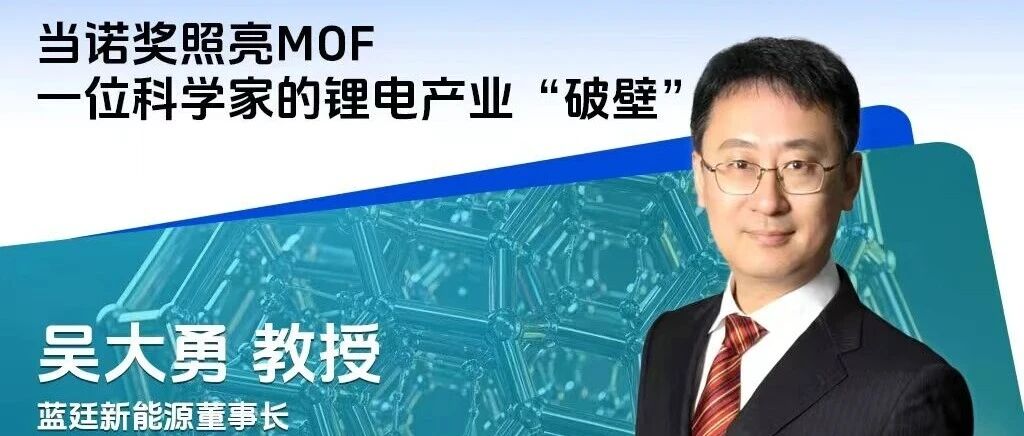
当诺奖照亮MOF:一位科学家的锂电产业“破壁”
高工锂电· 2026-01-08 10:47
Core Viewpoint - The article discusses the potential of Metal-Organic Frameworks (MOF) in breaking the performance boundaries of batteries, particularly in the lithium battery industry, following the recognition of MOF in the 2025 Nobel Prize in Chemistry [1][2]. Group 1: MOF's Industrial Relevance - MOF has gained attention in the lithium battery industry after years of research, with companies beginning to explore its industrial applications [2]. - The focus is on whether MOF can enhance battery performance and achieve stable production, rather than being a completely new material [2]. Group 2: MOF's Structural Advantages - MOF's unique properties, such as its electrical characteristics and designable structure, can influence electrolyte dissociation and lithium ion migration [4]. - The material's porous structure and functional group design provide a basis for capturing by-products and improving interface conditions [4]. Group 3: Research and Development Focus - The research has shifted from feasibility to practical questions regarding the effectiveness of specific MOF types, industrial synthesis capabilities, and cost and environmental control [5]. - MOF's design allows for precise control over its structure, which is crucial for enhancing battery performance [6]. Group 4: Application in Solid-State Batteries - Certain MOF materials, like UIO-66, maintain structural stability under high temperatures and pressures, making them suitable for solid-state battery applications [7]. - MOF can enhance lithium ion migration rates and improve overall battery performance, particularly in high-demand applications like drones and high-end electric tools [9]. Group 5: Competitive Landscape - The future competition in the MOF space will hinge on both the design of new structures and the efficiency of synthesis and production capabilities [11]. - The synthesis of MOF is not overly complex, but industrialization poses challenges that affect the consistency and electrochemical behavior of the final product [12]. Group 6: Product Development Strategy - The company is focusing on developing MOF-based functional materials for battery applications, particularly in enhancing ion migration and interface stability [16]. - The strategy includes creating a "super solid electrolyte" that combines high-performance solid electrolytes with MOF materials, aiming to differentiate from competitors in the lithium battery market [16].
2026年宏观经济与资产配置展望
Sou Hu Cai Jing· 2026-01-08 10:17
Group 1 - The core theme for China's economy in 2026 will focus on boosting domestic demand and emphasizing technology development, as external uncertainties persist due to factors like the US-China trade war [2][3][25] - The economic growth target for 2026 is set at approximately 5.0%, which aims to ensure over 10 million new jobs, balancing current needs with long-term goals [6][25] - The potential GDP growth rate is projected to decline to around 4.63% during the 15th Five-Year Plan period (2026-2030), influenced by structural constraints such as an aging population and diminishing capital returns [4][5][6] Group 2 - The government is expected to implement more proactive fiscal and monetary policies, maintaining a fiscal deficit of around 4% and a broad fiscal deficit rate potentially exceeding 10% [7][12] - To address insufficient effective demand, an annual injection of 4 trillion to 5 trillion yuan into the economy is necessary to maintain normal economic circulation [12][25] - The real estate market is anticipated to face significant challenges, with a projected need for approximately 4.58 trillion yuan to normalize unsold housing inventory [9][10] Group 3 - The focus on technology will include significant investments in AI infrastructure, semiconductor manufacturing, and high-end manufacturing sectors, with domestic companies expected to benefit from policy support [21][25] - The consumer market is expected to see a shift towards service consumption, with policies aimed at enhancing consumer environments and increasing household income [19][20] - Structural policies will be necessary to improve income distribution and enhance consumer spending, particularly targeting middle and low-income groups [14][17][25]

锂电大变局
虎嗅APP· 2026-01-08 09:39
Core Viewpoint - The article discusses the geopolitical implications of the U.S. interest in Venezuela's oil resources under the guise of anti-drug efforts, highlighting the potential shifts in global commodity pricing and supply chains due to U.S. actions in South America [4]. Group 1: Lithium Market Overview - South America, particularly the "Lithium Triangle" of Argentina, Chile, and Bolivia, holds over half of the world's lithium reserves, with Chile currently being the core producer [7]. - Argentina is expected to see a significant increase in lithium production, with projections of over 700,000 tons of lithium carbonate equivalent by 2030 [8]. - China's lithium carbonate imports heavily rely on South American salt lake lithium, with 49% of imports coming from Chile and 36% from Argentina as of November 2025 [10]. Group 2: Price Dynamics and Market Trends - The price of lithium carbonate has seen a remarkable recovery, stabilizing around 80,000 yuan/ton in October 2025 and peaking at over 120,000 yuan/ton by December, reflecting a doubling from mid-year lows [10]. - The supply-demand balance in the lithium market is tight, influenced by production cuts from upstream companies, which have led to a significant price increase [12]. - Major lithium producers have seen substantial stock price increases, with companies like Dazhong Mining and Cangge Mining rising over 200% in 2025 [12]. Group 3: Midstream and Downstream Implications - The demand for lithium battery materials is shifting from solely electric vehicles to a dual-driven model including energy storage, with energy storage demand growing rapidly [14]. - By the end of 2024, China's new energy storage capacity is projected to reach 84.53 million kilowatts, requiring a compound annual growth rate of 30% from 2025 to 2027 [17]. - The price of lithium hexafluorophosphate, a key component in battery electrolytes, surged to over 120,000 yuan/ton by November 2025, reflecting strong downstream demand [18]. Group 4: Competitive Landscape - Companies like CATL face challenges due to their lack of control over salt lake resources, which are crucial for lithium extraction, while competition intensifies with other players in the market [24]. - The relationship between battery manufacturers and automotive companies is becoming more complex, with competition heating up in the lithium iron phosphate segment [27]. - The upcoming changes in tax policies and subsidy structures for new energy vehicles are expected to impact sales and production strategies in the industry [28].