
饮料

Search documents
中国经济样本观察·企业样本篇|“小饮料”何以释放大能量——东鹏饮料转型记
Xin Hua She· 2025-12-29 15:40
Core Insights - The article highlights the transformation of Dongpeng Beverage from near bankruptcy to a leading player in the energy drink market, emphasizing innovation and consumer-centric strategies [2][3][22] Financial Performance - Dongpeng Beverage reported a revenue of 10.737 billion yuan and a net profit of 2.375 billion yuan for the first half of the year, marking year-on-year growth of 36.37% and 37.22% respectively, continuing a trend of double-digit growth for over six years [4] Product Innovation - The introduction of the dust-proof cap on Dongpeng's energy drink addresses consumer hygiene concerns and has contributed to its popularity, particularly among consumers with high physical demands [4][10] - Dongpeng has innovated its production processes, including the development of mid-temperature filling technology, which reduces costs and maintains product quality [12] Digital Transformation - The company has implemented a comprehensive digital marketing strategy using QR codes to connect with consumers, track product distribution, and manage inventory effectively [16][14] - Dongpeng's automated production facility can produce 1.5 billion bottles annually, showcasing its commitment to efficiency and scalability [13] Market Position and Strategy - Dongpeng's energy drink series generates over 13.3 billion yuan in annual revenue, positioning it among the top brands in China [5] - The company has established over 4.2 million sales points nationwide, reflecting its extensive distribution network [16] Employee Engagement and Innovation - Dongpeng encourages employee suggestions for product development and operational improvements, fostering a culture of innovation [21][19] - The company has received over 840 suggestions through its "small innovations, big improvements" platform, with many being implemented [21] Global Expansion - Dongpeng is actively pursuing international markets, aiming to establish a global presence similar to that of Coca-Cola [22]

财政部、税务总局最新公告!
Sou Hu Cai Jing· 2025-12-29 13:30
Core Points - The announcement outlines tax deductions for advertising and promotional expenses for specific industries, including cosmetics, pharmaceuticals, and non-alcoholic beverages, allowing deductions up to 30% of annual sales revenue [1] - Companies can share advertising and promotional expenses through agreements, allowing for flexibility in tax deductions between related entities [1] - Tobacco companies are explicitly prohibited from deducting advertising and promotional expenses from taxable income [1] - The new regulations will be effective from January 1, 2026, to December 31, 2027, replacing previous guidelines [1] Summary by Category Tax Deductions - Advertising and promotional expenses for cosmetics, pharmaceuticals, and non-alcoholic beverage companies can be deducted up to 30% of annual sales revenue [1] - Any expenses exceeding this limit can be carried forward to future tax years for deduction [1] Related Party Agreements - Related companies can enter into agreements to share advertising and promotional expenses, allowing one party to deduct expenses within the allowable limit while the other can also benefit from the shared expenses [1] Tobacco Industry - Tobacco companies are not allowed to deduct any advertising and promotional expenses when calculating taxable income [1] Implementation Timeline - The new tax deduction rules will be in effect from January 1, 2026, to December 31, 2027, and will replace the previous announcement from 2020 [1]

东鹏饮料:12月29日召开董事会会议
Mei Ri Jing Ji Xin Wen· 2025-12-29 10:57
Group 1 - The core viewpoint of the article is that Dongpeng Beverage has announced the convening of its 18th meeting of the third board of directors on December 29, 2025, to discuss the appointment of a board secretary and other documents [1] - For the year 2024, Dongpeng Beverage's revenue composition is reported to be 99.89% from the beverage industry and 0.11% from other businesses [1] - As of the time of reporting, Dongpeng Beverage has a market capitalization of 139.4 billion yuan [1]
两部门明确广告费和业务宣传费支出税前扣除有关事项
Xin Hua Wang· 2025-12-29 10:53
Core Viewpoint - The Ministry of Finance and the State Taxation Administration announced new tax deduction rules for advertising and business promotion expenses for certain industries, effective from January 1, 2026, to December 31, 2027 [1] Group 1: Tax Deduction Rules - Advertising and business promotion expenses for cosmetics manufacturing or sales, pharmaceutical manufacturing, and beverage manufacturing (excluding alcoholic beverages) can be deducted up to 30% of the annual sales revenue [1] - Any expenses exceeding the 30% threshold can be carried forward to future tax years for deduction [1] Group 2: Exclusions - Tobacco companies are explicitly prohibited from deducting any advertising and business promotion expenses when calculating taxable income [1]
香飘飘破局:多维调整寻求增长突破 竞争压力下面临多重不确定性
Xin Lang Cai Jing· 2025-12-29 10:34
Core Viewpoint - The company is attempting to break through growth bottlenecks through diversification adjustments amid pressure on traditional brewing business and intense competition in the ready-to-drink sector [1][2][8] Business Highlights: Multi-Dimensional Adjustments Seeking Growth Breakthrough - The company has entered the health functional beverage sector with the launch of its first product, "Ancient Five Red" warm milk tea, currently in trial sales [3][9] - A significant channel strategy adjustment has been made, moving away from expanding the number of outlets to focusing on existing terminal resources, with approximately 400,000 outlets in the brewing segment and 300,000 in the ready-to-drink segment [3][9] - The company is prioritizing collaboration with over 30,000 leading snack retail stores and has introduced customized products to meet channel demands, while also exploring the restaurant channel with tailored products based on Meco cup fruit tea [3][9] Overseas Expansion Plans - The company plans to establish a production base in Thailand, which will serve as a production center and export hub for cup beverages, targeting ASEAN countries [4][10] - The products will emphasize high-end cup fruit tea with 25% real fruit juice content, low sugar, zero fat, and premium transparent packaging, leveraging local tropical fruit resources to create a differentiated advantage [4][10] Challenges and Uncertainties in Transformation - The company's performance structure shows a significant reliance on the sales peak before the Spring Festival, with operational pressures for 2025 already evident [5][11] - For the first three quarters, the company reported revenue of 1.684 billion yuan, a year-on-year decline of 13.12%, and a net loss of 89 million yuan, a drastic drop of 603.07%, primarily due to declining sales in brewing products [5][11] - The ready-to-drink segment, seen as a growth engine, faces challenges due to a lack of product diversity and operational capacity, prompting a shift of resources towards Meco fruit tea [5][11] Key to Transformation: Converting Plans into Results - The company faces intensified market competition, including pressure from freshly brewed tea, brand competition in the ready-to-drink sector, and price wars in snack retail channels [6][12] - The year 2026 will be critical for validating the strategic transformation, with market feedback on health products, sales performance during the Spring Festival, progress on the Thailand base, and profitability from new channels being key determinants [6][12]

食品饮料周报(25年第48周):贵州茅台召开全国经销商联谊会,全面推进营销市场化转型-20251229
Guoxin Securities· 2025-12-29 09:30
Investment Rating - The investment rating for the food and beverage sector is "Outperform the Market" [4][5][10]. Core Views - The food and beverage sector is expected to perform well in 2026, with four main investment themes: cost advantages, efficiency improvements, innovation-driven growth, and opportunities for recovery from difficulties [3][10]. - The report highlights a differentiation in the fundamentals of various categories, with beverages outperforming food and alcoholic beverages [2][10]. Summary by Relevant Sections Market Overview - The food and beverage sector (A-shares and H-shares) experienced a cumulative decline of 0.46% this week, with A-shares down 0.57%, underperforming the CSI 300 by approximately 2.52 percentage points [1]. - The top gainers in the food and beverage sector this week included Anji Food (29.65%), Richen Co. (9.00%), and Ximai Food (8.54%) [1]. Alcoholic Beverages - The demand for liquor remains weak, with premium liquor companies focusing on supply-side optimization. The report recommends companies like Luzhou Laojiao, Shanxi Fenjiu, and Guizhou Moutai for their growth potential [2][10]. - The report notes that the white liquor sector is in a left-side layout phase, with positive signals expected from both supply and demand sides [10]. Beer - The beer industry is in a healthy inventory position, awaiting demand recovery. The report suggests actively investing in the beer sector, particularly in leading brands like Yanjing Beer [2][11]. Dairy Products - The dairy sector is experiencing a steady recovery in demand, with supply gradually clearing. The report recommends focusing on leading dairy companies like Yili for their valuation safety margins [2][13]. Snacks - The report emphasizes selecting strong alpha stocks in the snack sector, particularly those benefiting from the growth of konjac snacks, with leading companies like Weilong and Yanjinpuzi showing strong competitive advantages [2][11]. Investment Recommendations - The recommended investment portfolio includes Baba Foods, Dongpeng Beverage, Weilong, and Shanxi Fenjiu, with an average decline of 0.27% this week, underperforming the food and beverage sector by 2.21 percentage points [15].

两部门:烟草企业的烟草广告费和业务宣传费支出, 一律不得在计算应纳税所得额时扣除
Sou Hu Cai Jing· 2025-12-29 09:16
Core Viewpoint - The announcement by the Ministry of Finance and the State Administration of Taxation outlines new tax deduction rules for advertising and promotional expenses for specific industries, allowing deductions up to 30% of annual sales revenue, with provisions for carryover of excess amounts to future tax years [1][2]. Group 1: Tax Deduction Rules - Advertising and promotional expenses for cosmetics manufacturing or sales, pharmaceutical manufacturing, and beverage manufacturing (excluding alcoholic beverages) can be deducted up to 30% of the annual sales revenue [1]. - Any expenses exceeding the 30% threshold can be carried forward to subsequent tax years for deduction [1]. Group 2: Related Party Agreements - For related enterprises that have signed a cost-sharing agreement, advertising and promotional expenses that do not exceed the annual sales revenue deduction limit can be deducted by either party, or allocated to the other party as per the agreement [2]. - The receiving party can exclude the allocated advertising and promotional expenses from their own deduction limit calculations [2].
财政部、税务总局:烟草企业的烟草广告费和业务宣传费支出 一律不得在计算应纳税所得额时扣除
Sou Hu Cai Jing· 2025-12-29 09:16
Core Viewpoint - The announcement by the Ministry of Finance and the State Taxation Administration outlines new tax deduction rules for advertising and business promotion expenses for specific industries, effective from January 1, 2026, to December 31, 2027 [1] Group 1: Tax Deduction Rules - For cosmetics manufacturing or sales, pharmaceutical manufacturing, and beverage manufacturing (excluding alcoholic beverages), advertising and business promotion expenses are deductible up to 30% of the annual sales revenue; any excess can be carried forward to future tax years [1] - Related enterprises that sign a cost-sharing agreement can deduct advertising and business promotion expenses within the allowable limit, either in the entity that incurred the expense or allocated to another entity as per the agreement [1] - Tobacco enterprises are prohibited from deducting any advertising and business promotion expenses when calculating taxable income [1] Group 2: Implementation Period - The new rules will be in effect from January 1, 2026, to December 31, 2027, and will replace the previous announcement (Announcement No. 43 of 2020) starting from the same date [1]
两部门发布关于广告费和业务宣传费支出税前扣除有关事项的公告
Xin Hua Cai Jing· 2025-12-29 09:14
Core Viewpoint - The Ministry of Finance and the State Taxation Administration have announced new tax deduction policies for advertising and business promotion expenses for specific industries, effective from January 1, 2026, to December 31, 2027 [1]. Group 1: Tax Deduction Policies - Companies in the cosmetics manufacturing or sales, pharmaceutical manufacturing, and beverage manufacturing (excluding alcoholic beverages) sectors can deduct advertising and business promotion expenses that do not exceed 30% of their annual sales revenue [1]. - Any advertising and business promotion expenses exceeding the 30% threshold can be carried forward to future tax years for deduction [1]. - For related enterprises that have signed advertising and business promotion expense sharing agreements, expenses within the deduction limit can be allocated between the parties involved [1]. Group 2: Specific Exclusions - Tobacco companies are explicitly prohibited from deducting any advertising and business promotion expenses when calculating taxable income [1].
两部门:烟草企业的烟草广告费和业务宣传费支出,一律不得在计算应纳税所得额时扣除
Zheng Quan Shi Bao Wang· 2025-12-29 09:04
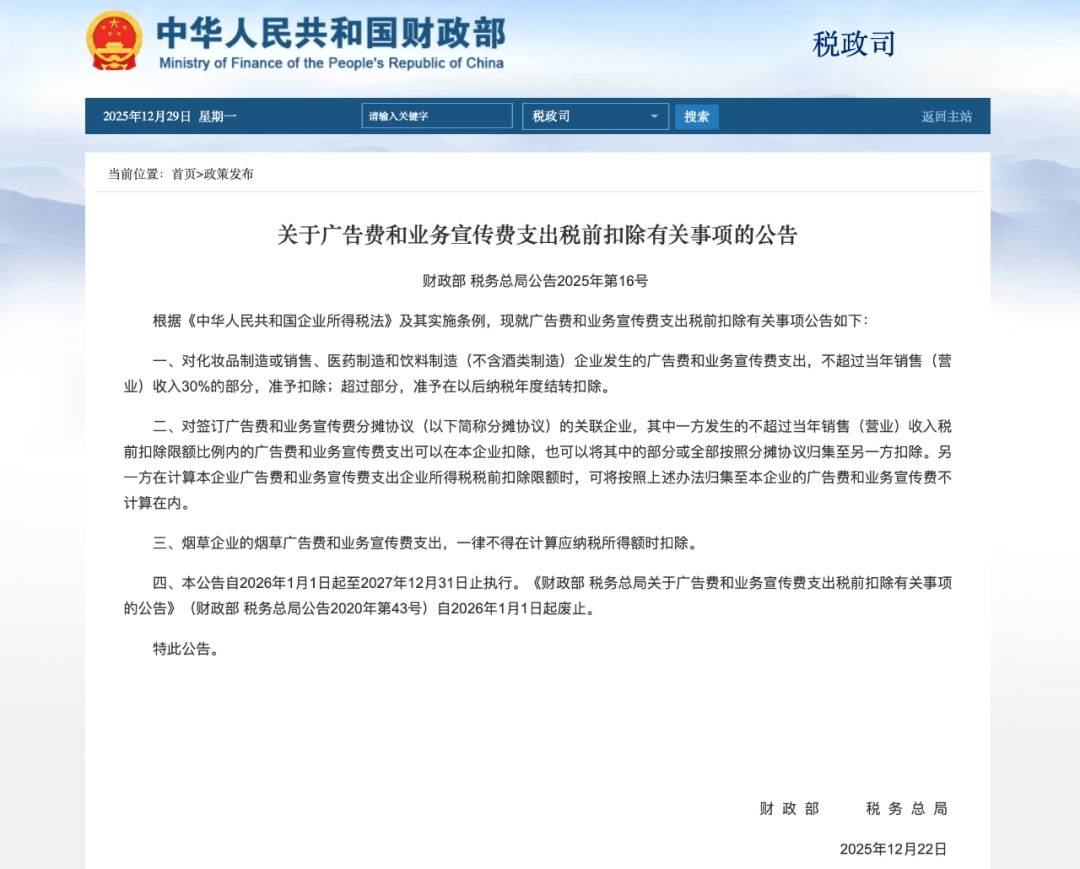
人民财讯12月29日电,财政部、税务总局发布关于广告费和业务宣传费支出税前扣除有关事项的公告, 一、对化妆品制造或销售、医药制造和饮料制造(不含酒类制造)企业发生的广告费和业务宣传费支出, 不超过当年销售(营业)收入30%的部分,准予扣除;超过部分,准予在以后纳税年度结转扣除。 三、烟草企业的烟草广告费和业务宣传费支出,一律不得在计算应纳税所得额时扣除。 四、本公告自2026年1月1日起至2027年12月31日止执行。《财政部税务总局关于广告费和业务宣传费支 出税前扣除有关事项的公告》(财政部税务总局公告2020年第43号)自2026年1月1日起废止。 二、对签订广告费和业务宣传费分摊协议(以下简称分摊协议)的关联企业,其中一方发生的不超过当年 销售(营业)收入税前扣除限额比例内的广告费和业务宣传费支出可以在本企业扣除,也可以将其中的部 分或全部按照分摊协议归集至另一方扣除。另一方在计算本企业广告费和业务宣传费支出企业所得税税 前扣除限额时,可将按照上述办法归集至本企业的广告费和业务宣传费不计算在内。 ...