
电动汽车

Search documents
电动汽车需求下降 特斯拉季度交付量降幅超预期
Xin Lang Cai Jing· 2026-01-02 14:22
特斯拉周五公布的第四季度交付量降幅大于预期,全年销量连续第二次下滑。在取消税收补贴后,该公 司难以提振对其电动汽车的需求。特斯拉表示,第四季度,它交付了418227辆汽车,低于去年同期的 495570辆。根据Visible Alpha的数据,分析师预计会交付434,487辆车。全年,特斯拉交付了164万辆汽 车,而2024年为179万辆。Visible Alpha调查的分析师此前预计,该公司全年交付量约为165万辆。这些 数据引发了人们的疑问:在连续两年销量下滑之后,特斯拉能否稳定其核心汽车业务,不过该公司正在 转向机器人和自动驾驶汽车等未来项目,以证明其高估值的合理性。分析人士表示,特斯拉在2025年面 临的最大压力来自北美和欧洲,那里的竞争加剧,而且该公司今年早些时候还面临着与马斯克的政治言 论有关的品牌负面反应。尽管汽车交付量有所下降,但特斯拉的股价在2025年仍上涨了约11.4%,这增 加了马斯克的财富。 ...

特斯拉四季度交付量418227 辆,同比下滑16%
Xin Lang Cai Jing· 2026-01-02 14:19
Core Insights - The article discusses Tesla's recent challenges, including a recall of nearly all vehicles sold in the U.S. due to defects in its autonomous driving system, and the impact of the termination of federal EV subsidies on sales [3][7][12]. Group 1: Vehicle Production and Delivery - Tesla reported a total delivery of 418,227 vehicles and a total production of 434,358 vehicles for Q4 2025, which was slightly below Wall Street's expectation of 426,000 deliveries [4][5]. - The Q4 2025 delivery volume represents a 16% year-over-year decline compared to Q4 2024, where deliveries were 495,570 vehicles [5]. - The company faces increasing competition from rivals such as BYD, Kia, Hyundai, and Volkswagen in the electric vehicle market [5][7]. Group 2: Battery Storage Business - Tesla's battery storage deployment reached a record high of 14.2 GWh in Q4, up from 12.5 GWh in the previous quarter, indicating strong performance in its energy storage segment [6]. Group 3: Market Challenges and Competition - The termination of the $7,500 federal EV subsidy on September 30, 2025, has negatively impacted Tesla's sales, as some sales were pulled forward to Q3 due to policy changes [12]. - Tesla's market share in Europe has significantly decreased, with a reported 39% drop in vehicle registrations from January to November 2025, while BYD's registrations surged by 240% in the same period [14]. - The competitive landscape has expanded to include new entrants like Xiaomi and Geely, intensifying the pressure on Tesla [16]. Group 4: Future Outlook and Strategic Focus - Analysts suggest that the launch of the more affordable Model Y Standard Edition in October may help Tesla regain market share in the coming quarters [15]. - Tesla's current messaging to investors emphasizes a vision of "sustainable prosperity," focusing on future innovations such as autonomous taxis and humanoid robots, rather than just vehicle sales [16].

马斯克为自动驾驶欢呼雀跃,特斯拉销量前景却愈发黯淡
Xin Lang Cai Jing· 2026-01-02 09:10
Core Viewpoint - Tesla's strong momentum at the end of last year is overshadowed by challenges in converting investor enthusiasm into actual vehicle sales, despite a significant rise in stock price driven by Elon Musk's optimistic vision for autonomous vehicles [1][7]. Group 1: Sales Performance - Tesla is expected to report fourth-quarter deliveries of approximately 440,900 vehicles, reflecting an 11% year-over-year decline, with internal forecasts suggesting a more pessimistic 15% drop [1][7]. - Analysts have drastically reduced their expectations for Tesla's 2026 delivery numbers from over 3 million vehicles two years ago to around 1.8 million vehicles [1][7]. - The company is facing a likely year-over-year decline in vehicle sales for the second consecutive year, with challenges anticipated in 2026 due to the termination of federal tax credits for electric vehicle purchases [6][13]. Group 2: Investor Sentiment - Investors are increasingly focused on Tesla's long-term growth prospects rather than short-term performance, although concerns about financial challenges are growing [1][7]. - The stock price saw a significant rebound after Musk shifted focus back to core objectives, including the development of a fully autonomous ride-hailing service [3][10]. Group 3: Consumer Concerns - Despite investor excitement about Tesla's robotaxi prospects, consumer interest remains cautious, particularly regarding the fully autonomous driving system (FSD), which still requires human oversight [5][12]. - Tesla faces stiff competition in the Chinese electric vehicle market, where local companies like BYD and Xiaomi are gaining market share with similar features as standard offerings [5][12]. Group 4: Future Challenges - The end of federal support for electric vehicle purchases may lead to several difficult quarters for Tesla, as warned by Musk [6][13]. - The company is also navigating regulatory scrutiny related to its autonomous driving claims, which have led to legal challenges and temporary sales license suspensions in California [5][12]. - Analysts predict that Tesla's electric vehicle business may see flat growth or only a 5% increase in sales next year, emphasizing the need for stability in the automotive segment to meet investor expectations [6][13].
中国的反击打到脸上,法国知道疼了,沉默三天还是忍不住来求和
Sou Hu Cai Jing· 2026-01-02 04:13
Group 1 - The EU has decided to impose tariffs on Chinese electric vehicles, aiming to weaken their competitive edge in the European market [3][5] - The EU's justification for the tariffs is based on the belief that Chinese EV companies benefit from substantial government subsidies, creating an unfair competitive advantage [5] - In response, China has targeted the French brandy industry with restrictive measures, including increased tariffs and import inspections, significantly impacting the sector [7][20] Group 2 - French cognac producers are experiencing a sharp decline in orders and prices due to the trade tensions, leading to an uncertain outlook for the industry [9][20] - The French government is actively seeking to mitigate the situation, recognizing the critical importance of the Chinese market for its brandy exports [11] - The trade conflict highlights the complex economic relationship between China and the EU, with intertwined interests that can lead to significant repercussions from unilateral actions [13][14] Group 3 - The EU's tariff policy is viewed as a manifestation of trade protectionism, raising questions about the balance between protecting domestic industries and fostering fair competition in a globalized economy [15] - The trade friction may serve as a turning point in China-EU economic relations, with both sides needing to focus on equality and mutual benefit to avoid unnecessary conflicts [22][24] - The ongoing trade war could ultimately harm ordinary consumers and businesses, emphasizing the need for dialogue and cooperation to resolve differences and achieve win-win outcomes [26]

港股电动汽车股多数上涨 得益于12月份交车表现
Xin Lang Cai Jing· 2026-01-02 02:32
蔚来汽车和零跑汽车等中国电动汽车股大多攀升,12月份交付量同比强劲增长。比亚迪股价在香港市场 也上涨超过2%,投资者仍关注其乐观的海外销售势头。个股走势:蔚来股价上涨 1.7%,小米上涨 2.7%,零跑上涨 2.8%,比亚迪上涨 2.3%,理想上涨 6%,小鹏上涨 1.6%小米公司公告显示,其 12 月 汽车交付量突破 5 万辆。花旗集团分析师在研报中指出,这一成绩大概率达到了投资者的预期。花旗集 团预计,小米 2025 财年电动汽车交付量或将突破 41 万辆,超过其最新设定的 2025 年 40 万辆交付目 标。 ...
日经:比亚迪2025年电动车销量将首超特斯拉 成全球第一
Feng Huang Wang· 2026-01-02 00:56
Group 1 - BYD is expected to surpass Tesla in annual sales for the first time, becoming the world's largest electric vehicle seller [1] - BYD's pure electric vehicle sales are projected to grow by 28% year-on-year in 2025, reaching 2.25 million units, while Tesla's sales are estimated to decline by 8% to 1.64 million units [1][2] - In 2024, Tesla narrowly maintained its position as the global sales leader over BYD by just over 20,000 units [1] Group 2 - BYD's total vehicle sales are expected to increase by 8% year-on-year in 2025, reaching 4.6 million units, marking the fifth consecutive year of growth [2] - The company has seen a significant increase in overseas sales, driven by strong performance in the European market and expansion in Latin America and Southeast Asia [2] - BYD's factory in Brazil is set to begin production in 2025, and its Thailand factory will supply the local market and export to Europe [2] Group 3 - In February, BYD stimulated consumer demand by offering advanced driver-assistance features for free on over 20 models [3] - Despite ongoing growth, BYD faced challenges with a year-on-year sales decline in September, marking the first drop in 19 months, and a further 18% decline in December [3] - Increased competition from traditional rivals like Geely and new entrants like Xiaomi is intensifying in the Chinese market, potentially impacting BYD's sales [3]


马斯克“自动驾驶狂热”难掩销量寒冬,特斯拉2026年面临更严峻考验
Zhi Tong Cai Jing· 2026-01-02 00:17
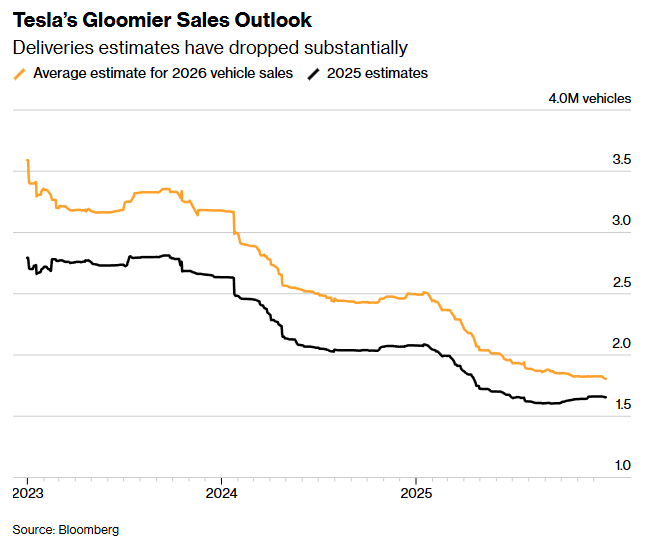
Core Viewpoint - Tesla's stock surged over 11% by the end of 2025, driven by investor confidence in Elon Musk's vision for autonomous vehicles, despite disappointing sales figures and a projected decline in deliveries [1][4]. Group 1: Sales Performance - Tesla is expected to announce approximately 440,900 vehicle deliveries for Q4, representing an 11% year-over-year decline, with a more pessimistic forecast suggesting a 15% drop [1]. - Analysts have drastically reduced their 2026 delivery forecasts for Tesla from over 3 million vehicles two years ago to around 1.8 million [1]. Group 2: Investor Sentiment - Investors are focused on Tesla's long-term prospects rather than short-term performance, although concerns about financial headwinds are growing [2]. - Despite the challenges, some investors remain optimistic that maintaining stability in the automotive business could satisfy market expectations [10]. Group 3: Market Challenges - Tesla's sales have been impacted by production line upgrades for the Model Y and backlash against Musk's political actions [4]. - The cessation of federal tax credits for electric vehicle purchases in the U.S. is expected to create further challenges for Tesla in 2026 [10]. Group 4: Competition - Competitors like BYD are outpacing Tesla in sales, particularly in China, where Tesla's Full Self-Driving (FSD) system has not gained regulatory approval [6]. - Analysts predict that BYD's electric vehicle sales will surpass Tesla's globally for the fifth consecutive quarter [6].
马斯克“自动驾驶狂热”难掩销量寒冬!特斯拉2026年面临更严峻考验
Zhi Tong Cai Jing· 2026-01-02 00:05
Core Insights - Tesla's stock surged over 11% by the end of 2025, driven by investor confidence in Elon Musk's vision for autonomous vehicles and advancements in AI and robotics [1] - Despite record delivery numbers in Q3, Tesla's overall vehicle sales in the past six months are likely lower than the same period last year, indicating a disconnect between investor sentiment and consumer demand [1][6] - Analysts have significantly downgraded their forecasts for Tesla's vehicle deliveries in 2026, with estimates dropping from over 3 million to around 1.8 million [1][2] Group 1: Sales Performance - Tesla is expected to announce approximately 440,900 vehicle deliveries for Q4, reflecting an 11% year-over-year decline, with some estimates predicting a 15% drop [1] - The company's sales outlook for 2025 has been bleak, with early-year performance hampered by factory upgrades and external political backlash against Musk [4][10] - Analysts predict that Tesla will face further challenges in 2026, particularly after the U.S. ceased federal tax credits for electric vehicle purchases [10] Group 2: Investor Sentiment - Investors are focused on Tesla's long-term vision rather than short-term performance, but concerns about financial headwinds are growing [2] - Musk's efforts to pivot towards a long-term goal of launching a fully autonomous ride-hailing service have helped stabilize stock prices after a significant drop earlier in the year [5] - The introduction of a new compensation plan for Musk, tied to ambitious delivery milestones, has contributed to a rebound in Tesla's stock price [5] Group 3: Competitive Landscape - Tesla's attempts to differentiate itself in the crowded EV market through advanced driver-assistance features have not resonated with consumers as expected, especially in China [6] - Competitors like BYD are outperforming Tesla in sales, with analysts forecasting that BYD will surpass Tesla's global electric vehicle sales for the fifth consecutive quarter [6][9] - The withdrawal of U.S. policy support for electric vehicles may create opportunities for Tesla as other manufacturers scale back their EV investments [10]
马斯克“自动驾驶狂热”难掩销量寒冬!特斯拉(TSLA.US)2026年面临更严峻考验
智通财经网· 2026-01-02 00:05
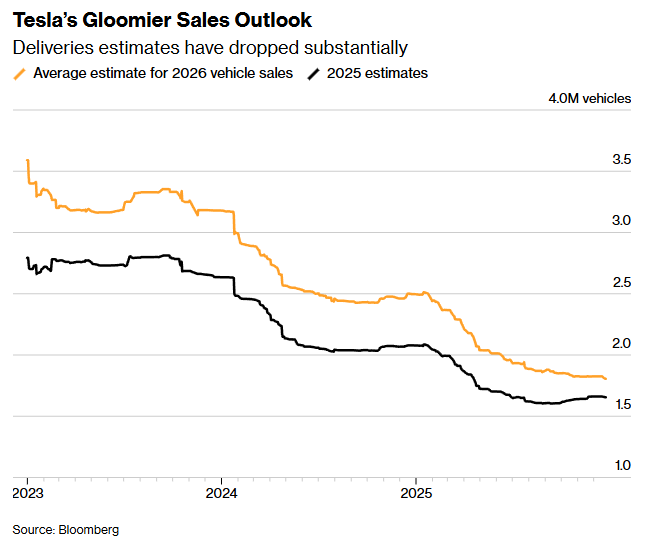
Core Insights - Tesla's stock surged over 11% by the end of 2025, driven by investor confidence in Elon Musk's vision for autonomous vehicles and advancements in AI and robotics [1] - Despite record delivery numbers in Q3, Tesla's overall vehicle sales in the past six months are likely lower than the same period last year, indicating a disconnect between investor enthusiasm and consumer demand [1] - Analysts have significantly downgraded their expectations for Tesla's vehicle deliveries in 2026, with projections dropping from over 3 million to approximately 1.8 million [1][2] Sales Outlook - Tesla's sales performance in early 2025 was poor, partly due to production line upgrades for the Model Y and backlash against Musk's political actions [4] - The company is expected to report around 440,900 vehicle deliveries for Q4, a year-over-year decline of 11%, with some estimates suggesting a 15% drop [1][4] - The outlook for Tesla's sales remains bleak, with analysts predicting a second consecutive year of declining sales in 2025 [10] Investor Sentiment - Investors are focused on Tesla's long-term potential rather than short-term performance, but concerns about financial headwinds are growing [2] - Musk's efforts to pivot towards a long-term goal of launching a fully autonomous ride-hailing service have helped stabilize stock prices after a significant drop earlier in the year [5] - Despite investor excitement about autonomous taxi services, consumer skepticism remains a challenge, particularly regarding the capabilities of Tesla's Full Self-Driving feature [5][6] Competitive Landscape - Tesla faces increasing competition in the electric vehicle market, particularly from companies like BYD and Xiaomi, which offer similar driving assistance features as standard [6] - Analysts expect BYD's electric vehicle sales to surpass Tesla's globally for the fifth consecutive quarter, highlighting the competitive pressures Tesla is under [6][9] - The cessation of federal tax credits for electric vehicle purchases in the U.S. may pose additional challenges for Tesla, although some see this as an opportunity due to reduced competition from other manufacturers [10]
1月起一批重要国家标准实施
Xin Lang Cai Jing· 2026-01-01 17:42
Group 1: National Standards Implementation - A set of important national standards will be implemented starting January 2026, focusing on children's furniture safety, aging-friendly products, electric vehicle energy consumption limits, and automotive maintenance and diagnostics [1][2][3] - The mandatory national standard for children's furniture safety specifies requirements for materials, structure, flame resistance, electrical safety, harmful substance limits, and warning labels for products used by children aged 0 to 14 [1] - The aging-friendly product standards include general requirements for fitness equipment and specific requirements for various types of equipment, as well as standards for commodes [1][2] Group 2: Electric Vehicle Standards - The "Electric Vehicle Energy Consumption Limit" is the world's first mandatory standard, setting energy consumption limits based on vehicle weight and usage characteristics, with a requirement that electric vehicles weighing around 2 tons must not exceed 15.1 kWh per 100 km [2] - The implementation of this standard is expected to improve the average range of electric vehicles by approximately 7% without changing battery capacity, enhancing the driving experience [2] Group 3: Automotive Maintenance and Safety - The "Automotive Maintenance, Detection, and Diagnosis Technical Specification" establishes guidelines for maintenance levels, cycles, operational requirements, and quality assurance to ensure vehicle safety [3] - New standards for the disposal of photovoltaic components and information security management systems are also introduced to support the safe development of emerging industries and ensure disaster recovery capabilities [3]