资产管理

Search documents
Is Blackstone stock at risk after Trump's residential housing threat?
Invezz· 2026-01-08 12:13
Core Viewpoint - Blackstone's stock price experienced a significant decline following a warning from Donald Trump regarding the prohibition of institutional investors from purchasing residential properties, dropping to a low of $147 [1] Company Summary - Blackstone's stock price fell sharply as a direct reaction to the political statement made by Donald Trump, indicating potential regulatory changes that could impact institutional investment in the residential real estate market [1]



美国对委动武后投资者看涨拉美市场
Xin Lang Cai Jing· 2026-01-08 09:24
作者:罗德里戈・坎波斯 利比・乔治 2026 年是拉美地区的关键选举年,美国总统唐纳德・特朗普在委内瑞拉与阿根廷接连采取强硬举措, 进一步助推拉美地区整体政治风向右转。投资者预期该地区将推行利好市场的改革政策,外资涌入拉美 市场的意愿显著升温。 上周末美国推动罢免委内瑞拉总统尼古拉斯・马杜罗后,委内瑞拉违约债券价格暴涨。而特朗普政府去 年的另一项政治豪赌也已见成效 —— 当时美方为拉美意识形态盟友、阿根廷总统哈维尔・米莱提供了 高达 400 亿美元的财政支持,随后米莱所在政党在关键的中期选举中表现亮眼。 放在以往,特朗普这种强硬的外部干预手段很可能引发拉美地区强烈的反制声浪,谴责其粗暴干涉他国 内政。但如今,随着拉美地区政治整体向右偏转,虽然并非所有国家都对美方举措表示欢迎,外界的反 应却相对温和。投资者认为,政策转向利好市场将推动拉美金融资产价值走高。 格雷梅西资产管理公司首席投资官兼管理合伙人罗伯特・柯尼希斯伯格表示:"从历史经验来看,拉美 地区的发展趋势往往具有联动效应,呈现出齐头并进的浪潮式特征。当前拉美地区的政治风向,显然正 从左翼全面转向右翼。" 他指出,正是基于这种判断,投资者更愿意增加对拉美市 ...

20%上涨空间可期!高盛:TPG(TPG.US)借力保险巨头,以低成本模式构建长期盈利护城河
智通财经网· 2026-01-08 09:09
Core Viewpoint - Goldman Sachs has issued a report on TPG Inc. focusing on its long-term strategic partnership with Jackson Financial, which is expected to provide stable asset management and fee income for TPG, laying a solid foundation for future growth [1] Group 1: Partnership Details - TPG will manage an asset portfolio valued at $12 billion from Jackson Financial, with a diverse investment scope including investment-grade bonds and direct lending, expected to grow to $20 billion over the next five years [1] - In return, Jackson will receive $150 million in TPG stock and TPG will invest $500 million into Jackson [1] Group 2: Financial Projections - By 2028, TPG's free cash flow per share is projected to grow by 1.2% to 2.1%, while diluted earnings per share may see a slight decline of -0.2% to an increase of 1% [2] - The net present value (NPV) from the $20 billion asset is estimated to positively impact TPG's diluted earnings per share by approximately 2% to 3% in 2027 [2] Group 3: Fee Structure and Profitability - TPG will charge at least 50 basis points in management fees from Jackson's assets, with actual rates expected to range between 60 to 75 basis points as direct lending strategies increase [2] - TPG's incremental free cash flow margin is anticipated to remain high at 85% to 100%, benefiting from limited capital investment requirements [2] Group 4: Strategic Alignment and Future Plans - The partnership aligns with TPG's strategy of maintaining a light balance sheet and provides a long-term stable capital source [2] - TPG plans to raise approximately $20 billion in credit funding by 2025, with $8 billion expected in the fourth quarter, further enhancing its credit management fee income [2] Group 5: Investment Outlook - Goldman Sachs maintains a "Buy" rating for TPG with a 12-month target price of $80, based on a comprehensive valuation of TPG's cash flows [3] - The partnership with Jackson Financial is viewed as a significant opportunity for TPG to generate stable income and enhance overall profitability and market competitiveness [3]

思博瑞资管:全球经济将持续增长 未来一年挑战与机遇并存
Zhi Tong Cai Jing· 2026-01-08 09:05
Group 1 - The core viewpoint is that despite challenges in the coming year, opportunities are expected, with a strong belief in continued global economic growth [1] - The U.S. economy is projected to grow at a rate of 2% to 3% due to the effects of interest rate cuts by 2026, supported by low mortgage rates and stable real income [1] - Outside the U.S., economic growth is expected to slightly improve due to a stable job market and improved tariff conditions, with Germany and China implementing significant development plans and stimulus measures [1] Group 2 - U.S. inflation is expected to stabilize by 2026, but reaching the Federal Reserve's 2% target may take longer due to the need for service prices and wages to weaken further [2] - The inflation situation in most countries outside the U.S. has reached targets, allowing central banks to implement more stimulus measures, with Eurozone inflation expected to drop below 2% [2] - The Federal Reserve's interest rate decisions will be data-driven, with potential fewer rate cuts in 2026 due to strong economic growth, necessitating a careful balance between supporting employment and stabilizing prices [2] Group 3 - Geopolitical risks are expected to remain high in 2026, with ongoing conflicts such as the Russia-Ukraine situation and U.S.-China strategic competition impacting global trade flows [3] - The U.S. has relied more on fiscal policy than monetary policy for economic support since the COVID-19 pandemic, which may lead to long-term inflation pressures and increased financing difficulties for the government [3] - The independence of central banks is crucial, as any signals weakening inflation targets in pursuit of higher growth could heighten investor uncertainty and increase risk premiums [3]
【环球财经】利空消息打压 纽约股市三大股指7日涨跌不一
Xin Hua Cai Jing· 2026-01-08 05:43
新华财经纽约1月7日电(记者刘亚南)受利空消息打压和投资者选择获利了结,纽约股市三大股指7日 开盘时涨跌不一,早盘走势分化,午后整体走弱,收盘时纽约股市三大股指涨跌不一,标普500指数和 道指收盘中均创下历史新高。 美国供应管理学会当日上午发布的数据显示,美国2025年12月服务业景气指数为54.4,高于市场预期的 52.2和前一个月的52.6。 美国投资公司Globalt Investments的高级投资组合经理基思·布坎南(Keith Buchanan)表示,从股市角度 看,南美发生的事情尚未改变美国增长的前景。在评估日益增加整体地缘政治风险方面存在一些自满, 但自己不认为委内瑞拉发生的事情引起改变。只是感觉仍旧处于紧张局势之中。 布坎南说,油价没有出现大幅波动显示出市场认为供需远远没有达到紧张程度。有显著的供应过剩风 险。 美国总统特朗普当日表示,在防务公司解决自己对行业的关切之前,自己不会允许发放红利或回购股 票。他还称,正在立即采取行动禁止大型机构投资者购买更多单户住宅,以应对很多人买不起住房的问 题。 特朗普这一表态刺激相关股票价格显著走低,黑石集团(Blackstone Inc.)股价当日盘中跌 ...
资管产品信息披露更加规范透明
Jin Rong Shi Bao· 2026-01-08 01:03
Core Viewpoint - The Financial Regulatory Administration has issued the "Management Measures for Information Disclosure of Asset Management Products by Banking and Insurance Institutions," marking a significant institutional innovation in the information disclosure of asset management products, aiming to protect investors' rights and enhance transparency in the industry [1][2]. Group 1: Regulatory Framework - The new measures unify the information disclosure standards for asset management trust products, wealth management products, and insurance asset management products, addressing the lack of a dedicated regulatory framework and inconsistent standards across different products [2][3]. - The measures will take effect on September 1, 2026, allowing an 8-month transition period for institutions to adjust their product documentation and systems [1]. Group 2: Disclosure Requirements - The measures differentiate between public and private products, imposing stricter disclosure requirements on public products to enhance transparency while allowing private products to respect contractual agreements [3]. - A "1+3" disclosure rule system will be established, encouraging the formulation of self-regulatory norms tailored to the characteristics of each product type [3]. Group 3: Lifecycle Disclosure - The measures mandate comprehensive disclosure throughout the entire lifecycle of asset management products, including fundraising, ongoing management, and termination phases, to ensure transparency and reduce information asymmetry [4]. Group 4: Dual Channel Disclosure - Public products are required to disclose information through at least one unified industry channel and, as per investor agreements, through mainstream financial media or other channels, enhancing information accessibility and reducing costs for investors [5][6]. Group 5: Performance Benchmark Regulations - The measures restrict adjustments to performance benchmarks, requiring product managers to adhere to internal approval processes for any necessary changes and to disclose historical adjustments in regular reports [7][8]. - This regulation aims to stabilize performance benchmarks as reliable reference points for investors, promoting rational decision-making and accountability among asset management institutions [7][8].
业务丛谈丨将严的要求贯穿作风建设始终
Zhong Yang Ji Wei Guo Jia Jian Wei Wang Zhan· 2026-01-07 23:39
坚持系统施治,构建作风建设方法路径。作风建设是一项系统工程,必须运用系统观念,坚持标本兼 治、综合施策,构建起全链条、闭环式的工作方法。打好"纠治—剖析—治理"组合拳,在精准纠治违规 吃喝、违规收送礼品礼金等顽瘴痼疾的同时,建立"四风"问题背后权力运行风险剖析机制,对查处的每 一起作风问题,都深入分析其滋生的土壤条件、关联的业务流程和存在的制度漏洞,实现从"查处一件 事"到"规范一类事"的升级。完善风腐同查工作机制,既"由风查腐",在纠治"四风"时注重发现其背后 可能存在的腐败线索;又"由腐纠风",在查办腐败案件时必查审查调查对象本人及涉及其他公职人员 的"四风"问题线索,着力斩断风腐勾连链条。构建"智慧监督"新格局,积极运用大数据、信息化手段为 作风建设赋能增效,整合业务、财会、审计等数据资源,构建作风建设线上监督平台,对公务支出、业 务接待、权力运行关键环节进行动态监测和智能预警,通过数据建模精准发现"快递送礼""电子红包"等 隐形变异问题,推动监督关口前移,实现从"被动查"到"主动防"的转变。健全"制度+文化"双支撑,坚 持"当下改"与"长久立"相结合,针对反复出现的作风问题和监督检查中发现的制度漏洞, ...
万亿外资巨头,加仓!
Zhong Guo Ji Jin Bao· 2026-01-07 13:52
Group 1 - BlackRock increased its holdings in Haier Smart Home, WuXi Biologics, Midea Group, and Bank of China on January 2, 2026 [1][3] - The shareholding percentage of WuXi Biologics increased from 5.32% to 6.14%, Midea Group from 5.15% to 6.75%, Bank of China from 5.98% to 6.11%, and Haier Smart Home from 7.72% to 8.34% [3] - Previously, on December 29, 2025, BlackRock had reduced its holdings in Midea Group from 7.03% to 5.16% and in Bank of China from 6.07% [3] Group 2 - Goldman Sachs released a report predicting that China's GDP growth in 2026 will exceed market expectations, recommending an overweight position in Chinese stocks [4][5] - The report anticipates a continuation of the bull market in Chinese stocks, with annual growth rates of 15% to 20% in 2026 and 2027, supported by earnings growth and valuation re-rating [5] - UBS Wealth Management expressed optimism for the Chinese market, highlighting advanced manufacturing and technological self-reliance as new growth engines, with a projected 37% earnings growth for the Hang Seng Tech Index in 2026 [5]



证监会宣布,这两家被核准!
Zhong Guo Ji Jin Bao· 2026-01-07 11:43
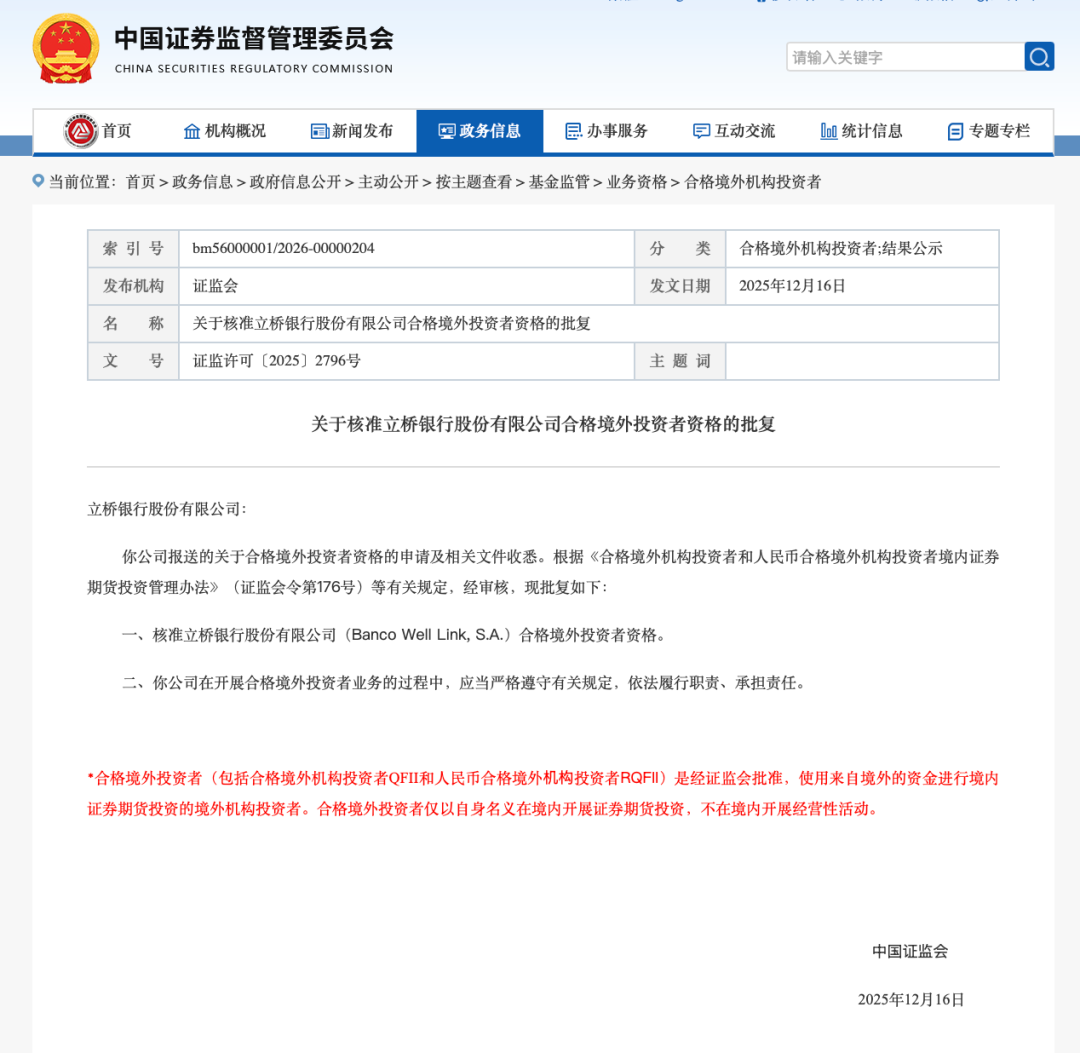
Core Viewpoint - The China Securities Regulatory Commission (CSRC) has approved the Qualified Foreign Institutional Investor (QFII) qualifications for Banco Well Link, S.A. and Citadel Advisors Singapore Pte. Limited, allowing them to engage in domestic securities and futures investments using foreign funds [1][4]. Group 1: Company Information - Citadel Advisors Singapore Pte. Limited is a subsidiary of the top U.S. hedge fund group Citadel LLC, established in 2020, focusing on the Asia-Pacific market and providing multi-strategy hedge fund management, alternative investments, and cross-border asset allocation services [7]. - Banco Well Link, S.A. is a fully licensed commercial bank based in Macau, established in 1996, with total assets amounting to 33.2 billion Macau Patacas as of June 2025 [7]. Group 2: Regulatory Framework - The QFII system, which includes both QFII and Renminbi Qualified Foreign Institutional Investor (RQFII), is a key mechanism for foreign institutional investors to invest in China's capital markets, having maintained stable operations since its inception [8]. - The CSRC aims to enhance the attractiveness of the QFII system for long-term foreign capital through a two-year reform plan, promoting a new open structure that balances onshore and offshore channels [8].
证监会宣布,这两家被核准!
中国基金报· 2026-01-07 11:37
Core Viewpoint - The China Securities Regulatory Commission (CSRC) has approved Banco Well Link, S.A. and Citadel Advisors Singapore Pte. Limited as Qualified Foreign Institutional Investors (QFII) as of December 2025, enhancing foreign investment opportunities in China's capital markets [2][3]. Group 1: Company Profiles - Citadel Advisors Singapore Pte. Limited is a subsidiary of the top U.S. hedge fund group Citadel LLC, established in 2020, focusing on multi-strategy hedge fund management and alternative investments in the Asia-Pacific market [3]. - Banco Well Link, S.A., established in 1996, is a fully licensed commercial bank in Macau, with total assets amounting to 33.2 billion Macanese Patacas as of June 2025 [3]. Group 2: Regulatory Framework - The QFII system allows approved foreign institutional investors to use overseas funds for domestic securities and futures investments, without engaging in operational activities within China [3]. - The QFII system is one of the earliest open systems in China's capital market, maintaining stable operations and serving as a comprehensive asset allocation channel for foreign investors [3]. Group 3: Future Developments - In October 2025, the CSRC issued a work plan aimed at optimizing the QFII system over the next two years, enhancing its attractiveness to long-term foreign capital [4][5]. - The CSRC plans to implement various open optimization measures to create a balanced development between onshore and offshore channels, as well as between allocation-type and trading-type funds [5].