
银行理财

Search documents
这类产品以4.63%的收益率领跑!上半年理财产品月度榜单解析
Zhong Guo Zheng Quan Bao· 2025-07-28 23:57
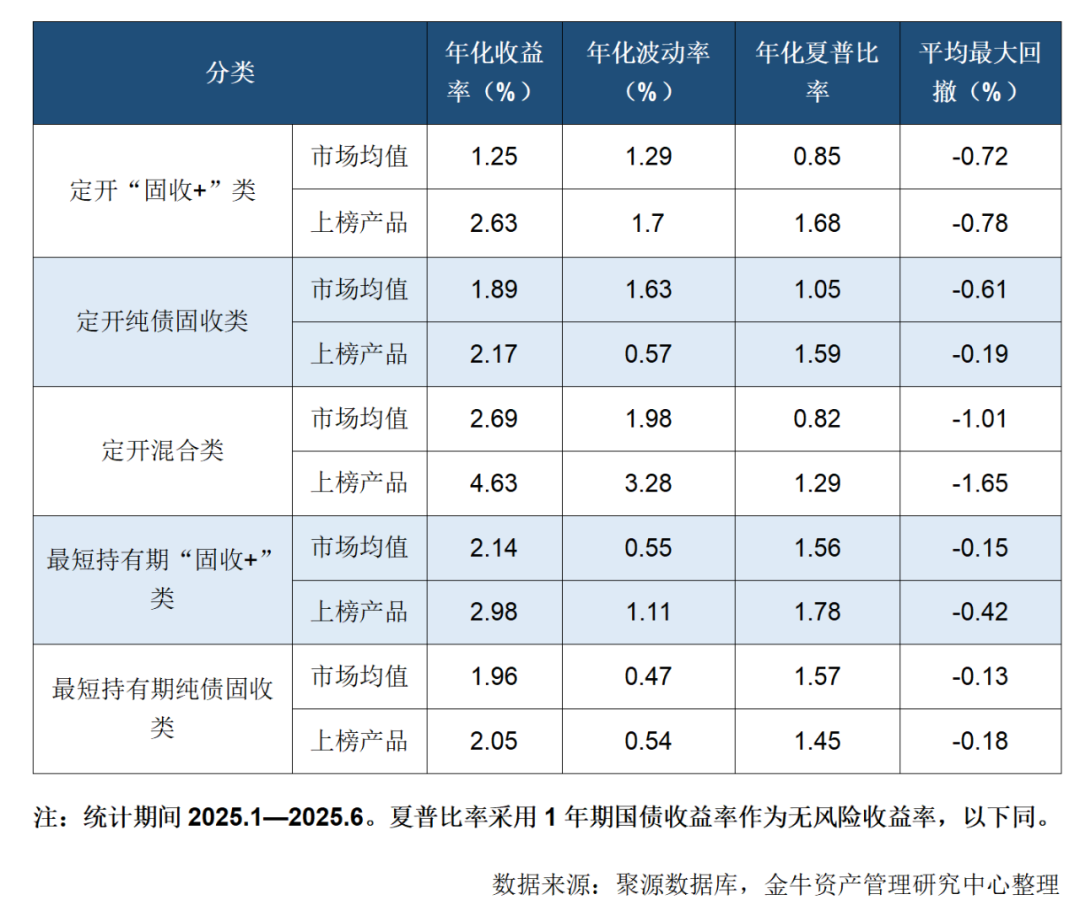
Core Viewpoint - The performance of bank wealth management products has improved in the first half of 2025, with a focus on quality over scale, leading to optimized product structures and a decrease in the central levels of returns and risks [1] Group 1: Product Performance - The monthly ranking of wealth management products shows significant cumulative excess returns, with fixed-open mixed products achieving the highest annualized return of 4.63% [1][4] - Fixed-open "bond+" products and shortest holding period "bond+" products demonstrated excellent risk-adjusted returns [1] - The average annualized return for fixed-open "bond+" products was 2.63%, significantly higher than the market average of 1.25% [4] - Fixed-open pure bond products had an annualized return of 2.17%, outperforming the market average of 1.89% [5] - The annualized return for fixed-open mixed products was 4.63%, with a volatility of 3.28%, indicating a strong ability to balance risk and return [6] Group 2: Product Categories and Metrics - The total number of fixed-open "bond+" products was 4,400, with a total scale of 20.5 trillion yuan [2] - The annualized Sharpe ratio for fixed-open "bond+" products was 1.68, compared to the market average of 0.85 [4] - The annualized return for the shortest holding period "bond+" products was 2.98%, with a Sharpe ratio of 1.78, both exceeding market averages [6] Group 3: Institutional Performance - Systemically important banks and their wealth management subsidiaries led in product scale and quantity, with 招银理财 achieving the highest number of product rankings at 9 times [7] - In city commercial banks, 杭银理财 ranked first with 10 product rankings, while in rural financial institutions, 渝农商理财 led with 12 rankings [7]

纯固收类银行理财产品收益率回调 业内认为债市调整空间有限
Zheng Quan Ri Bao· 2025-07-28 16:52
Core Viewpoint - The bond market is experiencing adjustments due to the "see-saw effect" triggered by rising stock markets, but a significant decline in the bond market is unlikely in the second half of the year [1][2][3] Group 1: Market Performance - As of July 28, the average annualized yield of wealth management products was 3%, a decrease of 42 basis points from the end of June; pure fixed-income products saw a more pronounced decline, with yields dropping to 2.23%, down 54 basis points [2] - The 10-year government bond yield increased from 1.65% at the beginning of July to 1.74% by July 25, leading to a decline in bond prices and consequently affecting the net value of wealth management products [2][3] Group 2: Future Outlook - Analysts believe that the likelihood of a significant decline in the bond market is low due to the continuation of a moderately loose monetary policy and the need for low interest rates to support the economy [2][3] - The current monetary policy environment lacks strong drivers for a substantial drop in bond prices, despite factors that may increase volatility [2][3] Group 3: Investment Strategies - Wealth management companies are advised to upgrade their product systems and adopt "fixed income plus" strategies to enhance yields by including equity assets [1][4] - To stabilize investor sentiment and avoid irrational large redemptions, several wealth management subsidiaries have communicated that the current bond market adjustment is within a reasonable range and do not warrant excessive panic [3][4] - Recommendations for investors include shortening investment durations, diversifying product types, and increasing allocations to cash management and mixed-asset products to mitigate risks associated with pure fixed-income investments [4]
2025年理财半年报点评:规模扩张下的结构转型
ZHONGTAI SECURITIES· 2025-07-28 14:03
Report Title - "Structural Transformation under the Expansion of Wealth Management Scale - Review of the Semi - annual Report of Wealth Management in 2025" [1] Core Viewpoints - In the context of falling deposit rates and deposit migration, the wealth management market has steadily expanded. As of the end of June 2025, there were 194 bank institutions and 32 wealth management companies with outstanding wealth management products, with a total of 41,800 products, a 3.78% increase from the beginning of the year and a 4.54% increase year - on - year. The outstanding scale reached 30.67 trillion yuan, a 2.38% increase from the beginning of the year and a 7.53% increase year - on - year. The wealth management company's outstanding scale accounted for 89.61% of the total market, with a year - on - year growth of 12.98%, while the bank institution's outstanding scale decreased by 24.04% year - on - year [9]. - The product yield has significantly declined. In the first half of 2025, the average annualized yield of wealth management products was 2.12%, a 68 - basis - point decline from 2.80% in the first half of 2024 and a 53 - basis - point decline from 2.65% at the end of 2024 [9]. - In terms of product structure, the scale of cash - management products has continued to shrink. As of the end of June 2025, the outstanding scale of open - ended wealth management products was 24.82 trillion yuan, accounting for 80.93%, a slight increase of 0.13 percentage points from the beginning of the year. The outstanding scale of cash - management products was 6.40 trillion yuan, accounting for 25.79% of open - ended products, a 14.55% decline from the same period last year [6][9]. - The proportion of credit bonds has slightly declined, and there is active allocation of assets such as science and technology innovation bond ETFs. As of the end of June 2025, the total investment assets of wealth management products were 32.97 trillion yuan. Bond - related assets (including bonds and inter - bank certificates of deposit) were the largest allocation category, with a scale of 18.33 trillion yuan, accounting for 55.60% of total investment assets. The scale of held credit bonds was 12.79 trillion yuan, accounting for 38.79% of total investment assets, a 2.34 - percentage - point decline from the same period last year. Since July, many wealth management products have actively participated in the subscription of science and technology innovation bond ETF products, and the proportion of wealth management products among the top ten holders of 10 science and technology innovation bond ETF products has reached 3.57% [10]. - From a time - series perspective, the proportion of cash and non - standard assets has been continuously compressed, and the proportion of bond allocation has stabilized. The proportion of cash and bank deposits has increased from 23.9% at the end of 2024 to 24.8% in the middle of 2025. The proportion of equity assets has continued the downward trend, accounting for 2.40% of total investment assets in the middle of 2025. The proportion of bonds and inter - bank certificates of deposit has stabilized at 55.60% in the middle of 2025 after gradually adjusting from the high point of 68.39% at the end of 2021 [10]. Industry Investment Rating - The document does not mention the industry investment rating. Summary by Related Catalogs Product Scale and Structure - As of the end of June 2025, there were 194 bank institutions and 32 wealth management companies with outstanding wealth management products, with 41,800 products, a 3.78% increase from the beginning of the year and a 4.54% increase year - on - year. The outstanding scale was 30.67 trillion yuan, a 2.38% increase from the beginning of the year and a 7.53% increase year - on - year [9]. - The wealth management company's outstanding scale was 27.48 trillion yuan, accounting for 89.61% of the total market, with a year - on - year growth of 12.98%, while the bank institution's outstanding scale was 3.19 trillion yuan, a 24.04% decline year - on - year [9]. - Open - ended wealth management products had an outstanding scale of 24.82 trillion yuan, accounting for 80.93%, a slight increase of 0.13 percentage points from the beginning of the year. Closed - ended products had a scale of 5.85 trillion yuan, accounting for 19.07% [6][9]. - The outstanding scale of cash - management products was 6.40 trillion yuan, accounting for 25.79% of open - ended products, a 14.55% decline from the same period last year [6]. Product Yield - In the first half of 2025, the average annualized yield of wealth management products was 2.12%, a 68 - basis - point decline from 2.80% in the first half of 2024 and a 53 - basis - point decline from 2.65% at the end of 2024 [9]. Asset Allocation - As of the end of June 2025, the total investment assets of wealth management products were 32.97 trillion yuan. Bond - related assets (including bonds and inter - bank certificates of deposit) were the largest allocation category, with a scale of 18.33 trillion yuan, accounting for 55.60% of total investment assets [10]. - The scale of held credit bonds was 12.79 trillion yuan, accounting for 38.79% of total investment assets, a 2.34 - percentage - point decline from the same period last year. The scale of interest - rate bonds was 0.99 trillion yuan, accounting for 3.01% of total investment assets [10]. - Other assets included cash and bank deposits (24.8%), inter - bank lending and bond repurchase (6.6%), and public funds (4.2%) [10]. - Since July, many wealth management products have actively participated in the subscription of science and technology innovation bond ETF products, and the proportion of wealth management products among the top ten holders of 10 science and technology innovation bond ETF products has reached 3.57% [10]. Long - term Trend - The proportion of cash and bank deposits has increased from 23.9% at the end of 2024 to 24.8% in the middle of 2025. The proportion of equity assets has continued the downward trend, accounting for 2.40% of total investment assets in the middle of 2025 [10]. - The proportion of bonds and inter - bank certificates of deposit has stabilized at 55.60% in the middle of 2025 after gradually adjusting from the high point of 68.39% at the end of 2021 [10].
上半年理财产品发行量同比增幅超40%,短期限开放式成发力方向
2 1 Shi Ji Jing Ji Bao Dao· 2025-07-28 07:29
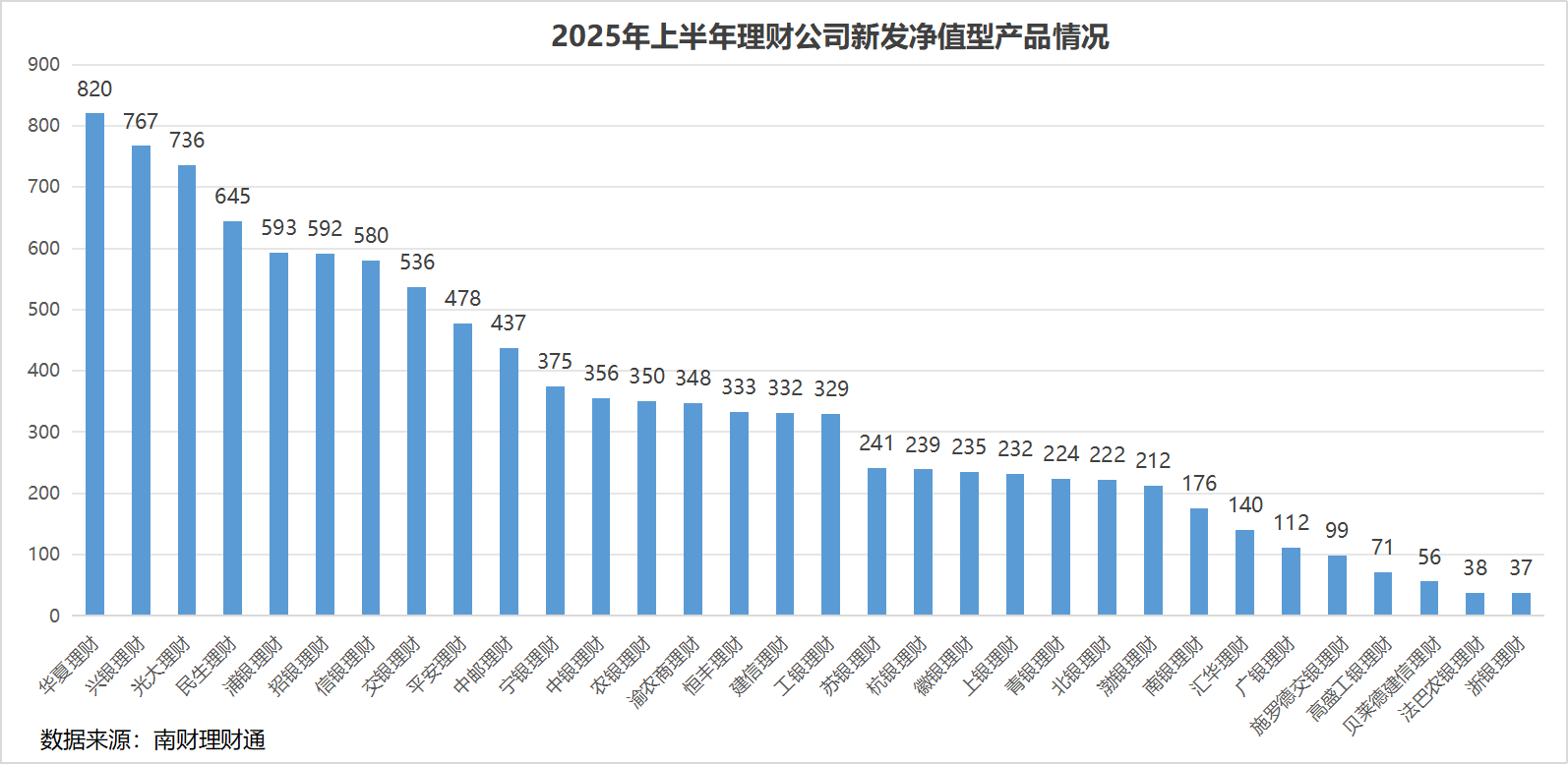
Core Insights - In the first half of 2025, banks lowered deposit rates, enhancing the attractiveness of wealth management products, leading to a significant shift of funds from deposits to these products [1][2] - The issuance of net value-based wealth management products increased by over 40% year-on-year, with 10,941 products launched by 32 companies compared to 7,805 in the first half of 2024 [1][2] - The product structure is shifting towards multi-asset and multi-strategy approaches, with a notable increase in the issuance of mixed and equity products [4][5] Product Issuance - The number of newly issued products reached 10,941, with a year-on-year increase of over 40% [2] - Leading issuers include Huaxia Wealth Management with 820 products, followed by Xingyin Wealth Management and Everbright Wealth Management, each exceeding 700 products [2] - The majority of new products are public offerings, accounting for approximately 90.6%, while private offerings make up 9.4% [4] Investment Characteristics - Fixed-income products represent 97.4% of the total, a slight decrease of 0.9 percentage points year-on-year, while mixed and equity products have seen an increase in issuance [4] - The proportion of closed-end net value products has dropped significantly to 59.9%, while open-end products have risen to 40% [4] - Short-term products (less than one month) now account for 22.2% of new issuances, up 5.5 percentage points from the previous year [4] Pricing Trends - The performance benchmark for wealth management products has been on a downward trend, with one-month products dropping below 2%, recorded at 1.88% in June 2025 [7][8] - The pricing for products with longer durations has also decreased, with two to three-year products falling to 2.71% and three-year products below 2.5% [7][8] Fundraising Dynamics - The total fundraising for newly issued products in the first half of 2025 was approximately 17,579.06 billion yuan, with an average fundraising size of 2.69 million yuan, down 13.5% from 3.11 million yuan in the same period of 2024 [8][9] - Only one product exceeded 100 billion yuan in fundraising, the "Anying Xiang Fixed Income Stable Profit 14-Month Series" from Xinyin Wealth Management [9][11] - The competition for fundraising has intensified, with the top ten products raising a total of 823.2 billion yuan, a year-on-year increase of 24.88% [9]
《中国银行业理财市场半年报告(2025年上)》点评:2Q平稳收官 下半年还有哪些关注点?
Xin Lang Cai Jing· 2025-07-27 12:29
Scale - The total wealth management scale increased by 0.72 trillion, returning to over 30 trillion [1] - As of the end of Q2 2025, the wealth management balance reached 30.67 trillion, reflecting a 2.4% growth since the beginning of the year [1][2] - The Q2 single-season wealth management scale increment was 1.53 trillion, lower than the 1.89 trillion from the same period last year, but higher than the average increment of 0.64 trillion from 2021 to 2023 [1][3] Product Characteristics - Open-ended products maintained a stable proportion of around 80%, while cash management products decreased to 6.4 trillion [5] - Open-ended products contributed 86.1% of the scale increment in the first half of the year, with significant growth from minimum holding period products [5] - Fixed income products accounted for 97.2% of the total wealth management products, with a slight increase in the proportion of mixed and equity products [8][10] Asset Allocation - As of the end of Q2 2025, cash and bank deposits reached 8.18 trillion, increasing by 500 billion since the beginning of the year [11] - The allocation to public funds significantly increased by 450 billion, reaching 1.38 trillion, indicating a growing preference for high liquidity assets [12] - The overall asset allocation showed a tendency to increase high liquidity assets while reducing credit bonds [9][11] Market Dynamics - The "disintermediation" effect is expected to support the growth of wealth management scale, although potential disturbances may increase in the second half of the year [13][14] - The low interest rate environment and the need for stable returns are driving the demand for fixed income products, while cash management products face challenges due to lower yields [15] - Regulatory changes are anticipated to enhance the asset management capabilities of wealth management institutions, focusing on quality over scale [16]

银行理财赚了多少?上半年数据来了→
Jin Rong Shi Bao· 2025-07-26 06:29
Core Insights - The report indicates that the bank wealth management market has a total outstanding scale of 30.67 trillion yuan as of June 2025, with 16,300 new wealth management products launched in the first half of the year, raising 36.72 trillion yuan and generating returns of 389.6 billion yuan for investors [1][2] - The average annualized return on wealth management products is reported to be 2.12% for the first half of the year, with a 14.18% increase in returns compared to the same period last year [2] - Fixed income products remain the dominant category, accounting for 97.20% of the total outstanding scale, while mixed products have seen a slight increase in their share [2] Wealth Management Market Overview - As of June 2025, the fixed income product outstanding scale is 29.81 trillion yuan, showing a slight decrease of 0.13 percentage points from the beginning of the year but an increase of 0.32 percentage points year-on-year [2] - The outstanding scale of mixed products is 0.77 trillion yuan, representing 2.51% of the total, with a year-to-date increase of 0.07 percentage points [2] Investor Behavior and Preferences - The number of investors holding wealth management products reached 136 million by June 2025, reflecting an 8.37% increase since the beginning of the year, with individual investors accounting for 98.66% of this total [4][5] - The risk preference of individual investors remains conservative, with 33.56% classified as moderate risk-takers, while the proportion of conservative and aggressive investors has increased slightly compared to the previous year [5] Personal Pension Products - Since the launch of personal pension products, six wealth management companies have introduced 35 products, with a total balance of over 15.16 billion yuan, marking a 64.7% increase since the beginning of the year [3] - The average annualized return for personal pension products exceeds 3.4%, with total returns exceeding 390 million yuan for investors [3] Distribution Channels - As of June 2025, there are 32 established wealth management companies, with 30 of them expanding their distribution channels beyond their parent banks [6] - Direct sales by wealth management companies reached 319.7 billion yuan in the first half of the year, with a slight increase in the number of cooperative distribution institutions [6]
行至六载,进而有为——中银理财成立六周年
21世纪经济报道· 2025-07-26 03:38
Core Viewpoint - The article emphasizes the commitment of Bank of China Wealth Management to the path of financial development with Chinese characteristics, focusing on serving the economy, society, and sustainable development through innovative financial products and services [1]. Group 1: Financial Innovation and Support - The company has accumulated nearly 20 billion yuan in net assets and has issued products that have created absolute returns for clients [3]. - The focus on technology finance is highlighted as a key driver for economic transformation, with the central financial work conference placing it at the forefront of financial initiatives [4]. - Bank of China Wealth Management is enhancing financial support for advanced manufacturing, particularly in sectors like equipment manufacturing, green technology, and strategic emerging industries [5]. Group 2: Green Finance Initiatives - The company is actively promoting green finance to align with national carbon neutrality goals, developing a diversified green wealth management product system [9]. - Since launching the first "ESG Preferred" series product in 2021, the scale of ESG-themed products has rapidly grown, exceeding 70 billion yuan [10]. - The company has invested over 20 billion yuan in green-related bonds, demonstrating a strong commitment to sustainable investment [10]. Group 3: Inclusive Finance and Social Responsibility - The company prioritizes inclusive finance to enhance financial service coverage and efficiency, particularly in rural areas [13]. - Collaborating with the China Bond Financial Valuation Center, the company has developed a customized rural revitalization bond index to support rural development [14]. - The introduction of the "Love Charity" wealth management product reflects the company's commitment to social welfare and community development [15]. Group 4: Pension Finance Development - The company is addressing the aging population by innovating financial products for retirement, with a total pension finance product scale exceeding 50 billion yuan [19]. - The pension product offerings include a series of themed brands aimed at meeting diverse retirement needs [18]. - The company has launched multiple pension wealth management products across various distribution channels, ensuring broad market coverage [20]. Group 5: Digital Finance Transformation - The company is advancing its digital transformation in wealth management, aligning with national strategies for high-quality digital finance development [22]. - Investment in a new integrated asset management technology platform aims to enhance digital capabilities across various business areas [23]. - The implementation of a "data x AI+" strategy is underway to leverage data analytics and artificial intelligence for improved operational efficiency [25]. Group 6: Internationalization and Cross-Border Investment - The company supports high-level opening-up and contributes to national diplomatic and economic strategies by exploring offshore financial development [27]. - It has diversified its cross-border asset offerings, including investments in various international bonds and currencies [27]. - The establishment of over 123 distribution channels has facilitated significant sales growth, with over 500 billion yuan in non-Bank of China channel sales [29].

布局港股发行市场 银行理财加快权益投资转型
Zhong Guo Jing Ying Bao· 2025-07-25 18:49
Core Viewpoint - The financial management companies are actively seeking new paths for growth amid challenges of scarce quality assets and volatility in the bond market, particularly by participating in Hong Kong IPOs to enhance returns and innovate product structures [1][4]. Group 1: Participation in Hong Kong IPOs - Financial management companies, such as ICBC Wealth Management, have recently participated in IPOs like Sanhua Intelligent Control and IFBH, marking a significant move into the new consumption sector [1][2]. - In the first half of this year, the Hong Kong Stock Exchange completed 43 IPOs, raising a total of HKD 1,067.13 million, a 688.54% increase compared to the same period last year [2]. - The participation of financial management companies in IPOs allows them to enhance their equity investment capabilities and innovate product strategies, particularly through cornerstone investments [3][4]. Group 2: Product Innovation and Strategy - The cornerstone investor system, established in 2005, aims to address information asymmetry in new stock issuances by involving credible institutional investors [3]. - Financial management companies are developing products that combine fixed income with Hong Kong IPO investments, featuring characteristics such as a lock-up period and a dual-structure for returns [3][4]. - The "fixed income + Hong Kong IPO" strategy allows financial management companies to meet client needs for stability while gradually introducing them to equity assets, laying the groundwork for future pure equity products [4][5]. Group 3: Regulatory Support and Market Dynamics - Regulatory changes have facilitated the participation of financial management companies in the stock and primary markets, evolving from restrictions to encouragement [5][6]. - The implementation of policies supporting long-term capital market investments has allowed financial management companies to act as strategic investors in capital increases [6]. - The current low-interest environment has limited profit margins on fixed income assets, making Hong Kong IPO investments a viable alternative for financial management companies [4][5]. Group 4: Risk Management and Research Enhancement - Financial management companies must strengthen their research capabilities and risk management practices when participating in volatile IPO markets [7][8]. - It is essential for these companies to conduct thorough evaluations of industry cycles, business models, and valuation rationality to mitigate risks associated with high volatility [7][8]. - Establishing a comprehensive management mechanism for investment processes, including pre-investment, during investment, and post-investment phases, is crucial for effective risk control [8].
【银行理财】银行理财IPO布局提速,费率模式市场化探索破局——2025年6月银行理财市场月报
华宝财富魔方· 2025-07-25 09:43
Regulatory Policies and Industry News Interpretation - The acceleration of bank wealth management's layout in A-shares and Hong Kong IPOs is driven by regulatory policies that provide institutional support for medium to long-term capital entering the market [2][8] - The low interest rate environment is pushing wealth management institutions to explore new paths for returns, with a focus on "fixed income plus" strategies to expand revenue sources [8][9] - The Hong Kong IPO market has significant strategic value, supported by continuous optimization of the listing mechanism [9][10] Market Trends and Performance - As of June, the total outstanding scale of wealth management products slightly decreased by 1.39% month-on-month to 30.85 trillion yuan, while year-on-year growth was 9.97% [3] - Cash management products saw a near 7-day annualized yield of 1.45%, up by 0.50 basis points, while pure fixed income products had an annualized yield of 2.66%, down by 0.01 percentage points [3] - The market's wealth management product net value decline rate fell to 1.73% in June, a decrease of 0.1 percentage points month-on-month [3] New Product Issuance - The scale of newly issued wealth management products rebounded in June, aligning with seasonal trends, with a continued dominance of "fixed income plus" products, closed-end products, and 1-3 year products [3][4] - Most new wealth management products in June continued to lower their performance benchmarks, reflecting a consensus among wealth management companies on the long-term low interest rate environment [3][4] Product Performance - The closed-end product compliance rate reached 85.46% in June, an increase of 1.04 percentage points from May, while the compliance rate for open-end products was 68.72%, down by 0.12 percentage points [4]

《金融机构产品适当性管理办法》:“卖者尽责、买者自负”并重
Minmetals Securities· 2025-07-25 09:19
Regulatory Framework - The "Financial Institutions Product Suitability Management Measures" emphasizes the dual principles of "seller's due diligence and buyer's self-responsibility" to ensure appropriate product sales to suitable clients[3] - The measures will take effect on February 1, 2026, and aim to enhance investor education and break rigid repayment structures[3][7] Impact on Financial Institutions - Compliance costs for banks in the wealth management sector are expected to rise due to stricter suitability matching requirements, necessitating upgrades in information systems and human resources[15][16] - The measures will lead to improved client data quality, enhancing product design capabilities within the banking wealth management industry[3][15] Investor Responsibility - Investors are required to understand products and make informed decisions based on their risk preferences, with a focus on providing accurate information to financial institutions[14] - The measures stipulate that investors must undergo risk assessments, limiting the frequency of such assessments to twice a day and a maximum of eight times within twelve months[14] Market Dynamics - The proportion of high-risk wealth management products is anticipated to increase, as the measures clarify the responsibilities of both buyers and sellers, potentially leading to a rise in equity investments[19][20] - As of the end of 2024, only 0.27% of wealth management products were rated as high-risk, despite over 20% of investors having a risk tolerance above level four[20][22] Future Projections - It is estimated that by 2026, the proportion of equity assets in wealth management products could increase by 1%, translating to an additional RMB 320 billion entering the A-share market[22]