
装备制造业

Search documents
深度报道︱前三季度用电量创新高 从电力数据看“算力新城”拔节生长
国家能源局· 2025-10-26 02:50
Group 1 - The total electricity consumption in China reached a historical high of 7.77 trillion kWh in the first three quarters, with year-on-year growth rates of 2.5%, 4.9%, and 6.1% respectively, indicating a gradual recovery in growth rates [1][4] - The third quarter saw unprecedented high temperatures, with electricity consumption exceeding 1 trillion kWh for two consecutive months, equivalent to the annual electricity consumption of ASEAN countries, contributing to a total of 2.9 trillion kWh in the third quarter [3][4] - The increase in electricity consumption reflects the resilience of China's energy supply capabilities, with production of coal, oil, gas, and electricity all maintaining growth, and clean energy generation accounting for 35.3% of total generation, up 1.9 percentage points year-on-year [6][4] Group 2 - The growth in electricity consumption indicates enhanced economic vitality, with the secondary industry’s electricity consumption increasing by 2.7 percentage points compared to the first half of the year, and the tertiary industry’s consumption rising by 1.2 percentage points [8][4] - The internet and related services sector saw a significant year-on-year electricity consumption increase of 33.8%, highlighting the rapid development of the digital economy as a new growth driver [9] - In Gansu's Qingyang, a key node in the "East Data West Calculation" project, electricity consumption related to computing has surged, with the project driving local tertiary industry investment growth by nearly 20% [11][13] Group 3 - The secondary industry’s electricity consumption reached 4.91 trillion kWh in the first three quarters, with a year-on-year growth of 5.1% in the third quarter, contributing 51% to the overall electricity consumption growth [17] - In Ningbo, the manufacturing sector's electricity consumption grew by 14.87% year-on-year in September, with the equipment manufacturing sector contributing 40% to the overall manufacturing electricity consumption growth [17] - Suzhou's electricity consumption in the computer, communication, and other electronic equipment manufacturing sectors exceeded 6 billion kWh in the third quarter, with a year-on-year growth of 8.5%, reflecting the rapid expansion of high-tech and equipment manufacturing industries [19]


前三季度江苏GDP增长5.4%
Xin Hua Ri Bao· 2025-10-25 20:26
Core Viewpoint - The economic performance of the province in the first three quarters of the year shows stability and progress, characterized by "stability, advancement, innovation, and resilience" [1] Group 1: Economic Growth - The province's GDP reached 102,811.0 billion yuan, with a year-on-year growth of 5.4% [1] - The primary industry added value was 3,241.4 billion yuan, growing by 3.6% [1] - The secondary industry added value was 43,450.8 billion yuan, increasing by 5.2% [1] - The tertiary industry added value was 56,118.8 billion yuan, with a growth of 5.6% [1] Group 2: Industrial Performance - The total industrial added value grew by 6.3%, contributing 2.3 percentage points to GDP growth [1] - Industrial electricity consumption increased by 4.2%, accelerating by 1 percentage point compared to the first half of the year [1] - The added value of industrial enterprises above designated size grew by 6.8%, with equipment manufacturing growing by 9.4%, contributing 73.7% to the industrial growth [2] Group 3: Consumer and Trade Dynamics - The total retail sales of consumer goods increased by 4.2%, with major goods under the "old-for-new" policy growing by 8.5% [2] - The province's total import and export volume reached 4.38 trillion yuan, a year-on-year increase of 6.4%, accounting for 13% of the national total [2] Group 4: Emerging Industries - The output value of high-tech industries accounted for 51.8% of the industrial enterprises above designated size, an increase of 1.1 percentage points from the previous year [2] - The added value of the digital core product manufacturing industry grew by 10.3%, surpassing the overall industrial growth by 3.5 percentage points [2] - Online retail sales increased by 8.7%, with physical goods online retail sales growing by 6.2% [2] Group 5: Resilience Indicators - In September, the added value of industrial enterprises above designated size grew by 6.8%, accelerating by 2.2 percentage points from the previous month [3] - The total retail sales of consumer goods increased by 4.8%, with a month-on-month acceleration of 3.1 percentage points [3] - The total export volume grew by 21.6%, accelerating by 14.8 percentage points from the previous month [3] Group 6: Income Growth - The per capita disposable income of residents reached 44,252 yuan, with a year-on-year growth of 4.6% [3] - Urban and rural residents' per capita disposable income grew by 4.3% and 5.2%, respectively [3] - The income ratio between urban and rural residents was 2.05, narrowing by 0.02 compared to the same period last year [3]

前三季度浙江GPD超6.8万亿元 进出口保持韧性增长
Sou Hu Cai Jing· 2025-10-24 10:19
Economic Performance - Zhejiang's GDP reached 68,495 billion yuan in the first three quarters, with a year-on-year growth of 5.7% at constant prices [1] - The primary industry added value was 1,735 billion yuan, growing by 3.7%; the secondary industry added value was 26,086 billion yuan, growing by 5.2%; and the tertiary industry added value was 40,674 billion yuan, growing by 6.0% [1] Trade and Export - Zhejiang's import and export maintained resilient growth, with total imports and exports reaching 4.17 trillion yuan, exports at 3.16 trillion yuan, and imports at 1.01 trillion yuan, accounting for 12.4%, 15.8%, and 7.4% of the national total respectively [1] - Year-on-year growth rates for imports and exports were 6.2%, 8.3%, and 0.2%, all significantly higher than the national average [1] Emerging Industries - The development of emerging industries in Zhejiang accelerated, with high-tech manufacturing, digital economy core industries, equipment manufacturing, and strategic emerging industries growing by 12.4%, 11.6%, 10.6%, and 9.6% respectively [3] - Investment in high-tech industries and digital economy core industries increased by 12.3% and 10.0%, both significantly higher than the overall investment growth [3] Private Sector Contribution - The added value of private enterprises in Zhejiang's industrial sector grew by 7.4%, outpacing the overall industrial growth by 0.3 percentage points, contributing 76.2% to the industrial added value growth [3] - Private enterprises accounted for 82% of the province's total import and export, contributing 6.3 percentage points to the overall growth, with exports increasing by 9.4% [3]

2025年前三季度宏观政策“三策合一”研究报告
Sou Hu Cai Jing· 2025-10-24 08:51
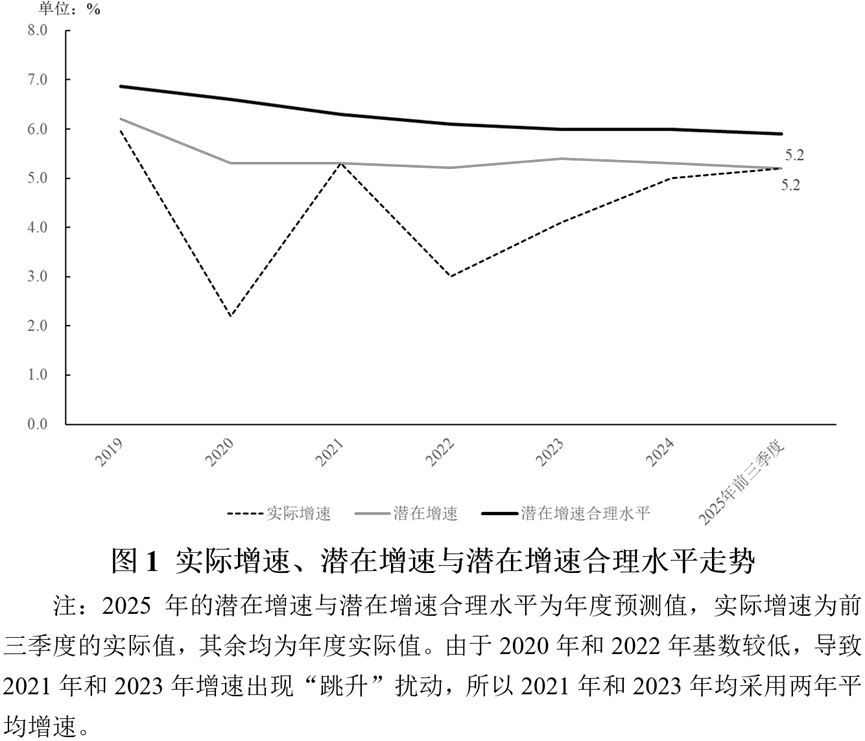
Core Viewpoints - The main contradiction in the current macroeconomic environment is insufficient domestic demand, particularly in consumer spending, highlighting the strategic importance of enhancing consumption [2][9] - It is recommended to maintain the actual GDP growth rate above the potential growth rate of 5.2% for 2025 and set the 2026 GDP growth target around 5% to signal stability [2][37] - A gradual approach to price level control is suggested, aiming for a three-step process to achieve a core CPI growth target of 2% over two to three years [2][38] Macroeconomic Overview - The GDP growth rate for the first three quarters of 2025 is 5.2%, aligning closely with the potential growth rate, indicating a stable economic operation [6] - Industrial profits have shown positive improvement, with a 0.9% year-on-year increase in profits for large industrial enterprises from January to August 2025 [7] - The service sector has also experienced growth, with a 5.4% year-on-year increase in value added, particularly in modern service industries [8] Current Economic Contradictions - The primary contradiction in the macroeconomy is on the demand side, characterized by insufficient consumer demand, with retail sales growth slowing to 4.5% year-on-year in the first three quarters [9][11] - Investment demand has also declined, with fixed asset investment showing a -0.5% year-on-year growth, a drop of 3.3 percentage points from the first half of the year [9] Macroeconomic Policy Evaluation - The monetary policy index for the first three quarters of 2025 is 44.0, indicating a slight increase in policy strength, with M2 growth at 8.4% by the end of September [12] - The fiscal policy index stands at 57.9, reflecting an increase in fiscal policy strength, with public budget expenditure growing by 3.1% year-on-year [13] - The overall efficiency of stabilization policies is rated at 50.0, showing a positive trend in policy effectiveness [26] Policy Recommendations - It is advised to enhance stabilization policies to address the lack of effective domestic demand, with a focus on both monetary and fiscal measures [38] - Growth policies should prioritize the development of new productive forces, with an emphasis on employment-friendly industrial policies [39] - Structural policies need to optimize investment, industrial, and income distribution structures to better balance total supply and demand [39]
GDP增长5.2%,解码中国经济“三季报”
3 6 Ke· 2025-10-24 02:47
Core Insights - China's GDP for the first three quarters grew by 5.2% year-on-year, indicating a steady economic performance amidst a complex international environment [1][2] - The quarterly GDP growth rates showed a mild recovery trend: 5.4% in Q1, 5.2% in Q2, and 4.8% in Q3, with a quarter-on-quarter growth of 1.1% in Q3, suggesting a gradual accumulation of internal economic momentum [1][2] Economic Overview - The total GDP reached 10,150.36 billion yuan, with a growth rate that outpaced both the previous year and the same period last year by 0.2 and 0.4 percentage points respectively, maintaining a leading position among major global economies [2] - Industrial production demonstrated strong resilience, with a 6.2% year-on-year increase in the added value of industrial enterprises above designated size, particularly in equipment manufacturing and high-tech manufacturing, which grew by 9.7% and 9.6% respectively [2] - The service sector also showed steady recovery, with a 5.4% year-on-year increase in added value, led by the information transmission, software, and IT services sector, which grew by 11.2% [2] Consumption and Employment - The consumer market continued to recover, with total retail sales of consumer goods growing by 4.5% year-on-year, driven by strong sales in essential and some upgraded goods, with categories like food, sports and entertainment products, and jewelry seeing retail growth rates exceeding 10% [2][3] - The policy of replacing old consumer goods with new ones has shown significant effects, with retail sales in categories such as home appliances, furniture, and communication equipment also growing around 20% [3] - Employment and prices remained stable, with an average urban unemployment rate of 5.2% and a slight decrease of 0.1% in the Consumer Price Index (CPI) year-on-year [3] New Growth Drivers - New economic drivers are accelerating, with the added value of the lithium-ion battery manufacturing industry growing by 29.8% and the production of new energy vehicles increasing by 29.7% [3] - The total import and export volume reached 33,607.8 billion yuan, with a year-on-year growth of 4.0%, and private enterprises' imports and exports grew by 7.8%, accounting for 57.0% of the total [3] Expert Insights - Experts noted that the economic growth rate is relatively high compared to global standards, with the IMF predicting a global growth rate of 3.2% for 2025 [4] - Recommendations for enhancing consumer capacity include improving wage determination mechanisms and increasing the proportion of labor remuneration in initial distribution [5] - The importance of innovation and R&D investment is emphasized, with R&D intensity increasing from 1.91% in 2012 to 2.68% in 2024, and a significant rise in the share of basic research funding [5][6]
透过“三季报”看中国经济稳中有进
Qi Huo Ri Bao Wang· 2025-10-24 00:48
Economic Overview - China's GDP grew by 5.2% year-on-year in the first three quarters, reflecting strong resilience despite external pressures [1][2] - The economic performance indicates a transition from "scale expansion" to "quality improvement" [1][3] Macroeconomic Indicators - The urban unemployment rate averaged 5.2%, remaining stable [2] - Consumer Price Index (CPI) decreased by 0.1%, while core CPI increased by 0.6%, indicating a gradual recovery in consumer confidence [2] - Total import and export value reached 33.6 trillion yuan, a 4.0% increase year-on-year, marking a historical high for the period [2] Industrial Growth - High-tech manufacturing output increased by 9.6%, outpacing overall industrial growth by 3.4 percentage points [3] - Notable growth in "hardcore" products: 3D printing equipment up by 40.5%, industrial robots by 29.8%, and new energy vehicles by 29.7% [3] Consumer Trends - Retail sales of consumer goods grew by 4.5%, with significant increases in jewelry and sports goods [4] - The "trade-in" policy boosted sales in home appliances and communication equipment, with growth rates of 25.3% and 20.5% respectively [4] - Online retail sales increased by 9.8%, reflecting a shift towards experience-based consumption [4] Foreign Trade Performance - Exports grew by 7.1%, with a trade surplus of 6.28 trillion yuan, a record high [5][6] - The export of mechanical and electrical products rose by 9.6%, accounting for 60.5% of total exports [5] Market Confidence - The 5.2% growth rate in the first three quarters supports the goal of around 5% growth for the entire year [7] - Long-term confidence is bolstered by China's large market size and complete industrial system, despite short-term fluctuations [7]
融发核电:关于一级全资子公司签订日常经营合同的公告
Zheng Quan Ri Bao· 2025-10-23 13:40
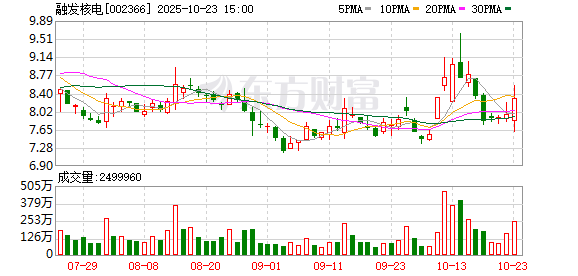
Group 1 - The company Rongfa Nuclear Power announced the signing of two contracts with Henan Dening Hydraulic Machinery Co., Ltd. for the purchase of Ф900 type hinge beam accessories [2] - The total contract amount is 126,000,000.00 RMB (including tax), with individual contract amounts of 81,000,000.00 RMB and 45,000,000.00 RMB [2] - These contracts are classified as routine operational contracts, and the company has completed the internal approval procedures for signing [2]

三季度工业增速超预期,后续走势如何
第一财经· 2025-10-23 12:10
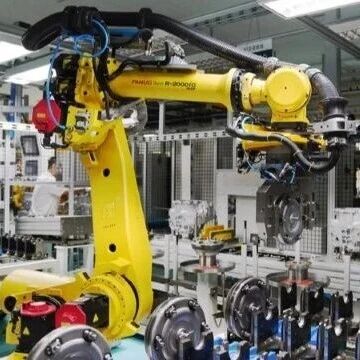
Core Viewpoint - China's macroeconomic policies have become more proactive this year, leading to a rapid growth in industrial production, with a year-on-year increase of 6.2% in the first three quarters, serving as a stabilizing force for the macro economy [3][4]. Industrial Growth - In September, the industrial added value for large-scale enterprises grew by 6.5% year-on-year, accelerating by 1.3 percentage points from August, marking a three-month high [4]. - The manufacturing sector saw a growth of 6.8%, outpacing the overall industrial growth by 0.6 percentage points, while mining and utilities grew by 5.8% and 2.0%, respectively [5]. - Among 41 major industrial categories, 37 experienced year-on-year growth, resulting in a growth coverage of 90.2% [5]. Export Performance - The improvement in exports has been a significant factor in the industrial growth exceeding expectations, with a year-on-year increase of 3.3% in the export delivery value for large-scale industries in the first three quarters [5]. - In September, the export delivery value turned from a decline in August to a growth of 3.8%, indicating a notable recovery in industrial exports [5]. Sectoral Analysis - The added value of the equipment manufacturing sector grew by 9.7%, accounting for 35.9% of the total industrial output, highlighting its stabilizing role [8]. - High-tech manufacturing added value increased by 9.6%, contributing 24.7% to the overall industrial growth, with significant growth in new energy vehicles and related products [9]. Industrial Profitability - From January to August, profits of large-scale industrial enterprises increased by 0.9%, reversing a declining trend since May, with manufacturing profits rising by 7.4% [10]. - The capacity utilization rate for large-scale industrial enterprises was 74.6% in the third quarter, reflecting a 0.6 percentage point increase from the second quarter [10]. Policy Support - The Ministry of Industry and Information Technology has introduced multiple support measures for ten key industries, which collectively account for about 70% of large-scale industrial output, aiming to stabilize the industrial economy [10]. Future Outlook - Analysts suggest that the steady development of new productive forces and the implementation of new policy financial tools are expected to continue supporting industrial production [11].
智库·数据丨“数”览2025年前三季度国民经济“成绩单”
Sou Hu Cai Jing· 2025-10-23 07:06
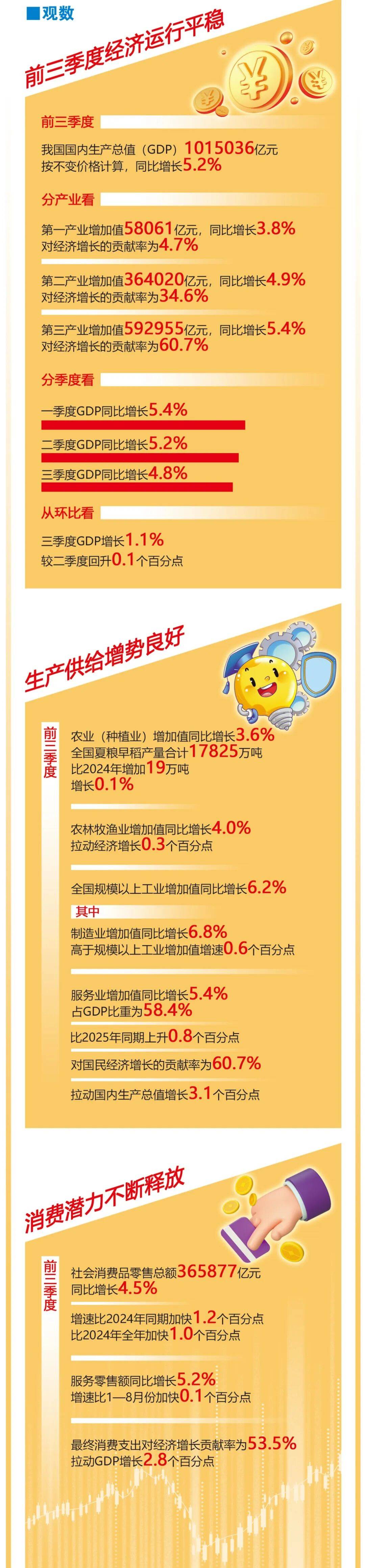
Economic Growth Overview - In the first three quarters of 2025, China's GDP reached 10,150.36 billion yuan, with a year-on-year growth of 5.2% [17] - The GDP growth in the third quarter was 1.1%, a slight increase of 0.1 percentage points from the second quarter [3][17] - The contribution of the primary industry to economic growth was 4.7%, while the secondary industry contributed 34.6%, and the tertiary industry contributed 60.7% [17] Consumption and Retail - Final consumption expenditure contributed 53.5% to economic growth, driving GDP up by 2.8 percentage points [4][13] - The total retail sales of consumer goods reached 365,877 billion yuan, with a year-on-year growth of 4.5%, accelerating by 1.2 percentage points compared to the same period in 2024 [4][18] - Service retail sales increased by 5.2%, showing a continuous acceleration in growth [4][18] Investment Trends - National fixed asset investment (excluding rural households) totaled 371,535 billion yuan, a year-on-year decrease of 0.5% [6][18] - Excluding real estate development investment, fixed asset investment grew by 3.0%, indicating a shift towards more promising sectors [6][18] - Infrastructure investment rose by 1.1%, while manufacturing investment increased by 4.0% [6][18] Foreign Trade Performance - The total import and export value reached 336,078 billion yuan, with a year-on-year growth of 4.0% [8][18] - Exports amounted to 199,450 billion yuan, increasing by 7.1%, while imports slightly decreased by 0.2% to 136,629 billion yuan [8][18] - The contribution of net exports to GDP growth was 1.5 percentage points, with a contribution rate of 29.0% [8][18] Industrial and Service Sector Developments - The added value of the industrial sector increased by 6.2%, with manufacturing growing by 6.8%, outpacing the overall industrial growth rate [3][17] - The high-tech manufacturing sector saw a 9.6% increase in added value, contributing 24.7% to the growth of the industrial sector [14][18] - The information transmission, software, and IT service industries reported a revenue growth of 12.1%, surpassing the overall service sector growth by 4.4 percentage points [10][18]
前三季度GDP同比增长5.2%,实现全年目标有支撑
Ren Min Wang· 2025-10-22 03:22
Group 1 - The core viewpoint of the articles highlights that China's GDP growth in the first three quarters of 2025 reached 5.2% year-on-year, indicating a stable economic performance despite external pressures and internal challenges [1][2] - The economic growth in the first three quarters resulted in an increase of 39,679 billion yuan, which is 1,368 billion yuan more than the previous year, showcasing the difficulty of maintaining stability in a large economy [1] - China's total import and export value of goods reached 33.61 trillion yuan, a year-on-year increase of 4%, marking a historical high for the same period and demonstrating strong resilience in foreign trade [1][2] Group 2 - The transformation of green and innovative "momentum" into economic "dynamics" has been effective, with the added value of the equipment manufacturing and high-tech manufacturing industries accounting for 35.9% and 16.7% of the total industrial added value, respectively [2] - Non-fossil energy consumption's share of total energy consumption increased by approximately 1.7 percentage points year-on-year, indicating progress in green and low-carbon transformation [2] - Despite global economic challenges, China's economic growth rate of 4.8% in the third quarter remains significantly higher than that of most major economies, with the total economic output reaching 35.5 trillion yuan [2] Group 3 - Looking ahead, achieving the annual economic targets requires sustained effort and confidence, with a focus on expanding domestic demand and strengthening the domestic circulation [3] - Continuous efforts are needed to enhance endogenous growth momentum to promote sustained and healthy economic development [3]