
啤酒

Search documents
食品饮料行业双周报(2025、12、12-2025、12、25):欧盟乳制品反补贴落地,把握结构性机会-20251226
Dongguan Securities· 2025-12-26 09:37
Investment Rating - The report maintains an "Overweight" rating for the food and beverage industry, indicating an expectation that the industry index will outperform the market index by more than 10% over the next six months [55]. Core Insights - The report highlights the structural opportunities arising from the EU's anti-subsidy measures on dairy products, which are expected to benefit domestic alternatives such as cheese and cream [50]. - The white liquor sector is experiencing a weak recovery in consumption, with expectations of continued pressure on sales in the fourth quarter and first quarter of the following year, but a potential rebound in the second quarter due to low base effects [50][51]. - The report emphasizes the importance of monitoring inventory levels ahead of the Spring Festival and the operational goals set by various liquor companies for the upcoming year [51]. - The report suggests focusing on high-end liquor brands like Kweichow Moutai (600519) and other regional brands such as Shanxi Fenjiu (600809) and Guojiao Liquor (000596) [51]. - The report notes that approximately 87% of stocks in the food and beverage sector recorded positive returns during the review period, with notable performers including Anji Food (+27.96%) and Huanlejia (+20.94%) [15]. Summary by Sections Market Review - From December 12 to December 25, 2025, the SW food and beverage industry index rose by 1.33%, underperforming the CSI 300 index by approximately 0.66 percentage points [11]. - Most sub-sectors outperformed the CSI 300 index, with the baking sector showing the highest increase of 7.63% [13]. Industry Data Tracking - **Liquor Sector**: The price of Feitian Moutai increased to 1575 RMB/bottle, while Guojiao 1573 decreased to 840 RMB/bottle [21]. - **Condiments Sector**: Prices for soybean meal and white sugar decreased, with soybean prices at 4288.90 RMB/ton [24]. - **Beer Sector**: Aluminum prices increased while glass and corrugated paper prices decreased; barley prices remained stable at 2200.00 RMB/ton [29]. - **Dairy Sector**: Fresh milk prices rose slightly to 3.03 RMB/kg [37]. - **Meat Sector**: The average wholesale price of pork decreased to 17.44 RMB/kg, with a year-on-year decline of 22.04% [39]. Important News - The report discusses the preliminary ruling on anti-subsidy measures for EU dairy imports, which is expected to positively impact domestic dairy producers [44][45]. - It also notes a decline in the production of white liquor and beer in November, with white liquor production down 11.3% year-on-year [43]. Company Announcements - Kweichow Moutai plans to distribute cash dividends amounting to at least 75% of its net profit for the years 2024-2026, alongside a share buyback plan [52]. - Haitian Flavoring plans to maintain a cash dividend payout ratio of no less than 80% of its net profit for the next three years [48].



非白酒板块12月26日跌0.67%,惠泉啤酒领跌,主力资金净流出1156.97万元
Zheng Xing Xing Ye Ri Bao· 2025-12-26 09:07
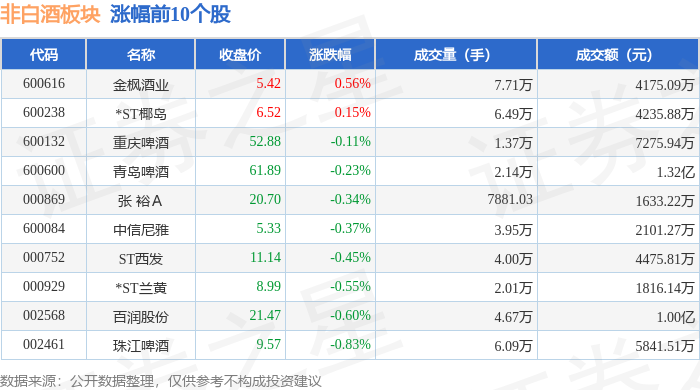
Core Viewpoint - The non-white liquor sector experienced a decline of 0.67% on December 26, with Huichuan Beer leading the drop, while the Shanghai Composite Index rose by 0.1% and the Shenzhen Component Index increased by 0.54% [1] Group 1: Market Performance - The closing price of Huichuan Beer was 12.61, reflecting a decrease of 2.85% with a trading volume of 175,800 shares and a transaction value of 222 million yuan [2] - The non-white liquor sector saw a net outflow of 11.57 million yuan from main funds, while retail investors experienced a net outflow of 28.99 million yuan, and speculative funds had a net inflow of 40.57 million yuan [2][3] Group 2: Individual Stock Performance - The top performers in the non-white liquor sector included Jin Feng Jiu Ye, which closed at 5.42 with a slight increase of 0.56%, and *ST Ye Dao, which closed at 6.52 with a 0.15% increase [1] - Conversely, stocks like Chongqing Beer and Gu Zhi Lang Xue saw minor declines of 0.11% and 0.23%, respectively, with closing prices of 52.88 and 68.19 [1] - The stock of *ST Lan Huang closed at 66.8, down by 0.55%, with a trading volume of 20,100 shares [1]


燕京啤酒(000729) - 000729燕京啤酒投资者关系管理信息20251226
2025-12-26 08:44
Group 1: Company Overview and Strategic Direction - The company is committed to deepening nine major reforms to enhance management quality and efficiency, focusing on production, market, supply chain, and digitalization [1] - The company aims to leverage its strengths in party building to drive high-quality development and maintain a market-oriented reform direction [1] - The "Fifteen Five" strategic planning is being developed, focusing on four key areas: excellence in management, market development, supply chain transformation, and digitalization [3] Group 2: Market Expansion and Product Strategy - The company is actively expanding into new markets and channels, adapting to changes in consumer behavior towards personalized and scenario-based consumption [4] - The implementation of a big product strategy centered around Yanjing U8 has been a priority, with continuous product innovation to enhance brand influence and market share [5] - The product matrix has been enriched with mid-to-high-end products like Yanjing V10 and Lion King Craft, catering to diverse consumer needs [5] Group 3: Shareholder Returns - The company places a high emphasis on shareholder returns, planning to distribute cash dividends based on the total share capital of 2,818,539,341 shares, with a proposed distribution of 1.00 RMB per 10 shares [6] - A total cash dividend of approximately 281,853,934.10 RMB is expected to be distributed for the first three quarters of 2025 [6]

F PARTY荣膺第九届《旅游天地》年度最佳精酿啤酒奖
Jiang Nan Shi Bao· 2025-12-26 07:26
近日,第九届《旅游天地》星榜盛典于上海黄浦江畔盛大启幕。作为文旅行业极具权威性与影响力的年 度盛会,本届盛典以"星耀文旅,共赴未来"为主题,全面覆盖目的地、酒店、航空、酒饮等全产业链, 现场颁发23类重磅奖项。在这场汇聚行业精英、引领发展趋势的盛会上,云仓酒庄旗下精酿啤酒品牌F PARTY通过在业务模式、产品理念以及与文旅场景融合等多方面的卓越表现,脱颖而出,荣获"年度最 佳精酿啤酒"奖项,成为当晚备受瞩目的焦点之一。 在竞争激烈的酒饮市场中,F PARTY以创新为驱动,构建起独特的业务模式,为品牌发展奠定了坚实基 础。云仓酒庄通过整合全球供应链资源,与优质原料产地建立深度合作,从源头确保原料的高品质与稳 定性,为生产出卓越的精酿啤酒提供了有力保障。同时,优化物流配送体系,采用高效、灵活的物流模 式,降低供应链成本,提高运营效率,使得F PARTY能够在保证产品品质的前提下,以更具竞争力的价 格进入市场,满足不同消费层次的需求。 F PARTY深谙消费者对于酒饮品质和体验的追求,秉持融合多元的产品理念,将传统工艺与现代创新相 结合,打造出独具特色的精酿啤酒产品。一方面,严格遵循传统精酿啤酒的酿造工艺,注重原料 ...
2025消费市场八大关键词
3 6 Ke· 2025-12-26 06:04
Group 1 - The core themes of the 2025 consumer market are "rational return" and "experience upgrade," reflecting consumers' focus on product value and the overall consumption experience [1] - The cultural tourism market has seen significant growth, with searches for "intangible cultural heritage experiences" increasing by 387% and "intangible cultural heritage crafts" by 790% during the Spring Festival [2] - Young consumers are driving innovation in the cultural tourism industry, with new trends like "slow travel" and significant increases in theme park bookings, with a 70% rise in reservations for theme parks during the summer of 2025 [4][5] Group 2 - The AI content explosion in 2025 has transformed advertising and media, with AI-generated images and videos becoming prevalent, impacting consumer engagement [8][10] - AI music has gained traction, with AI-generated songs achieving notable chart success, indicating a shift in the music industry towards AI integration [10][11] - The trend of "cross-border flavors" in the food industry reflects consumers' complex demands for innovative food combinations, such as the popular "liver crispy potato" dish [14][17] Group 3 - The digital consumer market is experiencing a shift towards "technology sinking," with products like action cameras and 3D printers finding new growth among younger consumers [18][20] - The sales of action cameras reached 4.76 million units in 2025, marking a 252% increase, while 3D printer prices have dropped significantly, making them more accessible [20][23] - The concept of "heart-price ratio" has emerged, emphasizing emotional value and social identity in consumer choices, moving beyond traditional price-performance metrics [34][36] Group 4 - The evolution of "national tide" reflects a deeper integration of traditional culture with modern product innovation, with the market expected to exceed 2.5 trillion yuan in 2025 [30][31] - The focus on quality and cultural depth in national tide products is evident in the fashion industry, where traditional techniques are combined with contemporary designs [31][33] - The rise of new Chinese-style beverages, such as tea-infused craft beers, showcases the blending of cultural elements with modern consumption trends [33] Group 5 - The 2025 consumer market is characterized by a dual focus on rational and emotional values, with brands needing to adapt to diverse consumer demands [45] - The shift from a single value-driven consumption model to a more nuanced approach that includes emotional experiences is reshaping market dynamics [45] - Brands must evolve their product offerings and marketing strategies to align with the changing consumer landscape, emphasizing the importance of understanding user needs [45]

浙江省酒业协会:今年黄酒产业产销量均有微量增长
Cai Jing Wang· 2025-12-26 05:29
Group 1 - The core viewpoint of the news highlights the performance of the Zhejiang liquor industry in 2025, indicating mixed results across different segments, with yellow wine showing a decline in sales but an increase in profit, while beer and white liquor face challenges in sales despite some growth in production and revenue [1][2]. Group 2 - In the yellow wine sector, from January to October 2025, production reached 288,971 thousand liters, a year-on-year increase of 17.07%, while sales volume decreased by 3.40% to 255,588 thousand liters. Sales revenue fell by 8.74% to 3.145 billion yuan, but total tax profit rose by 10.12% to 697 million yuan, with profit increasing by 26.67% to 440 million yuan [1]. - The beer industry in Zhejiang produced 2,569,844 thousand liters from January to October 2025, a decrease of 2.11%, but sales revenue increased by 0.49% to 7.666 billion yuan. Tax profit rose by 5.87% to 1.963 billion yuan, with tax revenue increasing by 3.86% to 1.090 billion yuan, and profit grew by 8.50% to 873 million yuan [1]. - The white liquor sector saw production rise by 37.18% to 10,113 thousand liters, but sales volume fell by 13.62% to 5,516 thousand liters. Revenue from eight white liquor companies dropped by 14.49% to 7.602 million yuan, indicating a challenging economic environment for the sector [1]. - The overall outlook for the yellow wine industry suggests slight growth in both production and sales in 2025, while the beer industry is adapting to new consumer demands with improved product structures and a focus on high-end offerings [2]. - The white liquor industry is enhancing its production capacity and market outreach, with a reported capacity increase of 9.03% year-on-year, and is actively participating in major exhibitions to boost its influence [2].
A股8股今日股权登记
2 1 Shi Ji Jing Ji Bao Dao· 2025-12-26 00:47
Core Viewpoint - Eight A-shares are undergoing equity registration today, with five companies planning to distribute dividends and three companies planning to increase their share capital [1] Dividend Distribution - Five companies have their equity registration date on December 26, with the largest dividends being distributed by CITIC Publishing, Yanjing Beer, and Longyuan Power, which will pay 1.60 yuan, 1.00 yuan, and 1.00 yuan per 10 shares respectively [1] Capital Increase - Three companies are increasing their share capital, with *ST Lingda, *ST Meigu, and *ST Zhang having the highest capital increase ratios, distributing 15 shares, 13.4278 shares, and 10 shares for every 10 shares held respectively [1] Upcoming Dividend Proposals - Three companies have announced upcoming dividend proposals, with Jinling Sports, Zijin Bank, and Founder Securities planning to distribute dividends of 1.0 yuan, 0.5 yuan, and 0.1 yuan per 10 shares respectively [1]




燕京啤酒:公司以研发变革驱动产品升级焕新
Zheng Quan Ri Bao Zhi Sheng· 2025-12-25 13:17
Core Viewpoint - Yanjing Beer is leveraging research and development to drive product upgrades and meet diverse consumer demands through a robust technical foundation, including a national-level technology center and laboratory [1] Group 1: Product Development - The company is increasing its R&D efforts to develop new products that cater to personalized and diversified consumer preferences [1] - Yanjing Beer has launched strategic national products such as Yanjing U8 and V10 white beer, and is also incubating differentiated products like alcohol-free white beer and dry beer [1] - The product structure covers mass, mid-range, and high-end markets, creating a product matrix with strong market penetration and brand recognition [1] Group 2: Innovation Strategy - The company has adopted a mature innovation model of "developing a batch, launching a batch, and reserving a batch" to enhance its product offerings [1]
燕京啤酒:公司以“全渠道融合+区域深耕”为双引擎,系统激活市场增长潜力
Zheng Quan Ri Bao Zhi Sheng· 2025-12-25 13:17
(编辑 丛可心 王雪儿) 证券日报网12月25日讯 ,燕京啤酒在接受投资者提问时表示,公司以"全渠道融合+区域深耕"为双引 擎,系统激活市场增长潜力,构建全渠道销售网络,优化布局区域策略,在"百县工程"基础上新增"百 城工程",形成梯度化市场开发策略。通过区域资源倾斜与差异化策略,持续扩大销售网络和市场覆盖 范围,提升渠道覆盖力和渗透率,实现"强势市场深挖潜、新兴市场快布局"的良性循环。公司在新兴市 场和消费新场景中同样展现出积极的市场拓展和产品升级趋势。 ...
燕京啤酒:公司深刻洞悉数智化转型对传统制造企业的战略价值
Zheng Quan Ri Bao Zhi Sheng· 2025-12-25 13:17
Core Viewpoint - Yanjing Beer recognizes the strategic value of digital transformation for traditional manufacturing companies and has integrated digital upgrades into its core strategic initiatives [1] Digital Strategy - The company has developed a "154" digital strategy blueprint to systematically advance its digital construction [1] - Key focus areas include the digital transformation of the supply chain and the establishment of a digital system platform [1] Operational Goals - The company aims to enhance cost efficiency through the introduction of digital technology tools [1] - The objectives include achieving "fully online business, fully connected processes, and data visualization" to create an agile, intelligent, and green supply chain [1]