
保险业

Search documents
新浪财经隔夜要闻大事汇总:2026年2月26日
Xin Lang Cai Jing· 2026-02-25 23:45
Market - US stock market closed higher for the second consecutive day, with AI concept stocks rising broadly. The Dow Jones, Nasdaq, and S&P 500 all increased. Nvidia and Salesforce are set to release earnings reports, leading investors to reassess tech stock valuations amid concerns about the sustainability of AI capital expenditures. Nvidia's stock rose, but its recent performance has been poor, raising market concerns about AI spending being unsustainable. Some investors believe current market fears are excessive [2][4][5] Company - Nvidia reported fourth-quarter earnings that exceeded expectations, with core data center revenue growing 75% year-over-year, becoming a major driver. Adjusted earnings per share and total revenue also surpassed expectations, with net profit nearly doubling. The company expects first-quarter revenue of $78 billion, significantly outperforming other large tech stocks this year [25][26] - Microsoft shares rose 2.98% despite facing an antitrust investigation by Japan for potential unfair competition in the cloud services market [55] - Salesforce's fourth-quarter revenue was $11.2 billion, a 12% year-over-year increase, marking the fastest growth in two years. However, the company's guidance for fiscal year 2027 indicates a growth of only 10%-11%, which is below Wall Street's expectations. Salesforce has allocated $50 billion for stock buybacks [31] - Samsung launched its Galaxy S26 series, with prices increasing by $100 for two models. The average smartphone price is expected to rise by 6.9% in 2026 due to a shortage of storage chips [22] - Ctrip reported a 60% year-over-year increase in international OTA bookings for Q4 2025, serving approximately 20 million inbound tourists throughout the year [29]






每日债市速递 | 上海优化调整房地产政策
Sou Hu Cai Jing· 2026-02-25 23:40
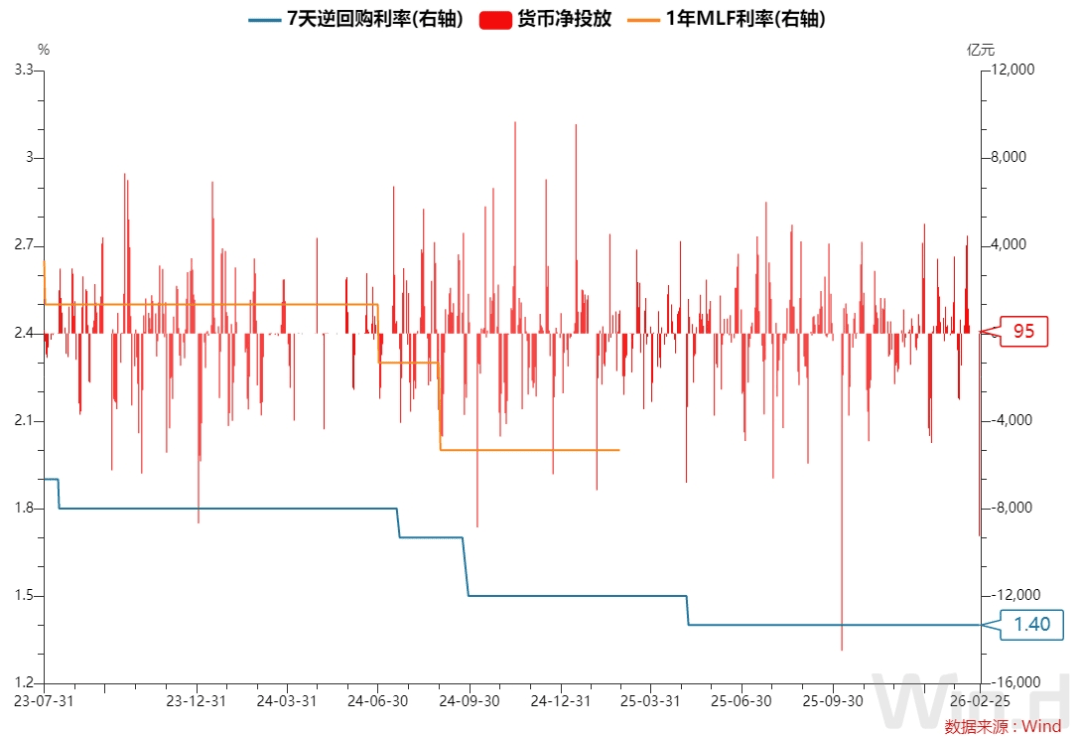
Monetary Policy Operations - The central bank announced a 7-day reverse repurchase operation of 409.5 billion yuan at a fixed rate of 1.40% on February 25, with a net injection of 9.5 billion yuan after 400 billion yuan matured on the same day [1] Market Liquidity - The interbank market remains tight due to the tax period and month-end effects, with the weighted average rate of DR001 rising nearly 2 basis points to above 1.38%, while DR007 decreased [3] - The overnight rate in the anonymous click (X-repo) system is reported at 1.43%, indicating unstable supply, with non-bank institutions borrowing overnight funds against pledged credit bonds at rates close to 1.6% [3] - The overnight financing rate in the US stands at 3.66% [3] Interbank Certificates of Deposit - The latest transaction rate for one-year interbank certificates of deposit among major banks is around 1.59%, showing a slight increase from the previous day [5] Bond Market - Major interbank bond yields have risen, with the 30-year futures contract down 0.47%, the 10-year down 0.13%, the 5-year down 0.10%, and the 2-year down 0.06% [9] Regulatory Developments - The draft amendment to the Certified Public Accountant Law was submitted for review, aiming to further regulate professional conduct and enhance accountability [10] - A joint notice from five departments in Shanghai aims to optimize real estate policies, including adjustments to housing purchase restrictions for non-local residents starting February 26, 2026 [10] International Developments - The US President highlighted low gasoline prices and mortgage rates in his State of the Union address, emphasizing the government's efforts to lower inflation [12] - The Bank of Thailand unexpectedly cut its key interest rate by 25 basis points to 1% [12] Upcoming Events - The China Development Bank plans to issue no more than 44 billion yuan in financial bonds on February 26 [15] - Country Garden intends to repurchase up to 450 million yuan of its domestic bonds [15]
人形机器人上保险风险轮廓还需摸得清
Zhong Guo Zheng Quan Bao· 2026-02-25 20:22
Core Insights - The discussion around humanoid robots remains high during the Spring Festival, with advancements in embodied intelligence technology pushing these robots from laboratories into everyday life. Concurrently, the demand for insurance coverage for these robots is increasing, with several major property insurance companies entering this market [1] Group 1: Insurance Development for Humanoid Robots - Major insurance companies are developing customized insurance plans for humanoid robots, focusing on two main areas: physical damage insurance and third-party liability insurance [1][2] - China Pacific Insurance has launched a specialized insurance product called "Smart Insurance" designed for the commercial application of humanoid robots, providing integrated coverage for physical damage and third-party liabilities [3] - Ping An Property & Casualty has introduced a comprehensive financial solution for embodied intelligent robots, integrating various risk scenarios into tailored insurance products [2][4] Group 2: Challenges in Risk Assessment - The lack of historical data and the rapid technological evolution in the humanoid robot sector pose significant challenges for insurance companies in pricing and claims processing [3][5] - Insurers are establishing dynamic risk assessment systems to better quantify risks associated with humanoid robots, employing diverse methods to gather more reference data [3][4] Group 3: Future Directions and Recommendations - Experts suggest enhancing data sharing and standardization between industries, academia, and insurance sectors to improve risk monitoring and assessment services [5][6] - The insurance industry is expected to evolve with the integration of new technologies, leading to the development of innovative insurance products tailored for cutting-edge sectors like humanoid robotics [6]



谢亚轩:也谈“存款搬家”
Xin Lang Cai Jing· 2026-02-25 09:07
Core Viewpoint - The article discusses the potential "migration" of bank deposits as a significant portion of household wealth matures in 2026, influenced by low deposit rates and an increasingly active capital market [1][7]. Group 1: Financial Asset Structure - As of the end of 2022, the financial assets of Chinese households were composed of cash and deposits (50.2%), bonds (8.8%), stocks and equity (19.5%), securities investment funds (11.7%), and insurance (9.8%) [2][8]. - The choice of whether to "migrate" deposits is fundamentally about the selection of financial assets based on risk, return, and liquidity considerations [2][8]. Group 2: International Comparisons - Research indicates that by 2024, the financial asset structure of U.S. households will be significantly different, with cash and deposits at 11.2%, bonds at 4.5%, stocks and investment funds at 55.3%, and insurance and pensions at 27.8% [3][9]. - The comparison with developed countries shows that cash and deposits in countries like the UK, Japan, and Germany remain above 30%, suggesting that the U.S. model may not be applicable to China [3][9]. Group 3: Demographic and Economic Influences - Aging population trends in China are expected to increase the preference for low-risk assets, as older individuals tend to favor safer investments [4][10]. - Low interest rates are prompting households to seek higher returns, but the method of achieving this—whether through direct stock investments or indirect methods like insurance and funds—remains uncertain [4][10][11]. Group 4: Market Performance Correlation - Historical data shows that the proportion of household stock holdings correlates with long-term stock market performance, with increases in stock fund holdings observed in the U.S., Japan, and Germany from 2013 to 2024 [5][11]. - The stability of stock and equity holdings among Chinese households is crucial for achieving a sustained bullish market [5][11].
平安产险:以保险之力,精准护航“粤制造”发展
Nan Fang Nong Cun Bao· 2026-02-25 03:04
Group 1 - The core theme of the Guangdong High-Quality Development Conference focuses on the synergy between manufacturing and service industries, with Ping An Property & Casualty Insurance showcasing its innovative insurance services to support the high-quality development of Guangdong's manufacturing sector [2][3][5] - Ping An Property & Casualty Insurance has partnered with XAG Technology to create a digital underwriting and claims system for agricultural drones, addressing high operational risks and streamlining the insurance process [9][10][11] - The company has introduced a low-altitude economy insurance product, covering over 30,000 industrial drones and providing more than 13 billion yuan in risk protection, thereby reducing operational costs for drone users [12][13] Group 2 - Ping An Property & Casualty Insurance aims to support Guangdong's emerging manufacturing and technology sectors by offering comprehensive insurance solutions, including a financial package for embodied intelligent robots and risk coverage for semiconductor manufacturing [14][15][17] - By 2025, the company plans to provide risk protection exceeding 24.8 trillion yuan for 65,000 manufacturing clients in Guangdong, including over 10,000 technology enterprises [19][20] - The company emphasizes the importance of technology insurance as a means to address the dual challenges of risk aversion among tech companies and the financial sector's limited ability to assess technical risks [26][28][30] Group 3 - Ping An Property & Casualty Insurance is transitioning from a reactive compensation role to a proactive risk management approach, integrating disaster prevention, loss reduction, and claims processing into a unified risk management model [38][40][46] - The company has developed a "Internet of Things" platform that utilizes AI and edge computing to enhance risk management, providing 24/7 monitoring and intervention for various disaster scenarios [41][43][45] - By 2025, the platform is expected to deliver over 21.99 million warnings to more than 30,000 enterprise clients, resulting in a loss reduction of over 40 million yuan [48]

低空保险需精准对接低空产业需求
Jin Rong Shi Bao· 2026-02-25 02:46
Core Insights - The low-altitude economy is rapidly transitioning from concept to reality, driven by technological breakthroughs and the expansion of application scenarios, necessitating financial support and coordinated industrial development [1] - The recent implementation of the "Implementation Opinions" by various regulatory bodies aims to optimize insurance coverage across the entire industry chain, with a goal to establish a mandatory insurance system for unmanned aerial vehicles by 2027 [1][3] Group 1: Industry Development - The low-altitude economy has been steadily growing since its inclusion in the government work report in 2024, creating a diverse application ecosystem with scenarios like "low-altitude + tourism," "low-altitude + logistics," and "low-altitude + inspection" [1] - The rapid development of the industry is accompanied by challenges in risk prevention and insurance services, which have not kept pace with the fast-evolving nature of the low-altitude sector [2] Group 2: Insurance Challenges - The insurance industry has made gradual progress in low-altitude economic coverage, but there is still a problem of product homogeneity, primarily focusing on simple drone liability insurance, while coverage for medium and large equipment and manned flights is still being developed [2] - A significant portion of low-altitude operators are small enterprises and individual pilots with limited risk-bearing capacity, leading to a concentrated demand for low-cost, highly adaptable, and quick-claim insurance products [2] Group 3: Policy and Regulatory Framework - The new policy document addresses industry pain points and provides clear guidelines for the collaborative development of low-altitude economy and insurance, including mandatory insurance requirements for unmanned aerial vehicles [3] - The document emphasizes the need to establish systems related to liability, responsibility recognition, and accident handling procedures, while also exploring the development of new insurance products for various low-altitude risks [3] Group 4: Future Directions for Insurance - The insurance industry is encouraged to break through product homogeneity by developing customized products for different scenarios such as agricultural protection, urban inspection, and low-altitude logistics, incorporating new risks like operational downtime and data security [4] - There is a push for digital transformation within the insurance sector to create a low-altitude insurance information platform, utilizing AI and IoT technologies for precise pricing and intelligent risk control [4] - With the implementation of the new policy, insurance is expected to become an essential part of the low-altitude economy, deeply integrated with industry needs to enhance safety and operational standards [4]
国信证券晨会纪要-20260225
Guoxin Securities· 2026-02-25 01:07
Core Insights - The report highlights the anticipated upward trend in convertible bonds following the Spring Festival, with a significant probability of price increases due to favorable market conditions and investor sentiment [9][10]. - The insurance industry is expected to see an increase in equity investments, with the proportion of equity assets reaching a four-year high, indicating a shift towards riskier assets amid a stable regulatory environment [12][13]. - The company "遇见小面" (Meet Noodle) is positioned as a leader in the standardized operation of Chinese noodle restaurants, with ambitious expansion plans and a projected revenue growth of 44.2% in 2024 [14][15]. Market Overview - The report provides a snapshot of major market indices, showing a mixed performance across different regions, with the Shanghai Composite Index closing at 4117.40 points, up by 0.86% [2]. - The fixed income market is experiencing a stable environment, with the 10-year government bond yield at 1.79%, reflecting a slight decrease, indicating a favorable climate for bond investments [8]. Company and Industry Analysis - "遇见小面" aims to expand its store count to 503 by 2025, representing a 39.7% increase, with a focus on both direct and franchise models [14][15]. - The Chinese noodle restaurant market is projected to grow to 326 billion yuan by 2025, with a compound annual growth rate (CAGR) of approximately 11.0%, highlighting the sector's growth potential [15]. - The insurance sector's total investment income is expected to improve, driven by a higher allocation to equity assets, with the overall investment return rate anticipated to remain favorable [12][13]. Investment Strategy - The report suggests that investors should focus on sectors such as battery production and semiconductor equipment, which are expected to benefit from increased production and demand in the coming months [9]. - The company "遇见小面" is projected to achieve adjusted net profits of approximately 1.25 to 1.4 billion yuan in 2025, reflecting a significant increase compared to previous years [14][15].
中国人寿广州市分公司:扎根湾区再突破 护航广州新征程
Guang Zhou Ri Bao· 2026-02-25 00:16
Core Insights - Guangzhou Life Insurance has achieved a historic milestone by surpassing 20 billion yuan in annual premium revenue, becoming the first city-level company in the China Life system and Guangdong insurance industry to reach this figure, marking a significant leap in its development [1] Group 1: Financial Performance - In 2025, the company reported a total premium scale of over 20 billion yuan, reflecting a rapid growth from over 10 billion yuan achieved in 2017, indicating a strong commitment to serving the Greater Bay Area and enhancing public welfare [1] - The company provided risk protection totaling 39.34 trillion yuan and served over 10.44 million customers, demonstrating its role as an economic stabilizer and social safety net [2] - In 2025, the company processed claims for 1.1696 million people, with a total payout of 1.643 billion yuan, showcasing its operational efficiency [8] Group 2: Community and Social Responsibility - Since 2013, the company has donated insurance protection worth 121.2 billion yuan, benefiting 1.4 million people, and has collaborated with various government departments to support vulnerable groups [3] - The company has actively participated in rural revitalization efforts, providing agricultural insurance premiums of 17.7 million yuan and covering 257,500 rural residents with micro-insurance [3] Group 3: Health and Elderly Care Initiatives - The "Guangzhou Mama Love Plan," initiated in collaboration with the Women's Federation, has engaged over 3.567 million participants and provided direct assistance to over 12,400 individuals, with total aid exceeding 147 million yuan [4] - The "Silver Age Health Action" has achieved full coverage of accident insurance for residents aged 60 and above in Guangzhou, with cumulative payouts reaching 420 million yuan over 11 years [4] Group 4: Digital Transformation and Innovation - The company is committed to the "Digital China" initiative, enhancing service efficiency through digital platforms, achieving a 100% paperless insurance application rate and a 93% intelligent underwriting rate [6] - The "Sui Suikang" project has established a one-stop instant settlement system, achieving over 98% of "no-feel" claims, significantly improving customer experience [6] Group 5: Support for Economic Development - In 2025, the company provided insurance coverage of nearly 1 trillion yuan for over 20,000 small and micro enterprises, supporting the stable operation of the real economy [6] - The company has launched specialized overseas insurance products to support Chinese enterprises participating in the Belt and Road Initiative, providing coverage exceeding 7.2 billion yuan for 72 companies [7]

险资抱团布局股权投资再落子 注册资本达86亿元 泰康人寿、长城人寿等7家险企参与
Mei Ri Jing Ji Xin Wen· 2026-02-24 15:11
Core Viewpoint - Insurance companies are increasingly participating in private equity funds as a strategy to invest in emerging industries and align with their core business, driven by supportive policies for long-term investments [1][4]. Group 1: Company Formation and Structure - Tianjin Lanqin Equity Investment Partnership (Limited Partnership) has been established with a registered capital of 8.601 billion yuan, involving seven insurance companies including Taikang Life and others [2]. - The partnership's operations will focus on private equity investments, asset management, and investment management, pending registration with the China Securities Investment Fund Industry Association [2]. Group 2: Investment Strategy and Trends - Insurance capital is increasingly collaborating in private equity investments to mitigate risks and enhance overall investment returns, as seen in previous joint ventures like the establishment of Beijing Baoshichengyuan Equity Investment Partnership with a total investment of 13 billion yuan [3]. - The strategy of investing in private equity funds is supported by recent policy changes that encourage insurance capital to engage in equity investments, aiming to boost direct financing for the real economy [4]. Group 3: Future Directions and Innovations - The insurance sector is expected to optimize its private equity investment strategies by incorporating secondary market transactions and enhancing liquidity, while also exploring cross-border investment opportunities [5]. - Future strategies may include a combination of primary investments, secondary market funds, and ESG considerations to achieve a balance between excess returns, risk diversification, and liquidity [5].
港股午评 恒生指数早盘跌1.93% 智谱逆市反弹20%
Jin Rong Jie· 2026-02-24 05:27
Group 1 - The Hang Seng Index fell by 1.93%, dropping 521 points to 26,560, while the Hang Seng Tech Index decreased by 2.36%. The morning trading volume was HKD 138.7 billion [1] - Zhizhu (02513) and MINIMAX-WP (00100) saw gains of over 20% and 7% respectively, indicating a rebound in the large model sector [1] - Kintor Group (00148) rose by 4.5% and Kintor Laminates (01888) increased by over 11% due to a rise in both volume and price of copper-clad laminates and upstream materials, contributing to annual performance growth [1] - Tongguan Gold (00340) increased by over 5%, with expected profit growth of approximately 289% to 298% year-on-year [1] Group 2 - Dongfang Electric (01072) rose by over 6%, driven by a long-term supply-demand gap in main engines and potential expansion in gas turbine exports [2] - Changfei Optical Fiber (06869) increased by over 5%, reaching a new high, with expectations for continued upward momentum in the optical fiber and cable sector [3] Group 3 - China Duty Free Group (01880) fell by over 9%, with a cumulative drop of more than 20% over three days, as institutions believe the stock price has already reflected the strong performance of Hainan's duty-free sales [4] - Gaming stocks collectively declined, with MGM China (02282) dropping by 4.2% due to lower-than-expected daily gambling revenue in Macau during the Spring Festival holiday [4] - Domestic insurance stocks retreated across the board, with New China Life Insurance (01336) falling by over 5%, as Q4 net profits for insurers may be affected by short-term investment fluctuations [4] - Maoyan Entertainment (01896) dropped by over 7%, reaching a nine-month low, attributed to weak box office performance during this year's Spring Festival [4]