机电

Search documents
时隔一年多,人民币又要升破7了!提振内需,需要靠汇率升值?
Sou Hu Cai Jing· 2025-12-21 06:18
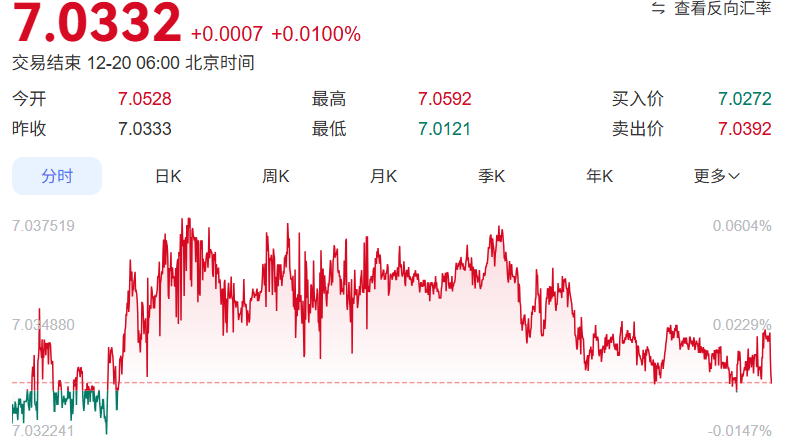
Group 1 - The offshore RMB closed at 7.033, with expectations of rising below 7.0 in the coming week, potentially marking the highest exchange rate since October 2024 [1] - The appreciation of the RMB is a result of multiple economic factors, reflecting China's strategic elevation in the global economic landscape and the dynamic adjustments in the global monetary system [3] - The current macroeconomic environment presents a strategic window for RMB appreciation, driven by the Federal Reserve's shift in monetary policy, which has seen the federal funds rate drop from 5.5% to 3.75% [3] Group 2 - The RMB's appreciation has significant strategic value for the Chinese economy, particularly in addressing the challenge of weak domestic demand [5] - Despite external pressures like increased tariffs from the U.S., China's foreign trade remains resilient, with a trade surplus exceeding $1 trillion in the first eleven months of 2025 [6] - The RMB's appreciation enhances purchasing power, benefiting imports and allowing consumers to access a wider range of imported goods at lower costs, thus stimulating consumption [8] Group 3 - RMB-denominated assets become more attractive to foreign investors due to valuation advantages, leading to increased capital inflows into the stock, real estate, and bond markets [9] - The appreciation of the RMB is expected to create significant value reassessment effects in asset markets [10] - While there are concerns about the impact of RMB appreciation on exports, Chinese exporters have demonstrated resilience, achieving year-on-year export growth despite tariff pressures [12] Group 4 - The export structure is undergoing a strategic upgrade, with high-value products like machinery, ships, and new energy vehicles becoming the main export drivers, capable of absorbing cost pressures from RMB appreciation [12] - Traditional labor-intensive products may face challenges, but these pressures can catalyze industry transformation towards high-tech and high-value sectors [14] - Overall, the RMB's appreciation aligns with the internal needs of China's economic transformation, enhancing import capacity, expanding consumption, optimizing asset allocation, and promoting industrial upgrades [14]

新股消息 兆威机电(003021.SZ)二次递表港交所
Jin Rong Jie· 2025-12-21 02:51
本文源自:智通财经网 智通财经获悉,据港交所12月19日披露,深圳市兆威机电股份有限公司(简称:兆威机电)(003021.SZ)向 港交所主板提交上市申请,招商证券国际、德意志银行为其联席保荐人。值得注意的是,兆威机电于6 月18日所递交的港股招股书满6个月,于12月18日失效。招股书显示,按2024年收入计,兆威机电是中 国最大的一体化微型传动与驱动系统产品提供商,是全球第四大一体化微型传动与驱动系统产品提供商 (根据弗若斯特沙利文报告),市场份额分别为3.9%及1.4%。 ...
【西安】前11月西安进出口总值同比增长17.5%
Shan Xi Ri Bao· 2025-12-20 00:26
Group 1 - The total import and export value of Xi'an reached 442.36 billion yuan in the first 11 months, with a year-on-year growth of 17.5%, surpassing the national growth rate of 13.9% [1] - Exports amounted to 307.69 billion yuan, increasing by 21.3%, while imports were 134.68 billion yuan, up by 9.6%, resulting in a trade surplus of 173.01 billion yuan [1] - In November alone, the import and export value was 47.82 billion yuan, with exports at 33.04 billion yuan and imports at 14.78 billion yuan, reflecting a year-on-year growth of 30.9% [1] Group 2 - Xi'an's trade with South Korea reached 73.18 billion yuan, making it the largest trading partner, followed by ASEAN at 70.3 billion yuan, and the EU at 56.71 billion yuan, which saw a significant growth of 48.2% [2] - The total import and export value with countries along the "Belt and Road" was 236.49 billion yuan, accounting for 53.5% of Xi'an's total trade, with a year-on-year growth of 7.1% [2] - Foreign-invested enterprises contributed significantly to the trade, with a total of 271.43 billion yuan, growing by 23%, while private enterprises had 147.18 billion yuan, up by 6.5% [2] Group 3 - The export scale of Xi'an continues to expand, with electromechanical products accounting for 88.7% of total exports, valued at 273 billion yuan, growing by 20.5% [3] - Integrated circuits exports reached 127.58 billion yuan, increasing by 23.7%, while automotive exports were 45.82 billion yuan, up by 22.4% [3] - Steel exports saw a remarkable growth of 330.4%, totaling 4.34 billion yuan, indicating a strong demand in this sector [3]
日元加息,恐慌来了?货币三国杀
Sou Hu Cai Jing· 2025-12-19 07:01
日元加息全世界都比较恐慌,比美国降息的影响更大,而与此同时,人民币最近一直升值,到了7.04了,海外机构甚至预计明年能到 6.7,这么巨大的变化,是因为背后有货币三国杀,美日联手想欺负人,谁能笑到最后呢? 咱们今天来说说这是怎么回事。 *此图由AI生成 作者| 史大郎&猫哥 来源| 是史大郎&大猫财经Pro(ID:caimao_shuangquan) 19号,日本定了要加息25个基点,这是今年第二次加息,利率达到0.75%,30年来最高。 现在美国进入了降息周期,之前硬挺着不降,目的就是要持续吸金,不让资金去大洋对岸输血,为了达到这个目的,一直说就业数据非 常好,经济非常好,所以没必要降息。 结果呢,就业数据全是水分,说是新增179万,结果下修了91万,超过一半都是虚的,也就是说,经济根本没那么好,所以降息就是必然 的。 美联储一降息,美元指数就跟着跌,从最高的114,降到了现在的98.4,那以美元计价的资产就跟着大跌了,许多资金就要从美国跑出 来,本来啊,很多资金是想跑咱们这来抄底的。 结果,这时候日本跳出来了,要给日元加息,今年总共加了50个基点,在30年历史上也没见几回,这是2006年之后头一次,但这可 ...

今年前11个月上海市进出口值同比增长5.7%
Zhong Guo Xin Wen Wang· 2025-12-18 10:01
Core Insights - Shanghai's import and export value increased by 5.7% year-on-year in the first 11 months of this year, reaching 4.1 trillion yuan, which is 2 percentage points higher than the national average growth rate [1] - Exports amounted to 1.83 trillion yuan, growing by 11.2%, while imports reached 2.27 trillion yuan, with a growth of 1.6% [1] - In November alone, the import and export value was 387.49 billion yuan, marking a 10.6% increase, with exports hitting a record high of 186.6 billion yuan, up 18.2% [1] Trade Partners and Market Diversification - Shanghai's trade with the European Union, its largest trading partner, reached 742.31 billion yuan, growing by 1.4% [1] - Trade with emerging markets such as ASEAN, the Middle East, and Africa saw significant growth, with increases of 12.6%, 17.5%, and 28.9% respectively, indicating effective market diversification [1] Export and Import Composition - In the first 11 months, Shanghai exported 1.19 trillion yuan worth of electromechanical products, accounting for 65.4% of total exports, with "new three types" products growing by 16.5% [2] - Notably, hybrid vehicle exports surged by 174.8% to 25.72 billion yuan, while liquid cargo ship exports increased by 130.5% to 34.24 billion yuan [2] - High-tech product imports totaled 737.21 billion yuan, with significant growth in semiconductor manufacturing equipment, computers, and aircraft, reflecting a robust manufacturing sector [2] Consumer Goods and Market Activity - The import of consumer goods showed positive trends, with fruit and dairy product imports growing by 17.8% and 14.2% respectively, alongside toys and sports equipment imports increasing by 17% and 15.1% [2]
新股消息 | 兆威机电港股IPO招股书失效
Zhi Tong Cai Jing· 2025-12-18 02:49
Group 1 - The core viewpoint of the article is that Shenzhen Zhaowei Electromechanical Co., Ltd. has seen its Hong Kong IPO application expire after six months, with招商证券国际 and Deutsche Bank serving as joint sponsors [1] - Zhaowei Electromechanical is an integrated provider of micro drive and drive system solutions, targeting high-growth industries such as smart vehicles, embodied robotics, consumer technology, medical technology, and advanced industrial manufacturing [1] - The company has launched three major platform-based proprietary product lines, including high-performance servo motors, drum motors, and dexterous hands, covering high-potential sectors like high-end smart consumer products, advanced manufacturing, and humanoid robotics [1]

吴江前11月外贸进出口同比增6.6%
Su Zhou Ri Bao· 2025-12-18 00:26
Core Insights - Wujiang's foreign trade total value reached 170.83 billion yuan, with a year-on-year growth of 6.6% [1] - Exports amounted to 136.4 billion yuan, increasing by 9.6%, while imports were 34.43 billion yuan [1] Trade Structure - General trade accounted for over half of the total trade, with a value of 85.99 billion yuan, growing by 4.7%, representing 50.3% of total trade [1] - Processing trade saw a significant increase, with a total of 43.86 billion yuan, growing by 15.5%, and accounting for 25.7% of total trade, up 2 percentage points from the previous year [1] Enterprise Performance - There were 4,061 enterprises engaged in import and export activities, an increase of 262 from the previous year [1] - Private enterprises accounted for nearly 60% of the total trade, with 3,422 private enterprises contributing 100.58 billion yuan, a growth of 4.7%, representing 58.9% of total trade [1] - Foreign-invested enterprises also showed rapid growth, with a total trade value of 70.25 billion yuan, increasing by 9.5%, accounting for 41.1% of total trade, contributing an additional 3.8 percentage points to foreign trade [1] Trade Partners - The share of trade with countries involved in the Belt and Road Initiative continued to rise, with a total trade value of 80.64 billion yuan, growing by 9.6%, and accounting for 47.2% of total trade, up from 45.9% in the previous year [1] Export Products - Nearly 70% of exports were electromechanical products, totaling 93.23 billion yuan, with a growth of 10.6%, representing 68.4% of total exports [2] - Computer exports reached 28.4 billion yuan, a decrease of 2%, while electrical equipment exports surged to 15.72 billion yuan, increasing by 48.2%, contributing 4.1 percentage points to total exports [2] - Labor-intensive products accounted for 35.23 billion yuan in exports, growing by 3.8%, representing 25.8% of total exports [2]
十五五,攻坚牛——2026年度策略
2025-12-17 15:50
Summary of Key Points from Conference Call Records Industry and Company Overview - The conference call discusses the Chinese economy and its growth prospects during the "Fifteen" period, aiming to surpass 70% of the US GDP by 2026, with industrial added value reaching 1.6 times that of the US, driven by R&D investment and industrial system construction [1][3][5]. Core Insights and Arguments - **Economic Growth and Challenges**: The US faces increasing debt and fiscal deficit challenges, with a potential long-term economic growth rate of only 1.2%. Concerns over US debt security are prompting foreign investors to reduce US debt holdings, while central banks are increasing gold purchases [1][3]. - **Investment Opportunities**: The next five years will focus on industrial upgrades, technological innovation, and consumption enhancement. High R&D investment and a complete industrial system provide a solid foundation to counter external technological blockades [1][5]. - **Export Performance**: China's export share is at a record high, with reliance on the US dropping below 10%. This diversification strategy enhances export resilience and leads to a continuous trade surplus, indicating improved competitiveness [1][9]. - **Consumer Spending**: To address weak consumption, China aims to increase the resident consumption rate, optimize "two new" policies, and strengthen stimulus measures to support domestic demand [1][11]. Additional Important Content - **Financial Market Reforms**: The 2025 financial market reforms aim to shift fund management from scale-oriented to benefit-oriented, with a tighter IPO schedule and low levels of share reduction expected to continue into 2026 [2][14][17]. - **Investment Focus for 2026**: Key investment opportunities include high-growth export chains, cyclical stocks, and sectors benefiting from a consumption rebound, with a focus on retail sales and CPI indicators to validate trends [2][18]. - **Emerging Industries**: Significant attention is directed towards emerging industries such as quantum technology, biomanufacturing, hydrogen energy, nuclear fusion, and brain-computer interfaces, which align with national strategic goals [1][10][19]. - **Domestic Economic Dynamics**: Enhancing domestic circulation's endogenous power and reliability through investment in both goods and human resources is crucial for sustainable economic growth [13]. This summary encapsulates the essential insights and projections from the conference call, highlighting the strategic focus areas for China's economic development and investment landscape.
中国机电供货商:互联网时代,机电供货商如何用数字引擎驱动行业新未来?
Sou Hu Cai Jing· 2025-12-17 09:38
Core Insights - The mechanical and electrical industry is undergoing a profound transformation driven by internet technology, with traditional supply models being replaced by smart supply chains, emphasizing efficiency, transparency, and innovation [1] Group 1: Pain Points of Traditional Supply Models - Information silos hinder efficiency, with order, inventory, and logistics data scattered across multiple systems, leading to a high error rate of 15% due to manual verification [1] - Slow response times result in an average of 7 days from order to delivery, causing missed market opportunities [1] - Fixed service boundaries limit offerings to product transactions, with customer repurchase rates below 30% [1] Group 2: How Internet Technology Restructures Supply Chains - Data transparency is achieved through IoT sensors that collect real-time operational data, combined with cloud-based ERP systems, resulting in a 40% increase in inventory turnover and a 65% decrease in customer complaints [3] - Intelligent forecasting shifts from reactive to proactive service by using AI algorithms to analyze historical orders and market trends, improving stock accuracy to 92% and tripling emergency order processing efficiency [3] - Service extension transforms the business model from selling products to offering solutions, including remote operation and maintenance platforms that enhance customer lifetime value by 2.8 times, with service revenue exceeding 35% [4] Group 3: Urgency for Transformation - The technology barrier has lowered, with SaaS tools allowing small and medium enterprises to achieve digital management for as little as a thousand yuan per month [6] - Customer preferences have shifted, with 85% of buyers prioritizing suppliers that offer online quotes and progress tracking [6] - Government incentives for smart manufacturing are available, with potential subsidies of up to one million yuan for transforming companies [6] - Recommended actions include prioritizing lightweight digital tools, collaborating with third-party technology platforms, and fostering a data-driven decision-making culture [6] Group 4: Industry Response to Transformation - Chinese mechanical and electrical suppliers are actively considering internet-driven transformation, utilizing offline foundations and online channels, including mini-programs for e-commerce, public accounts for promotion, and community marketing for precision targeting [7]

前11月外贸出口超预期强劲,人民币中间价陡峭升值
Sou Hu Cai Jing· 2025-12-16 11:38
Group 1 - The core viewpoint of the articles indicates that the Chinese yuan is experiencing a significant appreciation against the US dollar, driven by strong trade surpluses and favorable economic conditions [2][3][4] - The yuan's exchange rate has seen a steep decline, with the midpoint rate against the dollar dropping to 7.0602, a decrease of 54 basis points, and a total decline of 157 basis points since the beginning of the month [2] - China's trade surplus for November increased by 5.9% year-on-year, pushing the cumulative surplus for the first 11 months of the year to over $1 trillion, marking a historical first [2][3] Group 2 - The export structure has shifted significantly, with mechanical and electrical products accounting for 60.9% of total exports, and notable growth in integrated circuits (25.6%) and automobiles (17.6%) [3] - Despite a 20% decline in exports to the US due to tariffs, other regions have compensated for this drop, with ASEAN becoming the largest trading partner, growing by 8.5% [3] - The Chinese economy is benefiting from a strong export performance, which is crucial for supporting the yuan's appreciation, even amid domestic demand challenges [2][3] Group 3 - The yuan's appreciation is also influenced by US monetary policy, with expectations of further interest rate cuts by the Federal Reserve, which would likely lead to a weaker dollar [5][6][7] - The potential candidates for the Federal Reserve chair, both advocating for lower interest rates, suggest a continued dovish stance that could further impact the dollar's strength [6][7] - The Chinese central bank is expected to maintain a moderately loose monetary policy, which, combined with a narrowing interest rate differential with the US, is favorable for the yuan [5]