
石油行业

Search documents
温铁军:美元如何收割全世界?中国经济三次阵痛背后的收割逻辑
Sou Hu Cai Jing· 2025-11-05 11:09
Core Insights - The article argues that the true driver of the global economy is the US dollar, not institutions like the UN or IMF, and highlights a pattern of financial exploitation by the US over the past three decades [1] - It emphasizes that the US engages in financial manipulation rather than genuine economic development, leading to repeated crises in countries like China [1][14] Group 1: Historical Context - After the 2008 financial crisis, the US implemented significant quantitative easing (QE), injecting over 60% of new dollar liquidity into global markets, which caused commodity prices, including oil, to surge dramatically [3][5] - China, as the largest importer of raw materials and energy, was particularly affected by these price increases, leading to inflationary pressures [5][6] Group 2: Economic Impact - The influx of dollars led to "input-type inflation" in China, where local manufacturers faced rising costs while trying to compete in a global market dominated by US monetary policy [6][12] - The US's strategy of withdrawing liquidity through interest rate hikes and QE cessation resulted in a sharp decline in oil prices, adversely impacting exporting countries and leading to production overcapacity in China [8][14] Group 3: Dollar's Global Role - The dollar's status as the global reserve currency allows the US to dictate terms in international trade, particularly in commodities like oil, which must be purchased in dollars [10][12] - The US's financial maneuvers not only affect its own economy but also have significant repercussions for other nations, particularly those reliant on exports and foreign investment [12][16] Group 4: Strategic Implications - The article outlines a three-step process of financial exploitation by the US: first, through liquidity and commodity price manipulation; second, by compelling foreign entities to invest in US debt; and third, by leveraging this debt to gain influence over foreign infrastructure and policies [16] - The US's military presence and financial dominance serve as a strategic tool to maintain its economic hegemony, effectively isolating nations that challenge its authority [16][18] Group 5: Future Considerations - The article concludes that China must reassess its economic strategies and not solely focus on GDP growth, as financial warfare poses a significant threat to its industrial base [18][20] - It advocates for a shift towards reclaiming economic sovereignty and reducing dependency on the US dollar to prevent future crises [20]


和顺石油(603353)披露2025年前三季度利润分配方案,10月31日股价上涨5.58%
Sou Hu Cai Jing· 2025-10-31 10:35
Core Points - The stock of Heshun Petroleum (600353) closed at 21.58 yuan on October 31, 2025, marking a 5.58% increase from the previous trading day, with a total market capitalization of 3.71 billion yuan [1] - The company announced a profit distribution plan for the first three quarters of 2025, proposing a cash dividend of 0.1 yuan per share (tax included) to all shareholders, totaling 17,190,600 yuan [1] Financial Performance - For the first three quarters of 2025, Heshun Petroleum reported a net profit attributable to shareholders of 21,806,169.46 yuan [1] - The company's retained earnings at the end of the reporting period amounted to 300,112,888.75 yuan [1] Dividend Distribution - The cash dividend distribution is based on the total share capital as of the equity distribution registration date, with a total share capital of 171,906,000 shares as of September 30, 2025 [1] - The profit distribution plan has been approved by the company's fourth board of directors at its sixth meeting [1]

“十五五”规划建议的18个新提法,释放了哪些重要信号?
Mei Ri Jing Ji Xin Wen· 2025-10-29 15:24
Group 1 - The "15th Five-Year Plan" emphasizes the importance of technological innovation, mentioning "technology" 46 times and "innovation" 61 times, aiming to create a favorable environment for original and disruptive innovations [2] - The plan proposes to gradually increase the basic pension for urban and rural residents, highlighting the focus on improving people's livelihoods and promoting common prosperity [2][29] - New strategic technologies such as quantum technology, biomanufacturing, hydrogen energy, and artificial intelligence are identified as future economic growth points, with a focus on their commercialization during the "15th Five-Year Plan" period [3][4] Group 2 - The plan suggests establishing a risk-sharing mechanism for future industry investments, recognizing the uncertainties in technology and market conditions [5][6] - It proposes a new national system to tackle key technologies in areas like integrated circuits and advanced materials, emphasizing the need for collective efforts from various market entities [7] - The plan includes measures to enhance public service spending to boost consumer capacity, indicating a shift towards improving the consumption environment [9][10] Group 3 - The plan aims to peak coal and oil consumption, aligning with the broader goal of achieving carbon peak by 2030, necessitating a transition to a new energy system [12][13] - It emphasizes the need for proactive macroeconomic policies to stabilize growth, employment, and expectations, particularly in light of the challenges posed by traditional economic drivers [14][15] Group 4 - The plan highlights the importance of expanding service trade and optimizing market access, particularly in the service sector, to enhance international competitiveness [18][21] - It focuses on promoting green trade and intermediate goods trade, which are seen as vital for stabilizing foreign trade and aligning with global environmental goals [19][20] Group 5 - The plan includes initiatives to enhance food security through a new round of grain production capacity improvement actions, aiming for a significant increase in grain output [23][24] - It emphasizes the need for efficient land use in rural areas, addressing the mismatch between idle land and the demand for construction land to support rural development [25][26] Group 6 - The plan proposes to expand free education and explore extending compulsory education, which is expected to alleviate educational burdens and improve human capital development [27][28] - It aims to optimize the supply of affordable housing to meet the basic housing needs of urban wage earners and disadvantaged families, marking a shift towards a more inclusive housing policy [30][31]

资讯早班车-2025-10-24-20251024
Bao Cheng Qi Huo· 2025-10-24 01:55
1. Report Industry Investment Rating No relevant content provided. 2. Core Views of the Report - The 4th Plenary Session of the 20th CPC Central Committee put forward the main goals for economic and social development during the 15th Five - Year Plan period, aiming for significant achievements in high - quality development, a substantial increase in scientific and technological self - reliance, and new breakthroughs in comprehensive deep - seated reforms [2][16]. - Amid global geopolitical risks, sanctions on Russia's oil industry are likely to reshape the global energy trade and drive up oil prices, while OPEC is prepared to increase production to fill potential shortages [9]. - The new policy - based financial tools have reached over half of the 500 billion yuan quota, expected to drive over 4 trillion yuan in total project investment and stimulate credit and social financing growth [19]. 3. Summary by Relevant Catalogs 3.1 Macro Data Quick View - In September 2025, GDP growth at constant prices was 4.8% year - on - year, down from 5.2% in the previous quarter but up from 4.6% in the same period last year [1]. - The manufacturing PMI was 49.8%, slightly up from 49.4% in the previous month, and the non - manufacturing PMI was 50.0%, down from 50.3% [1]. - The year - on - year growth rates of M0, M1, and M2 were 11.5%, 7.2%, and 8.4% respectively, with M1 showing a significant increase compared to the previous month and the same period last year [1]. - The CPI decreased by 0.3% year - on - year, and the PPI decreased by 2.3% year - on - year [1]. - Fixed - asset investment (excluding rural households) decreased by 0.5% year - on - year on a cumulative basis, while the cumulative year - on - year growth rate of total retail sales of consumer goods was 4.46% [1]. - Exports and imports increased by 8.3% and 7.4% year - on - year respectively [1]. 3.2 Commodity Investment Reference 3.2.1 Comprehensive - The 4th Plenary Session of the 20th CPC Central Committee set long - term economic and social development goals, and China and the US will hold economic and trade consultations [2][16]. - Anshi China refuted the false remarks of the current management of Anshi Netherlands, and the Dutch Anshi may face delivery problems, affecting the global production of Japanese auto parts manufacturers [3]. - Multiple banks have raised the minimum investment amount for gold accumulation products to adapt to the rising gold prices [3]. 3.2.2 Metals - Gold prices have corrected, leading investors to "buy the dip". JPMorgan Chase maintains a bullish view on gold, predicting an average price of $5,055 per ounce in Q4 2026 [4][5]. - Russia's central bank's gold and foreign exchange reserves increased to $742.4 billion as of October 17 [5]. - London Metal Exchange inventories of most metals decreased, except for copper which increased slightly [5]. 3.2.3 Coal, Coke, Steel, and Minerals - China's Mineral Resources Appraisers Association joined the CRIRSCO on October 16 [7]. - Global crude steel production in September 2025 was 141.8 million tons, a 1.6% decrease from September 2024 [7]. - Coal transportation is expected to exceed 2024 levels due to the forecast of natural gas prices [7]. 3.2.4 Energy and Chemicals - In September, total social electricity consumption was 888.6 billion kWh, a 4.5% year - on - year increase, with the second and third industries showing significant growth [8][9]. - US crude oil futures rose 5.56% due to sanctions on Russia's oil industry and a decrease in US EIA crude oil inventories [9]. - New sanctions on Russia's oil industry may reshape the global energy trade and drive up oil prices, and OPEC is prepared to increase production [9]. 3.2.5 Agricultural Products - The Ministry of Commerce issued a notice on the second - round allocation of agricultural product export quotas in 2025 [12]. - US President Trump plans to increase tax - free beef imports from Argentina, which has caused controversy [12]. - The Starbucks Workers Union has initiated a strike authorization vote [13]. - On October 23, the price of New York Arabica coffee futures reached a record high [14]. 3.3 Financial News Compilation 3.3.1 Open Market - On October 23, the central bank conducted 212.5 billion yuan of 7 - day reverse repurchase operations, with a net withdrawal of 23.5 billion yuan [15]. - The Ministry of Finance and the central bank conducted a 120 - billion - yuan central treasury cash management commercial bank time - deposit auction on October 23 [15]. 3.3.2 Important News - The 4th Plenary Session of the 20th CPC Central Committee emphasized building a strong domestic market and achieving the annual economic and social development goals [16][17]. - China and the US will hold economic and trade consultations, and the APEC Finance Ministers' Meeting was held in South Korea [17][18]. - The EU's sanctions on Chinese enterprises in the 19th round of sanctions on Russia have been strongly opposed by China [18][19]. - The new policy - based financial tools have been put into use, and the scale of bank wealth management has increased [19]. 3.3.3 Bond Market Summary - China's bond market was weak and volatile, with mixed changes in bond yields and a decline in treasury bond futures [23]. - In the exchange - traded bond market, some bonds rose while others fell, and the money market remained stable [23][24]. - European and US bond yields generally increased [26][27]. 3.3.4 Foreign Exchange Market Express - The on - shore RMB against the US dollar rose 24 points to 7.1221 at the 16:30 close, and the central parity rate rose 36 points [28]. - The US dollar index rose slightly, and most non - US currencies showed mixed trends [29]. 3.3.5 Research Report Highlights - Citic Construction Investment believes that the Five - Year Plan reflects evolving policy concepts, with more emphasis on quality and new productivity [30]. - Huatai Fixed Income suggests that the supply of Chinese dollar - denominated bonds may increase in elasticity, and investors should pay attention to different types of bonds [30]. - CITIC Securities expects the RMB exchange rate to appreciate moderately in 2026 under normal export conditions [31]. - CITIC Securities analyzes that Japan's new Prime Minister's economic policies focus on curbing inflation and improving fiscal efficiency [31]. 3.4 Stock Market Important News - On Thursday, A - shares closed higher, with the Shanghai Composite Index up 0.22%, the Shenzhen Component Index up 0.22%, and the ChiNext Index up 0.09%, and the trading volume reached 1.66 trillion yuan [34]. - The Hong Kong Hang Seng Index rose 0.72%, ending a 5 - day losing streak, and the Southbound funds had a net purchase of HK$5.345 billion [34].
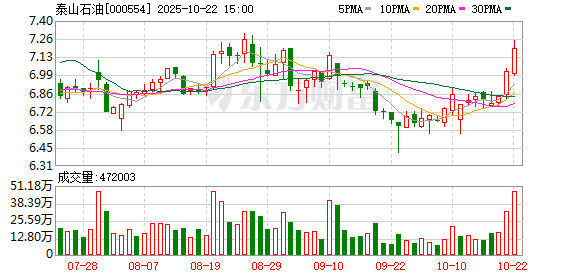
泰山石油(000554.SZ):前三季净利润1.13亿元 同比增长112.32%
Ge Long Hui A P P· 2025-10-22 09:08
Core Insights - Taishan Petroleum (000554.SZ) reported a decline in revenue for the first three quarters, amounting to 2.395 billion yuan, a year-on-year decrease of 5.60% [1] - The net profit attributable to shareholders increased significantly to 113 million yuan, reflecting a year-on-year growth of 112.32% [1] - The net profit attributable to shareholders after deducting non-recurring gains and losses reached 117 million yuan, marking a year-on-year increase of 105.22% [1]

泰山石油:前三季度净利润同比增长112.32%
Zheng Quan Shi Bao Wang· 2025-10-22 08:59
Core Viewpoint - The company reported a decline in revenue for the third quarter of 2025, while showing significant growth in net profit year-on-year [1] Financial Performance - In Q3 2025, the company achieved revenue of 807 million yuan, a year-on-year decrease of 5.54% [1] - The net profit attributable to shareholders for Q3 2025 was 21.73 million yuan, reflecting a year-on-year increase of 24.95% [1] - For the first three quarters of 2025, the company reported total revenue of 2.395 billion yuan, down 5.6% compared to the same period last year [1] - The net profit attributable to shareholders for the first three quarters was 113 million yuan, which represents a year-on-year growth of 112.32% [1]
泰山石油:截至2025年10月20日登记在册的公司股东户数合计43890户
Zheng Quan Ri Bao· 2025-10-22 08:39
Core Insights - Taishan Petroleum reported that as of October 20, 2025, the total number of registered shareholders is 43,890 [2] Company Summary - Taishan Petroleum has engaged with investors through an interactive platform, providing updates on shareholder statistics [2] - The company is actively monitoring its shareholder base, indicating a focus on investor relations and transparency [2]
回望“十四五”| 数说“十四五” ESG笔墨绘就企业发展新底色
Zhong Guo Zheng Quan Bao· 2025-10-21 00:27
Group 1: ESG Reporting and Development - The disclosure rate of ESG reports among A-share listed companies has increased significantly, with 2,521 companies publishing reports for the 2024 fiscal year, representing 46.83% of all listed companies, marking a 71% increase from 2021 [2] - The quality of ESG development has improved, with 342 companies in the Shanghai Stock Exchange included in MSCI ESG ratings, and 100 companies receiving upgrades in their ratings [2] - ESG has evolved from a conceptual framework to a key dimension for measuring corporate competitiveness, aligning with national development goals for green growth and harmony with nature [2][4] Group 2: Green Energy and Low-Carbon Initiatives - The share of renewable energy in power generation capacity has risen from 40% to approximately 60% during the "14th Five-Year Plan" period, with nearly 60% of new power generation coming from non-fossil energy sources [6] - A zero-carbon intelligent manufacturing base in Jiangsu has been established, generating over 600 million kWh of clean electricity annually and achieving net-zero emissions [5] - Significant reductions in energy consumption per unit of GDP have been achieved, with an 11.6% decrease over four years, equating to a reduction of 1.1 billion tons of CO2 emissions [6] Group 3: Corporate Social Responsibility and Community Engagement - A majority of listed companies are actively engaging in community services and educational support, with 67.16% involved in community service and 66.67% providing educational assistance [8] - The third industry has seen an increase in employment capacity, with 35.866 million people employed by the end of 2024, marking a 1.1 percentage point increase in its share of total employment [8] - Significant progress has been made in housing projects, with over 240,000 urban old residential areas renovated, benefiting over 40 million households [9] Group 4: Agricultural and Rural Development - Companies are integrating ESG practices with rural revitalization strategies, with over 6,000 enterprises supporting poverty alleviation efforts [12] - The contribution rate of agricultural technology has reached 63.2%, with over 75% of crop farming being mechanized by the end of 2024 [12] - Initiatives like the "MAP modern agricultural assistance model" have helped increase agricultural output and income for farmers [12]

数说“十四五” ESG笔墨绘就企业发展新底色
Zhong Guo Zheng Quan Bao· 2025-10-20 20:17
Core Insights - The disclosure rate of ESG reports among A-share listed companies has steadily increased, with a 71% year-on-year growth in the number of reports published for the 2024 fiscal year compared to 2021 [2] - ESG has evolved from a conceptual framework to a critical dimension for measuring corporate competitiveness, aligning with national development goals [2][3] - Companies are increasingly integrating sustainable development principles into their corporate culture and operations, demonstrating a commitment to ESG practices [2][3] ESG Disclosure and Performance - As of September 2025, 2,521 A-share listed companies have published ESG reports, representing 46.83% of all listed companies [2] - The quality of ESG disclosures has significantly improved, with 342 companies included in MSCI ESG ratings, and 100 companies receiving upgrades in their ratings [2] - The shift towards actionable ESG practices is evident across various industries, with companies adopting international ESG standards to enhance report quality [2] Green Development Initiatives - The share of renewable energy in China's power generation capacity has increased from 40% to approximately 60% during the "14th Five-Year Plan" period [4] - Significant reductions in carbon emissions have been achieved, with a reported decrease of 11.6% in energy consumption per unit of GDP, equating to a reduction of 1.1 billion tons of CO2 emissions [5] - Companies are increasingly adopting green technologies and practices, contributing to a sustainable business model and enhancing their competitive edge [3][4] Social Responsibility and Community Engagement - A growing number of companies are embedding social responsibility into their operations, with 67.16% engaging in community services and 66.67% supporting educational resources [6] - The third sector's employment capacity has strengthened, with 35.87 million people employed in this sector by the end of 2024, marking a 1.1 percentage point increase from 2020 [6] - Companies are actively participating in housing and elderly care initiatives, significantly improving living conditions and support networks for communities [6][7] Agricultural and Rural Development - Companies are integrating ESG practices with rural revitalization strategies, exemplified by successful projects like the silk industry in Guangxi, which is expected to generate over 8 million yuan in output by 2025 [8] - Digital solutions are being implemented to enhance agricultural productivity, with platforms connecting over 1,000 agricultural regions and benefiting millions of farmers [8] - The contribution of agricultural technology to productivity has reached 63.2%, with mechanization rates exceeding 75%, showcasing the role of innovation in modern agriculture [8]
多资产周报:PPI企稳下的资产价格含义-20251020
Guoxin Securities· 2025-10-20 14:26
Group 1: PPI and Asset Prices - The PPI has stabilized, with a month-on-month change of 0 for the second consecutive month, indicating a potential trend in domestic asset prices[1] - Despite the current international oil price affecting related industries, there is a strong expectation for future easing by the Federal Reserve, supporting prices of commodities like gold and copper[1] - The implementation of anti-involution policies is showing results in key sectors like photovoltaics and new energy, with significant price increases observed post-National Day[1] Group 2: Market Performance - From October 11 to October 18, the CSI 300 index fell by 2.23%, while the Hang Seng Index dropped by 3.97%, and the S&P 500 rose by 1.71%[2] - The 10-year China bond yield increased by 0.41 basis points, while the 10-year US Treasury yield decreased by 3.01 basis points[2] - The US dollar index decreased by 0.27%, and the offshore RMB appreciated by 0.3%[2] Group 3: Inventory and Fund Behavior - The latest oil inventory stands at 44,355 million tons, up by 2.78 million tons from the previous week[3] - The latest week saw a rise in gold ETF holdings to 3,366 million ounces, an increase of 960,000 ounces[3] - The dollar long position increased by 1,541 contracts to 14,032, while the short position decreased by 1,009 contracts to 24,376[3] Group 4: Economic Indicators - Fixed asset investment year-on-year change is at -0.50%[5] - Retail sales year-on-year growth is at 3.00%[5] - Exports year-on-year growth is at 8.30%[5] - M2 growth rate is at 8.40%[5]