
云计算

Search documents
突然爆发,20%涨停!两大利好突袭,“龙虾时刻”上演?
Xin Lang Cai Jing· 2026-01-28 04:19
Core Insights - The article highlights a significant surge in interest and investment in AI technologies, particularly with the launch of the AI Agent project Clawdbot, which has gained over 58,000 stars on GitHub within a month, marking a 62% increase in daily engagement [1][2][8] - Google Cloud has announced a price increase for its data transmission services, effective May 1, 2026, with North American rates doubling, indicating a pivotal shift in the long-standing trend of decreasing cloud service prices [2][8] - The demand for AI computing power is expected to rise dramatically, driven by the increasing integration of AI into workflows, which could lead to explosive growth in token demand and benefit the entire AI industry chain [3][8] Industry Developments - Google Cloud's price adjustments will affect three service categories: CDN Interconnect, Direct Peering, and Carrier Peering, with North American data transmission costs rising from $0.04 to $0.08 per GB, European costs from $0.05 to $0.08, and Asian costs from $0.06 to $0.085 [2][8] - The AI computing rental sector is experiencing a boom, with companies like Meiliyun seeing significant stock price increases, and AWS announcing a 15% price hike for its EC2 machine learning capacity blocks, marking its first price adjustment in nearly 20 years [3][9] - NVIDIA's investment of $2 billion in CoreWeave aims to enhance AI computing capabilities, further validating the high demand for AI cloud infrastructure [9][10] Competitive Landscape - CoreWeave, originally a cryptocurrency mining company, has shifted its focus to AI cloud computing and GPU rental services, reflecting the growing importance of AI infrastructure [4][9] - Alibaba has launched its flagship AI model, Qwen3-Max-Thinking, which boasts over 1 trillion parameters and has outperformed leading models in key performance benchmarks, positioning it as a strong competitor in the AI landscape [10][11] - The increasing capabilities of domestic giants like ByteDance, Alibaba, and Tencent are expected to significantly boost the demand for AI cloud infrastructure in China [11]





突然爆发,20%涨停!两大利好突袭,“龙虾时刻”上演?
券商中国· 2026-01-28 04:10
Core Insights - The article highlights a significant surge in interest and investment in AI technologies, particularly with the launch of the AI Agent project Clawdbot, which has gained over 58,000 stars on GitHub in less than a month, marking a 62% daily increase [1][2] - Google Cloud has announced a price increase for its data transmission services starting May 2026, with North American rates expected to double, indicating a shift in the long-standing trend of decreasing prices in the cloud services industry [2][4] Group 1: AI Agent and Market Response - Clawdbot is being referred to as the "ChatGPT moment" of 2026, with significant engagement in the tech community, including endorsements from notable figures like Tesla's former AI chief [2][3] - The demand for AI capabilities is projected to explode as AI integrates into workflows, benefiting the entire AI industry chain [3] Group 2: Data Center and Cloud Services - Google Cloud's price adjustments will affect various services, including CDN Interconnect and Direct Peering, with North American data transmission costs rising from $0.04 to $0.08 per GB, and similar increases in Europe and Asia [2] - Amazon Web Services (AWS) has also announced a 15% price increase for its EC2 machine learning capacity blocks, marking its first price adjustment in nearly 20 years, reflecting the growing demand for AI computing resources [4][5] Group 3: Investment and Infrastructure Developments - NVIDIA's investment of $2 billion in CoreWeave aims to enhance AI computing capacity, further validating the high demand for AI cloud infrastructure [4] - Alibaba has launched its Qwen3-Max-Thinking model, which boasts over 1 trillion parameters and has outperformed leading models in key performance benchmarks, indicating the competitive landscape in AI model development [5]



加拿大之后,欧洲终于明白:平等的朋友,美国给不了
Xin Lang Cai Jing· 2026-01-28 03:25
Core Viewpoint - The increasing friction between Europe and the United States in the technology sector indicates a potential shift towards technological independence for Europe, driven by long-standing grievances and a desire for self-sufficiency [1] Group 1: Current State of Dependence - Europe's reliance on American technology is evident, with U.S. companies like Amazon, Microsoft, and Google holding over two-thirds of the cloud computing market in Europe, while local suppliers account for only about 15% [3] - The search engine market is dominated by Google, which holds a 90% market share, and Amazon leads in the e-commerce sector [3] Group 2: Regulatory Responses - In response to this dependence, the EU has enacted regulations such as the Digital Services Act and the Digital Markets Act to counter the violations of U.S. tech giants, resulting in significant fines, including €29.5 billion for Google and €1.2 billion for X platform [5] - The U.S. government's reaction to these fines has escalated tensions, with political figures labeling them as "malicious fines" and implementing visa restrictions on European officials [5] Group 3: Broader Industry Conflicts - The conflict extends beyond digital technology to critical industries like renewable energy and semiconductors, where U.S. subsidies under the Inflation Reduction Act have diverted investments away from Europe [7] - The EU's efforts to boost its semiconductor industry through the Chips Act face significant challenges, with an EU audit indicating that achieving a 20% global market share by 2030 is "extremely unlikely" [7] Group 4: Future Initiatives for Autonomy - The EU plans to launch an "AI Super Factory" project by 2026 and aims to triple data center capacity in the next 5 to 7 years through the Cloud and AI Development Act [9] - However, achieving technological autonomy is hindered by funding and time constraints, with estimates suggesting a need for €300 billion and potentially up to €5 trillion in total costs [9] Group 5: Long-term Outlook - Despite the challenges, the trend towards technological independence in Europe is irreversible, as the region seeks to move away from being a follower of U.S. technology [11] - Successful navigation of this path will require collaboration among European nations and sustained investment, with the potential to reshape the global technology landscape over time [11]
谷歌云官宣涨价,云计算景气度攀升!阿里稳居国内市场断层第一,港股互联网ETF(513770)受资金关注
Xin Lang Cai Jing· 2026-01-28 03:10
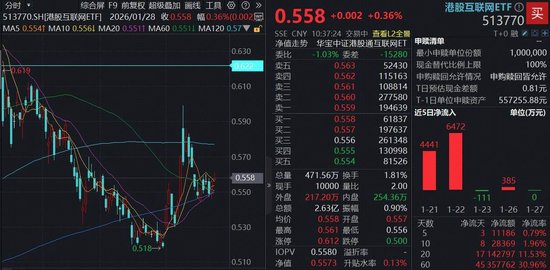
Group 1: Market Performance - Hong Kong stocks opened higher on January 27, with major internet companies showing strength; Tencent Holdings rose over 1%, Kuaishou and Bilibili increased by over 2%, while Alibaba remained stable [1][8] - The Hong Kong Internet ETF (513770), a core asset in AI, opened slightly higher and experienced narrow fluctuations, with a current price increase of 0.36% and a trading volume of 263 million yuan, indicating active trading [1][8] - In the past 20 days, the Hong Kong Internet ETF has attracted a total of 1.428 billion yuan in investments [1][8] Group 2: Cloud Services Price Adjustments - Google Cloud announced a price increase effective May 1, 2026, affecting Google Cloud, CDN Interconnect, Peering, and AI computing infrastructure services; Amazon Web Services (AWS) also announced a price hike [3][10] - The price adjustments reflect the high demand for AI computing power globally, indicating a robust growth trend in the AI sector [3][10] - The AI industry is experiencing a price increase trend across different segments, with storage prices expected to rise in the first half of 2025 and CPU prices starting in January 2026 [3][10] Group 3: AI Market Insights - According to a report by Infoman, the Chinese AI cloud market is projected to reach 22.3 billion yuan in the first half of 2025, with Alibaba Cloud holding a 35.8% market share, surpassing the combined share of the second to fourth players [3][10] - Alibaba recently launched its flagship reasoning model Qwen3-Max-Thinking, achieving several global records in authoritative evaluations, marking it as the strongest domestic AI model to date [3][10] Group 4: ETF Composition and Strategy - The Hong Kong Internet ETF (513770) and its linked funds passively track the CSI Hong Kong Internet Index, with the top ten weighted stocks including Alibaba, Tencent, Xiaomi, Kuaishou, and Bilibili, collectively accounting for nearly 77% of the index [4][11] - For investors looking to reduce volatility while still focusing on technology, the Hong Kong Large Cap 30 ETF (520560) is recommended, combining high-growth tech stocks with stable dividend-paying companies [4][12]
大行评级|美银:因SaaS板块估值普遍受压,下调亚马逊目标价至286美元,重申“买入”评级
Ge Long Hui· 2026-01-28 03:07
Core Viewpoint - Bank of America has lowered Amazon's target price from $303 to $286, reflecting pressure on the valuation of the Software as a Service (SaaS) sector, but maintains a "Buy" rating due to expected acceleration in AWS growth and improved sentiment in the AI market [1] Group 1: Financial Performance Expectations - Amazon is expected to report fourth-quarter earnings on February 5, with projected revenue of $213 billion and EBITDA of $26 billion, surpassing market expectations of $211 billion and $24.6 billion respectively [1] - AWS revenue is anticipated to grow by 22% year-over-year, an increase from 20% in the third quarter and above the market expectation of 21% [1] Group 2: Business Growth Drivers - Continuous improvement in AWS capacity and strong demand as indicated by the CEO's recent comments are expected to support business growth and pricing power [1] - The report suggests that Amazon's stock may underperform the market until 2025 due to concerns over its AI strategy and cloud business growth [1] Group 3: Future Outlook - Improvement in AWS capacity is expected by 2026, along with the anticipated IPOs of several large AI companies in the next two years, which could provide favorable benchmarks for AWS valuation and potentially boost Amazon's overall valuation [1]
ETF盘中资讯|云服务涨价驱动!网宿科技,3天斩获2个20CM涨停!创业板人工智能ETF(159363)涨逾1%冲击前高
Sou Hu Cai Jing· 2026-01-28 03:03
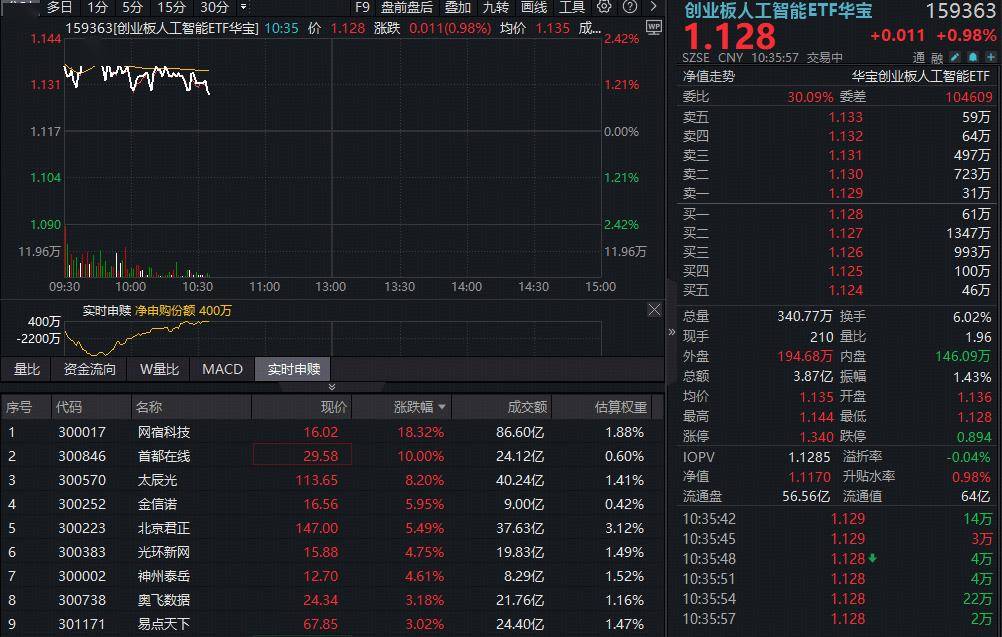
Core Viewpoint - The AI sector is experiencing significant growth, with a notable increase in stock prices for companies involved in AI and cloud computing, indicating a strong demand for AI computing power and a shift in pricing dynamics within the cloud services industry [1][2][3]. Group 1: Market Performance - The AI computing sector, particularly the ChiNext AI ETF (159363), has seen a rise of over 1%, approaching previous highs, reflecting investor confidence in AI technologies [1]. - Companies like Wangsu Science & Technology and Capital Online have reported substantial stock price increases, with Wangsu achieving two consecutive 20% daily limits and Capital Online rising over 12% [1]. - The largest and most liquid ChiNext AI ETF has also shown a positive trend, increasing by approximately 1% [1]. Group 2: Pricing Dynamics - Google announced a price adjustment for data transmission, set to double in North America by May 1, 2026, following a 15% price increase by Amazon Web Services (AWS) for its EC2 machine learning capacity blocks, indicating a significant shift in cloud computing pricing logic amid AI resource scarcity [1][2]. - The AI industry is witnessing a trend of price increases across various segments, including storage and CPU, marking a departure from the long-standing trend of declining cloud service prices [2]. Group 3: Investment Insights - Analysts suggest that the database sector may benefit significantly from the rising demand for AI, with expectations of a substantial increase in the number of tokens globally, potentially growing by 100 to 1000 times [2]. - The ChiNext AI ETF is positioned to capitalize on the commercialization of AI technologies, with a portfolio that includes approximately 60% in computing power and 40% in AI applications, reflecting a balanced approach to investment in both sectors [3].


通信2026年度投资策略-聚焦AI-算力降本向光而行-应用落地网络先行
2026-01-28 03:01
Summary of Key Points from Conference Call Records Industry Overview - The focus is on the AI and cloud services industry, particularly the transition to cloud-based computing and cost reduction strategies in 2026 [1][3][4]. Core Insights and Arguments - AI cloud services are expected to enter a growth phase in 2025, with model vendors converting capital expenditures into Kubernetes (K8S) to achieve cloud computing and cost reduction, similar to the mobile internet era [1][3]. - Data center computing power is projected to see significant growth with the large-scale adoption of 1.6T and 224G single-channel technologies, which will profoundly impact China's optical communication industry [1][4]. - LightCounting forecasts that by 2030, the shipment of 1.6T will accelerate, surpassing 800G and 400G around 2028, with Chinese upstream optical chip companies likely achieving global replacement [1][5]. - The transition from copper connections to performance realization narratives is highlighted, with expectations that copper connections will remain dominant for the next two years [1][6]. - The commercial space sector is anticipated to have significant developments in 2026, including reusable liquid rockets and the gradual implementation of commercial satellite constellations [1][12]. Additional Important Insights - The infrastructure for computing power is experiencing price increases, with cloud computing seeing its first price hike in over 20 years, expected to continue until 2026 [2][22][23]. - The CDN market may follow suit with price increases, potentially impacting smaller clients who may seek cheaper alternatives [24][25]. - AI inference in edge computing is projected to have vast applications, with edge nodes becoming ideal for reducing latency and improving cost-effectiveness [26]. - Liquid cooling systems are becoming crucial in data center construction due to increased power demands from GPUs, with significant market opportunities arising from this trend [27]. - Power technology is also evolving, with new market spaces emerging from innovations in power supply systems within data centers [28]. Investment Opportunities - Key investment opportunities in the communication industry include companies like Xuzhuang and Yizhongtian, which are gaining market share in the optical module sector [5][6]. - The potential for growth in AI modules from IoT modules is emphasized, with companies that can provide integrated intelligent solutions expected to see rapid growth [13]. - The commercial rocket sector is highlighted as a critical area for investment, with expectations of successful validation of new reusable rocket models in 2026 [18][19]. - Investors are advised to focus on companies with strong backing and significant satellite planning capabilities in the space computing sector [19][21].
算力租赁概念活跃,美利云一字涨停
第一财经· 2026-01-28 03:00
Group 1 - Naxing Co., Ltd. (南兴股份) reached a limit-up, while Wangsu Science & Technology (网宿科技) increased by 16%, Oulu Tong (欧陆通) rose by 13%, and Capital Online (首都在线) gained nearly 8% [2] - Other companies such as Yunzhai Zhili (云寨智联), Guanghuan Xinwang (光环新网), and Qingyun Technology (青云科技) also experienced increases [2] - The stock price changes for notable companies include: Wangsu Science & Technology at 15.81 with a rise of 16.77%, Oulu Tong at 258.59 with a rise of 13.45%, and Naxing Co., Ltd. at 22.72 with a rise of 10.02% [3] Group 2 - Google announced a price adjustment for data transmission methods such as CDN Interconnect, Direct Peering, and Carrier Peering, effective May 1, 2026, with prices in North America doubling [4]




未知机构:1月28日股市早报云计算AI应用算力硬件半导体设备贵金属超硬材料等-20260128
未知机构· 2026-01-28 02:55
Summary of Key Points from Conference Call Records Industry Overview - The records cover various sectors including cloud computing, AI applications, semiconductor equipment, precious metals, and advanced materials [1][2][3][4][5][6]. Core Insights and Arguments - **Gold and Silver Prices**: - Gold prices increased by 3.3% to $5180.2 per ounce, while silver rose by 7.92% to $112.16 per ounce due to a weakening dollar [1][2]. - Morgan Stanley predicts that gold prices could reach $5700 per ounce in the second half of the year, with potential for further increases [6]. - Citigroup raised its silver price target to $150 per ounce, indicating bullish sentiment in precious metals [6]. - **Semiconductor Industry Developments**: - A company plans to acquire 60% of Guangdong Changxing Semiconductor for 520 million yuan, expecting significant revenue contributions from storage chip business [2]. - Price increases for semiconductor products have been announced, with ranges from 15% to 100% for various chips, indicating strong demand and supply constraints [2]. - Micron Technology is investing approximately $24 billion in a new NAND flash manufacturing facility in Singapore, expected to be operational by mid-2028 [2]. - **Cloud Computing Pricing Changes**: - Google Cloud and Amazon Web Services (AWS) have announced significant price increases for their services, with AWS raising prices by about 15% for EC2 machine learning capacity blocks [2][4]. - Analysts suggest that these price hikes may trigger a chain reaction among cloud service providers, impacting the overall market dynamics [4]. - **AI and Data Center Growth**: - The demand for AI-driven data centers is projected to boost the optical module market revenue to over $18 billion by 2025 [5]. - The semiconductor equipment market is expected to grow significantly due to AI computing demand, storage chip cycles, and advanced packaging technology [5]. Other Important Insights - **Geopolitical Risks**: The geopolitical landscape and central bank strategies are influencing market conditions, particularly in the precious metals sector [6]. - **Technological Innovations**: - New AI models and breakthroughs in technology are emerging, such as the Clawdbot AI project and advancements in visual language models [4]. - A collaboration between Xi'an University of Electronic Science and Technology and the Chinese Academy of Sciences has led to the development of high-performance diamond radiation detectors, enhancing reliability and stability in extreme conditions [6]. - **Commercial Space Initiatives**: - Musk's plans for satellite deployment and data center construction through Starship are set to significantly impact the space and technology sectors [6][7]. This summary encapsulates the critical developments and insights from the conference call records, highlighting trends and potential investment opportunities across various industries.
未知机构:20260127复盘人工智能1谷歌正式发布将于5月-20260128
未知机构· 2026-01-28 02:50
Summary of Conference Call Records Industry Overview - **Artificial Intelligence**: - Google announced a price increase for Google Cloud, CDN Interconnect, Peering, and AI computing infrastructure services effective May 1, with North American prices doubling, continuing a trend of recent price adjustments in data transmission services [1] - Domestic major CSP vendors have also raised prices, with small and medium-sized firms showing a trend of increasing prices for new customers [1] - Meta plans to pay Corning up to $6 billion for fiber optic cables for AI data centers [1] - Deepseek released a new model that outperforms traditional visual-language models in processing complex images [1] - Tencent plans to expand its cloud business in the Middle East, while Baidu's intelligent cloud has raised its AI-related revenue growth target to 200% [2] - **Semiconductors**: - Micron announced an additional investment of $24 billion in Singapore over the next decade to build a new NAND flash wafer factory [2] - Samsung Electronics and SK Hynix have negotiated significant price increases for LPDDR memory with Apple [2] - Zhongwei Semiconductor announced price adjustments for MCU and Norflash products, with increases ranging from 15% to 50% [2] - **Satellite**: - Elon Musk announced the launch of the Starship V3 version in six weeks to send the next generation of Starlink satellites into space [2] - Starlink's order data has reached a historical high by the end of January [2] - A German defense giant plans to create a domestic version of "Starlink" for the German military [2] - **Energy Storage & Hydrogen**: - Some downstream developers mentioned project delays, waiting for the end of export tax rebates in March or for battery production capacity to increase later in the year, anticipating price reductions [2] Market Insights - The actual reduction ratio for the Shanghai Stock Exchange 50 and CSI 300 is less than 40%, while the reduction ratio for the CSI 1000 and dual innovation indices exceeds 50%. The CSI 500 has the lowest reduction ratio at around 20% [4] Strategy Observations - Today's trading volume was 2.895 trillion, with a decrease of 353.2 billion. The market showed strong support, with many participants anticipating upward movement towards the end of the trading day [5] - Key sectors leading the market include electronics (due to semiconductor price increases, equipment recovery, and AI), communications (AI momentum), and military (satellite rebounds) [6] - The market is experiencing a rotation among major sectors and themes, with AI being a focal point, supported by price increases in chemicals and non-ferrous metals, as well as semiconductor price hikes [7]