
半导体涨价

Search documents
A股超2700股上涨,半导体爆发,贵金属概念全线重挫,港股兆易创新飙涨16%
21世纪经济报道· 2026-03-16 07:43
Market Overview - On March 16, the A-share market showed a mixed performance, with the Shanghai Composite Index down by 0.26% to 4084.79, while the Shenzhen Component Index rose by 0.19% to 14307.58. The ChiNext Index and the Sci-Tech Innovation Board Index increased by 1.41% and 0.65%, respectively [1][2] - The total trading volume in the Shanghai and Shenzhen markets was 2.31 trillion yuan, a decrease of 75 billion yuan compared to the previous trading day, with over 2700 stocks rising across the market [1] Sector Performance - The deep-sea technology sector saw significant gains, with stocks like Dongfang Ocean, Shenkai Co., and Ocean King hitting the daily limit [5] - The PCB (Printed Circuit Board) sector was active, with stocks such as Jin'an Guoji, Chaoying Electronics, and Zhuolang Intelligent also reaching the daily limit [5] - The shipping sector experienced an uptick in the afternoon, with stocks like China Merchants Energy and HNA Technology hitting the daily limit [5] Declining Sectors - The energy storage and green electricity sectors continued to adjust, with China Nuclear Engineering and China Power Construction hitting the daily limit down [5] - The coal sector faced declines, with Zhengzhou Coal Electricity experiencing a significant drop [5] - Precious metals stocks collectively fell, with Shanjin International down over 7% and other major players like Western Gold and Shandong Gold dropping more than 5% [6] Semiconductor Sector - The semiconductor and memory chip sectors saw a surge, with Huahong Semiconductor's A-shares rising over 12% and reaching a market cap exceeding 200 billion yuan [8] - Stocks such as Baiwei Storage and Zhaoyi Innovation also saw significant increases, with Baiwei Storage up over 13% [8] - Reports indicated that major international chip manufacturers like Texas Instruments and NXP are planning to raise prices starting April 1, with increases potentially exceeding 10% [10] Hong Kong Market - The Hong Kong Hang Seng Index and the Hang Seng Tech Index both experienced substantial gains, with the Hang Seng Index rising over 1% and the Tech Index nearly 3% [11] - Notable increases were seen in tech stocks, including BYD up over 7% and NIO and Xiaomi both rising over 5% [11]


半导体,又迎涨价潮
财联社· 2026-03-16 02:19
Group 1 - The semiconductor industry is expected to experience a new wave of price increases, particularly in the mature process wafer foundries such as UMC, World Advanced, and Powerchip, with price hikes potentially reaching up to 10% or more starting from April 2026 [1] - UMC has not confirmed the rumors of price increases but mentioned that the current pricing environment is more favorable than before [1] - World Advanced plans to adjust its foundry prices starting from April 2026, although the specific increase has not been disclosed [1] - Powerchip has confirmed that it has already begun to raise prices this season, focusing on product lines with lower gross margins [1] Group 2 - Major customers in the mature process segment, particularly IC design firms led by driver ICs, are also planning to increase prices due to rising costs [2]


波动加剧,如何看待锡价后市走势?
Wu Kuang Qi Huo· 2026-03-05 01:38
Report Industry Investment Rating - Not provided Core View of the Report - In the context of macro - easing and widespread price increases in the semiconductor industry, the market sentiment for buying tin prices is strong. However, the marginal easing of tin ingot supply - demand and the recent steady increase in inventory suppress the sustainability of tin price increases. In the short term, tin prices are expected to mainly operate in a wide - range high - level oscillation [2][13] Summary by Relevant Catalogs Supply Side - Since mid - to late February 2026, the security situation in northern Myanmar has become tense again. The focus of this round of tension is in the Kutkai area in northern Shan State. The conflict is due to intensified contradictions between TNLA and MNDAA, which has affected local residents' lives and surrounding economic and trade exchanges [5] - Myanmar is crucial in global tin ore supply. But the main tin concentrate production in Myanmar is in the Man Maw mining area in Mong Hsuen County, Wa State, which is not directly involved in the Kutkai conflict. Transport routes also differ, and short - term "hard interruptions" in cross - border tin concentrate transportation are unlikely. However, the complexity and uncertainty of the situation in northern Myanmar still require continuous tracking [5][6] - During the Spring Festival, the operating rate of smelters in Yunnan decreased, and the post - festival recovery was slow. In Jiangxi, due to insufficient scrap supply, the supply of crude tin was tight, and the refined tin output remained at a low level [13] Demand Side - The core consumption of tin is in the solder (electronic welding) field, with strong demand resilience. When industries such as AI servers and advanced semiconductor packaging expand, the market tends to view tin as a "growth - type small metal" and raise its valuation. But currently, the demand for semiconductors in the AI field is still at a low level [9] - In the short - term, most downstream enterprises have not fully resumed work, and demand release is limited. After the price reached the high level of 430,000 yuan again, it further suppressed the downstream purchasing willingness. Some downstream enterprises are still on holiday and plan to resume work after the Lantern Festival on March 3rd. The demand recovery strength and post - holiday terminal consumption performance need further observation [12]
多家功率半导体商发布涨价函,科创半导体ETF、半导体设备ETF华夏午后拉涨
Mei Ri Jing Ji Xin Wen· 2026-02-26 05:48
Core Viewpoint - Power semiconductor companies are collectively raising prices due to significant increases in raw material and key precious metal costs, impacting wafer processing and packaging costs, which necessitates price adjustments to ensure sustainable operations and product supply stability [1] Group 1: Price Adjustments - Wuxi Xin Jie Neng Co., Ltd. announced a price increase of at least 10% for MOSFETs, effective from March 1, 2026 [1] - The company cited rising costs in upstream raw materials and key precious metals as the primary reason for the price hike [1] Group 2: Market Reaction - As of February 26, the semiconductor ETFs saw positive performance, with the high "equipment" content semiconductor ETF (588170) rising by 2.18% and the semiconductor equipment ETF (562590) increasing by 1.73% [1] - Individual stocks such as Oulei New Materials, Jingyi Equipment, and Shenkong Co. experienced significant gains, with increases of 19.70%, 8.32%, and 5.85% respectively [1] Group 3: Fund Flows - The semiconductor ETF has seen net inflows in 10 out of the last 17 trading days, totaling 227 million yuan, with an average daily net inflow of 13.33 million yuan [1] - The latest scale of the semiconductor ETF reached 8.488 billion yuan, marking a new high since its inception [1]
半导体全面涨价-LED-封装材料等
2026-02-10 03:24
Summary of Conference Call Records Industry Overview: Semiconductor and LED Key Points on the LED Industry - The LED industry is experiencing a price increase across the entire supply chain, with over 50 lighting companies announcing price hikes due to raw material shortages and currency fluctuations. Notably, overseas leader Signify announced a price increase of up to 50% for Philips brand products, while domestic leader Opple plans to raise prices by 5%-10% starting March 1, 2026 [2][4] - The price hikes reflect a broader trend in the industry, driven by global supply chain disruptions and rising commodity prices, alongside a shift towards smart and energy-efficient lighting solutions [4] Key Points on Semiconductor Market - The semiconductor market is seeing significant attention on LED driver chips and packaging materials due to high demand and rising precious metal prices. For instance, Taiwan's Changhua Technology announced a 20% price increase for lead frames in Q1 2026, with plans for quarterly adjustments [1][5] - The semiconductor packaging segment is benefiting from strong demand from emerging industries such as AI and new energy vehicles, leading to a high utilization rate of packaging plants and slight price increases from upstream foundries. The global supply of 8-inch wafers is expected to decline by 2.4% year-on-year in 2026, with capacity utilization rising to 85%-90% [6][7] Key Points on Analog Chip Sector - The analog chip sector has seen multiple price increases since 2025, with companies like TI and ADI implementing price hikes. ADI plans a 15% increase across all products starting February 2026, while domestic companies like Richtek are also beginning to raise prices to alleviate cost pressures and improve profit margins [8] Company-Specific Insights: Kangqiang Electronics Performance and Market Position - Kangqiang Electronics, a leading domestic semiconductor packaging materials manufacturer, focuses on lead frames and bonding wires. The company is expected to follow the price increase trend set by major players like Changhua Technology, benefiting from urgent downstream demand and cost transmission from upstream [3][10] - Lead frames account for 15%-25% of packaging material costs, with the Chinese market exceeding 12 billion yuan. The company’s main product areas are stamping and etching, with an expected recovery in utilization rates leading to rapid profit restoration [11] Strategic Initiatives - Kangqiang Electronics implemented its first stock incentive plan at the end of December 2025, reflecting confidence in future market developments and positioning [12] Additional Considerations - The semiconductor packaging materials market is currently at a low price point, but rising supply-side costs are expected to trigger price increases. Channel vendors are likely to stock up ahead of price hikes, which will drive replenishment demand across various segments [9] - The overall trend indicates a potential for further price increases in the semiconductor packaging materials market, which could positively impact the financial performance of companies like Kangqiang Electronics [9][11]

关注半导体自主可控和涨价连锁反应 | 投研报告
Sou Hu Cai Jing· 2026-02-10 00:57
Core Viewpoint - The electronic industry index declined by 3.73% during the week of February 2-6, 2026, with semiconductors down by 3.02%, reflecting market volatility following Trump's nomination of Kevin Warsh as Federal Reserve Chairman [1] Industry Summary - The electronic industry index fell by 3.73%, with semiconductors down 3.02%, optical optoelectronics down 0.07%, and consumer electronics down 4.19% [1] - In the overseas technology sector, significant stock movements were noted: Philadelphia Semiconductor Index rose by 0.63%, while Nvidia fell by 2.99%, AMD by 11.95%, Google by 4.48%, SanDisk rose by 3.77%, Micron fell by 4.87%, and Apple rose by 7.18% [1] - Google's capital expenditure exceeded expectations, with a notable increase in cloud revenue by 48% in Q4 2025, and 2026 capital expenditure guidance set at $175-185 billion, surpassing the previous market expectation of $130 billion [2] - The smartphone market is expected to remain weak until at least the second half of 2027, with MediaTek forecasting a significant decline in mobile business revenue for Q1 2026 [1][2] Price Trends - The supply-demand imbalance in memory chips continues, with Infineon issuing price increase notices due to tight supply and rising costs [2] - Samsung's foundry is considering a price increase of approximately 10% for 4nm and 8nm processes [2] - Adata reported a revenue of NT$8.412 billion in January 2026, nearly doubling year-on-year, while Phison's revenue reached a record high of NT$10.452 billion [2] Investment Recommendations - The company suggests focusing on the supply chain of Changxin's related equipment and materials, as well as the chain reaction of semiconductor price increases [3] - Recommended stocks include North Huachuang, Zhongwei Company, Tuojing Technology, and Jiangfeng Electronics [3] - Beneficiary stocks include Jingce Electronics, Zhaoyi Innovation, Purun Shares, Lanke Technology, Chipone Technology, Huazheng New Materials, Oule New Materials, Ashi Chuang, Jiejie Microelectronics, and New Clean Energy [3]
未知机构:半导体全面涨价系列之康强电子公司是半导体封装材料厂-20260204
未知机构· 2026-02-04 02:25
Summary of Conference Call Notes on 康强电子 (Kangqiang Electronics) Industry Overview - The company operates in the semiconductor packaging materials sector, focusing on lead frames and bonding wires used in packaging [1] - The current demand from downstream customers in the packaging sector is high, leading to price increases in packaging materials, specifically lead frames, with an average increase of 11-18% [1] Key Points - The recent price hikes are driven by upstream cost transmission and the company's need to restore profit margins, with a leading Taiwanese competitor raising prices by 20% in Q1, indicating a trend of quarterly price increases [1] - Lead frames account for 15%-25% of the cost of packaging materials, with the Chinese market size exceeding 12 billion [1] - The company has a significant market position in China, with a product mix of stamping to etching at a ratio of 3:1, indicating a strong competitive advantage [1] - The company's product utilization rate is expected to significantly improve by Q4 2025, leading to a rapid recovery in profitability, approaching levels seen in 2021 [1] - Price increases began in February, with expectations for further enhancement in profitability [1] Financial Performance - The company currently has a robust order book, focusing on high-margin, short-cycle product orders, with profit releases expected to exceed forecasts [2] - The successful introduction of MPS (NV power products) is attributed to the "China for China" strategy, which is anticipated to gradually release order flexibility [3] - The company has announced its first-ever equity incentive plan since its listing, reflecting confidence in a turning point in performance [4]
龙虎榜复盘丨贵金属携手爆发,机构买入多只半导体
Xuan Gu Bao· 2026-01-28 11:09
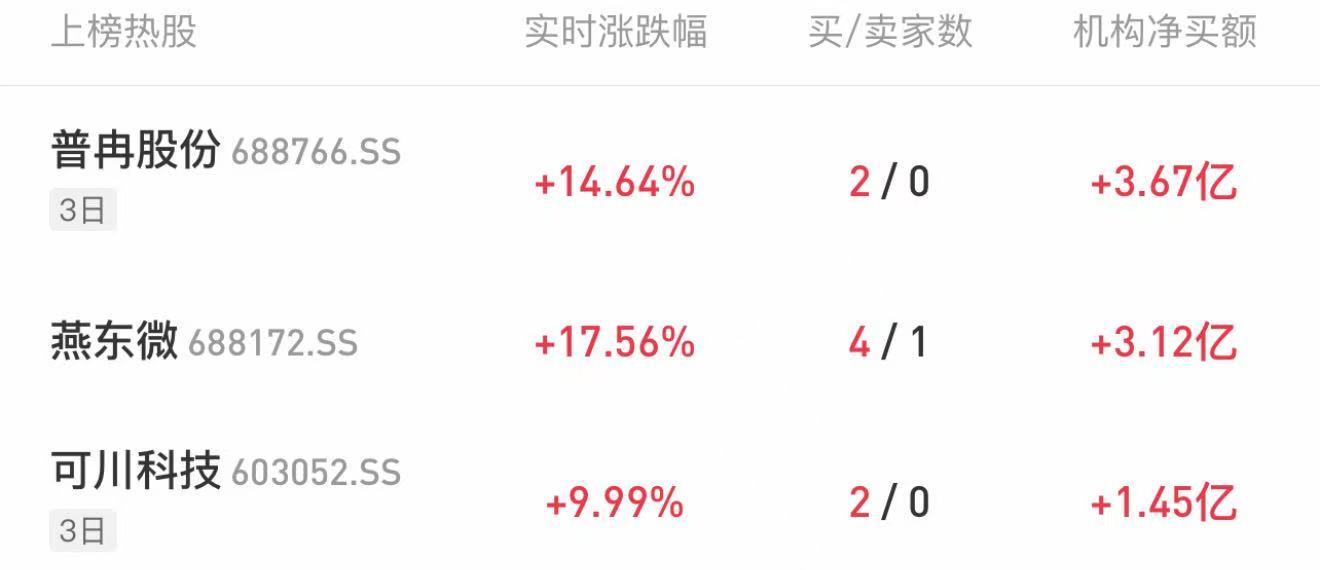
Group 1 - The core point of the news is that 43 stocks were listed on the institutional trading leaderboard, with 22 stocks experiencing net buying and 21 stocks facing net selling [1] - The top three stocks with the highest net buying by institutions are: Purun Co., Ltd. (3.67 billion), Yandong Microelectronics (3.12 billion), and Kecuan Technology (1.45 billion) [1] - Yandong Microelectronics saw a net buying of 3.12 billion from five institutions, coinciding with a rising trend in semiconductor prices [3] Group 2 - The stock Purun Co., Ltd. (688766.SS) increased by 14.64% with 2 buyers and 0 sellers [2] - Yandong Microelectronics (688172.SS) rose by 17.56% with 4 buyers and 1 seller [2] - Kecuan Technology (603052.SS) experienced a 9.99% increase with 2 buyers and 0 sellers [2] Group 3 - Recent price hikes in the semiconductor sector include a 15% to 50% increase for MCU and Norflash products announced by Zhongwei Semiconductor [3] - Guokai Microelectronics issued a price increase notice for KGD products, with increases of 40% for 512Mb, 60% for 1Gb, and 80% for 2Gb products [3] - The price of gold reached a historical high of 5300 USD/ounce, with a daily increase of over 2% [3]


电子行业点评:半导体行业涨价函频发,新一轮价格调整周期开启
Ping An Securities· 2026-01-28 07:09
Investment Rating - The industry investment rating is "Outperform the Market" (maintained) [1][9]. Core Viewpoints - The semiconductor industry is experiencing a new round of price adjustments, with multiple companies issuing price increase notices due to rising costs and supply chain pressures. This price increase is expected to impact various segments, including power devices, MCU, and SoC chips [4][6][7]. - The demand for AI-related applications, particularly in AI servers, is robust, leading to a shift in chip production towards higher-margin products. This has resulted in a tightening of supply for mature process products and a general increase in chip prices across the industry [6][7]. - The price increase cycle is driven by significant cost escalations across the supply chain, including raw materials and manufacturing costs, alongside a structural supply-demand imbalance exacerbated by increased demand for high-performance chips [7][8]. Summary by Sections - **Recent Developments**: Several semiconductor companies have announced price hikes ranging from 15% to 80% due to increased costs and supply constraints [7]. - **Market Dynamics**: The price increase trend is affecting all segments of the semiconductor industry, with a notable impact on LED drivers, analog chips, and power devices. The overall industry is facing a dual pressure of rising demand and shrinking supply [7][8]. - **Investment Recommendations**: The report suggests focusing on companies with strong market shares and pricing power, particularly those in segments experiencing significant price elasticity. Specific companies to watch include New Clean Energy, Yangjie Technology, and others listed in the report [8].

未知机构:20260127复盘人工智能1谷歌正式发布将于5月-20260128
未知机构· 2026-01-28 02:50
Summary of Conference Call Records Industry Overview - **Artificial Intelligence**: - Google announced a price increase for Google Cloud, CDN Interconnect, Peering, and AI computing infrastructure services effective May 1, with North American prices doubling, continuing a trend of recent price adjustments in data transmission services [1] - Domestic major CSP vendors have also raised prices, with small and medium-sized firms showing a trend of increasing prices for new customers [1] - Meta plans to pay Corning up to $6 billion for fiber optic cables for AI data centers [1] - Deepseek released a new model that outperforms traditional visual-language models in processing complex images [1] - Tencent plans to expand its cloud business in the Middle East, while Baidu's intelligent cloud has raised its AI-related revenue growth target to 200% [2] - **Semiconductors**: - Micron announced an additional investment of $24 billion in Singapore over the next decade to build a new NAND flash wafer factory [2] - Samsung Electronics and SK Hynix have negotiated significant price increases for LPDDR memory with Apple [2] - Zhongwei Semiconductor announced price adjustments for MCU and Norflash products, with increases ranging from 15% to 50% [2] - **Satellite**: - Elon Musk announced the launch of the Starship V3 version in six weeks to send the next generation of Starlink satellites into space [2] - Starlink's order data has reached a historical high by the end of January [2] - A German defense giant plans to create a domestic version of "Starlink" for the German military [2] - **Energy Storage & Hydrogen**: - Some downstream developers mentioned project delays, waiting for the end of export tax rebates in March or for battery production capacity to increase later in the year, anticipating price reductions [2] Market Insights - The actual reduction ratio for the Shanghai Stock Exchange 50 and CSI 300 is less than 40%, while the reduction ratio for the CSI 1000 and dual innovation indices exceeds 50%. The CSI 500 has the lowest reduction ratio at around 20% [4] Strategy Observations - Today's trading volume was 2.895 trillion, with a decrease of 353.2 billion. The market showed strong support, with many participants anticipating upward movement towards the end of the trading day [5] - Key sectors leading the market include electronics (due to semiconductor price increases, equipment recovery, and AI), communications (AI momentum), and military (satellite rebounds) [6] - The market is experiencing a rotation among major sectors and themes, with AI being a focal point, supported by price increases in chemicals and non-ferrous metals, as well as semiconductor price hikes [7]