网约车

Search documents
多地叫停网约车一口价特惠订单
21世纪经济报道· 2025-09-05 11:10
Core Viewpoint - The article discusses the regulatory measures taken by various cities in China to control the pricing behavior of ride-hailing platforms, aiming to balance platform competition and the rights of drivers [1][10]. Regulatory Actions - Multiple cities, including Xi'an, have implemented regulations to suspend low-price marketing behaviors such as "one-price" and "special price" orders since August 19, 2023 [1]. - Similar policies have been adopted in other regions like Guangdong, Henan, and Jiangxi to prevent platforms from forcing drivers to accept low-priced orders [1][10]. Impact on Drivers - Drivers have reported slight income increases since the implementation of these regulations, but overall earnings remain low due to high commission rates taken by platforms [4][5]. - The average daily operating hours for drivers in various cities range from 9.5 to 15 hours, with net monthly incomes for some drivers falling below 4,000 yuan [5][6]. Platform Performance - Despite regulatory challenges, major platforms like Didi have shown strong financial performance, with a core platform transaction volume exceeding 100 billion yuan in Q1 2023 and a 15.9% year-on-year growth in Q2 [10]. - Didi's total transaction volume reached 1,096 billion yuan in Q2, with a significant contribution from its domestic business [10]. Industry Dynamics - The article highlights a shift from aggressive price competition to a focus on service quality as platforms adapt to new regulations [11]. - The need for transparency in pricing algorithms and a balanced negotiation power between platforms and drivers is emphasized as essential for sustainable industry growth [11].


吉利控股集团董事长李书福:曹操出行将作为Robotaxi最重要的商业化载体 打造全球领先的科技出行平台
Zheng Quan Ri Bao Wang· 2025-09-05 10:49
Core Viewpoint - The news highlights the strategic initiatives of Geely Holding Group and its subsidiary Cao Cao Mobility in the development of Robotaxi services and the broader smart transportation ecosystem in Hainan Free Trade Port, emphasizing their technological advancements and market positioning [1][2]. Group 1: Company Initiatives - Geely Holding Group has established a presence in Hainan with investments in new energy commercial vehicles and smart mobility, with Cao Cao Mobility operating in six cities including Haikou [1]. - Cao Cao Mobility launched the "Cao Cao Zhixing" autonomous driving platform, creating a comprehensive self-research closed-loop intelligent driving ecosystem, making it the only domestic company with a full-chain capability similar to Tesla [1][2]. - The company has begun deploying a new generation of Robotaxi vehicles, integrating advanced features such as automatic dispatch and remote safety assurance [2]. Group 2: Strategic Partnerships and Market Outlook - Cao Cao Mobility has formed a strategic partnership with aerospace company Shikong Daoyu to leverage satellite technology for enhancing autonomous driving capabilities, aiming for continuous vehicle connectivity [2]. - Multiple institutions, including Dongwu Securities, predict that the Robotaxi market will reach several hundred billion yuan by 2030, positioning Cao Cao Mobility to lead in the large-scale deployment of Robotaxi services [2]. Group 3: Market Recognition - Cao Cao Mobility went public on the Hong Kong Stock Exchange in June, becoming the largest tech mobility platform in the market and was subsequently included in the Hang Seng Composite Index [3]. - The company is expected to be included in the Hong Kong Stock Connect on September 8, which will broaden its investor base and attract additional capital from mainland investors [3].
东吴证券:给予曹操出行(2643.HK)“买入”评级,有望凭借Robotaxi弯道超车
Ge Long Hui· 2025-09-05 10:14
Group 1 - The core viewpoint of the report is that Cao Cao Mobility (2643.HK) is positioned as a unique integrated platform for "vehicle, operation, and technology" in the domestic Robotaxi market, leveraging Geely's manufacturing capabilities and advanced driving technology [1] - The Chinese ride-hailing market is undergoing a significant transformation from "barbaric growth" to "compliant intelligence," with the focus shifting from capital subsidies to the restructuring of automated driving technology and human-vehicle relationships [1] - The report highlights that with L4 level autonomous driving technology, decreasing hardware costs, and an improving policy framework, the commercialization of Robotaxi services is accelerating [1] Group 2 - The analyst projects that Cao Cao Mobility's revenue will reach 20.67 billion, 26.24 billion, and 32.37 billion yuan from 2025 to 2027, with year-on-year growth rates of 41.0%, 26.9%, and 23.4% respectively [2] - The company is expected to achieve a net profit of -1.1 billion, -270 million, and 890 million yuan for the same period, with a forecasted turnaround to profitability by 2027 [2] - Cao Cao Mobility is set to be listed on the Hong Kong Stock Exchange on June 25, 2025, and is anticipated to be included in the Hang Seng Composite Index, which is expected to attract additional mainland capital [2]

多地叫停一口价特惠订单 网约车如何反“内卷”?
2 1 Shi Ji Jing Ji Bao Dao· 2025-09-05 09:04
Core Viewpoint - The article discusses the regulatory measures taken by various cities in China to curb low-price competition in the ride-hailing industry, focusing on the balance between platform competition and driver rights [1][7]. Regulatory Actions - Xi'an's Transportation Bureau issued a notice to suspend "fixed-price" and "discounted-price" marketing practices starting from August 19, aiming to eliminate price fraud and malicious underpricing [1]. - Similar policies have been implemented in multiple cities, including Guangdong, Henan, and Jiangxi, to prevent platforms from forcing drivers to accept low-priced orders [1][7]. Impact on Drivers - Drivers report that their income has slightly improved since the policy implementation, but overall earnings remain low due to high commission rates taken by platforms [2][3]. - The average daily operating hours for ride-hailing vehicles in Zhengzhou is about 9.5 hours, with some drivers earning less than 4,000 yuan per month after deductions [5]. Platform Responses - Major ride-hailing platforms, including Didi and T3, have announced reductions in their maximum commission rates, with Didi lowering it to 27% and Caocao to 22.5% [6]. - Didi's core platform transaction volume exceeded 100 billion yuan in Q1, with a significant year-on-year profit increase, indicating a shift from aggressive pricing strategies to a focus on service quality [8][10]. Industry Dynamics - The article highlights the ongoing struggle between platforms, drivers, consumers, and regulators in achieving a balanced and healthy market environment [5][10]. - The shift from price wars to refined service competition poses challenges for platforms, necessitating transparency in pricing and commission structures [10].
多地叫停一口价特惠订单,网约车如何反“内卷”?
2 1 Shi Ji Jing Ji Bao Dao· 2025-09-05 09:01
Core Viewpoint - The article discusses the regulatory measures taken by various cities in China to curb low-price competition in the ride-hailing industry, focusing on the balance between platform competition and driver rights [1][5]. Regulatory Actions - Multiple cities, including Xi'an, have implemented regulations to ban low-price marketing strategies such as "one-price" and "special price" orders, effective from August 19 [1][6]. - The regulations aim to prevent price fraud and protect drivers from being forced into low-paying orders [1][6]. - Other cities like Guangdong, Henan, and Jiangxi have also introduced similar policies to combat low-price competition [1][6]. Impact on Drivers - Drivers have reported slight income increases since the implementation of these regulations, but overall earnings remain low due to high commission rates taken by platforms [2][3]. - The average daily operating hours for drivers in Zhengzhou is about 9.5 hours, with some earning less than 4,000 yuan per month after deductions [4]. - Drivers express frustration over the high commission rates, which have increased over time, leading to reduced net income despite a rise in order volume [3][4]. Platform Performance - Despite regulatory challenges, platforms like Didi have shown strong financial performance, with a core platform transaction volume exceeding 100 billion yuan in Q1 and a 15.9% year-on-year growth in Q2 [7][8]. - Didi's total transaction volume reached 1,096 billion yuan in Q2, with a significant contribution from its domestic business [7]. - Cao Cao Mobility reported a revenue of 9.456 billion yuan in the first half of the year, marking a 53.5% increase [8]. Industry Dynamics - The competition in the ride-hailing industry is shifting from aggressive price wars to a focus on service quality, posing new challenges for platforms [8]. - Regulatory interventions are seen as positive steps, but issues such as opaque pricing algorithms and the imbalance in bargaining power between platforms and drivers remain unresolved [8][9].
吉利控股集团董事长李书福:曹操出行将作为Robotaxi最重要的商业化载体,打造全球领先的科技出行平台-财经-金融界
Jin Rong Jie· 2025-09-05 06:29
Core Insights - The event "Policy Project Promotion Conference to Support Private Enterprises in Participating in Hainan Free Trade Port Construction" was held in Haikou, attracting over 100 company representatives to explore opportunities in Hainan's free trade port development [1] - Geely Holding Group's Chairman Li Shufu announced the company's investments in new energy commercial vehicles and smart mobility in Hainan, with its subsidiary Cao Cao Mobility operating in six cities [1] - Cao Cao Mobility aims to become a leading global technology mobility platform, focusing on Robotaxi commercialization [1] Company Developments - Cao Cao Mobility is positioned as Geely Holding Group's strategic platform for intelligent shared mobility, having launched the "Cao Cao Zhixing" autonomous driving platform earlier this year [3] - The company has developed a comprehensive self-research closed-loop intelligent driving ecosystem, making it the only domestic company with capabilities across manufacturing, intelligent driving, and operations [3] - As of June 30, the company completed over 15,000 kilometers of autonomous driving testing in Suzhou and Hangzhou [3] Strategic Partnerships and Future Plans - In July, Cao Cao Mobility formed a strategic partnership with commercial aerospace company Shikong Daoyu to leverage satellite technology for autonomous driving, ensuring vehicles remain "always online" [3] - The company plans to deploy a new generation of Robotaxi starting April 2025, integrating advanced safety and operational capabilities [3] Market Outlook - Multiple institutions, including Dongwu Securities, predict that the Robotaxi market will reach several hundred billion yuan by 2030 [4] - Cao Cao Mobility's deep collaboration with Geely and its decade-long experience in ride-hailing positions it to lead in the Robotaxi market, providing a model for the transformation of the mobility industry [4] - Following its listing on the Hong Kong Stock Exchange, Cao Cao Mobility has gained recognition in the capital market and is expected to be included in the Hong Kong Stock Connect on September 8, broadening its investor base [4]
网约车司机抢单出“阴招”,自制“作弊神器”稳接机场高价单
Xin Jing Bao· 2025-09-05 05:29
Core Points - The article discusses the illegal use of cheating programs by ride-hailing drivers to gain an unfair advantage in receiving ride requests at airports and other high-demand areas [1][2] - Authorities have arrested three suspects involved in selling modified second-hand phones equipped with these cheating programs, which allowed drivers to manipulate their location and create a false impression of waiting time [1][2] Group 1: Cheating Mechanism - Some ride-hailing drivers are using a cheating program called "one-machine" to enter waiting areas ahead of others, despite a limited number of vehicles present [1] - The cheating program allows drivers to alter their phone's location, making it appear as if they have been waiting in high-demand areas without actually being there [1] Group 2: Criminal Activity - The suspects were found to have profited over 80,000 yuan by selling these modified phones to drivers, with prices ranging from 1,800 to 2,000 yuan [2] - The suspects, who were former ride-hailing drivers themselves, exploited their knowledge of the system to create and sell these cheating devices [2] Group 3: Law Enforcement Response - The police have taken criminal measures against the suspects for providing illegal control tools for computer information systems, and the case is under further investigation [2] - The ride-hailing platform is cooperating with law enforcement to manage affected driver accounts and restore normal operations [2]
曹操出行(02643):科技重塑共享出行,打造服务口碑最好品牌
Soochow Securities· 2025-09-05 05:11
Investment Rating - The report assigns a "Buy" rating for the company, marking its first coverage [1]. Core Viewpoints - The company is positioned as a leading shared mobility platform in China, leveraging technology to reshape the industry and enhance service reputation [12]. - The report highlights the significant growth potential in the ride-hailing market, driven by the integration of Robotaxi technology and the expansion of service areas [2][8]. - The company's revenue is expected to grow substantially, with projections indicating a rise from 20.67 billion CNY in 2025 to 32.37 billion CNY by 2027 [1]. Summary by Sections Company Overview - The company is the second-largest shared mobility platform in China, founded in 2015 as part of Geely's strategic investment in the "new energy vehicle sharing ecosystem" [12]. - It operates in 163 cities, with a monthly active driver count of 554,000 and a market share of 5.4% as of 2024 [12]. Market Dynamics - The ride-hailing market is transitioning from "barbaric growth" to "compliant intelligence," with a focus on automated driving and regulatory restructuring [8]. - The market is expected to reach nearly 1 trillion CNY by 2030, with significant growth opportunities for second-tier platforms [32]. Business Model and Growth Strategy - The company is expanding its customized vehicle fleet, which has reached 37,000 units, enhancing the standardization of service experiences [13]. - The integration of Robotaxi services is a key growth driver, with plans for mass production and deployment of autonomous vehicles [8][12]. Financial Performance - Revenue is projected to increase significantly, with 2024 revenue expected to reach 14.66 billion CNY, reflecting a year-on-year growth of 37.4% [1]. - The company is expected to narrow its losses, with net profit projections improving from -1.25 billion CNY in 2024 to a profit of 891.83 million CNY by 2027 [1]. Competitive Landscape - The report notes the competitive dynamics in the ride-hailing market, with major players like Didi holding over 70% market share, creating opportunities for other platforms [32]. - The rise of aggregation platforms is reshaping the market, allowing for better resource allocation and service integration [56].
又一潜力股将“入通”,曹操出行成长性突出,有望吸引内地增量资金
Zhi Tong Cai Jing· 2025-09-04 10:11
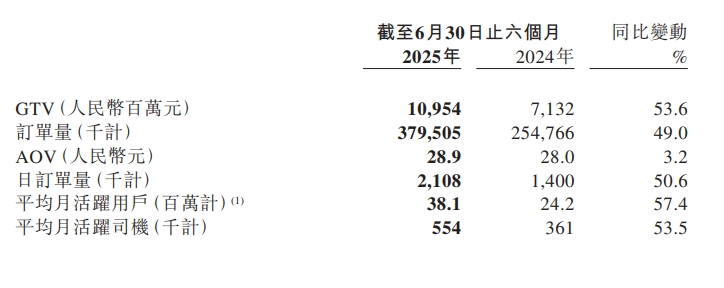
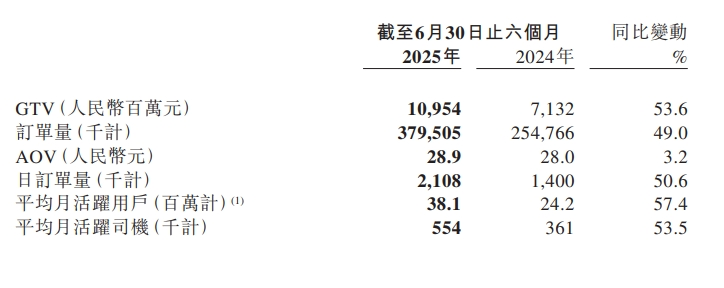
Core Viewpoint - The stock price of Cao Cao Mobility has shown strong performance since its IPO, indicating robust market confidence in its investment value, with the stock price doubling from its initial offering price of 41.94 HKD to a peak of 92.5 HKD within a few months [1] Financial Performance - In the first half of 2025, Cao Cao Mobility reported a significant increase in Gross Transaction Value (GTV) of 53.6% year-on-year, reaching 10.954 billion RMB [4] - The company achieved a revenue of 9.456 billion RMB, marking a 53.5% increase compared to the previous year [4] - The adjusted net loss narrowed to 3.3 billion RMB, with an adjusted net loss rate of 3.5%, improving by 4.6 percentage points year-on-year [5] - Operating cash flow turned positive with a net inflow of 325 million RMB, reflecting a 164.6% increase year-on-year [4] Market Position and Growth Potential - Cao Cao Mobility has expanded its operational footprint to 163 cities, with a fleet of over 37,000 customized vehicles, and has entered 27 new cities [3] - The company is expected to maintain a GTV growth rate of over 40% in the coming years, driven by its strategic expansion and the introduction of new vehicle models [7] Strategic Initiatives - The company has launched its autonomous driving platform, with plans to introduce L4 level Robotaxi models by the end of next year, positioning itself to benefit from the anticipated growth in the Robotaxi market [8] - The integration into the Hang Seng Composite Index is expected to attract additional mainland capital, enhancing trading activity and liquidity for the stock [2][14] Analyst Predictions - Analysts predict that Cao Cao Mobility will achieve adjusted net profit in the coming year, with target stock prices ranging from 98 to 108 HKD, indicating significant upside potential from current levels [15]
又一潜力股将“入通”,曹操出行(02643)成长性突出,有望吸引内地增量资金
智通财经网· 2025-09-04 09:07
Core Viewpoint - The stock price performance of Cao Cao Mobility (曹操出行) post-IPO indicates strong market recognition of its investment value, with the stock price doubling from its IPO price of HKD 41.94 to a peak of HKD 92.5, signaling robust growth potential [1][2]. Financial Performance - In the first half of 2025, Cao Cao Mobility reported a significant increase in Gross Transaction Value (GTV) of 53.6% year-on-year, reaching RMB 10.954 billion [4]. - The company achieved a revenue of RMB 9.456 billion, marking a 53.5% increase compared to the previous year, with a notable improvement in gross margin, which rose by 1.4 percentage points to 8.4% [4]. - The adjusted net loss for the period was RMB 3.3 billion, with an adjusted net loss rate of 3.5%, showing a substantial improvement of 4.6 percentage points year-on-year [5]. Market Expansion and User Growth - As of June 30, 2025, the company operated in 163 cities with a daily order volume of 2.108 million, reflecting a 50.6% increase year-on-year [4]. - The average monthly active users reached 38.1 million, up 57.4% year-on-year, and the average monthly active drivers increased by 53.5% to 554,000 [4]. Strategic Developments - Cao Cao Mobility has been approved for inclusion in the Hang Seng Composite Index, effective September 8, which is expected to attract additional mainland capital through the Hong Kong Stock Connect [2][14]. - The company plans to expand into 200 new cities this year and aims to sell 1.5-3.2 million customized vehicles from 2025 to 2027, leveraging its low Total Cost of Ownership (TCO) advantage [7][8]. Future Outlook - The company is strategically positioned to benefit from the anticipated growth of Robotaxi services, with plans to launch L4-level Robotaxi models by the end of next year [8]. - Analysts predict that the Robotaxi segment could significantly enhance profitability, with expectations of a return to positive adjusted net profit by next year [7][15]. - The Robotaxi market in China is projected to reach RMB 1.6 trillion by 2035, with Cao Cao Mobility aiming for a 15% market share, potentially valuing this segment at RMB 240 billion [13].