
消费金融

Search documents
海尔消金“多模态大小模型协同智能反欺诈系统”获青岛市金融创新二等奖
Jing Ji Guan Cha Wang· 2025-08-11 03:18
经济观察网8月11日,海尔消费金融股份有限公司(以下简称"海尔消金")宣布,其申报的"多模态大小模 型协同智能反欺诈系统"项目荣获2024年度青岛市金融创新成果激励二等奖。该奖项由青岛市金融工作 委员会办公室于8月7日公布的激励名单中正式发布。(编辑胡群) ...
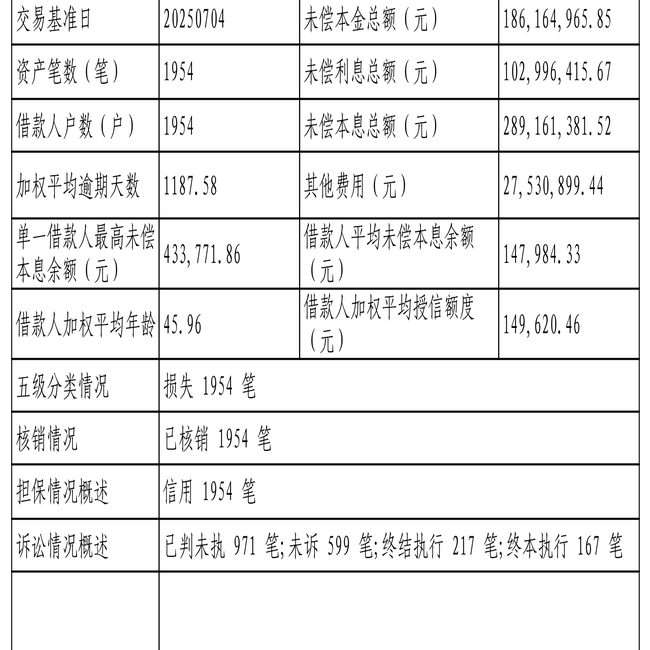
中银消费金融1954笔不良贷款转让,未偿本息总额2.89亿元
Sou Hu Cai Jing· 2025-08-09 01:45
Core Viewpoint - The announcement details the transfer of non-performing personal loans by China Bank Consumer Finance Co., with a total outstanding principal of approximately 186.16 million yuan and a total outstanding interest of about 102.99 million yuan, indicating significant asset management challenges for the company [1][2]. Group 1: Loan Details - Total outstanding principal amount is 186,164,965.85 yuan [1] - Total outstanding interest amount is 102,996,415.67 yuan [1] - Total outstanding principal and interest amount is 289,161,381.52 yuan [1] - Number of loans involved is 1,954 [1] - Average outstanding principal and interest balance per borrower is 147,984.33 yuan [1] Group 2: Borrower Information - Average age of borrowers is 45.96 years [1] - Maximum outstanding principal and interest balance for a single borrower is 433,771.86 yuan [1] - Average credit limit for borrowers is 149,620.46 yuan [1] Group 3: Loan Classification and Legal Status - The loans are classified as losses, totaling 1,954 cases [1][2] - Legal status includes 971 cases that have been adjudicated but not enforced, 599 cases that are not yet litigated, 217 cases that have concluded execution, and 167 cases under final execution [2] Group 4: Auction Details - The non-performing asset package will be auctioned starting on August 22, 2025, with a starting price of 9.53 million yuan and a bidding increment of 50,000 yuan [2]

趣店上涨2.2%,报4.19美元/股,总市值6.92亿美元
Jin Rong Jie· 2025-08-08 14:21
Group 1 - The core viewpoint of the articles indicates that Qudian Inc. (QD) has experienced a stock price increase of 2.2%, reaching $4.19 per share, with a total market capitalization of $692 million as of August 8 [1] - Financial data shows that as of March 31, 2025, Qudian's total revenue was 25.789 million RMB, representing a year-on-year decrease of 53.82%, while the net profit attributable to shareholders was 150 million RMB, reflecting a significant year-on-year increase of 303.92% [1] - Qudian is set to disclose its fiscal year 2025 mid-term report on September 5, with the actual disclosure date subject to the company's announcement [2] Group 2 - Qudian is identified as a consumer-oriented technology company based in China, initially focused on providing lending solutions to consumers [2] - The company is currently exploring innovative consumer products and services, leveraging its technological advantages to meet the basic needs of Chinese consumers in their daily lives [2]

数字金融周报|五大上市险企发放907亿“现金红包”;有尾部消金公司开启裁员
Sou Hu Cai Jing· 2025-08-08 11:54
Central Bank and Foreign Exchange Reserves - As of July 2025, China's foreign exchange reserves stood at $32,922 billion, a decrease of $252 billion from June, marking a decline of 0.76% [1] - The central bank has increased its gold reserves for the ninth consecutive month, reaching 7,396 million ounces (approximately 2,300.41 tons), with a month-on-month increase of 6,000 ounces (approximately 1.86 tons) [1] - The gold reserve balance increased by $10 billion to $243.985 billion, accounting for 7.41% of the foreign exchange reserves, up 0.09 percentage points from the previous month [1] Banking Sector Performance - Five banks, including Ningbo Bank and Hangzhou Bank, reported double-digit growth in both operating income and net profit for the first half of 2025 [1] - Ningbo Bank's total assets reached 3.47 trillion yuan, growing by 11.04% year-on-year, while Hangzhou Bank's total assets were 2.24 trillion yuan, up 5.83% [1] - As of June 2025, the total assets of Qilu Bank and Qingdao Bank were in the range of 700 billion to 800 billion yuan, and Changshu Bank's total assets exceeded 400 billion yuan, reaching 401.251 billion yuan [1] Retail Banking Developments - China Merchants Bank's retail assets under management (AUM) surpassed 16 trillion yuan, making it the first joint-stock commercial bank in China to achieve this milestone [2] - The bank's AUM growth accelerated, with the first 5 trillion yuan taking 9 years, the second 5 trillion yuan taking 5 years, and the latest 5 trillion yuan achieved in just over 3 years [2] - The bank's asset custody scale exceeded 24 trillion yuan, and its asset management scale approached 4.5 trillion yuan [2] Corporate Governance Changes - 18 listed banks have announced the cancellation or advancement of the dissolution of their supervisory boards, following a trend initiated by several state-owned banks [4] - This change is attributed to the implementation of the new Company Law in 2024 and regulatory guidance, indicating a shift in corporate governance practices [4] - The supervisory board's functions will be primarily taken over by the audit committee of the board of directors and employee directors, raising the governance standards for companies [4] Credit Card and Asset Management Innovations - China Bank will include litigation fees related to overdue credit card accounts in the billing statements starting September 14, 2025 [3] - The fees will cover various costs such as litigation, arbitration, and legal fees, with a pilot program starting in Shanghai [3] - Gansu Bank has sold non-performing assets to local asset management companies, with the latest sale valued at 14.922 billion yuan, resulting in a projected financial impact of 1.26 billion yuan [3] Insurance Sector Performance - 147 non-listed insurance companies reported a net profit exceeding 29 billion yuan in the first half of 2025, a significant increase from the previous year [4] - The number of loss-making insurance companies decreased from 30 to 21, with notable profits from companies like Taikang Life and Zhongyi Insurance [4] - Taikang Life's net profit surged by 164% year-on-year, reaching a historical high, while Zhongxin Insurance turned a profit after previous losses [4] Dividend Distribution by Major Insurers - Five major listed insurers announced a total cash dividend distribution of 907.89 billion yuan for 2024, reflecting a year-on-year increase of 20.21% [5] - China Insurance and New China Life announced significant cash dividends, with New China Life's total cash dividends for 2024 increasing by 197.6% compared to 2023 [5] Financial Technology Developments - Lexin's Q2 revenue reached 3.59 billion yuan, a 15.6% increase from the previous quarter, with a profit of 670 million yuan, marking a 116.4% year-on-year increase [9] - The company reported improved asset quality, with a decrease in various risk indicators for four consecutive quarters [9] - Yika's subsidiary in Japan achieved significant milestones, including registration for credit card business and compliance with global security standards [10]



别掉进“先学后付”等“培训贷”陷阱!中消协最新发布→
Jin Rong Shi Bao· 2025-08-08 11:25
Group 1 - The China Consumer Association reported a total of 995,971 consumer complaints in the first half of 2025, a year-on-year increase of 27.23%, with 509,655 cases resolved, recovering economic losses of 452 million yuan [1] - Complaints related to financial services increased from 0.24% to 0.76% of total complaints, amounting to 7,564 cases in the first half of 2025 [1] - The education and training services category saw a significant rise in complaints, totaling 44,126 cases, up 43.7% from 30,712 cases in the same period last year [1] Group 2 - The rise of misleading advertisements for "high-paying part-time jobs" has led to numerous consumer disputes, with issues including vague contract terms and unreasonable refund policies [2] - Many training institutions lure consumers with false promises and induce them to take out loans, leading to significant consumer complaints regarding "training loans" [2][3] - A specific case highlighted involved a consumer who was misled into believing in a "no-interest" installment plan, only to discover hidden interest charges totaling 2,005.84 yuan [3] Group 3 - Judicial cases related to "training loans" have emerged, with courts ruling on disputes arising from misleading educational contracts and the imposition of penalties for contract breaches [4] - Regulatory bodies have previously warned consumers about the risks associated with "training loans," emphasizing the need for vigilance against false promises and hidden costs [5] Group 4 - The market for skill training loans is substantial, with various lending institutions and consumer finance companies involved [6] - Recommendations for financial regulators include standardizing the "pay after learning" model and ensuring training institutions provide clear risk disclosures before loan agreements [6] Group 5 - Consumer finance institutions are advised to exercise caution in their partnerships and ensure compliance with regulations to protect consumer rights [7] - The increase in complaints and the prevalence of "training loan" traps highlight the need for enhanced consumer protection measures and regulatory enforcement [7]
资本市场“加速器”和“稳定器”角色更鲜明
Jin Rong Shi Bao· 2025-08-08 08:00
Group 1 - The core viewpoint of the articles emphasizes the role of the capital market in boosting consumer confidence and spending through various financial measures and policies [1][6] - The recent guidance from the People's Bank of China and other departments aims to enhance financial services from both supply and demand sides to stimulate consumption [1][4] - The focus is on increasing long-term capital inflow into the market and improving residents' property income to enhance their consumption capacity [2][3] Group 2 - The articles highlight the importance of diversifying income channels for residents, particularly through capital market functions that align investment and financing [2][3] - The introduction of innovative financial products tailored to family wealth management needs is emphasized as a way to increase residents' property income [2][3] - The capital market's high-quality development is seen as essential for attracting more long-term funds, which can improve pricing efficiency and resilience [2][3] Group 3 - The guidance includes measures to support various sectors such as culture, tourism, and education by facilitating bond issuance for qualified enterprises [4][5] - There is a focus on expanding financing channels beyond traditional credit support, including promoting equity financing and bond market support [4][5] - The support for consumer finance companies and other non-bank financial institutions to issue bonds is expected to alleviate funding pressures and stimulate consumer credit [5] Group 4 - The issuance of the guidance is viewed as a positive signal for expanding consumption supply and unlocking growth potential, which is likely to boost market sentiment [6] - The detailed planning across macroeconomic, industrial, and capital market policies is expected to enhance market expectations for domestic demand recovery [6] - The encouragement of government investment funds to participate in key consumption projects is anticipated to further stimulate market confidence [6]
消费贷莫存侥幸心理 守护征信从按时还款开始
Jin Rong Shi Bao· 2025-08-08 07:59
Core Viewpoint - The article discusses the relationship between consumer loans and credit reporting, emphasizing that most consumer loans are reported to the central credit system, which helps in risk management and transparency in the financial market [1][2]. Group 1: Understanding Credit Reporting - "Credit reporting" refers to the process where lending institutions submit consumer borrowing and repayment information to the central credit database managed by the People's Bank of China [1]. - The central credit system serves as a comprehensive credit archive, recording both individual and corporate credit information to mitigate financial risks [1][2]. Group 2: Consumer Loans and Credit Reporting - Most consumer loans, especially those from banks, are reported to the credit system once approved, and repayment records appear in the consumer's credit report [2]. - Internet-based consumer loans have become more regulated, with many platforms now reporting to the central credit system, increasing the reliability of these loans [2]. Group 3: Implications of Credit Reporting - Consumers should not fear credit reporting, as timely repayments can enhance their credit scores, facilitating future loan approvals and credit card applications [3]. - Delinquency on loans can lead to penalties and persistent collection calls, highlighting the importance of maintaining good credit practices [3]. Group 4: Recommendations for Consumers - Consumers are advised to manage their finances prudently, ensuring they do not overextend themselves with debt [4]. - Timely repayment of loans and accurate information submission during loan applications are crucial for maintaining a good credit record [5]. - Regularly checking credit reports for discrepancies and protecting personal information from misuse are essential practices for consumers [6][7]. - Seeking help through legitimate channels for any credit record disputes is recommended, avoiding scams related to credit repair [8].

“618”大促观察:藏在“囤货清单”里的消费新动向
Jin Rong Shi Bao· 2025-08-08 07:59
Group 1: E-commerce Performance - JD.com's "618" event achieved a record high with over 2.2 billion total orders and a user growth of over 100% year-on-year [1] - Tmall reported that 453 brands surpassed 100 million yuan in sales during the "618" event, marking a 24% year-on-year increase [1] - E-commerce platforms extended promotional periods and introduced new strategies, focusing on customized themes and niche categories [1] Group 2: Consumer Trends - Different consumer demographics, including the elderly, are showing diverse purchasing behaviors during the "618" event, reflecting a shift in consumption patterns [1][2] - The elderly demographic is increasingly engaging with technology and outdoor activities, demonstrating a significant increase in spending on AI products and outdoor gear [2][3] - The consumption preferences of the elderly are evolving from traditional categories to more lifestyle-oriented products, indicating a deeper transformation in their purchasing behavior [3][4] Group 3: Trade-in Policies - Trade-in policies have expanded to include a wider range of products, with subsidies increasing from hundreds to thousands of yuan [6] - E-commerce platforms are leveraging government subsidies alongside their own promotions to encourage consumers to trade in old products for new ones [6][7] - The trade-in initiatives have significantly boosted sales, contributing to a 1.6 percentage point increase in retail sales growth in the first quarter [7] Group 4: Consumer Finance - Consumer finance companies are actively participating in major promotional events like "618," offering flexible financing options to enhance consumer spending [8] - Various promotional activities, such as interest-free offers and interactive campaigns, are being introduced to attract consumers [8][9] - The integration of financial services into consumer spending is expected to stimulate market activity and enhance consumer satisfaction [9]


李云泽:坚定不移推动金融高水平开放 中国必将是全球金融机构展业兴业的沃土
Jin Rong Shi Bao· 2025-08-08 07:57
Group 1 - The core viewpoint emphasizes China's unwavering commitment to expanding high-level financial openness and building a mutually beneficial financial development framework, as stated by Li Yunzhe at the 2025 Lujiazui Forum [1] - The Financial Regulatory Bureau plans to further broaden and deepen financial openness to inject more momentum and vitality into high-quality development [1] - A joint action plan to support the construction of Shanghai as an international financial center was released, including measures to encourage innovation in technology finance and cross-border finance [1] Group 2 - Since the 18th National Congress, China's financial reform and development have been driven by openness, significantly enhancing the comprehensive strength of the financial industry [2] - Currently, 42 of the world's top 50 banks have established institutions in China, and nearly half of the 40 largest insurance companies have entered the Chinese market [2] - Foreign insurance companies' market share has increased from 4% in 2013 to 9% currently, while foreign banks' derivative business accounts for nearly one-fifth of the domestic market [2] Group 3 - The strategy to build a new high-level open financial framework includes steadily expanding institutional openness and replicating successful experiences from free trade zones [3] - Efforts will be made to optimize the business environment for foreign investment, ensuring a transparent and stable policy environment [3] - China aims to strengthen global financial security by actively participating in the formulation and maintenance of international financial regulatory rules [3] Group 4 - Over the past 40 years, China has achieved rapid economic growth and long-term social stability, with the financial industry maintaining healthy development [4] - China is accelerating its transformation into the world's largest consumer market, attracting foreign institutions with expertise in consumer finance [4] - The green finance market in China is leading globally, with significant funding needs projected for carbon peak goals by 2030, inviting foreign participation [4][5] Group 5 - The aging population in China is expected to exceed 400 million by 2035, with the silver economy projected to reach 30 trillion yuan, encouraging foreign institutions to engage in the pension market [5] - China's middle-income group is the largest globally, with household cash and savings significantly higher than the OECD average, prompting a demand for wealth management services [5]

消费金融公司被罚背后:贷后管理存在不到位问题
Jin Rong Shi Bao· 2025-08-08 07:52
Core Viewpoint - The consumer finance industry is experiencing significant growth, but companies are facing increasing pressure regarding post-loan management and asset quality, particularly with rising non-performing loans and regulatory scrutiny [1][2]. Group 1: Industry Challenges - Consumer finance companies are major players in the transfer of non-performing loans, with the transaction scale in Q1 2025 being second only to joint-stock commercial banks [1]. - Multiple consumer finance companies, including Zhaolian, Jiexin, and Ping An, have recently listed non-performing asset transfer projects, often at prices below 10% of their original value [1]. - The industry is under dual pressure from rising non-performing loan rates and the need for improved post-loan management, indicating increased risk [1]. Group 2: Regulatory Environment - Regulatory penalties have highlighted issues in post-loan management, with companies like Ant Consumer Finance and China Post Consumer Finance facing fines for inadequate management practices [2]. - The regulatory environment is tightening, requiring financial institutions to adhere strictly to laws and improve internal management mechanisms to ensure market stability [2]. - Common issues leading to penalties include inadequate outsourced collection management and the misappropriation of consumer loans [2]. Group 3: Consumer Protection and Compliance - There are ongoing issues with improper collection practices, including harassment and impersonation by collection agencies, which harm consumer rights and disrupt market fairness [3]. - New regulations prohibit the use of violent or threatening collection methods and require consumer finance companies to adhere to ethical collection practices [3]. - Companies are encouraged to enhance compliance management and risk governance frameworks, integrating consumer protection metrics into their performance evaluations [4]. Group 4: Recommendations for Improvement - Consumer finance companies should strengthen compliance management and establish a dynamic compliance matrix, ensuring consumer protection metrics are included in key performance indicators [4]. - Companies need to implement strict pre-loan audits and utilize big data to monitor fund flows during the loan period, allowing for timely detection of anomalies [4]. - Collaboration with partners should be improved through data sharing, and measures should be taken against those who misuse loan funds, such as account freezes and early loan recovery [4].