保险业

Search documents
新华资产(香港)支援香港火灾
Xin Lang Cai Jing· 2025-12-02 12:11
专题:香港大埔火灾,金融机构火速驰援 12月2日金融一线消息,新华保险发布公告称,公司2025年12月2日以电子邮件方式向全体董事发出第八 届董事会第四十次会议(以下简称"会议")通知和材料,会议于2025年12月2日在北京市以现场方式召 开,审议通过了《关于新华资产管理(香港)有限公司支援香港火灾捐赠事项的议案》。 责任编辑:王馨茹 专题:香港大埔火灾,金融机构火速驰援 12月2日金融一线消息,新华保险发布公告称,公司2025年12月2日以电子邮件方式向全体董事发出第八 届董事会第四十次会议(以下简称"会议")通知和材料,会议于2025年12月2日在北京市以现场方式召 开,审议通过了《关于新华资产管理(香港)有限公司支援香港火灾捐赠事项的议案》。 A股证券代码:601336 A股证券简称:新华保险 编号:2025-063号 H股证券代码: 01336 H股证券简称:新华保险 新华人寿保险股份有限公司 第八届董事会第四十次会议决议公告 新华人寿保险股份有限公司董事会及全体董事保证本公告内容不存 在任何虚假记载、误导性陈述或者重大遗漏,并对其内容的真实性、准 确性和完整性承担法律责任。 新华人寿保险股份有限公司 ...



普惠金融“提质”进行时:数智化浪潮下,如何寻求差异化路径
Nan Fang Du Shi Bao· 2025-12-02 11:16
Core Viewpoint - The introduction of the "Implementation Plan for High-Quality Development of Inclusive Finance in the Banking and Insurance Industries" marks a critical transition for inclusive finance in China, shifting from quantity expansion to quality enhancement, aligning with the "14th Five-Year Plan" for financial strength [5][6]. Group 1: Transition Characteristics - The transition to high-quality development presents three core characteristics: 1. Shift from scale-driven to quality-oriented, with the balance of inclusive loans reaching 36 trillion yuan by June 2025, 2.36 times that of the end of the 13th Five-Year Plan, emphasizing precision and service efficiency [5][6]. 2. Expansion from single credit services to comprehensive service offerings, with 16 measures proposed to optimize the inclusive finance service system [5]. 3. Digitalization evolving from a tool to a production method, highlighting the role of data elements in reshaping traditional models [5][6]. Group 2: Key Challenges - The key challenges include: 1. Balancing risk costs with commercial sustainability [6]. 2. Avoiding homogenization among inclusive finance institutions [6]. 3. Addressing the weaknesses in rural credit systems [6]. Group 3: Differentiation Strategies for New Financial Institutions - New financial institutions like private banks and village banks face challenges of overlapping customer bases and insufficient risk control. They should focus on: 1. Market positioning differentiation, with village banks serving rural economies and private banks leveraging technology for private sector services [7]. 2. Service model differentiation, utilizing local advantages to avoid direct competition with traditional banks [7]. 3. Risk control technology differentiation, transitioning to a digital scoring model [7]. Group 4: Collaborative Ecosystem Development - The key to breaking through in digital inclusive finance lies in building a collaborative ecosystem of "technology, system, and data": 1. Financial institutions should treat data as a key production factor and develop online, intelligent financial products for small enterprises and rural areas [8][9]. 2. Institutional improvements are needed for risk compensation and policy credit mechanisms to support inclusive finance [9]. 3. The synergy between technology and institutional frameworks must be established to avoid disconnects between technical implementation and institutional design [9]. Group 5: Addressing Structural Issues in Inclusive Finance - The current structure of inclusive finance shows a dominance of credit services, with slower development of non-credit sectors like inclusive wealth management. To address this: 1. Service thresholds should be significantly lowered, with investment minimums for bank products reduced to 1 yuan and trust services to below 1 million yuan [10]. 2. Product adaptability should be enhanced, focusing on low-threshold, low-fee, and low-risk offerings for middle-class and underserved markets [10]. 3. Digital methods should improve service accessibility, transitioning non-credit services from high-net-worth individuals to broader populations [10]. Group 6: Digital Transformation Progress and Shortcomings - Financial institutions have made significant progress in digital transformation, with widespread use of large models for intelligent risk control and online loan processes. However, three structural shortcomings remain: 1. Insufficient strategic planning and organizational management capabilities, with some institutions still at the technical modification stage [12]. 2. Weak data governance and integration capabilities, lacking a systematic data governance framework [12]. 3. Mismatched service capabilities and technology iteration speeds, necessitating enhancements in digital support and data governance [12].

“金融+海洋”:青岛加速引“金”入海
Xin Hua She· 2025-12-02 09:49
Core Viewpoint - Qingdao is accelerating the integration of finance and marine industries to build a comprehensive and multi-dimensional marine financial service system, aiming to support the development of a modern marine economy [1] Group 1: Financial Support and Growth - As of the end of Q3, the balance of marine-related loans from major banks in Qingdao reached 147.899 billion yuan, an increase of 39.70% compared to the beginning of the year [2] - Financial institutions in Qingdao have conducted service connections for 73 key marine enterprises and projects, resulting in new credit of 5.957 billion yuan and new loans of 3.170 billion yuan [4] - Qingdao Bank has allocated a total of 12.5 billion yuan in credit to the marine industry, covering various market entities along the industrial chain [5] Group 2: Policy and Ecosystem Development - Qingdao has established a policy framework to support the marine economy, including the "Action Plan for Financial Support of High-Quality Development of the Real Economy" [3] - The city has introduced 26 support measures to encourage banks and insurance institutions to enhance the "finance + marine" service system [3] - A financing demand service mechanism has been created to ensure that financing policies are effectively implemented and credit funds are accurately directed [3] Group 3: Innovation in Financial Products - Qingdao is promoting the innovation of blue financial products, with 33 banks and insurance institutions offering a total of 177 specialized products for marine enterprises [4] - The establishment of the Marine Sustainable Development (Qingdao) Equity Investment Fund, with a capital of 2 billion yuan, focuses on marine renewable energy sectors [6] - Qingdao Bank has optimized resource allocation and expanded credit limits to support both traditional and emerging marine industries [5] Group 4: Insurance and Risk Management - Marine insurance is crucial for ensuring the safety of marine industries and promoting sustainable development [7] - As of Q3, marine insurance premium income in Qingdao reached 1.412 billion yuan, a year-on-year increase of 39.27% [7] - Qingdao has introduced various marine insurance products to help mitigate risks for marine enterprises [7] Group 5: Financing and Guarantee Support - Qingdao Financing Guarantee Group has provided 55 no-collateral credit guarantees for marine enterprises, totaling over 140 million yuan [8] - The guarantee fee rate for marine products has been reduced from an annualized 1% to 0.6% starting July 2025, lowering financing costs for enterprises [8] - The city is encouraging marine-listed companies to utilize methods such as equity offerings and bond issuances for direct financing [8]
“活力与韧性 拓新与赋能”第十九届华夏机构投资者年会暨华夏金融(保险)科技论坛即将启幕
Hua Xia Shi Bao· 2025-12-02 08:57
Core Viewpoint - China's economy in 2025 is at a critical juncture, showcasing resilience and a strong foundation for sustainable growth despite global uncertainties [1] Group 1: Economic Performance - The economy achieved a growth rate of 5.2% in the first three quarters, reflecting its ability to navigate challenges and maintain momentum [1] - The focus is on high-quality development, emphasizing the need for vitality, resilience, innovation, and effective empowerment [1] Group 2: Forum Overview - The 19th Huaxia Institutional Investor Annual Conference will be held on December 12, 2025, in Beijing, centered around the theme "Vitality and Resilience, Innovation and Empowerment" [1] - The forum aims to gather insights from various experts to explore how to activate market vitality and enhance collaborative effects within the industrial ecosystem [2] Group 3: Resilience and Innovation - Resilience is defined as the ability to withstand pressure and adapt, stemming from a large domestic market, a complete industrial system, and flexible policy adjustments [3] - The forum will discuss how to build a more resilient financial system and industrial ecosystem to ensure stable long-term development [3] - Innovation is highlighted as a means to break traditional dependencies, with financial technology reshaping the industry and driving new products and services [3] Group 4: Empowerment - Empowerment involves optimizing resources and capabilities to enhance overall value, with financial institutions playing a crucial role in supporting economic growth and structural optimization [4] - The forum will feature high-level dialogues and case studies to analyze practical empowerment strategies and the creation of a new financial and industrial landscape [4] Group 5: Future Outlook - The conference serves as a platform for sharing insights on macroeconomic trends, financial technology, investment strategies, and collaborative value creation [5] - 2025 is seen as a pivotal year for adapting to changes in the global economy while maintaining a commitment to high-quality development and sustainable economic ecosystems [5]
港股收评:恒指涨0.24%,石油股、重型机械股活跃,科技股、汽车股分化
Ge Long Hui· 2025-12-02 08:21
另一方面,11月汽车股交付出炉,汽车股走势出现两极分化,广汽集团大涨超7%,"蔚小理"全天表现 低迷,药品类股全线下跌,影视娱乐股、半导体芯片股多数下跌,其中中芯国际跌超1%。(格隆汇) 盘面上,大型科技股呈现涨跌不一行情,其中,美团跌3%,阿里巴巴、小米小幅上涨;工程机械出海 大趋势明显,重型机械股集体走强,龙头三一重工、中联重科涨幅靠前;10月煤炭行业利润环比增长 5%,旺季临近需求有望改善,煤炭股表现活跃,摩通看好澳门博彩股明年趋势,濠赌股全天维持上涨 行情;保险股、石油股、内房股、苹果概念股多数上涨。 港股三大指数早盘高开盘中回落曾集体转跌,午后又再度回升,总体波动不大,市场情绪平稳。恒生指 数、国企指数分别上涨0.24%及0.11%,恒生科技指数则下跌0.37%。 ...
A股ESG评级历史新高;央行再开千万级罚单|ESG热搜榜
2 1 Shi Ji Jing Ji Bao Dao· 2025-12-02 06:59
Group 1 - In 2024, 26% of Chinese companies had their MSCI ESG ratings upgraded, marking a historical high, with the upgrade ratio significantly exceeding the downgrade ratio [1] - Over the past five years, the MSCI ESG ratings of A-share listed companies in China have shown a steady improvement and an increase in the proportion of leading enterprises, closely linked to the continuous introduction of sustainable development policies by regulatory authorities [1] - The China Securities Regulatory Commission has guided stock exchanges to release a series of ESG disclosure guidelines, prompting A-share companies to focus on establishing standardized internal ESG work systems and integrating ESG management into their strategic planning and core business processes [1] Group 2 - China Forestry Group's former executive Wang Dezhi is under investigation for serious violations of discipline and law, following a pattern of high-level executive dismissals within the state-owned enterprise [2] - The People's Bank of China has issued significant fines to Beijing Bank and Huaxia Bank for multiple violations in anti-money laundering practices, with fines totaling approximately 25.27 million yuan and 13.81 million yuan respectively [3] - Dongjiang Environmental Protection's subsidiary, Xiamen Oasis, was fined for tax evasion related to the purchase of used household appliances, amounting to 2,024,203.58 yuan, with the company committing to address historical issues and enhance internal management [4] - Longbai Group's subsidiary, Longbai Xiangyang Titanium Industry, was fined 1.49 million yuan due to a flash explosion accident that resulted in five fatalities and significant economic losses, attributed to violations in operational management [5] Group 3 - The "Energy Storage Insurance White Paper" was released at a forum hosted by Zhongyi Property Insurance, outlining the evolution of business models in the energy storage industry and predicting market growth from approximately 10.9 billion USD in 2025 to nearly 180 billion USD by 2035 [6][7] - The 2025 CSR China Education List was announced, recognizing companies like Nippon Paint China and TCL Technology for their exemplary corporate social responsibility initiatives, including significant contributions to ecological preservation and carbon reduction [8] - Beijing's Economic and Information Bureau announced the first batch of 74 lithium battery recycling points to enhance the management of electric bicycle batteries, aiming to establish a reliable recycling system as part of the city's "zero waste" initiative [9]
滁州监管分局同意泰康人寿明光营销服务部变更营业场所
Jin Tou Wang· 2025-12-02 06:03
2025年11月28日,国家金融监督管理总局滁州监管分局发布批复称,《关于泰康人寿保险有限责任公司 安徽滁州明光营销服务部变更营业场所的请示》(泰康人寿滁发〔2025〕11号)收悉。经审核,现批复 如下: 一、同意泰康人寿保险有限责任公司明光营销服务部将营业场所变更为安徽省滁州市明光市阳光城A2 幢3层116-3-8号305室、307室。 二、泰康人寿保险有限责任公司明光营销服务部应按照有关规定及时办理变更及许可证换领事宜。 ...
何欣获任东方嘉富人寿董事长
Zhong Guo Jing Ji Wang· 2025-12-02 05:39
公开资料显示,何欣,女,1982年出生,管理学学士,注册会计师。曾在普华永道中天会计师事务所西 安分所任职;2017年加入浙江东方集团。 据了解,2024年1月,东方嘉富人寿前身中韩人寿发布公告称,公司完成董事会换届,自2024年1月10日 起,金朝萍不再担任董事长,何欣当选董事长,其任职将在获得浙江金融监管局核准后正式生效。 来源:中国银行保险报 朱艳霞 数据显示,今年前三季度,东方嘉富人寿实现保险业务收入33.91亿元,净利润1.05亿元。截至三季度 末,该公司核心偿付能力充足率为128.04%,综合偿付能力充足率为256.09%。今年二季度,该公司风 险综合评级结果为BB级。 近日,浙江金融监管局发布批复称,核准何欣东方嘉富人寿董事长的任职资格。 (责任编辑:孟茜云) ...
2025年12月中英人寿福满佳C款分红险:低利率时代稳健之选
Cai Fu Zai Xian· 2025-12-02 02:42
Core Viewpoint - The article highlights the launch of the "Fumanjia C" whole life insurance (dividend type) by Zhongying Life in October 2025, which meets the growing demand for safe and profitable financial tools amid declining interest rates and product updates [1] Product Design - The "Fumanjia C" product features low entry barriers and high flexibility, catering to diverse family financial situations, with coverage for ages from 30 days to 62 years and various payment options [2] - A limited-time promotional policy reduces the minimum premium significantly, making it accessible for ordinary families [2] - The product offers lifelong death coverage with dynamic adjustment of payout ratios based on payment stage and age, ensuring basic risk coverage for families [2] - Dividend payout options include cash, accumulation, premium offset, and increased coverage, with the "increased coverage" option recommended for its compounding benefits [2] Revenue Structure - The product employs a "dual-track" design for revenue, providing a guaranteed minimum interest rate of 1.5% and a projected dividend rate of 4.25%, which is notably high compared to the industry average [3] - The expected yield, assuming a 100% realization rate, can reach 3.425%, indicating significant long-term potential despite operational costs [3][4] Company Strength - Zhongying Life's strong performance in dividend realization rates, with an average of 102% in 2024, positions it favorably in the industry [4] - The company boasts a robust investment capability, with a comprehensive investment return rate of 15.59% in 2024, placing it among the top non-listed life insurance companies [4][8] Additional Services - The "Fumanjia C" product integrates lifecycle services, offering VIP health management benefits and community connections for elderly care, enhancing its value beyond a mere savings tool [9] Target Audience and Recommendations - The product is particularly suitable for investors seeking stable medium to long-term returns, families planning for children's education or retirement, and high-net-worth individuals focused on efficient asset transfer [10] - It is recommended that investors consider this product as part of a broader financial strategy, rather than as a sole retirement tool [10]
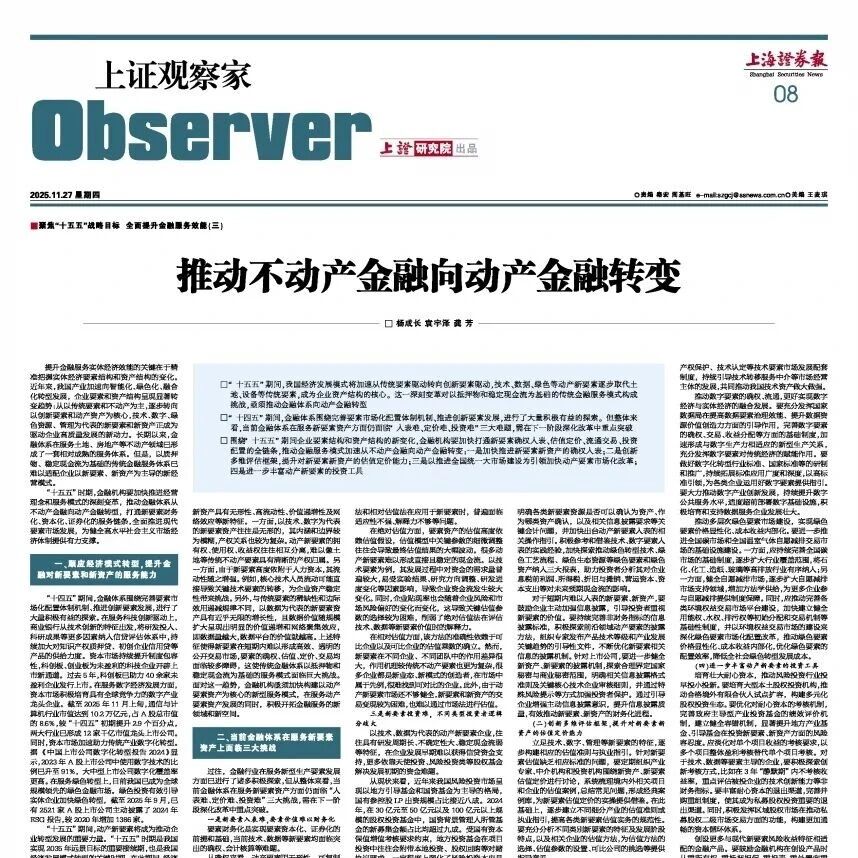
洞见 | 申万宏源杨成长:推动不动产金融向动产金融转变
申万宏源证券上海北京西路营业部· 2025-12-02 02:21
Core Viewpoint - The article emphasizes the need for China's financial system to transition from real estate finance to movable asset finance, driven by the shift in economic development from traditional factor-driven models to innovation-driven models during the "14th Five-Year Plan" and "15th Five-Year Plan" periods [2][3]. Group 1: Economic Transition and Financial System Challenges - During the "14th Five-Year Plan," the financial system explored ways to improve the market-oriented allocation of factors and promote the development of innovative factors, but it still faces challenges in serving new asset types [2][4]. - The transition to an innovation-driven economy will require financial institutions to adapt their service models to support new asset structures, focusing on technology, data, and green resources [5][6]. Group 2: New Asset Characteristics and Financial Service Requirements - New factors and assets are characterized by intangibility, high liquidity, and value increment, which pose challenges for traditional financial service models based on collateral and stable cash flows [7][8]. - The financial system must develop new service models that cater to movable asset characteristics, addressing the difficulties in rights confirmation, valuation, pricing, and investment [8][9]. Group 3: Current Challenges in Financial Services for New Factors - The financial system faces three main challenges: difficulty in incorporating new factors into financial statements, challenges in valuation due to lack of stable cash flows, and investment difficulties stemming from differing investor logic [8][9][10]. - New factors struggle with rights confirmation and accounting, as existing frameworks do not adequately address the unique characteristics of technology and data assets [9][10]. Group 4: Strategies for Financial Service Improvement - Financial institutions should enhance their capabilities in confirming rights and integrating new assets into financial statements, developing modern accounting systems that reflect the changes brought by technological and green transformations [16][17]. - A multi-dimensional evaluation framework should be established to improve the valuation and pricing capabilities for new factors and assets, involving industry experts and investment institutions [18][19]. - The construction of a unified national market for movable assets should be prioritized to facilitate the trading and circulation of new factors, enhancing market efficiency [20][21]. Group 5: Investment Tools and Financial Product Innovation - There is a need to diversify investment tools for movable assets, encouraging the development of patient capital and innovative financial products that align with the risk-return characteristics of new factors [23][24]. - Financial institutions should innovate their service models to better support the development of new factors, focusing on long-term investment strategies and enhancing risk management capabilities [25].