
软件

Search documents
超级利空 全线崩盘!黄仁勋驳斥人工智能将取代软件工具的担忧
Zhong Guo Ji Jin Bao· 2026-02-04 13:39
Core Viewpoint - The release of a new AI legal plugin by Anthropic has triggered a significant sell-off on Wall Street, resulting in a combined market value loss of approximately $300 billion for software, financial data, and exchange-traded stocks [1][2]. Group 1: Market Reaction - The introduction of Anthropic's AI automation tool led to a 6% drop in a basket of U.S. software stocks, marking the largest single-day decline since April of the previous year [3]. - The financial services index plummeted nearly 7%, reflecting widespread panic among investors [3]. - The sell-off has extended to global markets, with Indian IT exporters' index dropping nearly 6% and significant declines in Japanese software companies, including NEC, which fell by 11.79% [6][9]. Group 2: Analyst Insights - Analysts have noted a shift in market sentiment from skepticism to a "doomsday narrative," with traders indiscriminately selling off stocks of companies potentially impacted by AI advancements [11]. - Morgan Stanley analyst Toby Ogg highlighted that the current environment is one where software companies are presumed guilty until proven innocent, with market confidence severely shaken [5]. - Concerns are particularly focused on the "seat-based" pricing model of software companies, which may be undermined by AI tools that reduce the need for multiple user logins [5]. Group 3: Company Responses - NVIDIA CEO Jensen Huang dismissed fears that AI would replace software tools, arguing that such concerns are illogical and that AI will continue to rely on existing software rather than reinventing foundational tools [2]. - Huang emphasized that the recent breakthroughs in AI are centered around "tool usage," reinforcing the importance of existing software in the AI landscape [2].

今天还有2.4亿的资金去买白银基金,我有点看不懂了
表舅是养基大户· 2026-02-04 13:33
Group 1 - The article discusses the recent trading behavior of the silver LOF fund, which has seen significant price drops despite high premiums, indicating speculative trading behavior among investors [1][2] - The silver LOF experienced a third consecutive day of trading at the limit down, with a transaction volume of 240 million, reflecting a willingness among investors to take risks in hopes of finding buyers to absorb losses [2] - The article highlights the disconnect between the performance of silver prices and the fund's price, suggesting that investors may not fully understand the risks involved [5][8] Group 2 - The article identifies three main negative factors affecting the A-share and H-share markets, starting with the impact of AI advancements leading to fears of disruption in traditional software business models [10][12] - The second negative factor is Tencent's internal conflict regarding the "Yuanbao" red envelope feature, which has led to a decline in its stock price and reflects broader concerns about competition in the tech space [16][18] - The third negative factor involves ongoing technological changes in the optical module sector, which has resulted in significant stock price drops for key players in the industry [26][28] Group 3 - The article notes a concerning trend in financing, with a potential for a fifth consecutive day of net selling, which could indicate a broader market cooling [31][33] - It emphasizes the potential impact of reduced retail trading activity on previously high-flying stocks and sectors, suggesting that a market downturn could lead to significant corrections [33] Group 4 - The article mentions market movements influenced by external factors, such as Elon Musk's comments and actions, which have led to fluctuations in stock prices within the solar energy sector [36][40] - It also discusses regulatory changes in the automotive industry, specifically the phasing out of hidden door handles, which could affect the resale value of vehicles equipped with this feature [44]
超级利空,全线崩盘!黄仁勋,回应!
Zhong Guo Ji Jin Bao· 2026-02-04 13:31
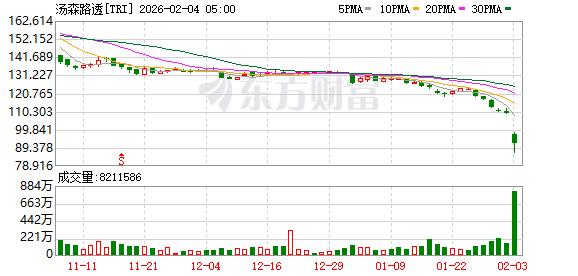
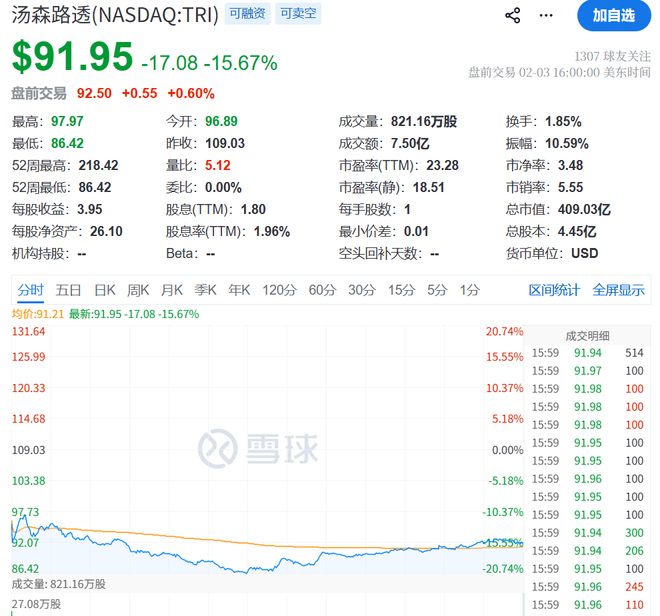
Core Viewpoint - Nvidia CEO Jensen Huang dismissed concerns that AI will replace software tools, stating that such fears are illogical and that AI will continue to rely on existing software rather than reinventing foundational tools [2][4]. Group 1: Market Reaction - The release of a new AI automation tool by Anthropic led to a significant market sell-off, with software, financial services, and asset management sectors collectively losing approximately $300 billion in market value [1][2]. - A basket of U.S. software stocks fell by 6%, marking the largest single-day decline since April of the previous year, while the financial services index plummeted nearly 7% [3][12]. - The Indian IT exporter index dropped nearly 6%, following the global trend in software stock declines [12][14]. Group 2: Analyst Insights - Analysts indicated that the current environment for software companies is one of presumption of guilt, where positive earnings are insufficient to reassure the market unless companies can convincingly demonstrate that AI will be a sustainable growth driver rather than a long-term drag [4][15]. - Concerns were raised about the "seat-based" pricing model, where software vendors charge per user, as AI tools may reduce the number of logins or users needed, potentially undermining this revenue model [4][15]. - The introduction of new AI tools, such as Anthropic's latest legal tool, could exacerbate investor concerns regarding the software sector [4][15]. Group 3: Stock Performance - Thomson Reuters saw a stock price decline of 15.67%, closing at $91.95, with a significant drop in trading volume [5][6]. - LegalZoom's stock fell by 19.68%, closing at $7.33, reflecting broader market fears [8][9]. - Other companies providing legal tools or research databases, such as Thomson Reuters and LegalZoom, experienced stock declines exceeding 12% [4][15].


人工智能相关风险引发投资者恐慌 软件股再度下挫
Xin Lang Cai Jing· 2026-02-04 13:24
摩根大通欧洲软件行业分析师Toby Ogg表示,即便过去12至18个月已持续减持,投资者对科技板块的 投资意愿仍处于低位。 他在研报中写道:"当前市场环境下,科技板块非但处于'未经证实清白即被推定有罪'的境地,更是陷 入了'未审先判'的局面。对于软件企业而言,'业绩超预期'已不足以打消市场顾虑。" 巴黎米罗瓦投资公司高级股票投资经理Karen Kharmandarian表示:"整个软件板块显然出现了无差别抛 售,目前未见底部支撑,下跌动能过于强劲,看上去颇有些止损抛售的意味。" 为对冲人工智能的颠覆性影响,投资者转而扎堆布局拥有实体工厂及基础设施的企业。周三,在欧洲斯 托克600基准指数成分股中,化工、电信及汽车板块领涨。 来源:环球市场播报 受投资者担忧人工智能工具升级带来的业务风险影响,软件开发商、广告代理商及投资机构再遭抛售潮 波及。 欧洲市场方面,软件巨头SAP SE下跌3.4%,创两年以来新低;旗下拥有数据分析服务商律商联讯的励 讯集团(Relx Plc)下跌2.5%;阳狮集团、Rightmove房产平台及殷拓集团也再度大幅下挫。 尽管当日跌幅较周二收窄,但市场对Anthropic PBC推出的工具 ...
全球最大主权基金掌门人最新对话:在风浪中前行的人,先要把自己绑在桅杆上...
雪球· 2026-02-04 13:00
Core Viewpoint - The article emphasizes the importance of discipline and rules in investment strategies, particularly in the context of the Norwegian sovereign wealth fund, which has successfully navigated market uncertainties through a systematic approach to asset allocation and rebalancing [4][5][28]. Group 1: Investment Strategy and Philosophy - The Norwegian sovereign wealth fund automatically rebalances its portfolio by selling bonds and buying stocks during market volatility, adhering to predefined rules rather than making tactical judgments [5][28]. - Over the past 30 years, the fund has achieved an annualized return of 6% to 7%, demonstrating the effectiveness of its long-term investment strategy [5][42]. - The fund's current asset allocation consists of 70% in equities and 30% in bonds, with some investments in real estate and renewable energy [5][25]. Group 2: Impact of AI on Investment and Society - AI is seen as a transformative force that could exacerbate inequality, with countries and companies that fully embrace AI rapidly distancing themselves from those that do not [5][46][49]. - The fund has integrated AI tools into its operations, with 100% of employees using large model tools and 65% participating in code enhancement work, indicating a significant shift towards technology at the organizational core [5][54]. - Despite the potential of AI, its impact on productivity has not yet been fully realized, with a belief that true transformation will occur once "AI agents" mature [5][57]. Group 3: Economic and Political Context - The fund's design was established to stabilize the economy and prepare for a post-oil era, with a clear spending rule allowing the government to utilize a maximum of 3% of the fund's size annually [21][23]. - Political consensus and transparency are crucial for the fund's operations, ensuring that investment philosophies remain stable despite government changes [24][25]. - The fund does not make tactical asset allocations based on geopolitical changes, as historical evidence suggests that such judgments are often inaccurate [39][43].

美股前瞻 | 三大股指期货涨跌不一,市场静待美财政部发债计划和ADP数据,Alphabet(GOOGL.US)盘后公布财报
智通财经网· 2026-02-04 12:59
Market Overview - US stock index futures showed mixed performance, with Dow futures up 0.25% and S&P 500 futures up 0.19%, while Nasdaq futures fell 0.11% [1][2] - European indices had varied results, with Germany's DAX down 0.23%, UK's FTSE 100 up 1.21%, France's CAC40 up 0.95%, and the Euro Stoxx 50 up 0.24% [2] Oil Market - WTI crude oil rose 0.44% to $63.49 per barrel, while Brent crude oil increased by 0.31% to $67.54 per barrel [3] Software Sector - A panic over AI replacing software is causing a significant sell-off in global software stocks, with Morgan Stanley stating the industry is in a state of "presumed guilty" [4] - Nvidia's CEO Jensen Huang refuted claims that AI will replace software, calling such ideas "illogical" and emphasizing that AI will rely on existing software [5] Geopolitical and Economic Insights - UBS CEO Sergio Ermotti indicated that geopolitical turmoil may persist for the next decade, prompting clients to diversify investments away from US assets [6] - The Financial Stability Board (FSB) warned about the risks of basis trading, which could trigger a crisis in the bond market due to leveraged financing [7] Company Earnings and Forecasts - Alphabet (GOOGL.US) is expected to report Q4 revenue of $111.45 billion, a 15.53% year-over-year increase, with a focus on Google Cloud's order backlog [8] - Eli Lilly (LLY.US) forecasts a 27% increase in sales by 2026, reaching $80-83 billion, driven by strong performance in weight loss and diabetes medications [9] - Uber (UBER.US) reported a 22% increase in Q4 bookings but issued a weak earnings outlook, leading to a 6% drop in stock price [10] - AMD (AMD.US) reported a 34% increase in Q4 sales but expressed concerns over Q1 forecasts, which fell short of market expectations [11] - Lumentum (LITE.US) exceeded expectations with Q2 revenue of $665 million, a 65% increase, and provided strong guidance for Q3 [12] - Electronic Arts (EA.US) reported mixed Q3 results, with revenue below expectations but strong pre-order numbers driven by the release of "Battlefield 6" [13] - Emerson Electric (EMR.US) exceeded Q1 earnings expectations and raised its full-year profit guidance [14] - Novartis (NVS.US) warned of profit declines in 2026 due to increased competition from generics [15] - UBS (UBS.US) reported a 56% increase in Q4 net profit, exceeding expectations, and announced a $3 billion stock buyback plan [16] Upcoming Economic Data - Key economic data releases include US ADP employment change, durable goods orders, factory orders, and ISM non-manufacturing PMI [20][21][22][23]

软件股大跌之际,黄仁勋驳斥“AI替代”论:这是世界上最不合逻辑的事
美股IPO· 2026-02-04 12:58
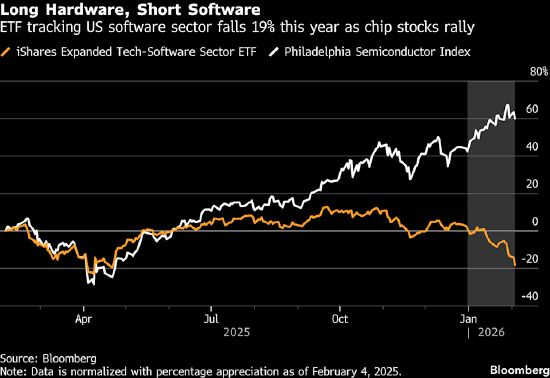
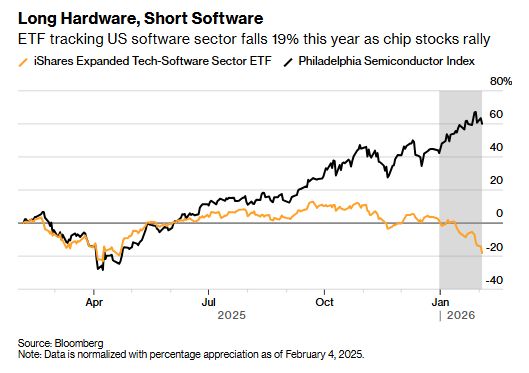
Core Viewpoint - Nvidia CEO Jensen Huang refuted the notion that AI will replace software tools, calling it "illogical" and emphasizing the importance of using existing tools rather than reinventing them [1][3][4] Group 1: AI and Software Industry Dynamics - Huang highlighted that the computing industry is undergoing a significant transformation, shifting from explicit programming to implicit programming, where users state goals and systems autonomously plan execution paths [4] - The recent launch of a legal automation tool by AI startup Anthropic triggered widespread panic selling in the software sector, leading to significant declines in major stock indices [3][5] - The iShares Expanded Tech-Software Sector ETF experienced a drop of 5.6%, marking a six-day losing streak with a cumulative decline of over 14% [5] Group 2: Market Reactions and Implications - Major software companies, including Microsoft, faced scrutiny despite solid quarterly earnings, as investors focused on slowing cloud business growth and the return on AI capital expenditures [6] - The overall market sentiment has shifted from concerns about individual AI tools to a systemic reassessment of the software industry's business models, with only 67% of S&P 500 software companies exceeding revenue expectations during the earnings season [6] - Analysts have downgraded several software companies, citing concerns over seat compression and the narrative of "ambient coding" potentially capping industry valuation multiples [6]

“AI替代恐慌”愈演愈烈!全球软件股跌势难止 小摩直言:行业已至“未审先判”境地
Zhi Tong Cai Jing· 2026-02-04 12:17
Core Viewpoint - A market panic triggered by advancements in artificial intelligence (AI) technology is spreading globally, particularly impacting the software sector, with ongoing pessimism among investors [1] Group 1: Market Reaction - On Tuesday, a basket of U.S. software stocks tracked by Goldman Sachs plummeted by 6%, marking the largest single-day drop since April due to tariff-induced sell-offs [5] - The financial services index fell nearly 7%, while the Nasdaq 100 index experienced a maximum intraday drop of 2.4%, ultimately closing down 1.6%, resulting in a total market value loss of approximately $285 billion [5] - The sell-off quickly spread to Asian markets on Wednesday, with European markets continuing to decline, as evidenced by a UBS index of European companies at risk of AI disruption, which fell by 8% on Tuesday and an additional 2.1% on Wednesday [5] Group 2: Investor Sentiment - Morgan Stanley analyst Toby Ogg noted that investor sentiment towards the software sector has shifted from "presumed guilty" to "guilty until proven innocent" [1] - Ogg's discussions with over 50 investors revealed a significant reduction in software stock holdings over the past 12 to 18 months, with a general lack of interest in bottom-fishing despite the recent downturn [1][6] - The current earnings season shows that only 67% of software companies in the S&P 500 exceeded revenue expectations, significantly lower than the overall tech sector's 83% [6] Group 3: Industry Challenges - Ogg stated that for software companies, exceeding earnings expectations is no longer a compelling factor for the market unless they can convincingly demonstrate that AI is a sustainable growth driver rather than a long-term hindrance [6] - The pricing model based on user count is under threat as AI tools may reduce the number of accounts needed for customers to complete tasks, directly impacting revenue [7] - The introduction of new AI products by leading platforms, such as Anthropic's recent legal AI tool, exacerbates investor concerns regarding the software sector [7]

黄仁勋:AI绝不会取代软件
3 6 Ke· 2026-02-04 12:12
Group 1 - Nvidia CEO Jensen Huang refuted concerns that artificial intelligence (AI) could replace software and related tools, stating that such ideas are "illogical" [1][2] - Huang emphasized that AI systems are designed to work alongside existing software tools rather than completely replace them, asserting that the notion of AI diminishing the importance of software companies is incorrect [2] - He highlighted that recent breakthroughs in AI focus on how to utilize existing tools more effectively, reinforcing the idea that software tools are essential components of advanced AI ecosystems [2] Group 2 - A significant sell-off of software stocks occurred in the U.S., with notable declines such as London Stock Exchange Group down 13%, Thomson Reuters plunging 16%, and Legalzoom.com dropping 20% [3] - The sell-off extended to Asia, with India's Nifty IT index falling over 6%, and major tech service companies like Infosys experiencing a drop of up to 7.3% [3] - In Hong Kong, software company Kingdee International Software Group saw its stock price plummet by more than 13% [4]
软件股大跌之际,黄仁勋驳斥“AI替代”论:这是世界上最不合逻辑的事
Hua Er Jie Jian Wen· 2026-02-04 11:47
Core Viewpoint - The CEO of Nvidia, Jensen Huang, refuted the notion that AI will replace software tools, calling it "extremely illogical" and emphasizing that both humans and AI will continue to use existing tools rather than reinvent them [1][2]. Group 1: Market Reaction - The launch of a new automation tool by AI startup Anthropic triggered widespread concerns about the software industry's future, leading to a global sell-off in software stocks [1][3]. - The iShares Expanded Tech-Software Sector ETF fell by 5.6%, marking a six-day losing streak with a cumulative drop of over 14% [3]. - The S&P North American Software Index experienced a 15% decline in January, the largest monthly drop since October 2008 [3]. Group 2: Corporate Performance - Microsoft, despite reporting solid quarterly earnings, faced scrutiny over slowing growth in its cloud business, resulting in a 10% drop in its stock price on a single day [4]. - Only 67% of S&P 500 software companies that reported earnings exceeded revenue expectations, significantly lower than the overall tech sector's 83% [4]. - Investment firm Piper Sandler downgraded several software companies, citing concerns over "seat compression" and the narrative of "ambient coding" potentially capping industry valuation multiples [4]. Group 3: Strategic Insights - Huang suggested that companies should focus on identifying their most impactful workflows and deploy AI there, advocating for a strategy of broad experimentation [2]. - He compared enterprise software to tools like screwdrivers and hammers, asserting that even advanced AI systems should focus on using tools rather than reinventing them [2].