食品

Search documents
利好来了,六部门联合发文
2 1 Shi Ji Jing Ji Bao Dao· 2025-11-26 14:25
Core Viewpoint - The article highlights a significant opportunity emerging from the government's new consumption policy aimed at enhancing the adaptability of supply and demand in consumer goods, with a focus on innovation and quality improvement in the market [1][3]. Group 1: Policy Implementation - The State Council has introduced an implementation plan to enhance the adaptability of supply and demand in consumer goods, which includes multiple key tasks such as accelerating the layout of new fields, promoting efficient manufacturing models, and integrating artificial intelligence [1][3]. - The plan sets clear targets, aiming to form three trillion-level consumption sectors and ten billion-level consumption hotspots by 2027, with a focus on high-quality development and increased contribution of consumption to economic growth [1][3]. Group 2: Industry Focus - The plan emphasizes key industries such as smart connected vehicles, smart home products, consumer electronics, modern textiles, food, and green building materials, aiming to create a hundred iconic products and a hundred innovative enterprises [5][6]. - The automotive sector, particularly in new energy vehicles, has shown strong growth, with October sales reaching 1.715 million units, a 20% year-on-year increase, marking a significant milestone in the market [5]. Group 3: Consumer Demand and Manufacturing - The article discusses the importance of flexible manufacturing to meet personalized consumer demands, highlighting the need for high-quality, small-batch, and specialized products [6][14]. - The plan proposes the promotion of efficient response manufacturing models, including flexible and customized production, to better align with consumer preferences [6][14]. Group 4: Artificial Intelligence Integration - The plan advocates for the application of artificial intelligence across the entire consumer goods industry, aiming to enhance product development efficiency and innovation through tools like generative AI and 3D digital design [8][10]. - AI is expected to play a crucial role in understanding consumer needs, providing customized products and services, and improving the overall shopping experience [11][12]. Group 5: Lifecycle Consumption - The plan addresses the needs of different consumer demographics, including children and the elderly, promoting the development of high-quality, intelligent products tailored to these groups [15]. - The focus on "lifecycle consumption" reflects a shift from merely meeting basic needs to creating quality living experiences, indicating a broader trend in consumer behavior [15].


重大利好来了!国务院同意→
Jin Rong Shi Bao· 2025-11-26 11:20
Core Viewpoint - The implementation plan aims to enhance the adaptability of consumer goods supply and demand, leading to consumption upgrades that drive industrial upgrades, thereby achieving a dynamic balance between supply and demand at a higher level [1][4]. Policy Framework - The plan is jointly issued by multiple government bodies, including the Ministry of Industry and Information Technology, the National Development and Reform Commission, and others, marking it as a significant policy document following the Fourth Plenary Session of the 20th Party Congress [1][2]. Goals and Targets - By 2027, the supply structure of consumer goods is expected to be significantly optimized, forming three trillion-level consumption sectors and ten hundred-billion-level consumption hotspots [4]. - By 2030, a high-quality development pattern characterized by positive interaction between supply and consumption is anticipated, with a steady increase in the contribution of consumption to economic growth [4]. Industry Focus Areas - The plan emphasizes the development of new fields and tracks, focusing on key industries such as smart connected vehicles, smart home products, consumer electronics, modern textiles, food, and green building materials [5]. - It encourages the integration of artificial intelligence across the entire consumer goods industry, promoting the development of AI-enabled products like household service robots and smart appliances [5]. Sports and Health Products - The plan aims to enhance the supply of leisure and sports products, targeting new demands from the sports economy, outdoor economy, and ice and snow economy [6]. - It supports the innovation and development of health products, including special dietary foods and high-end medical devices, while promoting the consumption of organic and geographical indication agricultural products [6]. Diverse Consumer Interests - The plan seeks to expand the supply of interest-based consumer products, including pet-related items, anime, and trendy products, while also promoting low-altitude tourism and private flying [7]. - It encourages the development of local intellectual property and innovative design in cultural products, as well as the transformation of traditional retail spaces to include trendy stores [7]. Customization and Experience - The plan emphasizes the need for precise matching of consumer needs, particularly in the baby and children's product sector, and encourages the development of high-end fashion brands and personalized services [8]. - It promotes the creation of immersive consumer experiences through the use of digital technologies, including virtual reality and the metaverse [10]. Financial Support and Services - The plan highlights the importance of financial support for the consumer goods industry, including policies for equipment upgrades and trade-in programs, as well as enhancing the adaptability and convenience of consumer financial services [11].
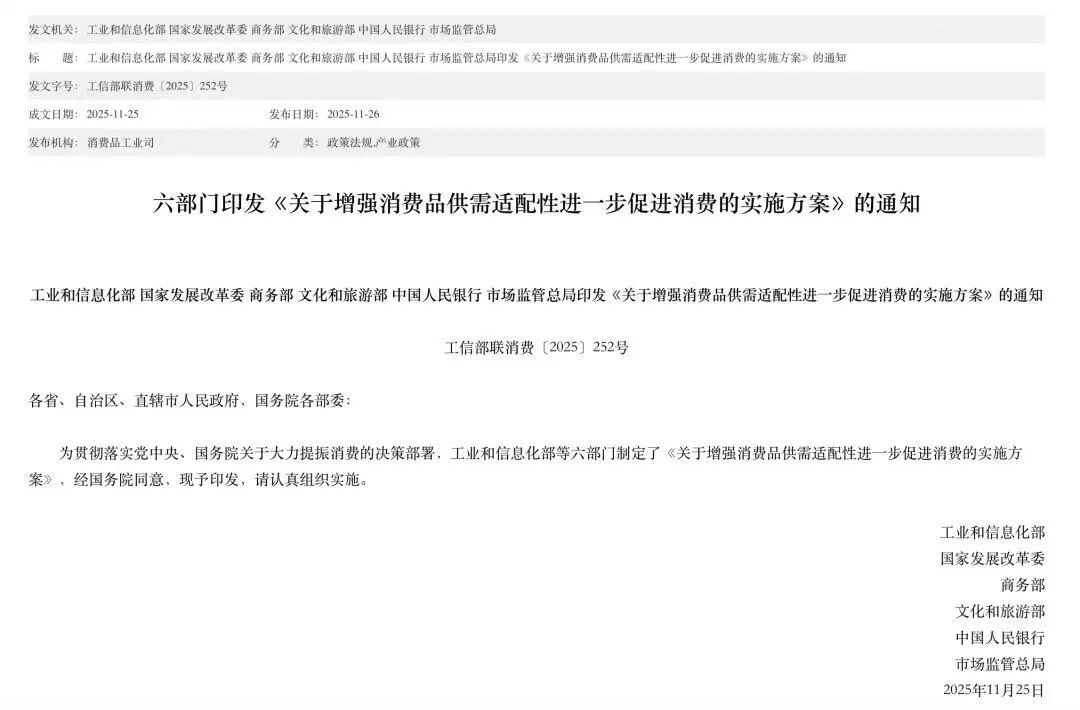
六部门发文!形成3个万亿级消费领域
Zhong Guo Zheng Quan Bao· 2025-11-26 08:41
Core Viewpoint - The implementation plan aims to enhance the adaptability of supply and demand in consumer goods, targeting the formation of three trillion-level consumption sectors and ten hundred-billion-level consumption hotspots by 2027 [1][2] Group 1: Strategic Goals - By 2027, the supply structure of consumer goods is expected to be significantly optimized, with a focus on high-quality consumer products that have cultural significance and global recognition [1] - By 2030, a high-quality development pattern characterized by positive interaction between supply and consumption is anticipated, with a steady increase in the contribution of consumption to economic growth [1] Group 2: Key Tasks - The plan outlines 19 key tasks across five areas: accelerating the application of new technologies and models, expanding the supply of unique and new products, precisely matching diverse consumer needs, cultivating new consumption scenarios and business formats, and creating a favorable development environment [1] - Emphasis is placed on expanding new fields and tracks, promoting efficient manufacturing models, and enhancing the integration of artificial intelligence [1] Group 3: Market Focus - The strategy targets key industries such as smart connected new energy vehicles, smart home products, consumer electronics, modern textiles, food, and green building materials, aiming to create hundreds of iconic products and innovative enterprises [1] - There is a push for the expansion and iteration of green products, improvement of rural consumer goods, and significant development of leisure and sports products [2] Group 4: Targeted Consumer Segments - The plan specifies the need to enrich the supply of baby and children's products, enhance quality student supplies, expand trendy fashion items, and optimize products for the elderly [2] - Development of refined, quality, and intelligent baby and children's products is prioritized, along with the design of writing tools that protect vision and posture [2]
广州御鲜萃食品有限公司成立 注册资本100万人民币
Sou Hu Cai Jing· 2025-11-26 07:25
Core Insights - Guangzhou Yuxian Cui Food Co., Ltd. has recently been established with a registered capital of 1 million RMB [1] Business Scope - The company operates in various sectors including personal internet live streaming services, wholesale and retail of edible agricultural products, and sales of health foods and food additives [1] - It also engages in the sale of household appliances, electronic products, home goods, sanitary ware, disinfectants (excluding hazardous chemicals), and personal protective equipment [1] - Additional services include information technology consulting, supply chain management, corporate image planning, brand management, and market research [1] - The company is involved in the retail and wholesale of cosmetics, maternal and infant products, daily necessities, and disposable medical supplies [1] - It provides internet sales services for pre-packaged food and conducts scientific research and experimental development related to food [1]
刚刚,重磅利好!直线封板!
中国基金报· 2025-11-26 07:08
Core Viewpoint - The article discusses a new implementation plan aimed at enhancing the adaptability of supply and demand in consumer goods, promoting consumption, and optimizing the supply structure by 2027 and 2030 [5][20]. Group 1: Implementation Goals - By 2027, the supply structure of consumer goods is expected to be significantly optimized, forming three trillion-level consumption sectors and ten hundred-billion-level consumption hotspots [5][20]. - By 2030, a high-quality development pattern characterized by positive interaction between supply and consumption is anticipated, with a steady increase in consumption's contribution to economic growth [5][20]. Group 2: Key Tasks - The plan outlines five main areas with 19 key tasks, including expanding new technologies and innovative applications, enhancing the supply of unique and new products, and accurately matching different demographic needs [6][7][8][9]. - Specific focus areas include smart connected vehicles, smart home products, consumer electronics, and green building materials, with initiatives to create flagship products and innovative enterprises [10][21]. Group 3: Market Segmentation - The plan emphasizes the need to diversify product offerings for various demographics, including enhancing supplies for children, students, and the elderly [7][27][28]. Group 4: New Consumption Scenarios - The initiative encourages the development of new consumption scenarios and business models, such as live e-commerce and shared consumption, to create immersive shopping experiences [8][30][31]. Group 5: Supportive Environment - The plan calls for strengthening financial support, organizing special events, and maintaining market order to foster a conducive environment for consumption growth [9][31]. Group 6: Market Reaction - Following the announcement of the plan, stocks related to the consumer sector experienced a surge, with several companies reaching their daily trading limits [12].


促进消费新方案来了!
清华金融评论· 2025-11-26 07:01
Core Viewpoint - The article outlines a comprehensive plan to enhance the adaptability of supply and demand in consumer goods, aiming to significantly optimize the supply structure by 2027 and establish a high-quality development pattern by 2030, with a focus on cultural and high-quality consumer products [6][7]. Group 1: Key Tasks - The plan includes 19 key tasks across five main areas: expanding new increments, deepening existing stock, segmenting markets, empowering scenarios, and optimizing the environment [4]. - It emphasizes the acceleration of new technology and model innovation, including the promotion of flexible manufacturing and the integration of artificial intelligence in the consumer goods sector [8][9]. Group 2: Product Supply Enhancement - The plan aims to expand the supply of distinctive and new products, focusing on green products, rural consumption upgrades, and the development of leisure and sports products [10][11]. - It encourages innovation in health products and aims to enhance the influence of historical classic products, promoting traditional crafts and cultural heritage [11][12]. Group 3: Market Segmentation - The strategy includes precise matching of different demographic needs, such as enriching the supply of children's products, enhancing quality student supplies, and expanding fashionable "trendy" products [13][14]. - It also focuses on optimizing products for the elderly, ensuring comfort and functionality in elder care products [14][15]. Group 4: New Consumption Scenarios - The plan promotes the establishment of new consumption scenarios and business models, including the support for flagship stores and innovative retail formats [16]. - It encourages the development of platform consumption and shared consumption models, leveraging technology to enhance consumer experiences [16][17]. Group 5: Supportive Environment - The plan outlines measures to strengthen financial support for the consumer goods industry, including the promotion of consumption finance products and government procurement [17]. - It emphasizes the importance of maintaining market order and enhancing regulatory measures to ensure product quality and safety [18].

六部门发文提出2027年形成3个万亿级消费领域
Sou Hu Cai Jing· 2025-11-26 06:56
Core Viewpoint - The implementation plan aims to enhance the adaptability of supply and demand in consumer goods, targeting significant improvements in supply structure by 2027 and establishing a high-quality development pattern by 2030 [1][2] Group 1: Supply Structure Optimization - By 2027, the plan envisions a noticeable optimization in the supply structure of consumer goods, creating three trillion-level consumption sectors and ten hundred-billion-level consumption hotspots [1] - The focus is on leading industrial upgrades through consumption upgrades and achieving a dynamic balance between supply and demand [1] Group 2: Key Tasks and Areas of Focus - The plan outlines 19 key tasks across five areas: accelerating innovation in new technologies and models, expanding the supply of unique and new products, precisely matching diverse consumer needs, cultivating new consumption scenarios and business formats, and creating a favorable development environment [1] - Specific industries targeted include smart connected new energy vehicles, smart home products, consumer electronics, modern textiles, food, and green building materials [1] Group 3: Enhancing Existing Supply - The plan emphasizes the need to promote the expansion and iteration of green products, improve the quality of rural consumer goods, and significantly develop leisure and sports products [2] - It includes adapting to trends in green and low-carbon consumption, enhancing product efficiency standards, and focusing on new demands from event economies and outdoor activities [2] Group 4: Targeting Niche Markets - The plan aims to enrich the supply of baby and children's products, enhance quality student supplies, expand fashionable "trendy" products, and optimize products for the elderly [2] - It promotes the refined, quality, and intelligent development of baby and children's products, including the design of writing tools that protect vision and posture [2]
六部门:增强消费品供需适配性 进一步促进消费
智通财经网· 2025-11-26 06:50
Core Viewpoint - The implementation plan aims to enhance the adaptability of supply and demand for consumer goods, promoting consumption through various new business models and technologies [1][4]. Group 1: Overall Requirements - The plan is guided by Xi Jinping's thoughts and aims to achieve a dynamic balance between supply and demand, with a target of optimizing the supply structure of consumer goods by 2027 and establishing a high-quality development pattern by 2030 [5]. Group 2: Accelerating Innovation in New Technologies and Models - Focus on key industries such as smart connected vehicles, smart home, and green building materials, with initiatives to create flagship products and innovative enterprises [7]. - Promote flexible and customized manufacturing models, establishing a digital system that connects user demand with intelligent design and flexible production [7]. - Encourage the integration of artificial intelligence across the consumer goods sector, supporting the development of smart home products and digital art [8]. Group 3: Expanding Supply of Unique and New Products - Promote green products and set standards for energy efficiency and emissions, encouraging low-carbon consumption in various sectors [9]. - Support the upgrade of consumer goods in rural areas, enhancing infrastructure and promoting high-quality products [9]. - Develop leisure and sports products to meet new demands from events and outdoor activities [10]. Group 4: Precise Matching of Different Consumer Needs - Enhance the supply of baby and children's products, focusing on safety and quality [12]. - Improve the availability of quality student supplies, integrating traditional and smart products [12]. - Expand the supply of fashionable products, fostering independent designers and high-end brands [12]. Group 5: Cultivating New Consumption Scenarios and Business Models - Support the establishment of flagship stores and new concept stores, enhancing core business districts [14]. - Encourage the development of platform consumption models such as live e-commerce and instant retail, utilizing AI and other technologies [14]. - Promote shared consumption models in public spaces, ensuring quality and safety [14]. Group 6: Creating a Favorable Development Environment - Strengthen financial support for the consumer goods industry, enhancing the adaptability of financial services [15]. - Organize promotional activities to highlight quality consumer goods and brands [15]. - Maintain market order by addressing issues like local protectionism and ensuring product safety standards [16].
“人造肉”千亿赛道的坍塌:资本的幻想与精英主义的泡沫
硅谷101· 2025-11-26 01:17
这是一个曾被比尔·盖茨、李嘉诚、小李子押注的千亿赛道,如今却沦为华尔街的笑话。2019年,Beyond Meat上市首日暴涨163%,一度被视为“拯救地球的未来”;而2025年,它的股价已较高点跌去99.5%,甚至沦为被散户爆炒的Meme“妖股”。更讽刺的是,为了生存,曾经的行业颠覆者Impossible Foods竟然宣布:考虑在植物肉里加“真肉”。 从受到全球资本疯狂追捧,到如今裁员、濒临破产,人造肉行业究竟做错了什么?是口感和价格的双输局面,还是资本健康神话的泡沫破裂?本期视频,我们将实地品尝硅谷现存的人造肉汉堡,并探访超市货架,翻开配料表、融资图,用亲身体验与客观数据揭开人造肉的真相。这场打着拯救地球旗号的科技精英主义实验,到底错在了哪里?人造肉还有机会东山再起吗? 你会看到: 人造肉神话破灭:从华尔街宠儿到妖股玩具 黄金赛道急冻:资本骤冷、投资退潮,消费者们用脚投票 Beyond Meat绝境:10亿美元债务危机下“回光返照”的妖股 Impossible Foods叛变:撕下100%植物基的最后一块遮羞布 不香了的人造肉:口味与价格是永远的痛点 健康神话的破灭:从“健康食品”到“超加工食品”(UPF ...


8点1氪:充电宝新规将落地,原3C认证将全面失效;上海地铁试点“站票车厢” ;超级猩猩客服回应“闭店潮”
36氪· 2025-11-26 00:09
Group 1 - The new national standard for power banks, titled "Mobile Power Safety Technical Specifications," is set to be implemented, rendering the existing 3C certification invalid. The new regulations are expected to be announced in December 2025, officially published in February 2026, and come into effect in June 2026. Approximately 70% of current production capacity may be forced to exit the market due to inability to meet the new technical requirements [2][3] - The implementation of the new standard will provide a six-month buffer period for existing products with 3C certification to clear inventory, while consumers can continue to use older certified products [2][3] Group 2 - The number of primary school students in Hong Kong has dropped to a 30-year low, with only 37,581 applicants for primary one places this year, reflecting a structural decline in the school-age population. This represents a year-on-year decrease of about 4,200 applicants, or approximately 10% [7] - The projected number of eligible children for primary one is expected to decline from 48,600 this year to 34,100 by 2030, indicating a nearly 30% overall decrease [7] Group 3 - Apple has announced layoffs in its sales department as it faces declining iPhone sales, particularly for the new iPhone Air model, which has not met sales expectations. The company is focusing on enhancing customer engagement while continuing to recruit for new positions [8] - The iPhone Air, which represents a significant design shift for Apple, is experiencing challenges in sales, leading to a reduction in production [8] Group 4 - Gree Electric Appliances plans to distribute a cash dividend of 5.585 billion yuan, with cumulative dividends exceeding 170 billion yuan since its listing. The company emphasizes the importance of maintaining operational capacity while meeting shareholder expectations [14][15] Group 5 - NIO reported a record revenue of 21.79 billion yuan for the third quarter of 2025, marking a year-on-year increase of 16.7%. The company also achieved a record delivery of 87,071 vehicles, a 40.8% increase year-on-year [24] - Xpeng Motors announced a total revenue of 181 million yuan for the third quarter, reflecting a year-on-year growth of 72% [25]