
创新药

Search documents
国信证券:港股修复行情已开启 AI方向仍将被重点关注
智通财经网· 2026-01-05 06:05
Core Viewpoint - The market anticipates that the next interest rate cut by the Federal Reserve will be delayed until late April 2024, following the December rate cut, with a focus on employment data and inflation pressures [1][2]. Group 1: U.S. Economic Outlook - Inflation pressures are decreasing, and future focus will be on employment data due to the impact of government shutdowns on economic data quality [2]. - The real estate market is weak, and the employment market is relatively sluggish, indicating that inflation pressures will remain manageable in the near term [2]. Group 2: Domestic Market Focus - The two main themes that could change market expectations in 2026 are the release of the 14th Five-Year Plan during the Two Sessions and the continuous improvement of the Producer Price Index (PPI) [3]. - The 14th Five-Year Plan will provide clearer growth expectations and market capacity, while PPI improvements will be crucial for corporate profitability and market sentiment [3]. Group 3: Hong Kong Stock Market - The market outlook for the first half of 2026 is positive, driven by a weaker U.S. dollar and improved domestic liquidity, creating a dual-driven market [4]. - AI remains a key focus for 2026, with expectations for accelerated domestic semiconductor hardware production and increased AI application deployment, particularly in the Hang Seng Technology and Internet sectors [4]. - The recovery of corporate profits in 2026 is supported by a trend against excessive competition, benefiting upstream metals and certain industrial companies [4]. Group 4: Non-Banking Sector - Non-banking sector performance has been significantly upgraded recently, with insurance and brokerage firms expected to benefit from market stabilization [5]. Group 5: Innovative Pharmaceuticals and Consumer Sector - The innovative pharmaceutical sector shows stable performance and is worth holding, with potential for recovery upon the release of new business development projects [6]. - In the consumer sector, certain areas like collectible toys have seen valuations drop to around 15 times earnings for 2026, and ongoing government consumer subsidies are expected to support recovery [6].

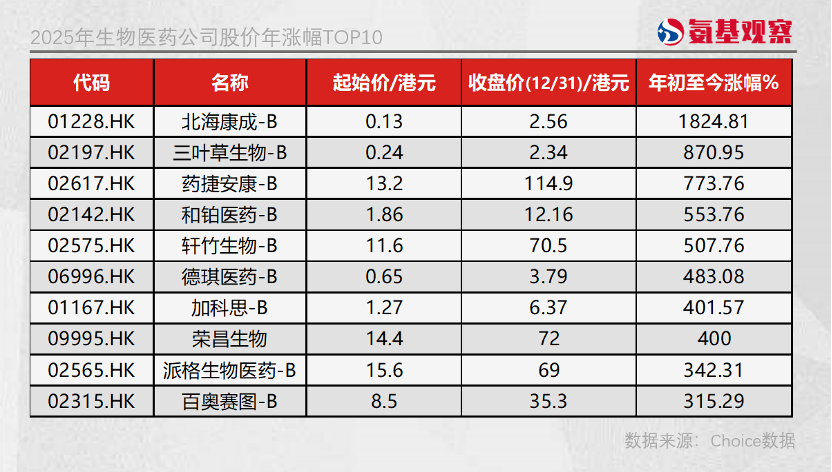
盘点2025中国创新药十大牛股,有点意外
Xin Lang Cai Jing· 2026-01-05 05:42
Core Insights - The innovative drug sector is experiencing a significant bull market, with the entry threshold for top-performing stocks raised considerably [1] - In 2024, the median stock price increase for the top 10 innovative drug companies was 57.9%, while in 2025, this surged to a median increase of 495.41%, with the highest increase reaching 1824% [2] Group 1: Top Performing Companies - The top-performing stock in 2025 was Beihai Kangcheng, with an astonishing annual increase of 1824%, surprising many in the market [4] - Following Beihai Kangcheng, the second highest was Sanleaf Biotech, which saw an increase of 870%, despite facing significant operational challenges [10] - Yaojie Ankang ranked third with a 773% increase, although its valuation raised concerns due to its limited clinical progress [12] - Heber Pharmaceuticals achieved a 553% increase, driven by its dual-engine model of R&D and business development [16] - Xuan Bamboo Biotech, a newly listed company, experienced a 507% increase, attributed to its new stock status and positive clinical data [20] Group 2: Market Dynamics and Trends - The market has seen a trend of speculative trading, with some companies experiencing price surges not necessarily backed by fundamental improvements [4] - The rise of companies like Heber Pharmaceuticals and Rongchang Biotech illustrates that long-term undervalued firms can achieve significant valuation recovery through continuous R&D and commercialization breakthroughs [4][30] - The innovative drug sector's growth is heavily influenced by liquidity and market sentiment, with many price increases based on speculative expectations rather than solid fundamentals [39] Group 3: Company-Specific Developments - Beihai Kangcheng's stock price recovery was linked to strategic capital injections, resolving its cash flow crisis [7] - Sanleaf Biotech's stock price rebound was primarily driven by its RSV vaccine pipeline, despite facing significant financial pressures [10][11] - Yaojie Ankang's rapid valuation increase raised questions about its sustainability, given its limited clinical advancements [13][14] - Heber Pharmaceuticals' growth was supported by strategic partnerships and a robust technology platform, enhancing investor confidence [18][19] - Rongchang Biotech's stock performance was bolstered by successful product approvals and strategic financing, improving its market outlook [31]

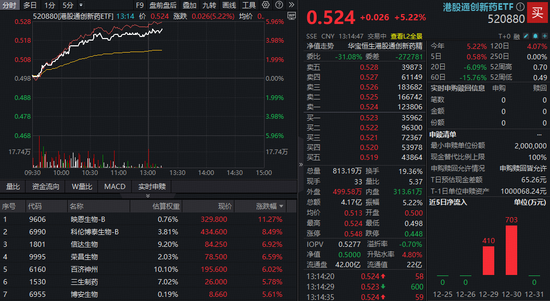
暴涨!高弹性港股通创新药ETF(520880)午后冲上5%,成交环比激增200%!大权重龙头联袂助攻!
Xin Lang Cai Jing· 2026-01-05 05:28
Core Viewpoint - The Hong Kong Stock Connect innovative drug sector is showing strong performance, with the Hong Kong Stock Connect Innovative Drug ETF (520880) experiencing a significant increase of 5.22% and a trading volume surge of nearly 200% compared to the previous trading day [1][7]. Group 1: ETF Performance - The Hong Kong Stock Connect Innovative Drug ETF (520880) covers 37 innovative drug research companies, with 36 stocks showing gains, including a rise of over 11% for InnoCare Pharma-B and over 8% for Kelun-B [1][7]. - Major weighted stocks such as Innovent Biologics, Rongchang Biopharmaceuticals, and BeiGene all increased by over 6% [1][7]. Group 2: Regulatory and Market Trends - According to the National Medical Products Administration, 76 innovative drugs are expected to be approved for market in China by 2025, a significant increase from 48 in 2024, marking a historical high [9][10]. - The domestic innovative drugs are particularly notable, accounting for 80.85% in chemical drugs and 91.30% in biological products [9][10]. Group 3: Market Opportunities - The total value of innovative drug licensing transactions in China is projected to exceed $130 billion in 2025, with over 150 transactions, both figures representing historical records and significant increases from 2024 [10]. - China's pipeline of new drugs currently holds a 30% share of the global total, ranking second worldwide [10]. Group 4: Investment Insights - Huafu Securities emphasizes that the long-term logic of pharmaceutical innovation remains unchanged, suggesting a positive outlook for innovative drugs in 2026 following a market adjustment in the second half of 2025 [10]. - The Hong Kong Stock Connect Innovative Drug ETF (520880) and its associated funds track the Hang Seng Hong Kong Stock Connect Innovative Drug Select Index, which has unique advantages in asset allocation [10].
全线飘红!沪指重返4000点背后,三大主力已抢跑,这个板块狂掀涨停潮!
Sou Hu Cai Jing· 2026-01-05 05:25
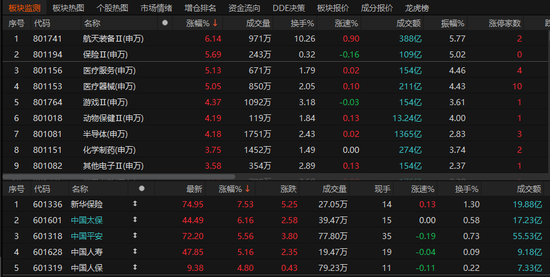
Core Viewpoint - The A-share market experienced a strong start to 2026, with major indices showing significant gains and a notable increase in trading volume, indicating a shift in market sentiment towards optimism [1] Market Performance - The Shanghai Composite Index rose by 1.07%, reclaiming the 4000-point mark, which is a key technical breakthrough and a sign of improved market confidence [1] - The Shenzhen Component Index and the ChiNext Index increased by 1.87% and 2.15%, respectively, while the STAR 50 Index surged by 4.05%, highlighting strong investor interest in technology innovation [1] - The total trading volume reached 1.65 trillion yuan, an increase of over 320 billion yuan compared to the previous trading day, indicating a robust volume-price relationship essential for sustaining the rebound [1] Sector Highlights - The brain-computer interface sector was the most prominent, driven by Elon Musk's announcement regarding Neuralink's plans for large-scale production of brain-computer interface devices in 2026, marking a significant step towards commercial application [2] - The innovative drug sector also performed strongly, supported by data from the National Medical Products Administration indicating that 76 innovative drugs are expected to be approved in 2025, a historical high, with total licensing transactions exceeding $130 billion [2] - The insurance sector saw leading companies' stock prices surge to historical highs, driven by a 7.6% year-on-year increase in premium income for the insurance industry in the first 11 months of 2025, with life insurance growth reaching 9.1% [2] Additional Sector Insights - The commercial aerospace sector continued its strong performance due to favorable policies related to the national Beidou application network [3] - The storage chip sector experienced a collective surge based on expectations of a cyclical turnaround, with DRAM contract prices anticipated to rise significantly [3] - Some sectors, such as the Hainan Free Trade Zone and stablecoin concepts, faced adjustments, reflecting a dynamic shift of funds from old themes to new mainlines [3] Market Outlook - The strong trading volume and upward movement of indices lay a solid foundation for a potential "spring market," with a clear focus on "hard technology" and "new growth" sectors [3] - Key sectors to watch include brain-computer interfaces, commercial aerospace, innovative drugs, and semiconductors, which are expected to maintain high activity levels due to both long-term growth potential and short-term policy catalysts [3] - Investors are advised to focus on technology growth leaders with matching performance and valuation, and to monitor whether trading volume can remain at elevated levels, which is crucial for assessing the strength and sustainability of the market [3]
20cm速递|创业板医药ETF国泰(159377)涨超1.9%,创新药与器械双主线或迎估值重塑
Mei Ri Jing Ji Xin Wen· 2026-01-05 04:53
Group 1 - The pharmaceutical and biotechnology industry is entering a critical phase of innovation realization and global layout, with a resonance of industrial, policy, and capital cycles expected by 2026, leading to a potential performance inflection point and valuation reshaping for Chinese innovative drugs, particularly in next-generation therapies such as ADCs, bispecific/multispecific antibodies, cell and gene therapies, and small nucleic acids [1] - The impact of policies on the medical device industry is diminishing, with over half of the market covered by centralized procurement, allowing domestic companies to achieve technological breakthroughs in certain high-end fields and surpass foreign competitors, alongside rapid growth in exports, which are expected to increase by 7.3% year-on-year from January to November 2025 [1] - The medical equipment sector is driven by a significant increase in procurement volume, with a projected 40% year-on-year growth in bidding amounts for 2025, positioning flow-type products and high-end export enterprises for high growth [1] - The demand for blood products and plasma collection continues to grow, with resources concentrating towards leading companies, and stable demand for major products such as albumin and immunoglobulin [1] Group 2 - The ChiNext Medical ETF (159377) tracks the Innovative Medicine Index (399275), which has a daily price fluctuation limit of 20%, and selects listed companies in the biotechnology, genetic engineering, and new drug development sectors from the ChiNext market to reflect the overall performance of high-growth and innovative biopharmaceutical frontier enterprises [1]

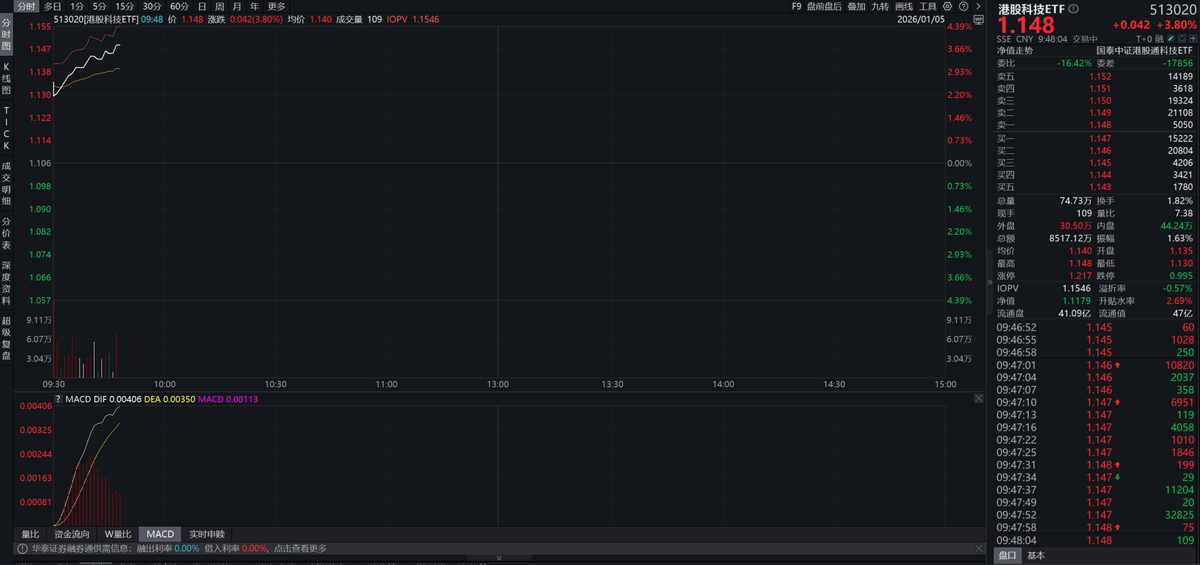
港股迎2009年以来最强“开门红”,港股科技ETF(513020)大涨近4%
Mei Ri Jing Ji Xin Wen· 2026-01-05 04:53
Core Viewpoint - The Hong Kong stock market experienced a strong start in 2026, with the Hang Seng Index rising by 2.76%, marking the best opening performance since 2009, and the Hang Seng Tech Index increasing by 4% [1] Group 1: Market Performance - The Hong Kong stock market saw significant inflows, with over HKD 10 billion in southbound capital purchases, setting a new annual record [1] - The Hong Kong Technology ETF (513020) rose nearly 4% during intraday trading, with a net inflow exceeding HKD 100 million over the past 20 days [1] Group 2: Sector Highlights - The Hong Kong Technology ETF (513020) tracks the CSI Hong Kong Stock Connect Index, encompassing leading stocks in sectors such as internet, chips, innovative pharmaceuticals, and new energy, including Alibaba, Xiaomi, Tencent, Meituan, BYD, and SMIC [3] - The Hong Kong Stock Connect Technology Index has outperformed the Hang Seng Tech Index and the Hong Kong Stock Connect Internet Index, with a cumulative increase of 45.19% from 2018 to the present, while the Hong Kong Stock Connect Internet Index decreased by 13.08% and the Hang Seng Tech Index fell by 0.61% during the same period [5][6] Group 3: Future Outlook - The development of AI in North America is expected to enhance the attractiveness of Hong Kong tech stocks, with leading internet companies leveraging their data and technology advantages to gain a competitive edge in AI model training [8] - Traditional internet platform companies are anticipated to shift focus from user growth to efficiency and overseas expansion in 2026, with AI technologies expected to improve profit margins and drive growth in cross-border e-commerce and digital content [9] - AI is projected to address long-standing challenges in various sectors, including smart driving, smart manufacturing, and innovative drug development, potentially leading to significant advancements in these areas [9] Group 4: Investment Opportunities - Investors are encouraged to consider the Hong Kong Technology ETF (513020) to capitalize on investment opportunities within the Hong Kong tech sector, which reflects a diversified representation of core technology assets and the overall performance of leading tech companies in the market [10]
2026年A股开门红,谁能成为最热赛道?
Xin Lang Cai Jing· 2026-01-05 04:32
2026年A股开市了!首个交易日,三大指数早盘集体上涨,上证指数盘中重回4000点。盘面热点快速轮 动,脑机接口板块掀起涨停潮,倍益康"30cm"涨停,三博脑科等超20只个股涨停。保险板块表现活 跃,中国太保、新华保险盘中双双创历史新高。商业航天板块延续强势,金风科技等近20只个股封板。 此外,创新药、有色金属、游戏等板块盘中均表现积极。 您觉得哪个板块能成为2026年首周A股最热赛道? 人脑工程板块掀涨停潮 创新药概念飙升 截至今日午间休市,沪指涨1.07%,深证成指涨1.87%,创业板指涨2.15%,沪深北三市半日成交16489 亿元,较上个交易日同期放量3240亿元。全市场超4000只个股上涨。人脑工程板块掀涨停潮,博拓生 物、熵基科技、三博脑科等10余只个股"20cm"涨停。 消息面上,埃隆·马斯克2025年12月31日在社交媒体上表示,其脑机接口公司"神经连接"(Neuralink) 将于2026年开始对脑机接口设备进行"大规模生产",并转向"更加精简和几乎完全自动化的外科手术流 程"。(详见马斯克发声!301293,开盘"20cm"涨停) 开源证券最新研报表示,上述行业事件印证了脑机接口技术预计将 ...





脑机接口概念爆发!创新药ETF天弘(517380)跟踪指数大涨超4.8%,涨幅超过港股通创新药
Mei Ri Jing Ji Xin Wen· 2026-01-05 04:02
Group 1 - A-shares opened higher today, with significant gains in innovative drug and brain-computer interface stocks, including Zhaoyan New Drug and BeiGene, which rose over 10% [1] - The innovative drug ETF Tianhong (517380) tracking the Hang Seng-Hushen-Hong Kong Innovative Drug Selected 50 Index surged over 4.8%, outperforming the Hong Kong Stock Connect Innovative Drug Index [1] - The biopharmaceutical ETF (159859) tracking the Guozhen Biopharmaceutical Index increased by over 3%, with a total scale exceeding 3.3 billion yuan and a net inflow of over 600 million yuan since September last year [1] Group 2 - The National Medical Products Administration has organized the formulation of the "Priority Approval High-end Medical Device Catalog (2025 Edition)," including medical electronic accelerators and implantable brain-computer interface medical devices [1] - Elon Musk announced that his brain-computer interface company, Neuralink, will begin large-scale production of brain-computer interface devices in 2026, transitioning to a more streamlined and nearly fully automated surgical process [1] - Analysts indicate that including implantable brain-computer interface medical devices in the priority approval category highlights policy support for related technological developments, with a broad potential market space and accelerated commercialization processes expected [1] Group 3 - McKinsey estimates that the global market size for brain-computer interface medical applications could reach $40 billion by 2030 and $145 billion by 2040, indicating significant application potential in the medical field [2] - Investors interested in the innovative drug sector can consider the innovative drug ETF Tianhong (517380) for easy access, while off-market investors may focus on linked funds [2] - The emphasis is on CXO and innovative drug mainline trends, with a recommendation to focus on the biopharmaceutical ETF (159859) that targets 30 industry leaders for higher sharpness and elasticity [2]




创新药ETF国泰(517110)涨超2.6%,创新疗法与国际化进程成关注焦点
Mei Ri Jing Ji Xin Wen· 2026-01-05 03:49
Group 1 - The innovative drug ETF Guotai (517110) rose over 2.6%, with a focus on innovative therapies and internationalization progress [1] - The chemical pharmaceutical sector performed moderately, while the innovative drug field saw multiple advancements, including Heng Rui Medicine's cMET ADC new drug SHE-1826 being proposed for breakthrough therapy designation [1] - Innovent Biologics' CTLA-4 biosimilar Daborhizumab is priced at 13,100 yuan per unit, and Zai Lab's DLL3/DLL3/CD3 tri-antibody received a $1.235 billion licensing deal with AbbVie, including an upfront payment of $100 million and up to $1.075 billion in milestone payments [1] Group 2 - Technological advancements in ADC, IO dual antibodies, GLP-1 weight loss, and small nucleic acid drugs are progressing, enhancing China's innovative drug internationalization capabilities [1] - The policy environment shows stabilization in medical insurance negotiations, with the introduction of a "commercial insurance innovative drug catalog" in 2025 to expand market opportunities, and the optimization of rules in the 11th batch of centralized procurement to alleviate fierce competition [1] - The CXO sector is experiencing growth in overseas orders and a recovery in domestic demand, with rapid increases in demand for ADC and peptide drugs [1] Group 3 - The medical device sector is focusing on performance recovery and overseas opportunities, with Hong Kong stocks highlighting the profit release of leading companies in niche segments, and new technologies like brain-computer interfaces and AI medical applications gaining investment interest due to policy support [1] - The traditional Chinese medicine sector is influenced by respiratory diseases and progress in the basic drug catalog, while the biopharmaceutical field is paying attention to the expectations of innovative pipeline authorizations and sales improvements for vaccine companies [1]
疫苗ETF(159643)涨超1.7%,创新兑现与全球布局成行业焦点
Sou Hu Cai Jing· 2026-01-05 03:48
Group 1 - The core viewpoint of the article highlights that the pharmaceutical and biotechnology industry is undergoing structural transformation, with the medical device sector expected to enter a new growth cycle by 2026 due to policy optimization and increased bidding activity [1] - The innovative drug sector is entering a "great era," with expectations that it will dominate the industry by 2026, as the combination of medical insurance and commercial insurance opens up payment space [1] - The medical service consumption sector is benefiting from policy optimization and upgraded demand, with specialized hospitals and chain pharmacies showing competitive advantages [1] Group 2 - The medical device sector is experiencing a trend of "policy clearance - innovation breakthrough - overseas expansion," with technologies like AI and brain-machine interfaces driving growth in high-end equipment exports [1] - The pharmacy industry has shifted from rapid expansion to quality optimization, with leading companies consolidating their positions through diversified operations [1] - Overall, the industry is entering a new phase driven by policy clearance and technological innovation, although attention is needed on risks such as centralized procurement and research failures [1] Group 3 - The vaccine ETF (159643) tracks the vaccine biotechnology index (980015), which selects listed companies involved in vaccine research, production, sales, and related biotechnology businesses to reflect the overall performance of the vaccine and biotechnology industry [1] - The index focuses on cutting-edge bioscience, covering vaccine companies with innovative technological capabilities and industrial advantages, effectively reflecting industry technological development trends and market dynamics [1]