医药生物

Search documents
【8日资金路线图】电子板块净流入近190亿元居首 龙虎榜机构抢筹多股
证券时报· 2025-12-08 12:18
盘后数据出炉。 12月8日,A股市场整体上涨。截至收盘,上证指数报3924.08点,上涨0.54%;深证成指报13329.99点,上涨1.39%;创业板指 报3190.27点,上涨2.6%;北证50指数上涨1.27%。A股市场合计成交20517.44亿元,较上一交易日增加3126.79亿元。 1.A股市场主力资金净流入7.34亿元 今日A股市场主力资金开盘净流出79.7亿元,尾盘净流出8.67亿元,A股市场全天主力资金净流入7.34亿元。 | | | 沪深两市近五日主力资金流向情况(亿元) | | | | --- | --- | --- | --- | --- | | 日期 | | | 净流入金额 开盘净流入 尾盘净流入 超大单净买入 | | | 2025-12-8 | 7. 34 | -79.70 | -8. 67 | 59. 68 | | 2025-12-5 | 17.75 | -82. 49 | 21.94 | 81. 12 | | 2025-12-4 | -214.71 | -121.97 | -35. 67 | -69.28 | | 2025-12-3 | -452. 50 | -107. 61 | ...


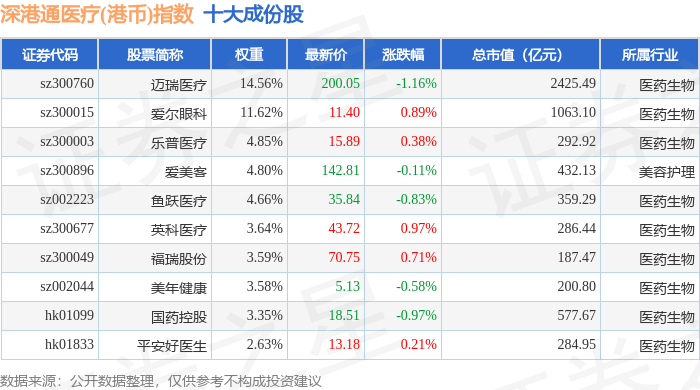
12月8日深港通医疗(港币)(983036)指数跌0.24%,成份股锦欣生殖(01951)领跌
Sou Hu Cai Jing· 2025-12-08 11:22
Core Insights - The Shenzhen-Hong Kong Stock Connect Medical Index (983036) closed at 4406.89 points, down 0.24%, with a trading volume of HKD 7.939 billion and a turnover rate of 0.88% [1] - Among the index constituents, 23 stocks rose while 34 stocks fell, with Yiyang Sunshine leading the gainers at 3.98% and Jinxin Fertility leading the decliners at 3.89% [1] Index Constituents Summary - The top ten constituents of the Shenzhen-Hong Kong Stock Connect Medical Index are as follows: - Mindray Medical (sz300760) holds a weight of 14.56%, latest price at HKD 200.05, down 1.16%, with a market cap of HKD 242.549 billion [1] - Aier Eye Hospital (sz300015) has a weight of 11.62%, latest price at HKD 11.40, up 0.89%, with a market cap of HKD 106.31 billion [1] - Lepu Medical (sz300003) has a weight of 4.85%, latest price at HKD 15.89, up 0.38%, with a market cap of HKD 29.292 billion [1] - Aimeike (sz300896) has a weight of 4.80%, latest price at HKD 142.81, down 0.11%, with a market cap of HKD 43.213 billion [1] - Yuyue Medical (sz002223) has a weight of 4.66%, latest price at HKD 35.84, down 0.83%, with a market cap of HKD 35.929 billion [1] - Yingke Medical (sz300677) has a weight of 3.64%, latest price at HKD 43.72, up 0.97%, with a market cap of HKD 28.644 billion [1] - Furuide (sz300049) has a weight of 3.59%, latest price at HKD 70.75, up 0.71%, with a market cap of HKD 18.747 billion [1] - Meinian Onehealth (sz002044) has a weight of 3.58%, latest price at HKD 5.13, down 0.58%, with a market cap of HKD 20.08 billion [1] - Sinopharm (hk01099) has a weight of 3.35%, latest price at HKD 18.51, down 0.97%, with a market cap of HKD 57.767 billion [1] - Ping An Good Doctor (hk01833) has a weight of 2.63%, latest price at HKD 13.18, up 0.21%, with a market cap of HKD 28.495 billion [1] Capital Flow Analysis - The index constituents experienced a net outflow of main funds totaling HKD 230 million, while retail investors saw a net inflow of HKD 268 million [1] - Detailed capital flow for specific stocks shows: - Furuide (sz300049) had a main fund net inflow of HKD 8.7323 million, with retail outflows of HKD 3.3726 million [2] - Aier Eye Hospital (sz300015) had a main fund net inflow of HKD 6.6536 million, with retail outflows of HKD 1.8752 million [2] - Lepu Medical (sz300003) had a main fund net inflow of HKD 3.7716 million, with retail outflows of HKD 0.7273 million [2]



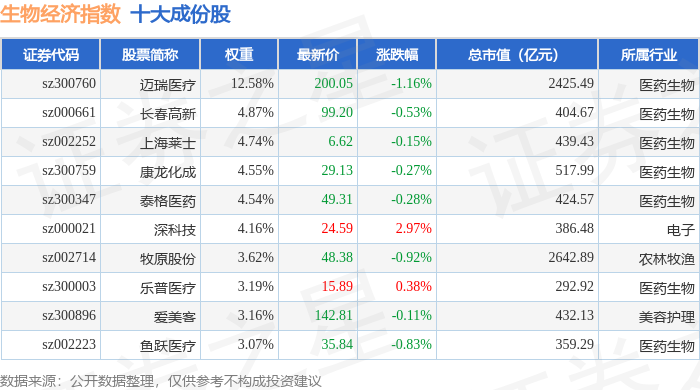
12月8日生物经济(970038)指数跌0.19%,成份股派林生物(000403)领跌
Sou Hu Cai Jing· 2025-12-08 11:05
Core Viewpoint - The Biotech Index (970038) closed at 2128.92 points, down 0.19%, with a trading volume of 12.11 billion yuan and a turnover rate of 0.9% [1] Group 1: Index Performance - On the day, 17 stocks in the Biotech Index rose, with Deep Technology leading at a 2.97% increase, while 31 stocks fell, with Palin Bio leading the decline at 1.77% [1] - The top ten constituent stocks of the Biotech Index include: - Mindray Medical (sz300760) with a weight of 12.58% and a latest price of 200.05, down 1.16% [1] - Changchun High-tech (sz000661) with a weight of 4.87% and a latest price of 99.20, down 0.53% [1] - Other notable stocks include Kanglong Chemical (sz300759), Biao Ge Medical (sz300347), and Deep Technology (sz000021) [1] Group 2: Capital Flow - The Biotech Index constituents experienced a net outflow of 197 million yuan from main funds, while retail investors saw a net inflow of 47.17 million yuan [3] - Deep Technology (000021) had a main fund net inflow of 148 million yuan, while other stocks like Aide Bio (300685) and Jingxin Pharmaceutical (002020) faced net outflows from main and retail funds [3] Group 3: Index Adjustments - Recent adjustments to the Biotech Index included the addition of 9 stocks and the removal of 9 stocks [3] - New stocks added include: - Chaoyan Co. (301602) with a market cap of 9.783 billion yuan [4] - Kanghua Bio (300841) with a market cap of 10.631 billion yuan [4] - Stocks removed include: - Wens Foodstuffs (300498) with a market cap of 120.303 billion yuan [4] - Red Sun Pharmaceutical (002020) with a market cap of 17.066 billion yuan [4]

东兴证券晨报-20251208
Dongxing Securities· 2025-12-08 10:42
Core Insights - The report emphasizes the need for a stable economic environment while enhancing quality and efficiency in 2026, with a focus on proactive fiscal policies and moderate monetary policies to improve macroeconomic governance [2] - The report highlights the significant growth of private enterprises in foreign trade, with a 7.1% increase in imports and exports, accounting for 57.1% of total foreign trade [2] - The report indicates a strong performance in the pet consumption sector, particularly during the Double Eleven shopping festival, showcasing resilience and growth potential in pet-related products [10][11] Economic Policy and Industry Trends - The Central Political Bureau meeting stresses the importance of effective investment and the integration of existing and new policies to stabilize the economy [2] - The report notes that the construction and building materials industry is facing challenges due to declining investment in infrastructure and real estate, with a negative growth forecast for fixed asset investment in 2025 [6][7] - The report discusses the ongoing negative cycle in the real estate sector, which continues to impact overall economic demand, although the intensity of this impact is decreasing [7][8] Company-Specific Developments - Zhongtong Bus reported a significant increase in production and sales in November 2025, with production up 61.89% and sales up 39.53% year-on-year [5] - Baidu Group is evaluating the potential spin-off and independent listing of its subsidiary Kunlun Chip, although no guarantees are provided regarding the outcome [5] - Xizang Pharmaceutical's product, a recombinant human brain natriuretic peptide, has been included in the medical insurance directory, indicating its significance in the treatment of acute heart failure [5] Consumer Behavior and Market Dynamics - The report identifies a trend towards domestic brands in the pet food market, with a notable increase in the market share of local brands during the Double Eleven sales event [11][12] - The pet food sector is experiencing diversification and a shift towards health-oriented and premium products, reflecting changing consumer preferences [11][13] - Export pressures in the pet food industry are noted, with a decline in export volume and value, although domestic consumption remains strong [13]
资金流向日报:15个行业资金呈净流入
Zheng Quan Shi Bao Wang· 2025-12-08 10:09
Market Overview - On December 8, the Shanghai Composite Index rose by 0.54%, the Shenzhen Component Index increased by 1.39%, the ChiNext Index climbed by 2.60%, and the CSI 300 Index gained 0.81% [1] - Among the tradable A-shares, 3,409 stocks rose, accounting for 62.67%, while 1,866 stocks declined [1] Capital Flow - The main capital saw a net inflow of 2.602 billion yuan throughout the day [1] - The ChiNext had a net inflow of 1.452 billion yuan, the Sci-Tech Innovation Board saw a net inflow of 2.746 billion yuan, and the CSI 300 component stocks had a net inflow of 1.424 billion yuan [1] Industry Performance - Out of the 25 primary industries classified by Shenwan, the top-performing sectors were Communication and Comprehensive, with increases of 4.79% and 3.03% respectively [1] - The sectors with the largest declines were Coal and Oil & Petrochemicals, with decreases of 1.43% and 0.84% respectively [1] Industry Capital Inflows - The Electronics industry led with a net inflow of 8.273 billion yuan and a daily increase of 2.60% [1] - The Communication industry followed with a net inflow of 2.387 billion yuan and a daily increase of 4.79% [1] - The Defense and Military industry had the largest net outflow of 3.567 billion yuan, despite a daily increase of 1.05% [1] - The Pharmaceutical and Biological industry experienced a net outflow of 2.700 billion yuan, with a daily increase of 0.12% [1] Individual Stock Performance - A total of 2,077 stocks saw net inflows, with 760 stocks having inflows exceeding 10 million yuan, and 134 stocks with inflows over 100 million yuan [2] - The stock with the highest net inflow was Shannon Chip Creation, which rose by 15.25% with a net inflow of 1.065 billion yuan [2] - Other notable stocks with significant net inflows included CITIC Securities and Shenghong Technology, with net inflows of 1.050 billion yuan and 0.821 billion yuan respectively [2] - Conversely, 92 stocks experienced net outflows exceeding 100 million yuan, with Aerospace Machinery, BOE Technology Group, and Wuliangye leading in outflows of 1.150 billion yuan, 0.704 billion yuan, and 0.686 billion yuan respectively [2]




27.00亿元主力资金今日撤离医药生物板块
Zheng Quan Shi Bao Wang· 2025-12-08 10:07
沪指12月8日上涨0.54%,申万所属行业中,今日上涨的有25个,涨幅居前的行业为通信、综合,涨幅 分别为4.79%、3.03%。医药生物行业今日上涨0.12%。跌幅居前的行业为煤炭、石油石化,跌幅分别为 1.43%、0.84%。 资金面上看,两市主力资金全天净流入26.02亿元,今日有15个行业主力资金净流入,电子行业主力资 金净流入规模居首,该行业今日上涨2.60%,全天净流入资金82.73亿元,其次是通信行业,日涨幅为 4.79%,净流入资金为23.87亿元。 主力资金净流出的行业有16个,国防军工行业主力资金净流出规模居首,全天净流出资金35.67亿元, 其次是医药生物行业,净流出资金为27.00亿元,净流出资金较多的还有食品饮料、基础化工、公用事 业等行业。 医药生物行业今日上涨0.12%,全天主力资金净流出27.00亿元,该行业所属的个股共477只,今日上涨 的有225只,涨停的有2只;下跌的有231只。以资金流向数据进行统计,该行业资金净流入的个股有170 只,其中,净流入资金超3000万元的有7只,净流入资金居首的是振德医疗,今日净流入资金2.36亿 元,紧随其后的是药明康德、海南海药,净流入 ...
脑科学与类脑技术领域把握(2025.12.1—2025.12.5):多层次研究与应用需求共振,技术突破驱动认知探索与产业化加速演进
Huafu Securities· 2025-12-08 07:51
Group 1: Core Insights - Brain science has emerged as a strategic high ground in global technological competition, driving advancements in the diagnosis and treatment of major brain diseases like Alzheimer's and supporting breakthroughs in brain-machine interface technologies [2][6][8] - Countries are increasingly incorporating brain science into national technology strategies, with significant initiatives such as the U.S. "BRAIN Initiative," the EU's "Human Brain Project," and China's "Brain Science and Brain-like Research" major project, reflecting a robust investment in research and infrastructure [2][7][8] - The global focus on brain science and brain-like intelligence is expected to continue growing, positioning these fields as key areas for future industrial development and international technological competition [8][9] Group 2: Market Performance - In the pharmaceutical sector, the medical services and traditional Chinese medicine II sub-industries recorded positive returns, with the pharmaceutical commercial sector leading at +5.19% [9][11] - The biopharmaceutical sector's valuation levels showed significant variation, with the highest being for biopharmaceuticals at 87.91 times earnings, while the lowest was for pharmaceutical commerce at 21.61 times [9][12] Group 3: Industry Trends - The recent international conference on artificial hearts highlighted the need for standardized definitions and terminology in the field, with significant participation from Chinese enterprises, indicating a collaborative effort to advance technology and improve clinical evaluations [14][15] - Shanghai is accelerating the development of brain-machine interface technologies, achieving milestones such as the first clinical trials for invasive brain-machine interfaces and the application of non-invasive products in rehabilitation and mental health [17][18]
中证A500ETF(159338)4日吸金超12亿元,指数长期跑赢沪深300
Mei Ri Jing Ji Xin Wen· 2025-12-08 07:15
Group 1 - Recent market volatility has increased, with funds allocating over 1.2 billion yuan to the CSI A500 ETF (159338) in the past four days [1] - The CSI A500 ETF tracks the CSI A500 Index, which offers comprehensive and balanced industry coverage, achieving 100% industry representation [1] - The CSI A500 Index includes approximately 50% traditional value sectors and 50% emerging growth sectors, reducing the representation of traditional industries compared to the CSI 300 [1] Group 2 - As of October 31, the CSI A500 Index has increased by 458.37% since its base date, outperforming the CSI 300 and CSI 800 indices by 96.15 and 49.07 percentage points, respectively [1] - From 2025 to the present, the CSI A500 has risen by 21.15%, while the CSI 300 and CSI 800 have increased by 17.94% and 20.50%, respectively, with excess returns of 3.21 and 0.65 percentage points [1] - Short-term market volatility is influenced by fluctuations in overseas market risk appetite, but the long-term bullish trend remains intact [2]
民营上市公司分红募资比高达54%,无锡凭什么?
2 1 Shi Ji Jing Ji Bao Dao· 2025-12-08 07:05
21世纪经济报道记者邓浩 12月5日,证监会主席吴清在中国证券业协会第八次会员大会提到,目前我国居民资产中股票基金等资 产占比约15%,相当于美国30年前水平,在利率中枢下移的当下,居民财富管理服务需求巨大。 比如,威孚高科上市以来累计分红123亿元,是募资总额的3.2倍,实现企业发展与股东收益共生共荣; 立霸股份自上市以来总分红达14.8亿元,实际募资仅2.2亿元,募资分红比超6倍,且"十四五"期间分红 金额逐年增长;奥特维上市5年分红规模已达募资总额的1.8倍,实现"高速成长"与"高额回报"同步推 进。 在股份回购方面,无锡企业同样积极响应。"十四五"期间,67家A股企业实施回购,药明康德以50亿元 回购金额领跑,威孚高科、朗新集团、协鑫能科三家企业回购超5亿元。 今年11月5日,朗新集团发布公告,已完成201.15万股回购股份的注销手续,涉及回购总金额约5100万 元。"十四五"期间,朗新集团共回购总额达5亿元,从回购用途看,一方面用于员工持股计划和股权激 励,另一方面,回购的股份将全部用于注销,减少公司注册资本。 某种程度而言,上市公司是现代财富管理服务的重要标的,也是打造金融强国的微观基础和重要支柱 ...
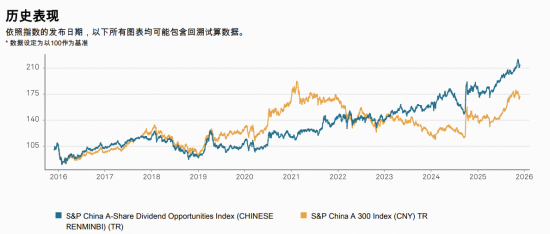
标普红利ETF(562060)标的指数11月月报出炉!今年以来总收益17.09%,市值中位数209亿元,最新股息率4.85%
Xin Lang Cai Jing· 2025-12-08 06:50
Core Viewpoint - The S&P China A-Share Dividend Opportunities Index has shown strong performance in recent periods, with notable annual returns and a solid dividend yield, indicating potential investment opportunities in the Chinese equity market [2][3][4]. Performance Summary - The index's total return for the past year is 17.09%, with a year-to-date return of 17.09% and a one-month return of 1.52% [2]. - The price return for the index is 11.64% year-to-date, with a one-month return of 1.34% [2]. - The benchmark index, S&P China A 300 Index, has a total return of 19.53% year-to-date, but a one-month return of -2.54% [2]. Annual Performance - The total return for the S&P China A-Share Dividend Opportunities Index in 2024 is 14.98%, compared to 14.21% in 2023 and -3.59% in 2022 [3]. - The price return for the index in 2024 is 8.18%, while the benchmark index has a total return of 15.81% in the same year [3]. Valuation and Dividend Yield - The historical price-to-earnings (P/E) ratio of the index is 11.57, with an expected P/E ratio of 10.67 [4]. - The dividend yield stands at 4.85%, indicating a favorable income potential for investors [4]. Index Composition Characteristics - The index comprises 100 constituent stocks, with an average market capitalization of CNY 128,766.74 million [5]. - The largest constituent stock has a market capitalization of CNY 2,566,723.46 million, while the smallest is CNY 3,997.07 million [5]. Top Ten Constituents - The top ten constituents include companies from various sectors, such as textiles, electrical equipment, and pharmaceuticals, with the largest being 002083.SZ (Jimu Co., Ltd.) in the textile sector [6][18]. - The top ten constituents account for 15.3% of the total index weight, with the largest single stock representing 2.4% [5][18]. Industry Distribution - The index is diversified across multiple industries, reflecting a broad exposure to the Chinese economy [19].