
非银金融

Search documents
21个行业获融资净买入,电力设备行业净买入金额最多
Zheng Quan Shi Bao Wang· 2025-11-14 01:47
Summary of Key Points Core Viewpoint - As of November 13, the market's latest financing balance reached 24,881.55 billion yuan, reflecting an increase of 40.69 billion yuan from the previous trading day, with 21 industries showing an increase in financing balance, particularly in the electric equipment sector, which saw the largest increase of 3.272 billion yuan [1][2]. Industry Financing Balance Changes - The electric equipment industry had the highest increase in financing balance, totaling 2,230.74 billion yuan, with a rise of 3.272 billion yuan, representing a growth of 1.49% [1]. - The electronic industry followed with a financing balance of 3,652.23 billion yuan, increasing by 2.126 billion yuan, or 0.59% [1]. - The non-ferrous metals industry reported a financing balance of 1,211.41 billion yuan, up by 1.499 billion yuan, marking a 1.25% increase [1]. - The basic chemical industry saw a financing balance of 1,008.91 billion yuan, with an increase of 1.052 billion yuan, or 1.05% [1]. - Conversely, the non-bank financial sector experienced the largest decrease, with a financing balance of 1,906.12 billion yuan, down by 6.30 billion yuan, a decline of 0.33% [2]. - The automotive industry reported a decrease of 2.55 billion yuan, bringing its financing balance to 1,200.71 billion yuan, a drop of 0.21% [2]. - The household appliances sector saw a reduction of 2.20 billion yuan, resulting in a financing balance of 375.68 billion yuan, down by 0.58% [2]. - The construction materials industry also faced a decline, with a financing balance of 136.78 billion yuan, decreasing by 1.87 billion yuan, or 1.35% [2]. Overall Financing Balance Trends - The comprehensive industry financing balance increased by 46.62 billion yuan, reflecting a growth of 2.18% [1]. - The textile and apparel industry had a financing balance of 81.90 billion yuan, with a growth of 1.40 billion yuan, or 1.74% [1]. - The public utilities sector reported a financing balance of 529.10 billion yuan, increasing by 4.66 billion yuan, or 0.89% [1].
【13日资金路线图】电力设备板块净流入逾192亿元居首 龙虎榜机构抢筹多股
证券时报· 2025-11-13 10:35
Market Overview - The A-share market experienced an overall increase on November 13, with the Shanghai Composite Index closing at 4029.5 points, up 0.73%, the Shenzhen Component Index at 13476.52 points, up 1.78%, and the ChiNext Index at 3201.75 points, up 2.55% [1] - The total trading volume in the A-share market reached 20658.28 billion yuan, an increase of 1008.79 billion yuan compared to the previous trading day [1] Capital Flow - The net inflow of main funds in the A-share market for the day was 124.7 billion yuan, with an opening net outflow of 31.11 billion yuan and a closing net inflow of 43.73 billion yuan [2] - The CSI 300 index saw a net inflow of 75.6 billion yuan, while the ChiNext index had a net inflow of 54.5 billion yuan, and the STAR Market experienced a net outflow of 17.09 billion yuan [4] Sector Performance - The power equipment sector led the net inflow of funds with 192.33 billion yuan, followed by non-ferrous metals with 171.62 billion yuan and basic chemicals with 106.27 billion yuan [6][7] - The top five sectors with net inflows included: - Power Equipment: 192.33 billion yuan, with a rise of 2.61% - Non-ferrous Metals: 171.62 billion yuan, with a rise of 3.10% - Basic Chemicals: 106.27 billion yuan, with a rise of 1.94% - Non-bank Financials: 30.29 billion yuan, with a rise of 1.05% - Pharmaceuticals: 21.68 billion yuan, with a rise of 0.95% [7] Stock Highlights - Ningde Times saw the highest net inflow of main funds at 26.47 billion yuan [8] - Institutional buying was noted in several stocks, including Haibo Sichuang, which had a net buying amount of 38158.95 thousand yuan, and Tianqi Materials with 23784.26 thousand yuan [10][11]


主力动向:11月13日特大单净流入280.68亿元
Zheng Quan Shi Bao Wang· 2025-11-13 10:01
Market Overview - The net inflow of large orders in the two markets reached 28.068 billion yuan, with 58 stocks seeing net inflows exceeding 200 million yuan, led by Ningde Times with a net inflow of 2.666 billion yuan [1][2] - The Shanghai Composite Index closed up 0.73%, with a total of 2,109 stocks experiencing net inflows and 2,737 stocks seeing net outflows [1] Industry Performance - Among the 18 industries with net inflows, the power equipment sector had the highest net inflow of 11.278 billion yuan, with an index increase of 4.31%, followed by non-ferrous metals with a net inflow of 7.338 billion yuan and a 4.01% increase [1] - 13 industries experienced net outflows, with the public utilities sector seeing the largest outflow of 783 million yuan, followed by household appliances with a net outflow of 670 million yuan [1] Individual Stock Performance - The top stocks with net inflows exceeding 200 million yuan included Ningde Times (2.666 billion yuan), Zhaoyi Innovation (2.591 billion yuan), and Tianqi Lithium (1.098 billion yuan) [2] - Stocks with net outflows included Xiangnong Chip (609 million yuan), Aters (486 million yuan), and China Metallurgical Group (362 million yuan) [4] - Stocks with net inflows saw an average increase of 9.52%, outperforming the Shanghai Composite Index, with notable performances from stocks like Fuxiang Pharmaceutical and Shangneng Electric, which closed at their daily limit [2] Detailed Stock Data - Top net inflow stocks: - Ningde Times: 26.66 billion yuan, 7.56% increase [2] - Zhaoyi Innovation: 25.91 billion yuan, 8.59% increase [2] - Tianqi Lithium: 10.98 billion yuan, 9.98% increase [2] - Top net outflow stocks: - Xiangnong Chip: -609 million yuan, -1.07% decrease [4] - Aters: -486 million yuan, -0.15% decrease [4] - China Metallurgical Group: -362 million yuan, 0.87% increase [4]



渤海证券研究所晨会纪要(2025.11.13)-20251113
BOHAI SECURITIES· 2025-11-13 03:21
Market Overview - The A-share market indices all rose last week, with the CSI 500 showing the largest increase of 1.12% and the ChiNext Index showing the smallest increase of 0.01% [2] - As of November 11, the margin trading balance in the Shanghai and Shenzhen markets was 2,497.40 billion yuan, an increase of 137.51 billion yuan from the previous week [2] - The average daily number of investors participating in margin trading decreased by 7.02% compared to the previous week, totaling 455,268 [2] Industry Insights - In October, excavator sales reached 18,096 units, representing a year-on-year growth of 7.77% [5][6] - Sales of loaders in October were 10,673 units, showing a significant year-on-year increase of 27.7% [6] - The machinery equipment sector's performance lagged behind the overall market, with the Shenwan Machinery Equipment Index rising only 0.22% compared to the CSI 300 Index's 0.72% increase [5][7] Valuation Metrics - As of November 11, the price-to-earnings ratio (TTM) for the Shenwan Machinery Equipment sector was 31.64 times, with a valuation premium of 135.82% relative to the CSI 300 [7] Future Outlook - The demand for construction machinery is expected to continue growing due to ongoing projects in hydropower and urban renewal, which will support the sector's recovery [7] - The recent advancements in humanoid robots have garnered significant attention, suggesting potential investment opportunities in the related supply chain [7] - The report maintains a "positive" outlook for the industry, with specific recommendations to increase holdings in companies such as Zoomlion (000157), Hengli Hydraulic (601100), Jiechang Drive (603583), and Haomai Technology (002595) [7]
行业轮动策略及基金经理精选:增配大盘价值,聚焦TMT和周期
SINOLINK SECURITIES· 2025-11-12 15:01
Core Insights - The report suggests increasing allocation to large-cap value stocks while focusing on TMT (Technology, Media, and Telecommunications) and cyclical sectors [3][30] - The industry rotation model has been optimized to adapt to market conditions, incorporating high-frequency factors and enhancing the strategy's effectiveness [4][26] - The latest industry rotation model identifies non-bank financials, steel, media, non-ferrous metals, environmental protection, and telecommunications as preferred sectors [30][33] Market Review and Fund Flow Tracking - As of October 31, 2025, the total monthly trading volume of A-shares reached 36.78 trillion yuan, with a slight decrease in daily average trading volume by 10.49% compared to the previous month [12][18] - The average stock return dispersion for the past month was 2.41%, indicating a slight decline but remaining above the median level for the past six months [12][18] - The industry rotation speed has continued to expand, significantly exceeding the average level since 2015 [12][18] Industry Rotation Model and ETF Fund Configuration - The report emphasizes the importance of focusing on large-cap value and cyclical sectors, particularly in the context of the current unclear market leadership [3][30] - The recommended ETF portfolio includes six funds: E Fund CSI 300 Non-Bank ETF, Guotai Junan CSI Steel ETF, GF CSI Media ETF, Southern CSI Non-Ferrous Metals ETF, Southern Yangtze River Protection Theme ETF, and Guotai Junan CSI All-Share Communication Equipment ETF [3][34] - The model's historical performance has shown consistent positive excess returns, outperforming major benchmark indices [5][42] Historical Performance and Model Effectiveness - The industry rotation model has maintained a strong performance over the years, achieving excess returns compared to industry averages, with a notable performance in 2025 [5][42] - The model's win rates over the past 1, 3, and 5 years are 83.33%, 69.44%, and 71.67% respectively, indicating its robustness [43][44] - The report highlights the significance of emotional and price-volume factors in capturing market dynamics, especially in weak market conditions [42][43]
港股红利低波ETF(520550)迭创4次新高,机构:险资增配高股息或达5000亿
Ge Long Hui· 2025-11-12 12:15
Group 1 - The Hong Kong Dividend Low Volatility ETF (520550) has seen a significant increase, rising over 1.1% and reaching historical highs four times recently, with a notable trend of net inflows for three consecutive days [1] - Southbound capital has increased its allocation to Hong Kong stocks, with a net inflow of 1.3 trillion HKD this year, marking a historical high [1] - Funds have primarily flowed into high dividend sectors such as banking, oil and petrochemicals, and non-bank financials over the past month [1] Group 2 - Insurance capital is expected to continue increasing its allocation to high dividend equities, with the proportion of FVOCI stocks in seven listed life and property insurance companies rising from 33.8% at the beginning of the year to 41.1% [1] - By 2025-2027, the high dividend scale of five A-share listed insurance companies is projected to reach 722.2 billion, 1.1 trillion, and 1.6 trillion CNY, with an annual increase of 250-500 billion CNY [1] - The probability of positive returns from dividend assets is higher in the first and fourth quarters, indicating favorable conditions for high dividend allocations in Hong Kong stocks in the fourth quarter [1] Group 3 - The Hong Kong Dividend Low Volatility ETF (520550) has the lowest fee rate in the market at a comprehensive rate of 0.2%, providing a safety net through its holdings in mature industries such as finance, energy, and public utilities [2] - The ETF employs a 5% weight limit on individual stocks to achieve risk diversification and avoids "dividend yield traps" by excluding stocks with significant declines [2] - Investors are encouraged to consider the Hong Kong Dividend Low Volatility ETF (520550) and its classes (A: 024029, C: 024030) to seize defensive opportunities [2]
11月12日深证国企ESGR(470055)指数跌0.46%,成份股佳电股份(000922)领跌
Sou Hu Cai Jing· 2025-11-12 10:20
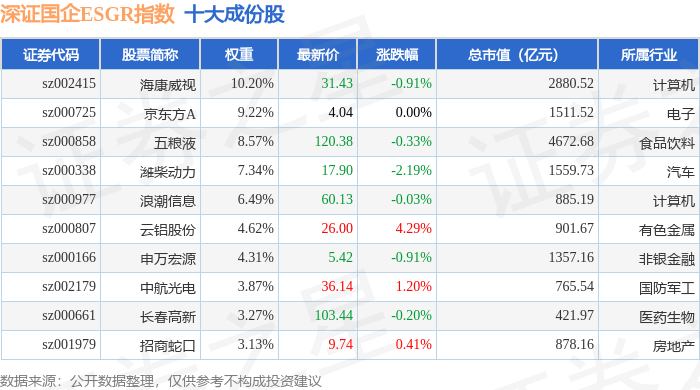
Core Points - The Shenzhen State-owned Enterprise ESGR Index (470055) closed at 1615.9 points, down 0.46%, with a trading volume of 36.083 billion yuan and a turnover rate of 1.3% [1] - Among the index constituents, 14 stocks rose while 35 fell, with Zhonglai Co. leading the gainers at 4.36% and Jiadian Co. leading the decliners at 6.33% [1] Index Constituents Summary - The top ten constituents of the Shenzhen State-owned Enterprise ESGR Index are as follows: - Hikvision (sz002415) holds a weight of 10.20% and closed at 31.43, down 0.91% with a total market value of 288.052 billion yuan [1] - BOE Technology Group (sz000725) has a weight of 9.22%, closing at 4.04 with no change, and a market value of 151.152 billion yuan [1] - Wrigley (sz000858) has a weight of 8.57%, closing at 120.38, down 0.33%, with a market value of 467.268 billion yuan [1] - Weichai Power (sz000338) has a weight of 7.34%, closing at 17.90, down 2.19%, with a market value of 155.973 billion yuan [1] - Inspur Information (sz000977) has a weight of 6.49%, closing at 60.13, down 0.03%, with a market value of 88.519 billion yuan [1] - Yun Aluminum (sz000807) has a weight of 4.62%, closing at 26.00, up 4.29%, with a market value of 90.167 billion yuan [1] - Shenwan Hongyuan (sz000166) has a weight of 4.31%, closing at 5.42, down 0.91%, with a market value of 135.716 billion yuan [1] - AVIC Optoelectronics (sz002179) has a weight of 3.87%, closing at 36.14, up 1.20%, with a market value of 76.554 billion yuan [1] - Changchun High-tech (sz000661) has a weight of 3.27%, closing at 103.44, down 0.20%, with a market value of 42.197 billion yuan [1] - China Merchants Shekou (sz001979) has a weight of 3.13%, closing at 9.74, up 0.41%, with a market value of 87.816 billion yuan [1] Capital Flow Analysis - The index constituents experienced a net outflow of 1.442 billion yuan from institutional investors, while retail investors saw a net inflow of 839 million yuan [1] - The detailed capital flow for selected stocks includes: - Zhongtung High-tech (000657) saw a net inflow of 168 million yuan from institutional investors [2] - Yun Aluminum (000807) had a net inflow of 137 million yuan from institutional investors [2] - BOE Technology Group (000725) recorded a net inflow of 43.82 million yuan from institutional investors [2] - Changchun High-tech (000661) had a net inflow of 27.15 million yuan from institutional investors [2] - AVIC Optoelectronics (002179) saw a net inflow of 15.82 million yuan from institutional investors [2]

【盘中播报】沪指涨0.27% 石油石化行业涨幅最大
Zheng Quan Shi Bao Wang· 2025-11-12 03:28
Market Overview - The Shanghai Composite Index increased by 0.27% as of 10:28 AM, with a trading volume of 61.67 billion shares and a transaction value of 893.47 billion yuan, a decrease of 6.50% compared to the previous trading day [1] Industry Performance - The top-performing industries included: - Oil and Petrochemicals: Increased by 1.77% with a transaction value of 8.62 billion yuan, led by Sinopec Oilfield Service, which rose by 10.21% [1] - Banking: Increased by 1.52% with a transaction value of 15.41 billion yuan, led by Agricultural Bank of China, which rose by 2.89% [1] - Home Appliances: Increased by 1.01% with a transaction value of 14.36 billion yuan, led by Beiyikang, which rose by 10.78% [1] - The worst-performing industries included: - Communication: Decreased by 1.33% with a transaction value of 34.89 billion yuan, led by Yongding Co., which fell by 5.45% [2] - Electric Power Equipment: Decreased by 1.25% with a transaction value of 148.46 billion yuan, led by Canadian Solar, which fell by 13.92% [2] - National Defense and Military Industry: Decreased by 0.92% with a transaction value of 16.72 billion yuan, led by Triangle Defense, which fell by 7.34% [2] Stock Performance - A total of 1,864 stocks rose, with 49 hitting the daily limit, while 3,394 stocks fell, with 2 hitting the lower limit [1]





江苏金租创历史新高,融资客减仓
Zheng Quan Shi Bao Wang· 2025-11-12 02:23
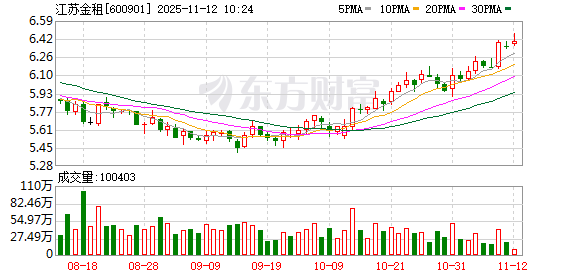
Company Performance - Jiangsu Jinzu's stock price reached a historical high, increasing by 1.57% to 6.45 yuan, with a trading volume of 3.0605 million shares and a transaction amount of 19.6294 million yuan [2] - The company's latest A-share total market capitalization is 37.361 billion yuan, with a circulating market capitalization of 37.348 billion yuan [2] - For the first three quarters, the company achieved operating revenue of 4.638 billion yuan, a year-on-year increase of 17.15%, and a net profit of 2.446 billion yuan, a year-on-year increase of 9.82% [2] Industry Overview - The non-bank financial sector, to which Jiangsu Jinzu belongs, experienced an overall decline of 0.13%, with 13 stocks rising, including Jiangsu Jinzu, China Pacific Insurance, and Great Wall Securities, which increased by 1.57%, 1.18%, and 0.76% respectively [2] - Conversely, 66 stocks in the sector saw declines, with Xiangcai Securities, Northeast Securities, and Guosheng Securities experiencing the largest drops of 8.36%, 4.40%, and 2.91% respectively [2] Financing and Ratings - As of November 11, the latest margin trading balance for Jiangsu Jinzu is 0.187 billion yuan, with a financing balance of 0.185 billion yuan, reflecting a decrease of 19.7353 million yuan over the past 10 days, a decline of 9.65% [2] - In the past 10 days, two institutions rated the stock, with Huachuang Securities setting a target price of 7.76 yuan on October 30 [2]

江苏金租创历史新高,融资客减仓
Zheng Quan Shi Bao· 2025-11-12 02:15
Company Performance - Jiangsu Jinzu's stock price reached a historical high, increasing by 1.57% to 6.45 yuan, with a trading volume of 3.0605 million shares and a transaction amount of 19.6294 million yuan [1] - The company's total market capitalization is 37.361 billion yuan, with a circulating market value of 37.348 billion yuan [1] - For the first three quarters, the company achieved operating revenue of 4.638 billion yuan, a year-on-year increase of 17.15%, and a net profit of 2.446 billion yuan, up 9.82% year-on-year, with basic earnings per share of 0.4200 yuan and a weighted average return on equity of 9.92% [1] Industry Overview - The non-bank financial sector, to which Jiangsu Jinzu belongs, experienced an overall decline of 0.13%, with 13 stocks rising, including Jiangsu Jinzu, China Pacific Insurance, and Great Wall Securities, which increased by 1.57%, 1.18%, and 0.76% respectively [1] - Conversely, 66 stocks in the sector saw declines, with Xiangcai Securities, Northeast Securities, and Guosheng Securities experiencing the largest drops of 8.36%, 4.40%, and 2.91% respectively [1] Financing and Ratings - As of November 11, the margin trading balance for Jiangsu Jinzu was 0.187 billion yuan, with a financing balance of 0.185 billion yuan, reflecting a decrease of 19.7353 million yuan over the past 10 days, a decline of 9.65% [1] - In the past 10 days, two institutions rated the stock, with Huachuang Securities setting a target price of 7.76 yuan on October 30 [1]