
人工智能产业

Search documents
加快新场景开放和大规模应用 培育壮大新兴产业和未来产业
Jing Ji Ri Bao· 2025-11-15 22:42
Core Insights - The article emphasizes the importance of leveraging vast data and diverse application scenarios to promote the deep integration of digital technology with the real economy, enabling the transformation and upgrading of traditional industries [1] - The recent implementation opinion from the State Council outlines the acceleration of cultivating 22 types of application scenarios, including digital economy and artificial intelligence, which are crucial for addressing the challenges of technology transfer and fostering new productive forces [1][4] Group 1: Innovation Paradigms - The article introduces a "scenario-driven" innovation paradigm that reshapes the path of technology transfer, moving away from the traditional linear model of research followed by application, which often leads to a disconnect between R&D and practical use [2] - It highlights the creation of "comprehensive testbeds" that serve as platforms for validating technologies, nurturing markets, and improving standards, essential for transitioning innovations from research to market products [2] Group 2: Ecosystem Development - The opinion acts as a "aggregator" and "guiding instrument," promoting the aggregation of high-end innovation elements such as talent, capital, and data towards strategic emerging industries, thereby accelerating the formation of new productive forces [3] - It emphasizes the importance of fostering an open innovation ecosystem that encourages cross-regional, cross-sector, and cross-entity collaboration, leveraging China's large-scale market advantages [3] Group 3: Strategic Industry Layout - The opinion outlines the need to focus on strategic emerging industries such as digital economy, artificial intelligence, and clean energy, creating application scenarios that align with national development strategies [4] - It stresses the significance of technology universality and integration, which can lead to transformative innovations across various sectors, exemplified by the impact of artificial intelligence on manufacturing and services [5] Group 4: Implementation Strategies - The article discusses the necessity of a systematic approach to cultivating and opening application scenarios, proposing specific measures across four dimensions: scenario openness, resource allocation, element reform, and institutional experimentation [7] - It suggests the establishment of a complete closed-loop from scenario cultivation to industrial application, emphasizing the role of government and state-owned enterprises in leading major scenario projects [8]
生态立区、文化兴区、科技强区,门头沟区高质量发展按下加速键
Xin Jing Bao· 2025-11-12 12:38
Core Viewpoint - The Mentougou District is focusing on ecological, cultural, and technological development strategies during the 14th Five-Year Plan period, aiming to transform into a desirable destination for residents and visitors alike [1] Group 1: Ecological Development - The district has made significant progress in environmental protection, with PM2.5 average concentration reduced to 23.6 micrograms per cubic meter, a 26.3% decrease from 2020 [2] - Successful completion of comprehensive governance and ecological restoration of the Yongding River, with groundwater levels rising for seven consecutive years, reaching a maximum of nearly 25 meters [2] - The forest coverage rate has reached 48.6%, and the grassland coverage rate is at 93.9%, with ongoing projects for afforestation and ecological restoration [2] Group 2: Cultural Development - Mentougou is developing into a national all-region tourism demonstration area, with tourism revenue reaching 4.13 billion yuan in the previous year [3] - The district is leveraging its rich cultural resources, including historical sites and traditional culture, to promote integrated development of culture, tourism, agriculture, and commerce [3] - Notable cultural projects include the inclusion of the Yongding River ancient irrigation project in the World Irrigation Heritage List and the establishment of multiple non-heritage protection bases [3] Group 3: Technological Development - The district is actively participating in the construction of an international technology innovation center, focusing on artificial intelligence, ultra-high-definition digital audio-visual technology, and cardiovascular medical devices [5] - The number of specialized and innovative enterprises has increased 24 times, reaching 225, while high-tech enterprises have grown by 15.8%, totaling 550 [5] - The annual revenue of the industrial park has surpassed 100 billion yuan, with a per square kilometer output rate of 23.6 billion yuan [5] Group 4: Future Development Plans - Looking ahead to the 15th Five-Year Plan, Mentougou aims to leverage its unique advantages to pursue green and high-quality transformation, enhancing its image as "the blessed land of Beijing's western region" [6]
第二十一届桂台经贸文化合作论坛在南宁开幕郭金龙韦韬潘贤掌王维平林政则李政宏等出席
Guang Xi Ri Bao· 2025-11-12 01:19
Group 1 - The 21st Guangxi-Taiwan Economic and Cultural Cooperation Forum opened in Nanning, Guangxi, focusing on "New Opportunities in the Shared AI Era and Promoting New Development in Guangxi-Taiwan Cooperation" [1][2] - Key leaders emphasized the importance of seizing historical trends and opportunities for industrial cooperation and integration, aiming to expand international markets and strengthen the economy of the Chinese nation [1][2] - Guangxi is positioned as a favorable location for collaboration, with multiple advantages in terms of location and policy, encouraging entrepreneurs from both sides to explore business opportunities [1][2] Group 2 - Guangxi is experiencing its best historical development period, with a call for collaboration in the AI sector and the establishment of an AI application cooperation center between China and ASEAN countries [2] - The forum aims to deepen industrial cooperation and promote the integration of supply chains between Guangxi and Taiwan, enhancing cultural, tourism, education, and youth exchanges [2] - The event included discussions on AI industry development, youth innovation and entrepreneurship, and cultural exchanges, with sub-forums focusing on AI industry innovation and biomedicine [3]
第二十一届桂台经贸文化合作论坛聚焦两岸人工智能合作新机遇
Xin Hua She· 2025-11-12 01:13
Core Insights - The 21st Guangxi-Taiwan Economic and Cultural Cooperation Forum was held in Nanning, Guangxi, focusing on the theme of "Sharing New Opportunities in the AI Era and Promoting New Development in Guangxi-Taiwan Cooperation" [1][2] - The forum aimed to deepen economic and cultural cooperation between the two sides, leveraging artificial intelligence as a new opportunity to expand into the ASEAN market [1][2] Group 1: Forum Objectives and Themes - The forum was co-hosted by the Taiwan Affairs Office of the State Council and the People's Government of Guangxi Zhuang Autonomous Region, with participation from political and business leaders, tech representatives, and youth entrepreneurs [1] - Discussions centered on the construction of a China-ASEAN AI application cooperation center and the integration of AI into various industry scenarios [1][2] Group 2: Regional Development and Collaboration - Guangxi is actively building a cross-border industrial ecosystem that integrates R&D from major cities with applications in ASEAN, aiming to establish itself as a hub for AI cooperation [1] - Taiwan's strengths in semiconductors, AI, and precision manufacturing were highlighted, with an emphasis on collaborative efforts to build a digital service platform and cultivate AI application service providers [1] Group 3: Perspectives on AI and Economic Integration - The forum emphasized the importance of AI in international technological competition and the need for both sides to seize opportunities in this field for regional prosperity and peace [2] - Keynote speeches addressed the innovation and cooperation prospects in the AI and biomedicine industries, fostering deeper exchanges between industries [2]
黄文涛:科技创新与资金流入双轮驱动 A股或迎“新四牛”行情
2 1 Shi Ji Jing Ji Bao Dao· 2025-11-11 14:12
Core Viewpoint - The Chinese stock market is experiencing a rise in risk appetite, characterized by the "New Four Bulls" framework, focusing on technological self-reliance, industrial upgrading, and resource security as the main themes for the medium to long term [1][6]. Group 1: Economic Context - The global economic landscape is undergoing significant restructuring, with emerging economies, particularly the BRICS nations, increasing their share of global GDP to approximately 34%, surpassing the G7's 29% [1][2]. - The debt-to-GDP ratio for G7 countries has risen to about 127%, while BRICS countries maintain a much lower ratio of around 36%, indicating differing policy spaces and potential shifts in global capital flows [2]. Group 2: Market Drivers - The "New Four Bulls" framework includes: 1. Capital inflow supported by foreign capital returning, long-term institutional investment, and shifts in household savings towards equity markets [3]. 2. Technological innovation in sectors like AI, semiconductors, and renewable energy, driven by both government support and market demand [3]. 3. Institutional reforms enhancing market efficiency and attractiveness through improvements in capital market systems [3]. 4. Consumer upgrades reflecting strong domestic demand, supported by rising income levels and changing consumption patterns [4]. Group 3: Investment Recommendations - In the stock market, sectors aligned with the "14th Five-Year Plan," such as AI, semiconductors, and high-end manufacturing, are expected to see significant growth opportunities [5]. - The bond market is entering a period of monetary easing, with long-term yield declines anticipated, although short-term fluctuations may occur due to inflation expectations [5]. - The currency market is expected to see a weakening of the US dollar, while the RMB is projected to remain stable and potentially appreciate [5]. - The real estate market is gradually resolving existing risks, creating opportunities in urban renewal and quality housing projects [5]. - Commodities like gold and silver may perform well due to geopolitical factors, while demand uncertainties may affect oil and copper prices [5]. Group 4: Future Outlook - The year 2026 marks the beginning of a new phase of technological and industrial revolution in China, with the "New Four Bulls" serving as a foundation for capital market development [6][7].
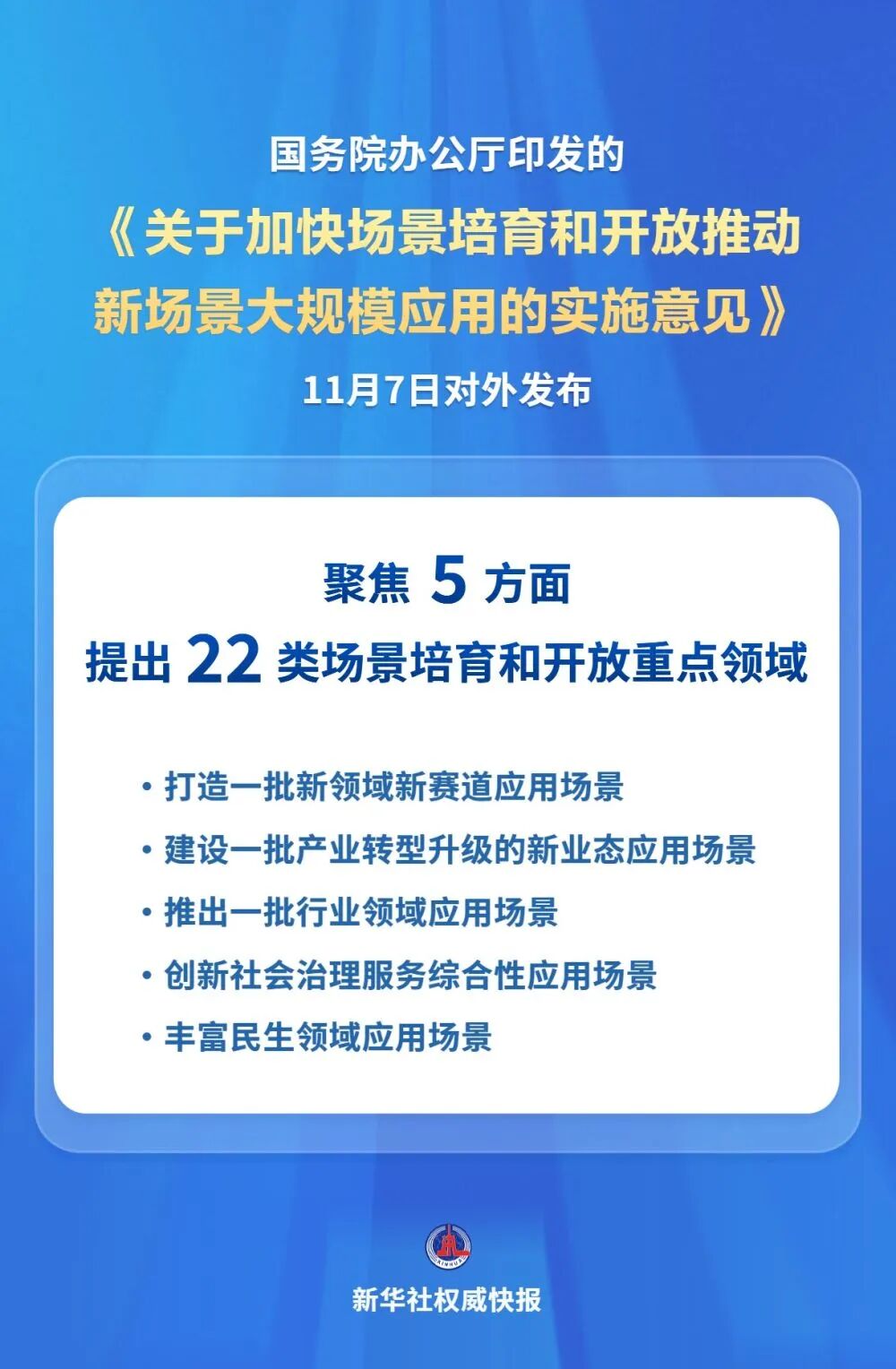
国办印发,事关加快场景培育和开放推动新场景大规模应用
Zhong Guo Zheng Quan Bao· 2025-11-07 10:00
Core Viewpoint - The State Council's implementation opinion focuses on accelerating the cultivation and large-scale application of new scenarios, emphasizing the importance of scenarios as a bridge connecting technology and industry, and promoting the integration of technological and industrial innovation [5][6]. Group 1: Overall Requirements - The implementation opinion is guided by Xi Jinping's thoughts and aims to fully leverage China's large-scale market and rich application scenarios to support the construction of various significant application scenarios [8]. - It emphasizes the need for a systematic approach to promote the large-scale application of new scenarios, forming a path from technological breakthroughs to industrial applications [5][8]. Group 2: Key Areas of Focus - The opinion outlines five key areas for scenario development: new field applications, new business model applications for industrial transformation, industry-specific applications, innovative social governance applications, and enriched livelihood applications [6][8]. - It proposes 22 categories of key areas for scenario cultivation and opening, highlighting the need for collaborative efforts across various sectors [6][8]. Group 3: Specific Application Scenarios - In the digital economy, the focus is on exploring applications of technologies like the metaverse and virtual reality to enhance the integration of the digital and real economies [8][9]. - The artificial intelligence sector aims to accelerate the cultivation and opening of high-value application scenarios to meet diverse development needs [8][9]. - The clean energy sector is encouraged to develop applications in transportation and energy management, promoting a low-carbon transition [9][10]. Group 4: Social Governance and Livelihood Applications - The opinion emphasizes the need for innovative applications in emergency management, mining safety, and smart water management to enhance operational efficiency and safety [13][14]. - In the healthcare sector, the integration of new technologies like big data and IoT is encouraged to improve medical services and patient care [16][17]. Group 5: Implementation and Coordination - Local governments and relevant departments are urged to strengthen collaboration and increase efforts in scenario cultivation and opening, ensuring effective implementation of the opinion [21]. - The National Development and Reform Commission is tasked with guiding and coordinating the efforts, proposing clear and executable requirements for scenario development [21].

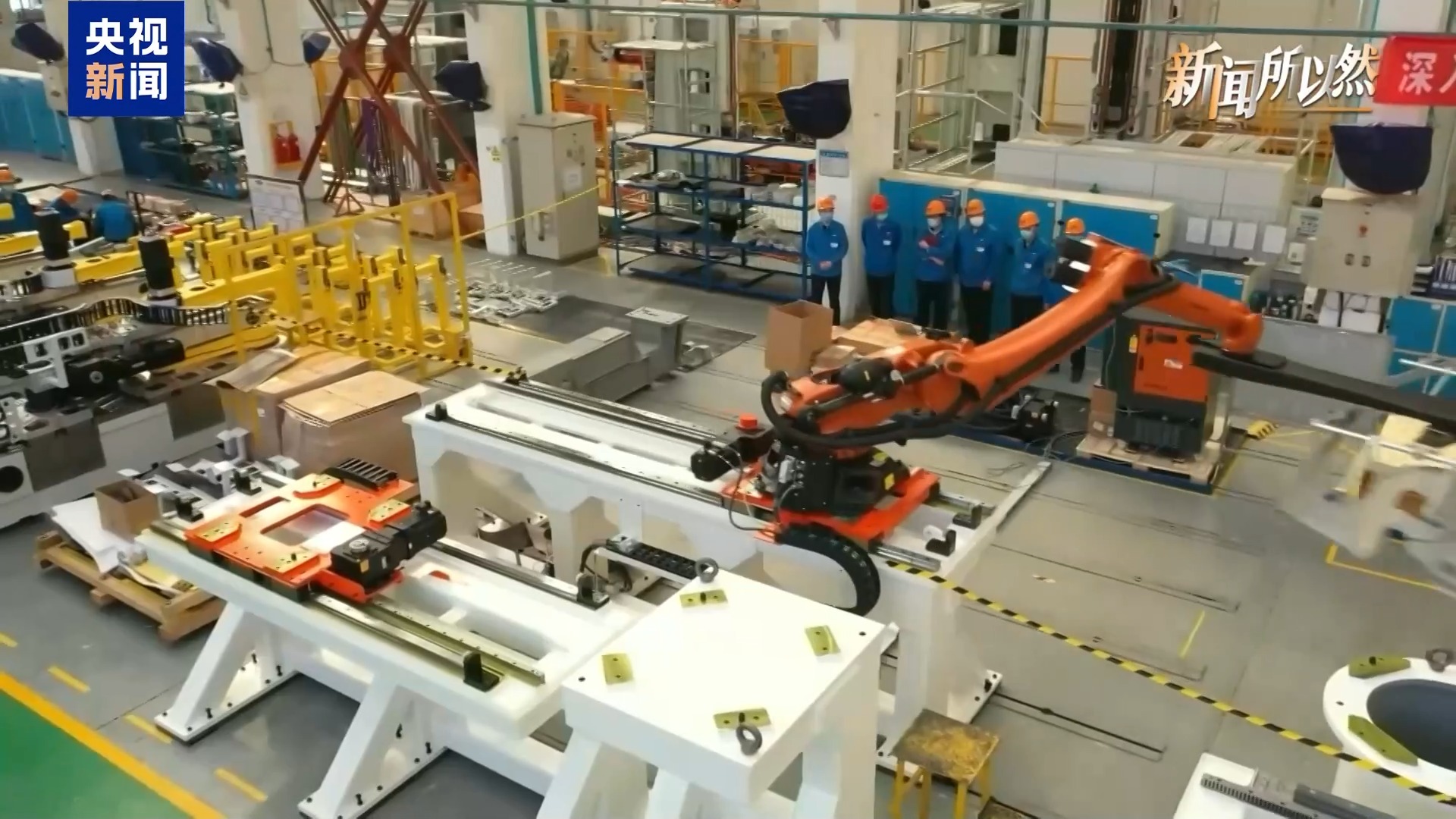
视频丨抓住“十五五”历史机遇 开启智能未来
Yang Shi Xin Wen Ke Hu Duan· 2025-10-31 07:41
Core Insights - The "14th Five-Year Plan" emphasizes seizing historical opportunities presented by a new round of technological revolution and industrial transformation, particularly in strategic emerging industries such as new energy, new materials, aerospace, and low-altitude economy, which are expected to harbor trillion-level markets [2][4] Group 1: Strategic Emerging Industries - Key industries identified include quantum technology, biomanufacturing, hydrogen energy, nuclear fusion, brain-computer interfaces, embodied intelligence, and sixth-generation mobile communication, which are projected to create a new high-tech industrial scale equivalent to recreating China's high-tech sector [2] - The plan highlights the importance of practical implementation and innovation in these sectors to drive growth [2] Group 2: Artificial Intelligence Integration - The plan proposes "Artificial Intelligence+" as a critical strategy for high-quality development, aiming to lead a transformation in research paradigms and secure a competitive edge in AI applications [4][5] - Two significant milestones are set: by 2027, the penetration rate of new intelligent terminals and agents is expected to exceed 70%, and by 2030, it should surpass 90% [5] Group 3: Employment and Lifestyle Changes - The integration of AI is anticipated to create numerous new job opportunities centered around computing power, algorithms, and data, leading to new work forms such as "human-machine collaboration" [7] - AI is expected to revolutionize daily life, with intelligent assistants becoming commonplace, enhancing consumer experiences across various sectors [7][9] Group 4: Education and Talent Development - The demand for education tailored to "Artificial Intelligence+" is expected to surge, prompting a nationwide push for quality undergraduate education to align with these needs [9] - The overall societal structure is projected to change significantly, with AI influencing work, study, and daily life [9]
“十五五”规划建议的18个新提法,释放了哪些重要信号?
Mei Ri Jing Ji Xin Wen· 2025-10-29 15:24
Group 1 - The "15th Five-Year Plan" emphasizes the importance of technological innovation, mentioning "technology" 46 times and "innovation" 61 times, aiming to create a favorable environment for original and disruptive innovations [2] - The plan proposes to gradually increase the basic pension for urban and rural residents, highlighting the focus on improving people's livelihoods and promoting common prosperity [2][29] - New strategic technologies such as quantum technology, biomanufacturing, hydrogen energy, and artificial intelligence are identified as future economic growth points, with a focus on their commercialization during the "15th Five-Year Plan" period [3][4] Group 2 - The plan suggests establishing a risk-sharing mechanism for future industry investments, recognizing the uncertainties in technology and market conditions [5][6] - It proposes a new national system to tackle key technologies in areas like integrated circuits and advanced materials, emphasizing the need for collective efforts from various market entities [7] - The plan includes measures to enhance public service spending to boost consumer capacity, indicating a shift towards improving the consumption environment [9][10] Group 3 - The plan aims to peak coal and oil consumption, aligning with the broader goal of achieving carbon peak by 2030, necessitating a transition to a new energy system [12][13] - It emphasizes the need for proactive macroeconomic policies to stabilize growth, employment, and expectations, particularly in light of the challenges posed by traditional economic drivers [14][15] Group 4 - The plan highlights the importance of expanding service trade and optimizing market access, particularly in the service sector, to enhance international competitiveness [18][21] - It focuses on promoting green trade and intermediate goods trade, which are seen as vital for stabilizing foreign trade and aligning with global environmental goals [19][20] Group 5 - The plan includes initiatives to enhance food security through a new round of grain production capacity improvement actions, aiming for a significant increase in grain output [23][24] - It emphasizes the need for efficient land use in rural areas, addressing the mismatch between idle land and the demand for construction land to support rural development [25][26] Group 6 - The plan proposes to expand free education and explore extending compulsory education, which is expected to alleviate educational burdens and improve human capital development [27][28] - It aims to optimize the supply of affordable housing to meet the basic housing needs of urban wage earners and disadvantaged families, marking a shift towards a more inclusive housing policy [30][31]
“十五五”规划建议全文:加强原始创新和关键核心技术攻关、全面实施“人工智能+”行动、大力提振消费
Xuan Gu Bao· 2025-10-28 09:35
Core Viewpoint - The "15th Five-Year Plan" period is crucial for achieving basic socialist modernization, building on the significant achievements of the "14th Five-Year Plan" period, and addressing complex domestic and international challenges [2][3][4]. Group 1: Achievements and Challenges - The "14th Five-Year Plan" period saw major achievements in economic stability, high-quality development, technological innovation, and social governance despite facing severe challenges such as the pandemic [2]. - The "15th Five-Year Plan" period will focus on consolidating advantages, overcoming bottlenecks, and enhancing weaknesses to secure strategic initiatives in international competition [3][4]. Group 2: Economic and Social Development Goals - The guiding principles for economic and social development during the "15th Five-Year Plan" include adhering to Marxism, promoting high-quality development, and ensuring that modernization benefits all citizens [6][7][8]. - Key goals include achieving significant results in high-quality development, enhancing self-reliance in technology, and improving social governance and public services [10][11][12]. Group 3: Modernization of Industry and Infrastructure - The establishment of a modern industrial system is essential, focusing on optimizing traditional industries and fostering emerging sectors such as new materials and aerospace [13][14]. - Infrastructure development will prioritize integrated planning and the construction of new types of infrastructure to enhance resilience and sustainability [15]. Group 4: Technological Innovation - The "15th Five-Year Plan" emphasizes the importance of technological self-reliance and innovation, aiming to strengthen the national innovation system and enhance the integration of technology and industry [16][17][18]. Group 5: Domestic Market and Consumption - Strengthening the domestic market is a strategic focus, with initiatives to boost consumption and investment while ensuring a positive interaction between supply and demand [21][22][23]. Group 6: High-Quality Development and Economic System - The plan aims to enhance the socialist market economy, stimulate various ownership enterprises, and improve the efficiency of resource allocation [24][25][26]. Group 7: Open Economy and International Cooperation - The strategy includes expanding high-level openness and cooperation, promoting trade innovation, and enhancing investment collaboration to create a win-win situation [27][28][29]. Group 8: Agricultural Modernization - Agricultural modernization is a priority, focusing on improving production capacity, quality, and efficiency while ensuring rural revitalization and integration with urban development [30][31][32]. Group 9: Regional Development - The plan aims to optimize regional economic layouts and promote coordinated development across different regions, enhancing infrastructure connectivity and collaborative growth [33][34]. Group 10: Cultural and Social Development - Cultural prosperity and social welfare are emphasized, with initiatives to enhance public services, promote cultural innovation, and ensure equitable access to resources [36][37][38][39][40].
受权发布|中共中央关于制定国民经济和社会发展第十五个五年规划的建议
Xin Hua She· 2025-10-28 08:35
Core Viewpoint - The "15th Five-Year Plan" period is crucial for achieving basic socialist modernization, building on the significant achievements of the "14th Five-Year Plan" and addressing complex domestic and international challenges [1][2][3] Economic and Social Development Goals - The guiding ideology for the "15th Five-Year Plan" emphasizes Marxism, Xi Jinping's thoughts, and the goal of building a modern socialist country, focusing on high-quality development and comprehensive reforms [6][7] - Key principles include maintaining the Party's leadership, prioritizing people's needs, promoting high-quality development, and ensuring effective market and government collaboration [7][8] - Major goals include achieving significant high-quality development, enhancing self-reliance in technology, deepening reforms, improving social civilization, and increasing the quality of life for citizens [9][10][11] Modernization of the Industrial System - The plan emphasizes the importance of a modern industrial system as the material and technical foundation for Chinese-style modernization, focusing on optimizing traditional industries and fostering emerging sectors [12][13] - It aims to enhance the quality and efficiency of the service sector and build a modern infrastructure system to support economic growth [14] Technological Self-Reliance - The plan highlights the need for technological modernization, focusing on original innovation and breakthroughs in key technologies, while promoting the integration of technology and industry [15][16] - It calls for strengthening the role of enterprises in innovation and fostering a supportive environment for research and development [17] Domestic Market Development - The strategy emphasizes the importance of a strong domestic market as a strategic foundation for modernization, advocating for increased consumption and effective investment [20][21] - It aims to eliminate barriers to a unified national market and enhance the efficiency of resource allocation [22] High-Level Socialist Market Economy - The plan seeks to enhance the socialist market economy by stimulating the vitality of various economic entities and improving the market-oriented allocation of resources [22][23] - It emphasizes the need for effective macroeconomic governance and sustainable fiscal policies to support high-quality development [24] Opening Up and International Cooperation - The strategy promotes expanding high-level openness and cooperation, enhancing trade and investment, and fostering a fair international economic order [25][26] - It aims to strengthen the Belt and Road Initiative and enhance international collaboration in various sectors [27] Agricultural and Rural Modernization - The plan prioritizes agricultural modernization and rural revitalization, focusing on improving agricultural productivity and quality of life in rural areas [28][29] - It emphasizes the importance of integrating urban and rural development and ensuring sustainable agricultural practices [30] Regional Economic Coordination - The strategy aims to optimize regional economic layouts and promote coordinated development across different regions, enhancing infrastructure connectivity and regional collaboration [31][32] Cultural and Social Development - The plan emphasizes the importance of cultural innovation and social development, aiming to enhance the quality of life and promote common prosperity for all citizens [34][37] - It focuses on improving education, social security, and public services to meet the needs of the population [39][40]