
煤炭加工

Search documents
永安期货焦炭日报-20251023
Yong An Qi Huo· 2025-10-23 01:35
Report Information - Report Title: Coke Daily Report - Report Date: October 23, 2025 - Research Team: Black Team of the Research Center [1] Industry Investment Rating - No information provided Core Viewpoints - No information provided Summary by Relevant Catalog Coke Price - The latest price of Shanxi quasi - first wet quenching coke is 1482.39, with no daily change, no weekly change, a monthly increase of 54.61, and a year - on - year decrease of 23.70% [2] - The latest price of Hebei quasi - first dry quenching coke is 1735.00, with no daily change, no weekly change, a monthly increase of 55.00, and a year - on - year decrease of 6.72% [2] - The latest price of Shandong quasi - first dry quenching coke is 1660.00, with no daily change, no weekly change, a monthly increase of 55.00, and a year - on - year decrease of 21.70% [2] - The latest price of Jiangsu quasi - first dry quenching coke is 1700.00, with no daily change, no weekly change, a monthly increase of 55.00, and a year - on - year decrease of 21.30% [2] - The latest price of Inner Mongolia second - grade coke is 1180.00, with no daily change, no weekly change, a monthly increase of 100.00, and a year - on - year decrease of 30.59% [2] Production and Inventory - The blast furnace operating rate is 90.33, with a weekly decrease of 0.22, a monthly decrease of 0.02, and a year - on - year increase of 3.22% [2] - The average daily pig iron output is 240.95, with a weekly decrease of 0.59, a monthly decrease of 0.07, and a year - on - year increase of 2.81% [2] - The coking plant inventory is 37.59, with a weekly decrease of 4.95, a monthly decrease of 4.62, and a year - on - year decrease of 1.36% [2] - The port inventory is 195.15, with a weekly increase of 0.06, a monthly decrease of 8.95, and a year - on - year increase of 8.28% [2] - The steel mill inventory is 639.44, with a weekly decrease of 11.38, a monthly decrease of 5.23, and a year - on - year increase of 13.58% [2] - The steel mill inventory days are 11.19, with a weekly decrease of 0.23, a monthly decrease of 0.23, and a year - on - year increase of 3.80% [2] - The coking capacity utilization rate is 74.95, with a weekly decrease of 0.05, a monthly decrease of 0.63, and a year - on - year increase of 2.57% [2] - The average daily coke output is 51.28, with a weekly decrease of 1.03, a monthly decrease of 0.55, and a year - on - year increase of 0.23% [2] Futures Market - The latest price of the futures contract 05 is 1840.5, with a daily increase of 3.00, a weekly increase of 43.50, a monthly increase of 31.50, and a year - on - year decrease of 10.53% [2] - The latest price of the futures contract 09 is 1921, with a daily increase of 3.50, a weekly increase of 45.00, a monthly increase of 76.00, and a year - on - year decrease of 8.85% [2] - The latest price of the futures contract 01 is 1696.5, with a daily increase of 5.00, a weekly increase of 47.50, a monthly increase of 32.00, and a year - on - year decrease of 14.38% [2] - The 05 basis is - 69.11, with a daily decrease of 3.00, a weekly decrease of 43.50, a monthly increase of 11.09, and a year - on - year decrease of 273.20 [2] - The 09 basis is - 149.61, with a daily decrease of 3.50, a weekly decrease of 45.00, a monthly decrease of 33.41, and a year - on - year decrease of 303.20 [2] - The 01 basis is 74.89, with a daily decrease of 5.00, a weekly decrease of 47.50, a monthly increase of 10.59, and a year - on - year decrease of 204.70 [2] - The 5 - 9 spread is - 144.00, with a daily increase of 2.00, a weekly increase of 4.00, a monthly increase of 0.50, and a year - on - year decrease of 68.50 [2] - The 9 - 1 spread is - 80.50, with a daily decrease of 0.50, a weekly decrease of 1.50, a monthly decrease of 44.50, and a year - on - year decrease of 30.00 [2] - The 1 - 5 spread is 224.50, with a daily decrease of 1.50, a weekly decrease of 2.50, a monthly increase of 44.00, and a year - on - year increase of 98.50 [2]
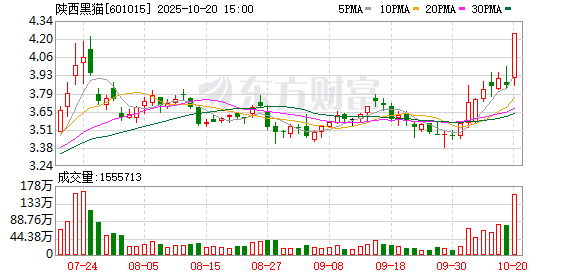
陕西黑猫10月20日获融资买入4946.40万元,融资余额1.23亿元
Xin Lang Zheng Quan· 2025-10-21 01:23
Core Viewpoint - Shaanxi Black Cat's stock price increased by 10.13% on October 20, with a trading volume of 632 million yuan, indicating strong market interest and activity [1]. Financing Summary - On October 20, Shaanxi Black Cat had a financing buy-in amount of 49.46 million yuan, with a net financing buy of 23.98 million yuan after repayments [1]. - The total financing and securities lending balance reached 124 million yuan, with financing balance accounting for 1.42% of the circulating market value, indicating a high level of financing activity compared to the past year [1]. - The company repaid 12,200 shares in securities lending and sold 5,500 shares, with a total selling amount of 23,300 yuan, while the securities lending balance was 1.45 million yuan, also at a high level [1]. Business Performance - As of June 30, the number of shareholders for Shaanxi Black Cat was 83,100, a decrease of 5.68% from the previous period, while the average circulating shares per person increased by 6.03% to 24,586 shares [2]. - For the first half of 2025, the company reported operating revenue of 5.234 billion yuan, a year-on-year decrease of 32.46%, and a net profit attributable to shareholders of -462 million yuan, a decrease of 3.76% year-on-year [2]. Dividend and Shareholding Structure - Since its A-share listing, Shaanxi Black Cat has distributed a total of 596 million yuan in dividends, with 204 million yuan distributed over the past three years [3]. - As of June 30, 2025, the top ten circulating shareholders included several ETFs, with notable increases in holdings from institutions such as Guotai Zhongzheng Coal ETF and Huashang Selected Return Mixed A [3].

陕西黑猫涨停,沪股通净买入508.35万元
Zheng Quan Shi Bao Wang· 2025-10-20 09:41
Group 1 - The stock of Shaanxi Black Cat (601015) reached the daily limit, with a turnover rate of 7.62% and a transaction amount of 632 million yuan, showing a fluctuation of 10.42% [2] - The stock was listed on the Shanghai Stock Exchange due to a daily price deviation of 9.50%, with net purchases from the Shanghai-Hong Kong Stock Connect amounting to 5.08 million yuan [2] - The top five trading departments accounted for a total transaction of 126 million yuan, with a net purchase of 21.51 million yuan [2] Group 2 - As of October 17, the margin balance for the stock was 99.97 million yuan, with a financing balance of 98.63 million yuan and a securities lending balance of 1.35 million yuan [3] - Over the past five days, the financing balance increased by 6.51%, totaling an increase of 6.03 million yuan [3] - The company's semi-annual report indicated a revenue of 5.23 billion yuan for the first half of the year, a year-on-year decrease of 32.46%, and a net loss of 462 million yuan [3]

9月份CPI环比上涨0.1% 消费市场运行总体平稳
Ren Min Ri Bao Hai Wai Ban· 2025-10-20 06:13
Group 1: Consumer Price Index (CPI) Insights - In September, the Consumer Price Index (CPI) increased by 0.1% month-on-month but decreased by 0.3% year-on-year, with the core CPI (excluding food and energy) rising by 1.0%, marking the fifth consecutive month of growth [1][2] - Food prices rose by 0.7% month-on-month, contributing approximately 0.13 percentage points to the CPI increase, while clothing prices increased by 0.8% due to seasonal changes [1] - Service prices declined by 0.3%, with significant drops in airfare, hotel accommodation, and tourism prices, collectively impacting the CPI by approximately 0.17 percentage points [1] Group 2: Producer Price Index (PPI) Insights - The Producer Price Index (PPI) remained flat month-on-month and decreased by 2.3% year-on-year, with the decline narrowing by 0.6 percentage points compared to the previous month [2][3] - The PPI's year-on-year decline was influenced by a lower comparison base from the previous year and the positive effects of macroeconomic policies, leading to price stabilization in certain industries [3] - Improvements in supply-demand structures and the impact of international oil price fluctuations contributed to the PPI trends, with coal processing prices rising by 3.8% month-on-month [2][3]
前三季度核心CPI持续回升,PPI降幅有所收窄
Guo Jia Tong Ji Ju· 2025-10-20 02:18
Group 1: Consumer Price Trends - Consumer prices remained stable in the first three quarters, with CPI decreasing by 0.1% year-on-year, consistent with the first half and the first quarter [2] - Core CPI, excluding food and energy, has shown a continuous recovery since March, rising to 1% in September, the highest in nearly 19 months [4] - Food prices saw a year-on-year decline of 1.8%, with fresh vegetable prices averaging a drop of 7.9% and pork prices shifting from an increase of 3.8% in the first half to a decrease of 2.9% in the first three quarters [2] Group 2: Energy Price Trends - Energy prices decreased by 3.3% year-on-year in the first three quarters, with gasoline prices dropping by 7.3% due to international oil price fluctuations [3] Group 3: Producer Price Trends - PPI decreased by 2.8% year-on-year in the first three quarters, with a narrowing decline of 0.3 percentage points in the third quarter compared to the second quarter [5] - The domestic market's competitive order has improved, leading to a recovery in prices for certain industries, such as coal processing and black metal smelting, which saw a reduction in year-on-year price declines [5] Group 4: External Influences on Prices - International oil prices have generally trended downward, impacting domestic oil-related industry prices, with a 9.9% decline in the oil and gas extraction industry [6] - Conversely, international non-ferrous metal prices have risen, leading to a 5.6% year-on-year increase in domestic non-ferrous metal smelting and rolling industries [6] Group 5: High-Tech Industry Developments - The development of high-tech industries and effective macro policies have driven price increases in certain sectors, such as integrated circuit packaging and testing, which rose by 3.0% year-on-year [7] - Upgraded consumer demand has also contributed to price increases in sectors like arts and crafts manufacturing, which saw a 12.7% rise [7]
消费市场运行总体平稳
Sou Hu Cai Jing· 2025-10-20 01:16
Group 1 - The consumer price index (CPI) increased by 0.1% month-on-month in September, while year-on-year it decreased by 0.3%, with the core CPI (excluding food and energy) rising by 1.0%, marking the fifth consecutive month of growth [1][2] - Food prices rose by 0.7% month-on-month, contributing approximately 0.13 percentage points to the CPI increase, while clothing prices increased by 0.8% due to seasonal changes [1] - The producer price index (PPI) remained flat month-on-month and decreased by 2.3% year-on-year, with the decline narrowing by 0.6 percentage points compared to the previous month [2][3] Group 2 - The year-on-year decline in CPI of 0.3% was primarily influenced by a negative carryover effect of approximately 0.8 percentage points, while new price changes contributed about 0.5 percentage points [2] - The PPI's month-on-month stability is attributed to improved supply-demand dynamics in certain industries, with coal processing prices rising by 3.8% and coal mining prices increasing by 2.5% [2][3] - The narrowing year-on-year decline in PPI is a result of ongoing macroeconomic policy effects, with some industries experiencing positive price changes due to market competition and structural upgrades [3]
宝泰隆换手率24.87%,沪股通龙虎榜上净卖出1049.95万元
Zheng Quan Shi Bao Wang· 2025-10-17 10:09
Core Viewpoint - The stock of Baotailong (601011) experienced a 1.27% increase today, with a turnover rate of 24.87% and a trading volume of 1.944 billion yuan, indicating significant trading activity and interest in the stock [1][2]. Trading Activity - The stock was listed on the Shanghai Stock Exchange's "Dragon and Tiger List" due to its high turnover rate, with a net sell of 10.4995 million yuan from the Shanghai-Hong Kong Stock Connect [2]. - The top five trading departments had a combined transaction volume of 282 million yuan, with buying amounting to 11 million yuan and selling at 17.2 million yuan, resulting in a net sell of 61.68 million yuan [2]. - The first major buying department was the Shanghai-Hong Kong Stock Connect, which had a buying amount of 26.5016 million yuan and a selling amount of 37.0011 million yuan, leading to a net sell of 10.4995 million yuan [2]. Price Performance - Over the past six months, the stock has appeared on the Dragon and Tiger List five times, with an average price increase of 7.85% the day after being listed and an average increase of 11.53% in the following five days [3]. Capital Flow - The stock saw a net outflow of 219 million yuan in principal funds today, with a significant outflow of 116 million yuan from large orders and 103 million yuan from major orders. Over the past five days, the net outflow totaled 218 million yuan [4]. - As of October 16, the margin trading balance for the stock was 260 million yuan, with a financing balance of 259 million yuan and a securities lending balance of 1.0641 million yuan. The financing balance increased by 57.954 million yuan over the past five days, representing a growth of 28.89%, while the securities lending balance rose by 389,600 yuan, a 57.77% increase [4]. Financial Performance - According to the semi-annual report released on August 26, the company achieved a revenue of 357 million yuan in the first half of the year, a year-on-year decrease of 55.99%. However, the net profit was 98.8835 million yuan, reflecting a year-on-year increase of 151.62% [4].

9月PPI同比降幅继续收窄
Zhong Guo Hua Gong Bao· 2025-10-17 03:37
Group 1 - In September, China's Producer Price Index (PPI) remained flat month-on-month and decreased by 2.3% year-on-year, with the decline narrowing by 0.6 percentage points compared to the previous month [1] - The PPI's month-on-month performance showed two main characteristics: first, improvements in supply and demand structures led to price stabilization in certain industries, notably a 3.8% increase in coal processing prices and a 2.5% increase in coal mining and washing prices, both rising for two consecutive months [1] - Second, domestic oil-related industry prices fell due to external factors, with a 2.7% decrease in oil extraction prices, a 1.5% decrease in refined petroleum product manufacturing prices, a 0.6% decrease in organic chemical raw material manufacturing prices, and a 0.2% decrease in chemical fiber manufacturing prices [1] Group 2 - Year-on-year, the effects of macroeconomic policies have become evident, with some industry prices showing positive changes, particularly in coal processing, coal mining and washing, photovoltaic equipment and components manufacturing, and battery manufacturing, where price declines narrowed by 8.3, 3, 2.4, and 0.5 percentage points respectively [2] - The upgrading of industrial structures and the release of consumer potential have contributed to price increases in related industries, such as a 1.2% rise in electronic specialty materials manufacturing prices [2]
核心CPI创近19个月以来新高,9月价格领域释放多重积极信号
Hua Xia Shi Bao· 2025-10-17 02:14
Core Insights - The overall consumption market in China remained stable in September, with the Consumer Price Index (CPI) showing a slight increase of 0.1% month-on-month and a year-on-year decrease of 0.3% [2][5] - The core CPI, excluding food and energy, rose by 1.0% year-on-year, marking the fifth consecutive month of growth and reaching the highest level in nearly 19 months [5][6] - The Producer Price Index (PPI) remained flat month-on-month for two consecutive months, with a year-on-year decline of 2.3%, but the rate of decline narrowed by 0.6 percentage points compared to the previous month [2][6] CPI Analysis - The CPI's month-on-month increase of 0.1% in September ended the previous month's stagnation, driven by a 0.7% rise in food prices, which contributed approximately 0.13 percentage points to the CPI increase [4][5] - Seasonal price increases were observed in fresh vegetables, eggs, fresh fruits, lamb, and beef, with price increases ranging from 0.9% to 6.1% [4] - Conversely, pork and aquatic product prices decreased by 0.7% and 1.8%, respectively, due to sufficient market supply [4] PPI Analysis - The PPI's year-on-year decline of 2.3% reflects a clearer upward trend, with various industries experiencing price increases or reduced declines, contributing to the PPI's stability [6][7] - Key industries such as coal processing, coal mining, and black metal smelting saw price increases of 3.8%, 2.5%, and 0.2%, respectively, for two consecutive months [6] - Input factors, particularly the decline in international oil prices, exerted downward pressure on domestic oil-related industries, but the overall impact on the PPI was limited [7] Future Outlook - Predictions indicate that the decline in pork prices will continue to weigh on the CPI in October, but increased travel during the National Day holiday is expected to boost service prices [3] - The annual CPI is projected to stabilize around 0%, while the PPI is anticipated to fluctuate at low levels, with a potential for positive growth by 2026 [3]

永安期货焦炭日报-20251017
Yong An Qi Huo· 2025-10-17 01:13
Group 1: Report Overview - Report Name: Coke Daily Report [1] - Date: October 17, 2025 [1] Group 2: Price Information - **Coke Prices**: - Shanxi Standard First - Wet Quenched: 1482.39, no daily, weekly, or monthly change, -21.49% year - on - year [2] - Hebei Standard First - Dry Quenched: 1735.00, no daily, weekly, or monthly change, -4.14% year - on - year [2] - Shandong Standard First - Dry Quenched: 1660.00, no daily, weekly, or monthly change, -19.61% year - on - year [2] - Jiangsu Standard First - Dry Quenched: 1700.00, no daily, weekly, or monthly change, -19.24% year - on - year [2] - Inner Mongolia Second - Grade: 1180.00, no daily change, 50.00 increase weekly and monthly, -28.48% year - on - year [2] - **Futures Prices**: - Futures 05: 1797, 15.50 daily increase, -16.50 weekly decrease, 53.00 monthly increase, -17.36% year - on - year [2] - Futures 09: 1876, 11.50 daily increase, -29.00 weekly decrease, 363.50 monthly increase, -13.85% year - on - year [2] - Futures 01: 1649, 13.50 daily increase, -12.50 weekly decrease, 33.50 monthly increase, -22.62% year - on - year [2] Group 3: Production and Capacity Information - **Blast Furnace**: - Blast furnace开工率: 90.55, -0.10 weekly decrease, 0.37 monthly increase, 5.77% year - on - year increase [2] - Daily hot metal production: 240.95, -0.59 weekly decrease, -0.07 monthly decrease, 2.81% year - on - year increase [2] - **Coking**: - Coking plant capacity utilization: 74.95, -0.05 weekly decrease, -0.63 monthly decrease, 2.57% year - on - year increase [2] - Daily coke production: 51.28, -1.03 weekly decrease, -0.55 monthly decrease, 0.23% year - on - year increase [2] Group 4: Inventory Information - **Coking Plant Inventory**: 37.59, -4.95 weekly decrease, -4.62 monthly decrease, -1.36% year - on - year decrease [2] - **Port Inventory**: 195.15, 0.06 weekly increase, -8.95 monthly decrease, 8.28% year - on - year increase [2] - **Steel Mill Inventory**: 639.44, -11.38 weekly decrease, -5.23 monthly decrease, 13.58% year - on - year increase [2] - **Steel Mill Inventory Days**: 11.19, -0.23 weekly and monthly decrease, 3.80% year - on - year increase [2] Group 5: Basis and Spread Information - **Basis**: - 05 basis: -25.61, -15.50 daily decrease, 16.50 weekly increase, -53.00 monthly decrease, -117.58 year - on - year change [2] - 09 basis: -104.61, -11.50 daily decrease, 29.00 weekly increase, -363.50 monthly decrease, -193.58 year - on - year change [2] - 01 basis: 122.39, -13.50 daily decrease, 12.50 weekly increase, -33.50 monthly decrease, -13.08 year - on - year change [2] - **Spread**: - 5 - 9 spread: -148.00, -2.00 daily decrease, 4.00 weekly increase, -19.50 monthly decrease, -104.50 year - on - year change [2] - 9 - 1 spread: -79.00, 4.00 daily increase, 12.50 weekly increase, -310.50 monthly decrease, -76.00 year - on - year change [2] - 1 - 5 spread: 227.00, -2.00 daily decrease, -16.50 weekly decrease, 330.00 monthly increase, 180.50 year - on - year change [2]