
商业地产

Search documents
一周文商旅速报(10.06—10.11)
Cai Jing Wang· 2025-10-11 07:16
Group 1: Domestic Travel Trends - During the National Day and Mid-Autumn Festival holiday, domestic travel reached 888 million trips, an increase of 123 million trips compared to the 2024 holiday [1] - Total spending on domestic travel amounted to 809 billion yuan, up by 108.19 billion yuan from the previous year [1] - The overall inter-regional mobility during the holiday is expected to reach 2.432 billion trips, averaging over 300 million trips per day, marking a year-on-year growth of 6.2% [1] Group 2: Tourism Performance in Beijing - Beijing received a total of 25.094 million visitors during the holiday, with tourism spending reaching 31.65 billion yuan, reflecting year-on-year growth of 3.6% and 4.7% respectively [1] - The top ten tourist attractions in Beijing included Tiananmen Square, Wangfujing, and the Summer Palace [1] Group 3: Club Med Performance - Club Med reported a 36% year-on-year increase in total revenue from its all-inclusive resorts in the Chinese market during the holiday period [1] - The overall guest count at Club Med resorts increased by 35% [1] - For the first half of 2025, Club Med's global revenue exceeded 9 billion yuan, with a 4% year-on-year increase, and resort operating income grew by 17% [1] Group 4: Retail Performance of Hang Lung Properties - Hang Lung Properties reported a 15% year-on-year increase in total tenant sales for its mainland properties during the first four days of the National Day holiday [2] - On National Day itself, tenant sales in mainland properties grew by over 20%, with 70% of the operational malls recording double-digit growth [2] Group 5: Harbin Ice and Snow World - The ticket price for the 27th Harbin Ice and Snow World remains unchanged at 328 yuan per adult [3] - The event will feature an expanded area and an increased number of ice and snow sculptures compared to previous years [3]


大家有没有发现?深圳和上海悄悄爆发4大怪象,背后原因值得深思
Sou Hu Cai Jing· 2025-10-11 06:43
Core Insights - The article discusses the paradoxical economic phenomena observed in Shenzhen and Shanghai, highlighting the disconnect between rising rents and increasing vacancy rates in commercial properties, as well as the contrasting performance of high-end and budget consumer sectors [1][8]. Group 1: Commercial Real Estate Trends - In Shenzhen, the vacancy rate for brand stores reached 18.7% in the first half of 2025, up 5.3 percentage points from the same period in 2024, while Shanghai's core areas reported a vacancy rate of 16.5% [2]. - Despite high vacancy rates, rental prices remain elevated, with Shenzhen's core areas maintaining rents between 800-1500 RMB per square meter, and Shanghai's rents even higher [2]. - Approximately 65% of property owners in both cities prefer to keep their properties vacant rather than significantly reduce rents, indicating a strong holding capacity among landlords [2]. Group 2: Consumer Behavior Shifts - High-end dining and shopping have seen a decline, with high-end restaurant revenues dropping by 15.3% and foot traffic in upscale shopping centers down by 12.7% in the first half of 2025 [4]. - Conversely, budget dining options and street food have thrived, reflecting a shift in consumer preferences towards more affordable dining experiences [4]. - The increase in essential expenditures, such as housing and education, has led to a reduction in discretionary spending, with real disposable income growth in Shenzhen at 2.1% and 2.8% in Shanghai for the first quarter of 2025 [4]. Group 3: Labor Market Dynamics - Shenzhen experienced a net outflow of 37,000 talents in the first half of 2025, with over 60% holding a bachelor's degree or higher, while Shanghai saw a net outflow of 25,000 [5]. - Despite the talent outflow, there is a simultaneous "labor shortage" in manufacturing and service sectors, with recruitment demand rising by 18.3% while job applications fell by 12.5% [5]. - The mismatch in labor supply and demand highlights structural issues, with high-skilled positions being oversupplied while basic labor roles remain unfilled due to low social recognition and high work intensity [6]. Group 4: Real Estate Market Observations - Both cities maintain high property prices, with average new home prices at 68,500 RMB per square meter in Shenzhen and 73,200 RMB in Shanghai, reflecting year-on-year increases of 2.3% and 1.8% respectively [7]. - New home sales have significantly declined, with transaction volumes down by 35.7% in Shenzhen and 28.5% in Shanghai [7]. - The real estate market is characterized by a "volume shrinkage, price stability" phenomenon, as developers prefer to hold onto properties rather than reduce prices, supported by financial institutions' policies [7]. Group 5: Economic Structural Issues - The article identifies these phenomena as indicative of a transitional economic phase, where traditional high-investment growth models are becoming unsustainable, leading to structural contradictions in the economy [8]. - The persistent high property prices and low transaction volumes suggest a "bubble" in the real estate market, where asset values are increasingly detached from actual market demand [8]. - Consumer confidence remains low, with consumer confidence indices for Shenzhen and Shanghai at 92.5 and 94.8, respectively, indicating concerns about future income growth and economic prospects [8].

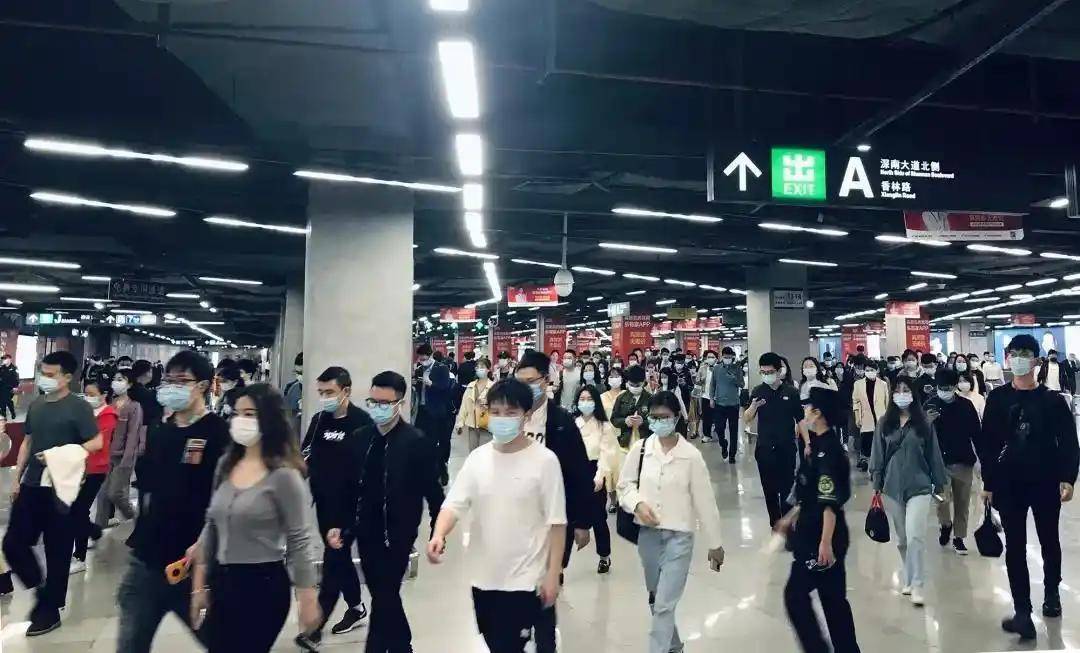
开业12年后,深圳核心区地标皇庭广场易主
2 1 Shi Ji Jing Ji Bao Dao· 2025-10-11 04:06
Core Viewpoint - The announcement of the debt settlement through asset transfer of the Huangting International's Huangting Plaza indicates significant financial distress for the company, despite the ongoing normal operations of the shopping center [1][2][4]. Group 1: Company Financial Situation - Huangting International's Huangting Plaza was publicly auctioned with a starting price of 305.2966 million yuan but ultimately failed to sell [3]. - The debt issue originated from a trust loan contract signed in 2016, where Huangting International's subsidiary borrowed 3 billion yuan, using Huangting Plaza and its land use rights as collateral [3]. - By the debt maturity in 2021, only 250 million yuan was repaid, leading to a lawsuit and subsequent judicial auction of the property [3]. Group 2: Impact on Operations - Despite the financial turmoil, Huangting Plaza continues to operate normally, with merchants reporting no disruption in business and new lease agreements in place [2][4]. - The shopping center has benefited from its strategic location near the border, attracting Hong Kong customers and showing a profit increase over the past two years [4]. Group 3: Asset and Revenue Loss - The revenue from Huangting Plaza for 2024 is projected at 36.8628 million yuan, accounting for 56.03% of the company's total revenue [6]. - The book value of Huangting Plaza is 574.9805 million yuan, representing 71.57% of the company's total assets, indicating a substantial loss of key assets and revenue channels for Huangting International [6].

戴德梁行:三季度深圳商办市场冷热交替 写字楼租赁需求有微调
Zheng Quan Shi Bao Wang· 2025-10-10 04:04
Core Insights - The article discusses the recent developments in Shenzhen's retail and office markets, highlighting the opening of new shopping centers and the dynamics of supply and demand in these sectors [1][2][3]. Retail Market Overview - Shenzhen's retail market continues to see strong supply, with approximately 280,000 square meters of new premium shopping center space added in Q3, bringing the total stock to 7.757 million square meters [2]. - New projects include Shenzhen Dayuecheng, Qianhai Ice and Snow World, and Shenzhen Bay MixC Phase II, each with unique positioning and brand offerings [2]. - Shenzhen Dayuecheng has achieved an average daily footfall of 150,000 and total sales nearing 370 million yuan within two months of opening [2]. - The retail sector's total social consumer goods retail sales growth rate has recovered to 3.6% in the first seven months, with merchandise retail growth at 3.8%, outpacing the restaurant sector [3]. Office Market Dynamics - The total stock of Grade A office space in Shenzhen has reached 8.879 million square meters, with significant new supply concentrated in the Qianhai area [5]. - The vacancy rate for Grade A offices has increased by 1.2 percentage points to 29.0%, driven by the influx of new supply [5]. - Average rental rates for Grade A offices have decreased to 153.4 yuan per square meter per month, reflecting a 4.2% quarter-on-quarter decline and an 11.2% year-on-year decline [5]. - The net absorption of office space reached 92,000 square meters in Q3, marking the highest quarterly figure since 2024 [5]. Trends and Innovations - There is a trend towards smaller retail spaces in mature projects as businesses seek to control costs and reduce risks [4]. - The collaboration between property owners and office service operators is evolving from traditional leasing to partnership models, enhancing risk-sharing and revenue-sharing mechanisms [6]. - The demand for office space is primarily driven by the TMT, financial, professional services, and retail sectors, with notable activity in niche technology companies entering the market [6][7].
恒隆地产涨超3% 旗下商场黄金周表现亮眼 内地销售双位数增长
Zhi Tong Cai Jing· 2025-10-10 03:29
Core Viewpoint - Hang Lung Properties (00101) experienced a stock price increase of over 3%, reaching HKD 9.07, with a trading volume of HKD 63.39 million, following the release of strong preliminary operational data for its properties in mainland China and Hong Kong during the National Day Golden Week [1] Group 1: Operational Performance - The preliminary operational data for the period from October 1 to 4, 2025, indicates significant growth in tenant sales and foot traffic in mainland shopping malls, with total tenant sales increasing by approximately 15% year-on-year [1] - Notable performances were recorded at Wuhan Hang Lung Plaza and Shanghai Port International Plaza, where tenant sales surged by over 70% and 50%, respectively [1] - On National Day (October 1), tenant sales in the mainland property portfolio saw a year-on-year increase of over 20%, with 70% of operational malls achieving double-digit growth [1] Group 2: Marketing Strategies - The strong performance during the Golden Week can be attributed to a variety of marketing activities and effective membership promotion strategies implemented across the mainland properties [1] - Wuhan Hang Lung Plaza attracted a large number of customers due to the debut of the popular IP "ButterBear" autumn baking workshop, resulting in tenant sales doubling compared to the previous year [1]
核心资产抵债 皇庭国际或退市
Nan Fang Du Shi Bao· 2025-10-09 23:13
Core Viewpoint - The core asset of Huangting International, the Shenzhen Huangting Plaza, has been auctioned for 30.53 billion yuan to settle debts, marking a significant loss for the company and raising concerns about its financial stability and future operations [4][6][8]. Debt and Legal Proceedings - Huangting International's subsidiary, Shenzhen Rongfa Investment Co., Ltd., borrowed 3 billion yuan in 2016, which was secured by the Huangting Plaza and its land use rights [4][10]. - Due to policy changes, the loan could not be renewed, leading to a lawsuit from the lender, CITIC Trust, after the company failed to repay the debt by the due date in 2021 [5][10]. - In 2024, a court ruling allowed CITIC Trust to transfer its debt rights to Guangyao Xialan (Shenzhen) Investment Co., Ltd., which became the new creditor [5][13]. Asset Auction and Financial Impact - The auction of Huangting Plaza, initially valued at approximately 43.61 billion yuan, started at a price of 30.53 billion yuan, equivalent to 70% of its assessed value [5][14]. - The plaza generated 3.69 billion yuan in revenue in 2024, accounting for 56.03% of the company's total revenue, indicating a critical loss of income following the asset transfer [7][8]. Company Financial Health - Huangting International has reported losses for five consecutive years, with a total net loss exceeding 4.4 billion yuan from 2020 to 2024 [8]. - As of March 31, 2025, the company had total assets of 8 billion yuan and total liabilities of 7.77 billion yuan, indicating a precarious financial situation [8]. - The loss of Huangting Plaza may trigger a financial warning under the Shenzhen Stock Exchange's listing rules, potentially leading to forced delisting if the company cannot restructure its debts or attract new investment [7][8].
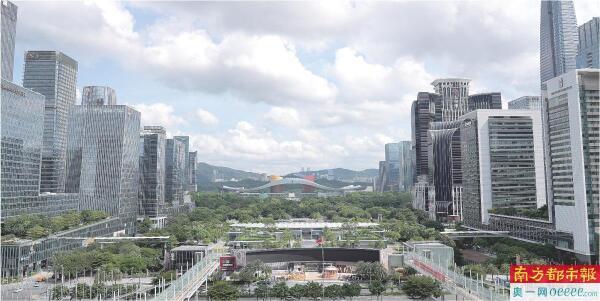
恒隆地产:国庆中秋假期前4日内地物业组合租户销售额同比增长约15%
Xin Lang Cai Jing· 2025-10-09 14:09
Core Viewpoint - Hang Lung Properties reported a significant increase in tenant sales for its mainland properties during the first four days of the National Day Golden Week, with an overall year-on-year growth of approximately 15% [1] Group 1: Tenant Sales Performance - Tenant sales for Hang Lung Properties' mainland portfolio increased by over 20% on October 1, with 70% of its operating malls recording double-digit growth [1] - Wuhan Hang Lung Plaza and Shanghai Port International Hang Lung Plaza were the standout performers, with tenant sales surging by over 70% and 50% respectively [1] - The overall tenant sales for the mainland portfolio rose by nearly 20% during the first four days, driven by popular events such as the "ButterBear" autumn baking workshop in Wuhan [1] Group 2: Customer Traffic Insights - The overall customer traffic for the mainland properties increased by over 20% in both Wuxi and Wuhan during the first four days compared to the same period last year [1] - In Hong Kong, customer traffic for the first four days of the National Day Golden Week grew by 4%, with The Peak contributing significantly with a 26% increase [1]
仲量联行:出海与科技赛道成深圳办公楼市场需求修复关键动力
Zheng Quan Shi Bao Wang· 2025-10-09 09:21
Core Insights - The overall leasing activity in Shenzhen's Grade A office market has declined in Q3 2023, with a net absorption of approximately 125,000 square meters and continued downward pressure on rental prices [1] - Despite the downturn, some companies are taking advantage of the rental adjustments to upgrade their office spaces in a cost-effective manner [1] - The demand recovery is being driven by the development of overseas markets and technology companies, which are significant contributors to the leasing activity [1] Demand Distribution - Technology companies remain the primary demand driver in Shenzhen's Grade A office market, accounting for about 30% of the leasing transaction area [1] - Sectors such as consumer electronics, artificial intelligence applications, and digital marketing are particularly active, leading to significant leasing transactions in areas like Technology Park and Qianhai [1] - As Shenzhen's tech firms shift towards higher value chains, there is an increasing emphasis on research and development efficiency, team collaboration quality, and integration with the industrial ecosystem, which boosts demand for high-quality office spaces [1] Emerging Drivers - Shenzhen's consumer electronics companies are significantly expanding their overseas presence, becoming a new driving force for demand recovery in the office market [2] - Several leading and emerging consumer electronics firms have newly leased or upgraded to Grade A offices, totaling over 10,000 square meters, primarily for overseas marketing, brand management, and cross-border business expansion [1] Market Outlook - Over the next 12 months, more than 1 million square meters of new supply is expected to enter Shenzhen's Grade A office market, maintaining a supply-demand imbalance and high vacancy rates [2] - The downward trend in rental prices is likely to continue in the short term [2] - Recent policies in Shenzhen encourage flexible adjustments of existing office buildings for alternative uses, such as hotels, medical facilities, and affordable housing, which may diversify operational models and alleviate temporary vacancy pressures [2]

深圳这座运营12年的商业地标正式易主!以超30亿抵债
Sou Hu Cai Jing· 2025-10-09 05:44
Core Viewpoint - The core asset of the company, Shenzhen Royal Court Plaza, has been officially transferred to a new owner through a court ruling, which will significantly impact the company's financial situation and operations [1][9]. Debt Disposal Process - The company's subsidiary, Rongfa Investment, had signed a trust loan contract with CITIC Trust in 2016 for a loan of 3 billion yuan, secured by multiple guarantees including the Plaza and land use rights [4]. - Due to policy changes, the loan could not be renewed, leading to a lawsuit by CITIC Trust, which resulted in a court ruling allowing the transfer of debt rights to Guangyao Xialan Investment [5][6]. Financial Impact - Shenzhen Royal Court Plaza, located in the core area of Futian CBD, was a significant revenue source, contributing 3.69 billion yuan, or 56.03% of the company's total revenue in 2024 [6][9]. - The company's net assets are projected to drop to approximately -1.92 billion yuan after the asset transfer, raising concerns about potential delisting risks due to financial instability [9][10]. - The company has reported continuous losses over five years, with a cumulative net profit loss exceeding 4.4 billion yuan, and a revenue decline of 18.48% in the first half of 2025 [9][11]. Broader Implications - The loss of the Plaza, the only stable cash flow source, may necessitate a fundamental restructuring of the company's business model, increasing pressure on its operational cash flow [11]. - The parent company, Royal Court Group, is also facing financial difficulties, with a total of 10 enforcement cases amounting to approximately 5.23 billion yuan [11].
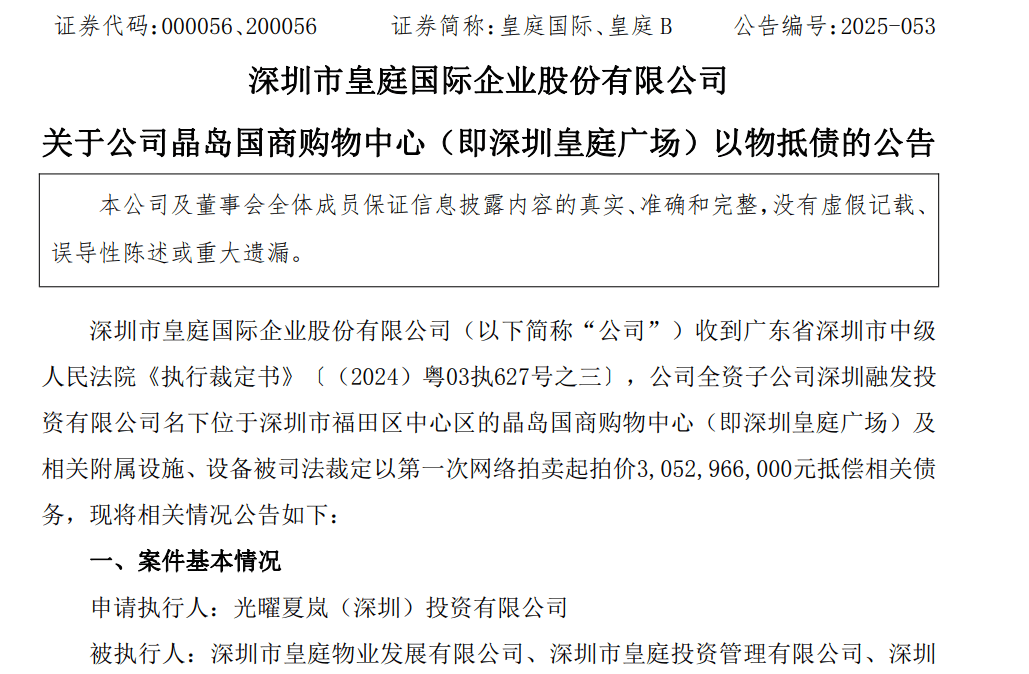
“达摩克里斯之剑”高悬,皇庭国际“以物抵债”恐触退市警示红线
Feng Huang Wang· 2025-10-09 04:43
Core Viewpoint - The recent announcement by Royal Court International regarding the "debt-for-assets" arrangement has led to a significant drop in its stock price, indicating severe financial distress and potential loss of core assets [1][6]. Group 1: Debt and Asset Situation - Royal Court International's subsidiary, Shenzhen Rongfa Investment Co., Ltd., is facing a judicial ruling to auction the Crystal Island International Shopping Center, valued at approximately 30.53 billion yuan, to settle debts [1][2]. - The shopping center, located in the core area of Shenzhen's CBD, is a key asset for the company, and losing ownership will have a substantial impact on its financial health and operations [1][3]. - The projected revenue from the Shenzhen Royal Court Plaza for 2024 is 36.86 million yuan, accounting for 56.03% of the company's total revenue, which will be lost if the asset is forfeited [1][4]. Group 2: Historical Context and Financial Obligations - The debt issue stems from a 30 billion yuan trust loan agreement signed in 2016 with CITIC Trust, secured by the Shenzhen Royal Court Plaza as collateral [4][5]. - Due to policy changes and business challenges, the subsidiary was unable to repay the loan, leading to a lawsuit and subsequent judicial actions [5][6]. - The company is now at risk of triggering financial delisting warnings under the Shenzhen Stock Exchange rules due to the potential negative impact on its net assets, which could drop to approximately -1.92 billion yuan post-debt settlement [1][5].