
公用事业

Search documents
Singapore’s largest industrial district cooling system begins operations to support STMicroelectronics’ decarbonization strategy
Globenewswire· 2025-10-21 06:00
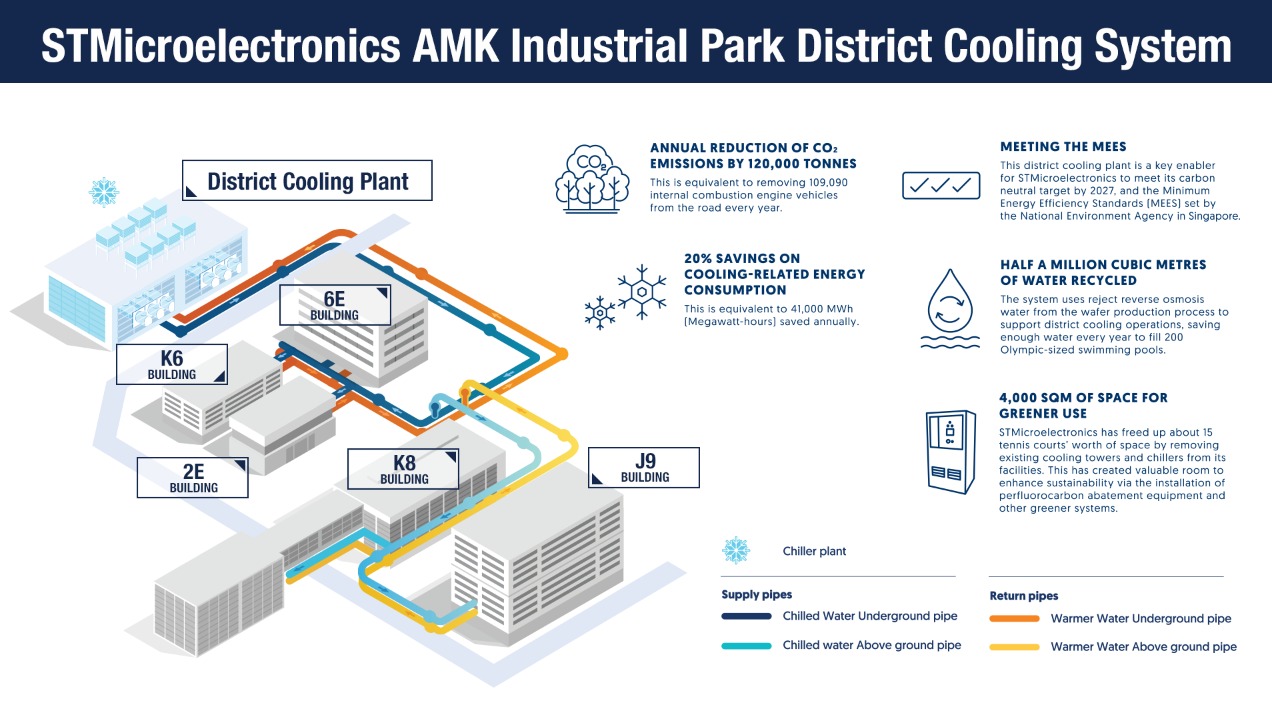
Core Insights - STMicroelectronics and SP Group have launched Singapore's largest industrial district cooling system at Ang Mo Kio TechnoPark, supporting ST's decarbonization strategy and sustainability goals [1][2][3] Environmental Impact - The new cooling system is projected to reduce carbon emissions by up to 120,000 tonnes annually and achieve a 20% reduction in cooling-related electricity consumption [2][15] - It will repurpose over half a million cubic meters of water each year by utilizing reject reverse osmosis water from ST's cooling towers [2][15] System Specifications - The district cooling system has an installed capacity of up to 36,000 refrigeration tonnes (RT) and serves an area of approximately 90,000 square meters through a centralized closed-loop pipe network [4][15] - The system employs chillers in a series counterflow configuration to enhance energy efficiency and ensure reliable 24/7 operation [5] Safety and Certification - The project achieved over 2 million accident-free man hours during construction and received the Green Mark Platinum Super Low Energy certification for its energy efficiency and sustainable design [7] Future Collaborations - STMicroelectronics and SP Group are collaborating on upgrading the cooling system at ST's Toa Payoh site, aiming to reduce carbon emissions by approximately 2,140 tonnes annually under a 20-year chilled-water-as-a-service agreement [8] - The partnership also includes the implementation of an energy management information system (EMIS) and smart water meters to enhance energy and water efficiency across ST's campuses [9][10]


9月和三季度经济数据点评:稳增长政策转向长期视角
Bank of China Securities· 2025-10-21 02:54
Economic Growth and GDP - The actual GDP growth for the first three quarters of 2025 is 5.2%, exceeding the annual target of 5.0%[4] - The GDP growth rate for Q3 2025 is 4.8%, a decrease of 0.4 percentage points from Q2 2025[4] - The nominal GDP growth rate for Q3 2025 is 3.7%, down 0.2 percentage points from Q2 2025[4] Industrial Production - The industrial added value in September increased by 6.5%, surpassing the consensus expectation of 5.23%[10] - The cumulative industrial added value growth for the mining industry from January to September is 5.8%, while manufacturing and high-tech industries show growth rates of 6.8% and 9.6%, respectively[12] Fixed Asset Investment - From January to September, fixed asset investment fell by 0.5%, with private investment declining by 3.1%[25] - Real estate investment dropped by 13.9% during the same period, with new construction area down 18.9%[31] Consumer Spending - Retail sales in September grew by 3.0%, marking the fourth consecutive month of decline[15] - Cumulative retail sales from January to September showed a year-on-year increase of 4.9%, with significant declines in categories like petroleum products and beverages[20] Policy and Future Outlook - The government has introduced a fourth batch of "national subsidies" amounting to 69 billion yuan and has set a new local government debt limit of 500 billion yuan for 2026[1] - The macroeconomic policy adjustments will focus on achieving high-quality growth during the 14th Five-Year Plan and addressing external uncertainties[44]
三季度4.8%,政策发力否
HUAXI Securities· 2025-10-20 15:24
Economic Growth - The GDP growth for the first three quarters is 5.2%, indicating low urgency for policy intervention[1] - The GDP growth rate for Q3 is 4.8%, a slowdown from 5.2% in Q2[1] - Q4 growth is projected at 4.5-4.6%, sufficient to meet the annual target of 5%[1] Price and Demand Indicators - The nominal GDP growth for Q3 is 3.73%, down 0.21 percentage points from Q2's 3.94%[2] - The GDP deflator index shows a year-on-year rebound of approximately 0.2 percentage points to -1.0%, remaining negative for ten consecutive quarters[2] - Weighted year-on-year growth for industrial and service sectors in September rebounded by 0.5 percentage points to 5.9%[2] Retail and Consumption Trends - Retail sales growth in September is 3.0%, the lowest this year, with a slowdown attributed to last year's high base effects[3] - Per capita consumption expenditure in Q3 increased by 3.4%, down 1.8 percentage points from Q2[3] - The urban consumption rate is 63.4%, slightly lower than 2019, while the rural consumption rate is 84.6%, higher than 2019[4] Investment and Real Estate - Fixed asset investment from January to September decreased by 0.5%, marking the first negative growth since October 2020[5] - Infrastructure investment (excluding electricity) saw a reduced decline of 1.2 percentage points to -4.6% in September[5] - Real estate sales in September showed a year-on-year decline of 10.5% in area and 11.8% in value, but the decline in sales value narrowed by 2.2 percentage points[5] Market Outlook - The necessity for policy tightening is reduced as the annual growth target of 5% is likely to be met[6] - Supply-demand imbalances persist, with production indicators growing at 5.7% while demand indicators show a decline of -0.6%[8] - The bond market may experience upward movement as risk appetite stabilizes, with potential monetary easing expected in 2026[8]
港股市场策略周报 2025.10.13-2025.10.19-20251020
Zhe Shang Guo Ji Jin Rong Kong Gu· 2025-10-20 08:07
Group 1: Market Performance Review - The Hong Kong stock market experienced a significant decline due to renewed US-China trade tensions and profit-taking after previous gains, with the Hang Seng Index, Hang Seng Tech Index, and Hang Seng Composite Index dropping by -4.11%, -3.97%, and -7.98% respectively [3][10][13] - Defensive sectors such as utilities and telecommunications showed resilience, while previously high-performing sectors like technology and healthcare faced substantial corrections [3][10][13] Group 2: Market Valuation Levels - As of the end of the week, the 5-year PE (TTM) valuation percentile for the Hang Seng Composite Index stood at 81.45%, indicating that the valuation level is close to one standard deviation above the 5-year average [3] Group 3: Market Macro Environment - The macroeconomic environment shows weak inflation in September, with CPI down by 0.3% year-on-year, while PPI decreased by 2.3% [37][43] - The central bank's monetary policy remains supportive, with a focus on enhancing domestic demand and stabilizing growth through proactive measures [37][43] Group 4: Fund Flow Analysis - Southbound capital showed strong buying interest, with a net inflow of 45.089 billion HKD, marking a new high in five weeks and maintaining a streak of 22 consecutive weeks of net inflows [43] - The top net buying companies included Pop Mart, Xiaomi, and China Mobile, indicating a preference for consumer discretionary and technology sectors [32] Group 5: Sector Allocation Outlook - The report favors sectors that are relatively prosperous and benefit from policy support, such as automotive, new consumption, innovative pharmaceuticals, and technology [3][43] - Low-valuation state-owned enterprises and local Hong Kong banks, telecommunications, and utility stocks are also highlighted as stable performers benefiting from the interest rate cut cycle [3][43]
今日95只个股涨停 主要集中在机械设备、电子等行业
Zheng Quan Shi Bao Wang· 2025-10-20 07:30
Core Viewpoint - On October 20, the A-share market showed a strong upward trend with 3,877 stocks rising, indicating positive market sentiment and potential investment opportunities in various sectors [1] Group 1: Market Performance - A total of 3,877 stocks increased in value, while 1,168 stocks decreased, and 108 stocks remained flat [1] - Excluding newly listed stocks, there were 95 stocks hitting the daily limit up, and 6 stocks hitting the limit down [1] Group 2: Sector Analysis - The sectors with the most stocks hitting the daily limit up included machinery, electronics, power equipment, public utilities, coal, and transportation [1]
2025年9月经济数据点评:4.8%的新旧之辩
Minsheng Securities· 2025-10-20 07:08
Economic Overview - In the first three quarters of 2025, China's GDP reached 10,150.36 billion yuan, with a year-on-year growth of 5.2%[4] - The GDP for Q3 2025 was 3,545 billion yuan, showing a year-on-year growth of 4.8% and a quarter-on-quarter increase of 1.1% after seasonal adjustments[4] New vs. Old Growth Drivers - Traditional growth engines like real estate and infrastructure are underperforming, while high-tech industries and manufacturing investments are leading with higher growth rates[5] - The acceleration in the transformation of economic drivers sets a strategic foundation for future industrial development discussions at the Fourth Plenary Session[5] Consumer Income and Demand - Resident income growth has slowed to match economic growth for the first time since Q2 2023, necessitating policies to boost domestic demand and consumption recovery[5] - The need for short-term counter-cyclical adjustments and long-term planning for income distribution reform and consumption incentives is emphasized[5] Industrial Production Insights - Industrial production saw a year-on-year increase of 6.5% in September, up from 5.2% in August, indicating a recovery in industrial activity[6] - The industrial capacity utilization rate rose from 74.0% to 74.6%, marking the highest level this year[6] Infrastructure and Investment Trends - Narrowly defined infrastructure investment growth improved from -5.9% in August to -4.6% in September, signaling marginal recovery[8] - Broader infrastructure investment continues to decline, highlighting a divergence in performance across sectors[8] Consumer Spending Challenges - Retail sales growth fell to 3% in September, primarily due to reduced government subsidies and preemptive demand for durable goods[10] - The decline in consumer spending is exacerbated by a drop in restaurant revenue growth to 0.9% after two months of recovery[10] Real Estate Market Dynamics - Real estate investment growth continued to decline, reaching -13.9% for the first nine months of 2025, with significant pressure expected in Q4 due to high base effects from previous policy support[10] - The need for enhanced policies to stabilize the real estate market is critical to prevent further declines[10] Policy Implications - The recent allocation of 500 billion yuan by the Ministry of Finance to support local projects indicates a focus on stabilizing expectations and facilitating the transition between old and new economic drivers[6] - The upcoming Fourth Plenary Session is anticipated to reassess the economic situation and signal potential policy easing measures[6] Risks and Considerations - Potential risks include policies falling short of expectations, unexpected changes in the domestic economic landscape, and fluctuations in export performance[11]
期金破4300美元!从黄金到股票市场,看全球风险偏好再根据股票配(risk)资公司趋势定价
Sou Hu Cai Jing· 2025-10-20 01:04
Group 1 - The recent surge in gold prices, surpassing $4300, is driven by a combination of macroeconomic factors, including expectations of interest rate stability and increased demand for safe-haven assets amid economic slowdown and geopolitical risks [2][5] - The global stock market is experiencing a rebalancing of risk preferences, with investors shifting from high-valuation sectors to defensive assets such as banks, energy, and utilities, while still finding opportunities in growth sectors like AI and robotics [3][6] - The relationship between gold and the stock market is evolving, with both potentially rising together due to a combination of liquidity expectations and the need for diversification in investment portfolios [5][8] Group 2 - The A-share market is showing signs of structural differentiation, with stable performance in cyclical, financial, and consumer sectors, while technology growth sectors are experiencing increased volatility [6] - There is a cautious yet active market sentiment, with institutional interest in sectors like computing power, energy, and high-end manufacturing, indicating a shift from emotion-driven to logic-driven investment strategies [6][8] - The recent rise in gold prices reflects a significant revaluation of risk in global markets, highlighting the ongoing changes in macroeconomic variables such as interest rates and monetary policy [5][8]

以史为鉴看本轮风格切换的时间和幅度
Changjiang Securities· 2025-10-19 23:30
Group 1 - The A-share market is currently experiencing an adjustment phase, with a shift from growth to value style, influenced by various short-term disturbances, differing from previous cycles [1][5][7] - A historical review from 2009 shows seven significant phases of style switching in the A-share market, indicating that such transitions are closely related to changes in fundamentals and economic cycles [5][6][7] - The current style switch is primarily driven by short-term factors such as external tariff concerns and profit-taking in the technology sector, rather than fundamental changes in the growth-value dynamic [7][8] Group 2 - The report highlights that the current value style dominance is characterized by two scenarios: upward market adjustments during economic improvements or downward adjustments due to rapid economic declines [6][7] - Historical data indicates that significant style switches often coincide with economic turning points or major policy adjustments, with the probability of switching increasing when the relative difference in ROE between value and growth indices widens [6][7][15] - The report anticipates that the ongoing trade tensions may lead to increased volatility, but the long-term "slow bull" trend remains intact, with specific investment directions suggested in both growth and value sectors [8][15]
【策略】短期调整,无需悲观——策略周专题(2025年10月第2期)(张宇生/王国兴)
光大证券研究· 2025-10-19 23:04
Core Viewpoint - The A-share market has experienced a pullback due to declining risk appetite, increased uncertainty in US-China relations, and a general market sentiment decline, with major indices showing a downward trend [4][5]. Market Performance - The A-share market saw a significant decline this week, with the STAR Market 50 index dropping the most at 6.2%, while the Shanghai 50 index fell the least at 0.2%. The overall valuation of the market is at a historically high level since 2010 [4]. - Market styles have diverged, with value stocks performing better. Large-cap value stocks increased by 2.1%, while mid-cap growth stocks decreased by 5.8% [4]. Short-term Market Outlook - The A-share market has shown notable volatility, with the Shanghai Composite Index briefly surpassing 3900 points, a level not seen since August 2015, before falling back below that threshold [5]. - Increased market volatility is attributed to high valuations and rising uncertainties in US-China relations, with the VIX index also showing a significant increase [5]. - Historically, pullbacks during bull markets are common, typically occurring after 60-80 trading days into a bull market, with a usual retracement of 6-7% before resuming upward movement [5][6]. Current Market Phase - The market is likely still in a bull phase, although it may enter a wide-ranging fluctuation stage in the short term. The maximum drawdown observed so far is 4.01%, which is within historical norms [6]. Sector Focus - In the short term, the focus should be on defensive and consumer sectors, as historically, these sectors perform better during market fluctuations. High-dividend stocks and consumer sectors such as food and beverage, social services, and beauty care are expected to benefit from increased domestic demand [7][8]. - In the medium term, attention should be directed towards TMT (Technology, Media, and Telecommunications) and advanced manufacturing sectors, which may gain traction due to liquidity-driven trends and ongoing developments in AI [8].

Analyst Likes This Utility Stock – ‘It’s Got Good Momentum’
Yahoo Finance· 2025-10-19 20:17
Core Viewpoint - PG&E Corporation (NYSE:PCG) is identified as a trending stock with positive momentum, particularly following its recovery from wildfire-related challenges earlier in the year [1][2]. Group 1: Company Performance - PG&E has been negatively impacted by wildfires, leading to a significant decline in its stock price, but its current liabilities are not as severe as previously feared by the market [2]. - The company is experiencing good momentum, indicating a potential recovery and positive outlook for investors [2]. Group 2: Market Sentiment - Analysts, including Jim Lebenthal from Cerity Partners, express a favorable view of PG&E, highlighting its resilience and potential for growth in the utility sector [1]. - Third Point Management acknowledges the recent tragic events in Southern California but emphasizes the importance of the company's performance and outlook in their investor communications [2].
