电力

Search documents
A股盘前市场要闻速递(2026-02-25)
Jin Shi Shu Ju· 2026-02-25 01:19
登录新浪财经APP 搜索【信披】查看更多考评等级 重要新闻 2. 商务部:中方愿与美方在将于近期举行的第6轮中美经贸磋商中开展坦诚磋商 商务部新闻发言人24日就美近期关税调整举措答记者问时表示,中方正密切关注并将全面评估美方相关 举措,后续将视情适时决定调整针对美方原芬太尼关税和对等关税的反制措施。中方将保留采取一切必 要措施的权利,坚决捍卫自身合法权益。中方愿与美方在将于近期举行的第6轮中美经贸磋商中开展坦 诚磋商。 3. 国常会:进一步释放银发消费需求,打造一批银发消费新场景新业态 国务院总理李强2月24日主持召开国务院常务会议。会议指出,我国银发经济潜力很大,要完善支持举 措、强化政策落实,促进养老事业和养老产业发展,为应对人口老龄化提供有力支撑。要进一步释放银 发消费需求,提升消费能力,发挥消费补贴等政策牵引作用,打造一批银发消费新场景新业态。要推动 普惠养老服务供给提质扩面,健全分级分类、普惠可及、覆盖城乡、持续发展的养老服务体系,更好保 障老有所养。要加强养老机构安全管理,及时排查化解风险隐患,严厉打击虚假宣传、非法集资和养老 诈骗等行为,切实维护老年群体合法权益。 (央视新闻) 4. 大疆起诉美 ...
全国首张电力业务许可证完成续期
Liao Ning Ri Bao· 2026-02-25 00:57
Core Viewpoint - The successful renewal of the first electricity business license in China by Huaneng International Power Co., Ltd. marks a significant advancement in the regulatory management of electricity business licenses, transitioning to a full-cycle management phase [1] Group 1: License Renewal Process - Huaneng Dalian Power Plant has completed the renewal of its electricity business license, which is the first in the nation to do so, indicating a streamlined process for license management [1] - The renewal process was facilitated by the Northeast Energy Regulatory Bureau through a "green channel," resulting in simplified materials and high efficiency [1] Group 2: Historical Context and Impact - The electricity business licensing system was implemented in 2005 as a foundational management measure in China's electricity reform, with the first license issued to Huaneng Dalian Power Plant [1] - By the end of 2025, nearly 20,000 companies holding various electricity licenses are expected to exist, supporting the maintenance of market order and the safety of electricity production [1] Group 3: Application Process Improvements - The application process for electricity business licenses has been standardized nationwide, allowing for a "one-stop" service with a reduced review period from 20 working days to as fast as 1 day [1] - The simplification of application materials has effectively reduced the burden on market participants [1]

中原证券晨会聚焦-20260225
Zhongyuan Securities· 2026-02-25 00:21
Core Insights - The report highlights the strong performance of the communication resources sector, leading the A-share market's upward trend, with a focus on investment opportunities in telecommunications and technology sectors [5][8][22] - The semiconductor industry is experiencing significant growth, driven by increased capital expenditure from major cloud companies and rising demand for AI-related hardware [31][34][35] - The agricultural sector, particularly in pig farming, shows signs of price stabilization and potential upward trends due to supply constraints [21][20] Domestic Market Performance - The Shanghai Composite Index closed at 4,117.41, with a slight increase of 0.87%, while the Shenzhen Component Index rose by 1.36% to 14,291.57 [3] - The A-share market is characterized by a mixed performance across sectors, with telecommunications, coal, and precious metals showing strength, while sectors like tourism and gaming lagged [5][9][10] International Market Performance - The Dow Jones Industrial Average closed at 30,772.79, down by 0.67%, while the S&P 500 and Nasdaq also experienced slight declines [4] - The international market reflects a cautious sentiment, with various indices showing mixed results, indicating potential volatility [4] Industry Analysis - The report discusses the strong performance of the AI sector, with significant advancements in AI models and applications expected to disrupt traditional industries such as media and software [17][19] - The telecommunications industry is projected to benefit from increased capital expenditures and technological advancements, with a focus on 5G and cloud integration [22][26] - The semiconductor industry is on an upward trajectory, with substantial growth in sales and capital investments anticipated, particularly in AI infrastructure [31][33][34] Investment Recommendations - Investors are advised to focus on sectors such as telecommunications, AI, and semiconductors, which are expected to yield strong returns due to ongoing technological advancements and market demand [19][34][35] - The report suggests a balanced investment strategy, emphasizing the importance of monitoring macroeconomic indicators and policy changes that could impact market dynamics [5][11][12]

大唐华银电力股份有限公司 关于向特定对象发行股票申请文件的审核问询函 回复的提示性公告
Zhong Guo Zheng Quan Bao - Zhong Zheng Wang· 2026-02-24 22:37
公司收到《审核问询函》后,会同相关中介机构对《审核问询函》所列问题进行了认真研究和逐项落 实,现根据相关要求对《审核问询函》回复进行公开披露,具体内容详见公司同日披露的《关于大唐华 银电力股份有限公司向特定对象发行股票申请文件的审核问询函的回复》等相关文件。 公司本次向特定对象发行A股股票事项尚需上交所审核通过,并获得中国证券监督管理委员会(以下简 称"中国证监会")作出同意注册的决定后方可实施。最终能否通过上交所审核,并获得中国证监会同意 注册的决定尚存在不确定性。公司将根据该事项的进展情况,按照有关法律法规的规定和要求及时履行 信息披露义务。敬请广大投资者注意投资风险。 特此公告。 登录新浪财经APP 搜索【信披】查看更多考评等级 本公司董事会及全体董事保证本公告内容不存在任何虚假记载、误导性陈述或者重大遗漏,并对其内容 的真实性、准确性和完整性承担法律责任。 大唐华银电力股份有限公司(以下简称"华银电力"或"公司")于2026年2月4日收到上海证券交易所(以 下简称"上交所")出具的《关于大唐华银电力股份有限公司向特定对象发行股票申请文件的审核问询 函》(上证上审(再融资)〔2026〕46号)(以下简称 ...

内蒙古蒙电华能热电股份有限公司 关于拟变更公司证券简称的公告
Zhong Guo Zheng Quan Bao - Zhong Zheng Wang· 2026-02-24 22:37
Core Viewpoint - The company, Inner Mongolia Mengdian Huaneng Thermal Power Co., Ltd., plans to change its stock abbreviation from "内蒙华电" (Inner Mongolia Huadian) to "华能蒙电" (Huaneng Mengdian) while keeping the stock code "600863" unchanged, pending approval from the Shanghai Stock Exchange [2][3][4]. Group 1 - The board of directors approved the change of the stock abbreviation with a unanimous vote of 9 in favor, 0 against, and 0 abstentions during the meeting held on February 14, 2026 [3][8]. - The current abbreviation "内蒙华电" is often confused with other power companies in Inner Mongolia, which could mislead the market and affect the company's brand image [4][5]. - The change aims to enhance brand recognition and clarify the company's identity as a subsidiary of Huaneng Group, emphasizing its main business in thermal power [4][5]. Group 2 - The abbreviation change will not significantly impact the company's current operating performance, and there are no major changes in its main business or development strategy [5]. - The company will apply for the abbreviation change to the Shanghai Stock Exchange, and the implementation is subject to their approval [2][5].

向上攀登、务实作为勇当价格改革“先锋队”“排头兵”
Xin Lang Cai Jing· 2026-02-24 22:23
Core Viewpoint - Hubei Province's Development and Reform Commission is actively implementing various reforms in pricing and energy sectors to enhance economic development and improve living standards, receiving recognition from provincial authorities [1][2][3] Group 1: Pricing Reforms - The commission is promoting market-oriented reforms in electricity pricing, optimizing the structure of transmission and distribution prices, and establishing a pricing mechanism for coal power capacity [1] - A total of 56 counties and cities have established residential price linkage mechanisms, while 63 have set up non-residential price linkage mechanisms to alleviate pricing discrepancies [1] Group 2: Support for Economic Development - The commission is working with energy departments to ensure stable and reasonable industrial and commercial electricity prices, significantly enhancing the sense of gain for the real economy [2] - Policies have been introduced to optimize time-of-use electricity pricing, including commercial and residential charging station pricing, to help businesses and consumers benefit from lower electricity costs [2] - The implementation of cross-subsidy policies for self-owned power plants is expected to save various users approximately 100 million yuan annually [2] Group 3: Focus on Livelihood and Environmental Protection - The commission is closely monitoring grain prices and has developed a purchase plan for wheat and rice to stabilize market conditions [2] - Efforts are being made to improve environmental fee management and establish a charging mechanism for urban waste treatment [2] Group 4: Party Building and Business Integration - A dual-driven mechanism for party affairs and business operations has been established to enhance organizational effectiveness and service quality [3] - The commission is fostering a learning-oriented and innovative environment within its branches to strengthen operational capabilities [3]
大唐华银电力股份有限公司关于向特定对象发行股票申请文件的审核问询函回复的提示性公告
Shang Hai Zheng Quan Bao· 2026-02-24 17:05
本公司董事会及全体董事保证本公告内容不存在任何虚假记载、误导性陈述或者重大遗漏,并对其内容 的真实性、准确性和完整性承担法律责任。 大唐华银电力股份有限公司(以下简称"华银电力"或"公司")于2026年2月4日收到上海证券交易所(以 下简称"上交所")出具的《关于大唐华银电力股份有限公司向特定对象发行股票申请文件的审核问询 函》(上证上审(再融资)〔2026〕46号)(以下简称《审核问询函》)。 公司收到《审核问询函》后,会同相关中介机构对《审核问询函》所列问题进行了认真研究和逐项落 实,现根据相关要求对《审核问询函》回复进行公开披露,具体内容详见公司同日披露的《关于大唐华 银电力股份有限公司向特定对象发行股票申请文件的审核问询函的回复》等相关文件。 登录新浪财经APP 搜索【信披】查看更多考评等级 证券代码:600744 证券简称:华银电力 公告编号:2026-005 大唐华银电力股份有限公司 关于向特定对象发行股票申请文件的审核问询函 回复的提示性公告 2026年2月25日 公司本次向特定对象发行A股股票事项尚需上交所审核通过,并获得中国证券监督管理委员会(以下简 称"中国证监会")作出同意注册的决定后方 ...
内蒙古蒙电华能热电股份有限公司第十一届董事会第二十二次会议决议公告
Shang Hai Zheng Quan Bao· 2026-02-24 17:05
Group 1 - The company held its 22nd meeting of the 11th Board of Directors on February 14, 2026, where all 9 directors participated in the voting [2][3] - The Board unanimously approved the proposal to change the company's stock abbreviation from "内蒙华电" to "华能蒙电" with 9 votes in favor, 0 against, and 0 abstentions [4][5][9] - The change in stock abbreviation is aimed at avoiding market confusion with other similar names and enhancing brand recognition, while the stock code "600863" will remain unchanged [9][10] Group 2 - The company plans to apply for the abbreviation change to the Shanghai Stock Exchange, which requires approval before implementation [9][10] - The rationale for the name change includes the need to clarify the company's identity and its relationship with its controlling shareholder, 华能 [9][10] - The company assures that this change will not significantly impact its current business performance or strategic direction [10]
突发!李嘉诚海外投资“载了”
Sou Hu Cai Jing· 2026-02-24 13:46
Core Viewpoint - Li Ka-shing, a prominent business figure and Hong Kong's richest man, faces a significant crisis as the Panamanian government forcibly takes control of two ports operated by his company, Cheung Kong Holdings, highlighting the challenges of international business in a politically charged environment [1][4][9]. Group 1: Company Overview - Li Ka-shing's wealth is estimated at $45.1 billion (approximately HKD 351.78 billion), reaffirming his status as Hong Kong's richest individual [1]. - Cheung Kong Holdings has a diversified portfolio, including real estate, ports, retail, energy, and telecommunications, with operations in over 50 countries [1][17]. - The company has faced a significant setback with the Panamanian government's takeover of the Balboa and Cristobal ports, which are crucial for global trade [4][8]. Group 2: Industry Context - The Panama Canal is a vital trade route, accounting for 6% of global maritime trade, making control over its ports strategically important [5]. - The U.S. has expressed concerns over foreign control of the Panama Canal, indicating geopolitical tensions that can impact international business operations [6][7]. - The recent actions by the Panamanian government reflect a broader trend where national interests can override international business agreements, posing risks for foreign investors [11][12]. Group 3: Financial Impact - Following the announcement of the port takeover, Cheung Kong Holdings' stock price fell by 2.65%, closing at HKD 62.55 per share, with a total market capitalization of HKD 239.6 billion [9]. - The company's previous successes in asset management and investment strategies may be challenged by the current geopolitical climate, affecting future operations and profitability [7][12]. Group 4: Historical Background - Li Ka-shing's business journey began in the 1960s, with significant investments in Hong Kong's real estate market, leading to the establishment of a vast business empire [14][17]. - His strategic acquisitions, such as the control of Hutchison Whampoa and investments in various sectors, have contributed to his wealth accumulation over decades [14][17]. Group 5: Future Outlook - The current crisis may force Li Ka-shing to reassess his investment strategies, particularly in politically sensitive regions, as the dynamics of international business continue to evolve [7][12]. - The company's focus on emerging sectors like artificial intelligence and renewable energy indicates a potential shift in investment priorities amidst geopolitical challenges [17].


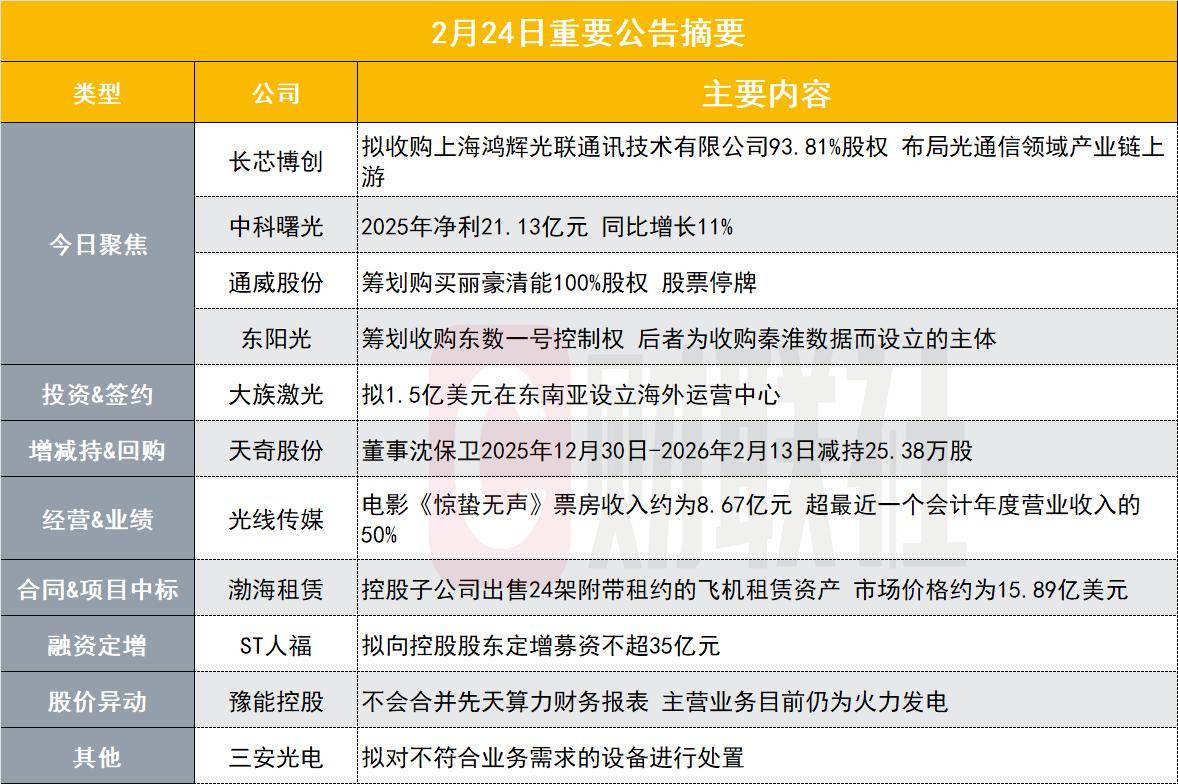
突发!480亿光模块概念股拟收购股权布局光通信产业链上游|盘后公告集锦
Sou Hu Cai Jing· 2026-02-24 13:44
Company Announcements - Changxin Bochuang plans to acquire 93.81% stake in Shanghai Honghui Guanglian Communication Technology Co., Ltd. to expand its presence in the optical communication sector [1] - Tongwei Co., Ltd. is planning to purchase 100% equity of Lihua Qingneng, leading to a stock suspension [1] - Dongyangguang is planning to acquire control of Dongshu Yihua, which was established to acquire Qinhuai Data [1] - Dazhu Laser intends to invest $150 million to establish an overseas operation center in Southeast Asia [2] - Avolon Holdings Limited, a subsidiary of Bohai Leasing, has signed an agreement to sell 24 aircraft leasing assets for approximately $1.589 billion [7] Financial Performance - Zhongke Shuguang expects a net profit of 2.113 billion yuan in 2025, representing an 11% year-on-year growth [1] - Guangxi Media's film "Silent Shock" has generated approximately 867 million yuan in box office revenue, accounting for about 50% of the company's revenue for the most recent fiscal year [7] - Wen's Group anticipates a 44% year-on-year decline in net profit for 2025 due to significant decreases in pig sales prices [7] - Nengxi Electronics reported a net profit of 82.24 million yuan in 2025, a year-on-year increase of 23.99% [7] - Microguide Nano expects a net profit of 213 million yuan in 2025, a year-on-year decrease of 6.12% [7] - Sanyuan Cultural Tourism received 1.1428 million visitors during the 2026 Spring Festival, generating revenue of 70.9237 million yuan [7] Shareholding Changes - Tianqi Co., Ltd.'s director Shen Baowei plans to reduce his holdings by 253,750 shares from December 30, 2025, to February 13, 2026, representing 0.0631% of the company's total share capital [4] - Hongbaoli's deputy general manager Tao Meijuan plans to reduce her holdings by up to 310,000 shares, not exceeding 0.04% of the company's total share capital [6] Project Contracts - Shaoneng Co., Ltd.'s wholly-owned subsidiary has signed a cooperation agreement with Yuancan Company for an independent energy storage project, with a total amount of 22 million yuan [3] - China Tianying has received approval for the expansion of its Hanoi waste-to-energy project, with an investment of approximately $2.2 million [10] Other Developments - Sanan Optoelectronics plans to dispose of equipment that does not meet business needs, with a book value of 447 million yuan [9] - ST Renfu intends to raise no more than 3.5 billion yuan through a private placement to its controlling shareholder [8] - Yunnan Huadian plans to change its stock name to "Huaneng Mengdian" [11]