
数据中心

Search documents
国家发展改革委有关负责人回答证券时报记者提问时表示: 基础设施REITs进一步扩围 酒店、体育场馆、商办设施等纳入
Zheng Quan Shi Bao· 2025-11-27 19:30
Group 1: REITs Expansion - The National Development and Reform Commission (NDRC) is actively promoting the expansion of infrastructure REITs to include urban renewal facilities, hotels, sports venues, and commercial office facilities [1][2] - Since its launch in 2020, the REITs market has expanded to cover 12 major industries and 52 asset types, with 18 asset types from 10 industries having achieved their first issuance [2] Group 2: "Two Heavy" Construction Achievements - The NDRC has allocated 7 trillion yuan and 8 trillion yuan in special long-term bonds for 2024 and 2025, respectively, to support 1,465 and 1,459 "hard investment" projects [3] - Significant improvements in urban safety resilience have been achieved through the construction and renovation of urban underground pipelines [3] - Over 100,000 new high school seats have been created, and 15,000 hospital wards have been renovated to improve healthcare conditions [3] Group 3: Credit Repair and Humanoid Robots - The NDRC has issued the "Credit Repair Management Measures," which will take effect on April 1, 2026, addressing challenges in credit repair management [4] - The NDRC emphasizes the need to balance speed and potential bubbles in the humanoid robot industry, aiming to prevent market saturation and ensure orderly development [5] - The establishment of industry standards and evaluation systems for the humanoid robot sector is a priority, along with support for collaborative technological advancements [5]
北京开展布局太空数据中心 太空数据中心要来了
Xin Lang Cai Jing· 2025-11-27 15:11
Core Viewpoint - The Beijing Municipal Science and Technology Commission and the Zhongguancun Science City Management Committee have released a plan for the construction of a space data center, aiming to establish a centralized large-scale data center system in the 700 to 800 km dawn-dusk orbit, capable of accommodating a million-class server cluster for space-based data relay transmission and computing services [1] Group 1 - The plan involves the construction and operation of a centralized large-scale data center system [1] - The proposed data center will be located in the 700 to 800 km dawn-dusk orbit [1] - The system is designed to accommodate a million-class server cluster [1] Group 2 - The data center will provide space-based data relay transmission services [1] - It will also offer computing services [1]
北京发布太空数据中心建设规划方案
Xin Lang Cai Jing· 2025-11-27 15:02
Core Viewpoint - The Beijing Municipal Science and Technology Commission and the Zhongguancun Science City Management Committee have released a plan for the construction of a space data center, aiming to establish a centralized large-scale data center system in the dawn-dusk orbit at altitudes of 700 to 800 kilometers [1] Group 1 - The proposed data center system will accommodate a server cluster capable of handling millions of computing tasks [1] - The initiative will facilitate space-based data relay transmission and computing services [1]
大摩:AI不仅“缺电”,还“缺水”!
美股IPO· 2025-11-27 10:28
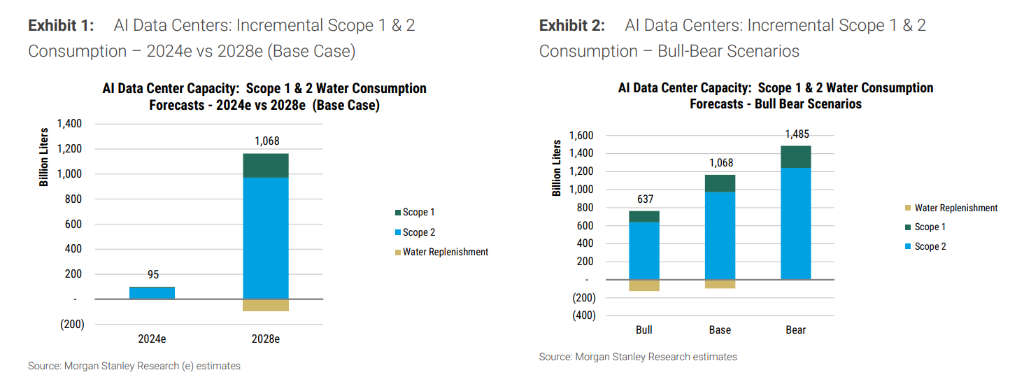
Core Insights - The report from Morgan Stanley reveals that the water consumption of AI data centers is expected to exceed 100 billion liters by 2028, highlighting a significant risk due to the inability to transport water across regions like electricity [1][9][10] - The focus on energy consumption overlooks the critical issue of water scarcity, which is becoming a local project killer for data centers [6][12] Water Consumption Projections - By 2028, the direct cooling and electricity production consumption of AI data centers is projected to reach 106.8 billion liters [9] - In an optimistic scenario, this figure could rise to 148.5 billion liters, while even in a pessimistic scenario, it would still be 63.7 billion liters [10][11] Localized Water Resource Risks - The real bottleneck is not the total water consumption but the localized availability of water resources, which cannot be easily transported [12][14] - Recent examples include Amazon's "Project Blue" being rejected in Tucson, Arizona, due to high water and electricity demands, and opposition to AI data center plans in North Lincolnshire, UK, due to existing water supply issues [14][15] Technological Adaptation - Tech giants are being forced to innovate to survive in a water-scarce environment, focusing on technologies that significantly reduce Water Usage Efficiency (WUE) [16] - Examples of emerging technologies include microchannel cooling plates and the use of natural cooling sources, such as Google's project in Finland utilizing seawater [17][18] Regulatory Landscape - Regulatory bodies are increasingly focused on water usage standards for data centers, with regions like Singapore and Malaysia setting strict WUE targets, and the EU planning mandatory minimum performance standards by 2026 [19][20][21] Beneficiaries of Water Solutions - Companies specializing in water treatment solutions, such as Ecolab, Toray Industries, Veolia, and DuPont, are expected to benefit from the rising demand for water resource management as data center operators strive for water sustainability [22]


国家发改委答证券时报记者提问:REITs发行范围已涵盖12大行业52个资产类型
Zheng Quan Shi Bao Wang· 2025-11-27 07:16
Core Insights - The National Development and Reform Commission (NDRC) has been actively promoting the expansion of the infrastructure Real Estate Investment Trusts (REITs) market since its initiation in 2020 [1] - Initially, the issuance scope included sectors such as warehousing logistics, toll roads, municipal facilities, and industrial parks, with subsequent expansions to include clean energy, data centers, affordable rental housing, water conservancy facilities, cultural tourism, and consumer infrastructure [1] - Currently, the issuance scope encompasses 12 major industries and 52 asset types, with 18 asset types across 10 industries having successfully completed their first issuance and listing [1]
凯雷专家警告:AI投资狂潮堪比页岩气泡沫前夜!
智通财经网· 2025-11-27 07:08
Core Insights - Large technology companies are making significant investments in artificial intelligence, reminiscent of the shale industry's capital expenditure boom before a market crash [1][2] - Energy and technology are identified as the two pillars of the economy, with the absence of either impacting critical sectors like finance and healthcare [1] - The capital expenditure in the energy sector during its peak reached 110% to 120% of cash flow, raising questions about the sustainability of similar spending in technology [1] Investment Trends - Investments in technology are primarily directed towards chips and data centers to enhance computational resources for AI development [1] - The cost of AI computation is compared to oil pricing, with expectations of stability around $1 to $2 per hour, similar to the confidence shale oil producers had in $100 per barrel oil prices [1] Financing Structures - Early in the shale oil boom, U.S. oil producers relied on debt and special purpose vehicles (SPVs) to manage capital expenditures, a structure that parallels current AI investment strategies [1] - The strategies employed by large tech companies in AI resemble those used in the energy sector, particularly in terms of land acquisition and resource positioning [2]

2025年前9个月,泰国企业投资额实现翻番
Shang Wu Bu Wang Zhan· 2025-11-27 06:57
Core Insights - Thailand's investment has significantly increased in the first nine months of 2025, with 840 projects totaling over 447 billion THB, representing a 99% year-on-year growth, indicating the private sector's potential in driving the country towards a "new economy" [1] Investment Focus Areas - Major investments are concentrated in five key sectors: - Agriculture, food, and biotechnology with over 31 billion THB, focusing on high-end food, bioplastics, and biofuels [1] - Tourism, logistics, and medical services with investments exceeding 30 billion THB [1] - Digital sector investments surpassing 140 billion THB, with data centers being a core growth driver [1] - Industrial utilities investments over 93 billion THB, primarily in solar and biomass energy [1] - Automotive and machinery parts investments exceeding 3.4 billion THB, reflecting Thailand's supply chain competitiveness [1] Support for SMEs - The BOI emphasizes special support for small and medium-sized enterprises (SMEs), with a minimum investment requirement of only 500,000 THB and higher corporate tax incentives to help more businesses grow into international competitors [1]
AI走向“大象起舞”:深度剖析PJM电网高频数据,透视AI算力需求
ZHONGTAI SECURITIES· 2025-11-27 04:59
Investment Rating - The report maintains an "Overweight" rating for the industry [2] Core Insights - High-frequency power data confirms that the demand for AI computing power is accelerating [3][4] - The AI landscape is evolving from "1 to N," with a positive outlook on Google's performance [4][6] Summary by Sections Industry Overview - The industry comprises 130 listed companies with a total market capitalization of 1,802.515 billion [3] - The circulating market capitalization stands at 1,665.920 billion [3] Power Demand Analysis - In the Virginia DOM region, the average monthly load increment for 2025 is approximately 3 GW, an increase of 0.98 GW compared to 2024 [5] - The average load increment for September to November shows significant year-on-year growth of 73%, 53.2%, and 56.4% respectively [5][28] - The Ohio AEP region shows an average load increment of about 1.34 GW for 2025, with a year-on-year increase of 158%, 223%, and 180% for the same months [5][29] Price Trends - Nighttime price differences have significantly increased, with the price difference for the ARCOLA node reaching 7.94 USD/MWh in October 2025, a 197% increase year-on-year [5][50] - In November 2025, the price reached 13.11 USD/MWh, marking a 680% increase year-on-year [5][50] AI Application Insights - The report identifies four major barriers to AI application: weak cost scale effects, subscription model limitations, high ROI requirements, and the need for a data feedback loop [6][65] - Google is highlighted as having a robust AI ecosystem, leveraging its proprietary TPU chips to reduce computing costs significantly [6][69] Investment Recommendations - Suggested stocks include Alphabet (GOOGL.O), Cipher Mining (CIFR.O) in the US, and Alibaba (9988.HK), Tencent (0700.HK), and others in Hong Kong [6]
AI不仅“缺电”,还“缺水”!
Hua Er Jie Jian Wen· 2025-11-27 03:25
Core Insights - The report from Morgan Stanley highlights that AI is not only a significant consumer of electricity but also a major "water hog," with water resource limitations posing a serious threat to AI expansion [2][3]. Group 1: Water Resource Challenges - AI data centers are increasingly dependent on physical resources, with the water consumption for cooling and chip manufacturing becoming a critical issue [3][5]. - The water consumption required to maintain large AI models is equivalent to the annual water usage of several medium-sized cities [4]. - The real bottleneck is not the total water consumption but the localized availability of water, which can halt data center projects if local authorities deny water access [6]. Group 2: Technological Adaptations - Tech giants are being forced to innovate to survive in a water-scarce environment, focusing on technologies that significantly reduce Water Usage Efficiency (WUE) [7]. - Regulatory bodies are tightening standards, with regions like Singapore and Malaysia aiming to limit WUE to 2.0 m³/MWh within ten years [8], and the EU planning mandatory minimum water performance standards for data centers by the end of 2026 [9]. Group 3: Future Water Consumption Projections - By 2028, the direct cooling and electricity production for AI data centers are projected to consume 106.8 billion liters of water, with potential increases to 148.5 billion liters under optimistic demand scenarios [11]. - Even in pessimistic scenarios, water consumption is expected to reach 63.7 billion liters [11]. Group 4: Market Opportunities - Companies specializing in water treatment technologies, such as Ecolab, Toray Industries, Veolia, and DuPont, are likely to benefit from the increasing demand for water recycling and desalination solutions as data center operators strive for water resource sustainability [12][13]. - The market logic indicates a structural growth in demand for water management solutions as large-scale data center operators aim to achieve "water positive" goals by 2030 [13].
瑞银展望-解码中国AI:投资者视角下的五大关键问题
瑞银· 2025-11-26 14:15
Investment Rating - The report indicates a positive outlook for the data center industry in China, highlighting the potential for valuation improvement despite current uncertainties in chip supply [1][2]. Core Insights - The report emphasizes that the valuation of Chinese data centers is significantly discounted due to uncertainties in chip supply, but this has already been reflected in current valuations. The rental outlook for data centers is better than other asset classes, suggesting potential for future valuation increases [1][2]. - The report notes that the EV/EBITDA multiple is commonly used for evaluating data centers due to their capital-intensive nature and high leverage, which allows for a better reflection of operational cash flow [3][4]. - It highlights the differences in market performance and development cycles between Chinese and overseas data center companies, with Chinese companies experiencing higher EBITDA growth from 2018 to 2021, but facing a supply surplus cycle from 2021 to mid-2024 [5]. - The report discusses the contrasting layouts of data centers in the US and China, with the US facing power supply challenges due to concentrated deployments, while China is preparing for AI demand through its "East Data West Computing" initiative [6]. - The development of REITs in China is seen as beneficial for the data center industry, providing liquidity and stable rental returns for investors [7][9]. Summary by Sections Data Center Valuation - Chinese data centers are undervalued compared to global peers due to chip supply uncertainties, but strong infrastructure support is expected to enhance their valuation as asset quality improves [2]. - The rental outlook for data center REITs is optimistic, with current valuations lower than other asset classes, indicating room for growth as investor awareness increases [9]. Market Dynamics - The report outlines that the rental market for data centers is expected to stabilize, with slight downward pressure in the short term but a long-term upward trend anticipated as AI demand grows [19]. - It also notes that large tech companies are likely to build their own data centers when demand is stable, but will opt for leasing in rapidly changing environments [20]. AI and Cloud Computing - Short-term monetization of AI is primarily seen in cloud computing and advertising, with significant growth in demand for cloud services driven by large models and generative AI [15]. - Long-term potential for AI commercialization is highlighted, with various sectors expected to benefit from AI integration, particularly in content generation and recruitment [16][18]. Competitive Landscape - The report indicates that the competitive landscape for data centers in China is evolving, with a stable supply-demand relationship expected post-2024, leading to a more favorable rental environment [19]. - It also discusses the ongoing efforts of Chinese tech companies to enhance GPU utilization and explore domestic solutions to mitigate chip supply uncertainties [23].