云计算

Search documents
阿里巴巴(BABA):首次覆盖报告:AI赋能成长提速大消费平台再启航
Western Securities· 2026-03-18 11:41
Investment Rating - The report assigns a "Buy" rating for Alibaba (9988.HK) [1][6] Core Insights - The report predicts Alibaba's revenue for FY2026-2028 to be CNY 1,037.73 billion, CNY 1,185.38 billion, and CNY 1,330.86 billion, representing year-on-year growth of +4.2%, +14.2%, and +12.3% respectively. The net profit attributable to shareholders is forecasted to be CNY 97.75 billion, CNY 122.51 billion, and CNY 144.48 billion, with year-on-year changes of -24.5%, +25.3%, and +17.9% respectively [1][6] Summary by Sections Business Overview - Alibaba has transitioned from an e-commerce platform to a "technology + big consumption platform" since 2019, focusing on enhancing its core business and AI capabilities [27][28] E-commerce Group - The domestic e-commerce revenue for FY2026H1 increased by +9%, driven by improved take rates and customer management revenue (CMR) growth of +10%. Instant retail business saw a significant increase of +37% [2][34] - The company is enhancing efficiency through AI-driven marketing tools, which have improved merchant ROI and increased advertising revenue [2][34] - The instant retail segment is expected to see revenue growth of +70.0%, +40.9%, and +20.0% for FY2026-2028 [12][69] International Digital Commerce Group (AIDC) - AIDC achieved profitability for the first time in FY26Q2, with revenue growth of +10% driven by improved unit economics in its international retail business [12][45] - The international wholesale business is expected to grow at +11.3%, +9.6%, and +8.0% for FY2026-2028 [12][69] Cloud Business - The cloud revenue is projected to grow by +33.4%, +33.0%, and +27.5% for FY2026-2028, supported by strong demand for AI-related products [13][70] - Alibaba plans to invest over CNY 380 billion in AI and cloud infrastructure over the next three years to enhance its capabilities [13][70] Investment Thesis - The report highlights that Alibaba's focus on AI and cloud services, along with its upgraded organizational structure, positions the company for significant growth in the consumer platform and technology sectors [3][16]

巨头混战AI下半场:亚马逊、微软、谷歌的三种野心
美股研究社· 2026-03-18 10:45
Core Viewpoint - The article discusses the evolving landscape of AI competition, highlighting a shift from model parameters to understanding profit layers, as companies navigate the complexities of capital, energy, and supply chains in the AI sector [1]. Group 1: Amazon's Strategy - Amazon aims to double its cloud revenue to $600 billion by 2036, indicating a strategic focus on "commoditizing computing power" as a long-term business model [3]. - The company emphasizes its core advantage by not defining models or binding applications, positioning itself as the essential infrastructure provider for AI [4]. - Amazon is accelerating the deployment of self-developed chips, such as Trainium and Inferentia, to reduce reliance on suppliers and offer cost-effective computing options [5]. Group 2: Microsoft's Approach - Microsoft is redefining the software industry by embedding AI into productivity tools, transitioning from selling software licenses to charging based on usage frequency and intelligence [7]. - This aggressive business model aims to transform software into an operating system-level capability, potentially increasing cash flow through AI integration [7]. - However, there are risks associated with user willingness to pay for AI features and the potential for open-source models to diminish Microsoft's competitive edge [8]. Group 3: Google's Focus - Google is shifting its focus from algorithms and computing power to energy and cooling solutions, recognizing that data center energy management is becoming a critical bottleneck [9]. - The company is exploring liquid cooling technology to support high-density GPU clusters, indicating a strategic move towards comprehensive infrastructure control [10]. - This approach suggests that future AI leaders must excel in energy and hardware engineering, expanding the competitive landscape beyond software and chips [10]. Conclusion - The three tech giants—Amazon, Microsoft, and Google—are pursuing distinct paths in the AI landscape: Amazon as a "water supplier," Microsoft as a "gateway reconstructor," and Google as a player in the "infrastructure deep water zone" [12]. - This divergence reflects a broader trend where AI is not a single track but a complex system reshaping global industry structures, emphasizing the importance of understanding these different strategies for investors [12].





罕见涨价!Token烧太猛了
格隆汇APP· 2026-03-18 10:30
Core Viewpoint - The article discusses the significant price increases in AI computing power and storage services by major cloud providers, driven by a surge in token consumption and the evolving landscape of AI applications, marking a shift towards a "Token economy" where tokens become a critical unit of value in the AI industry [3][9][10][12]. Group 1: Price Increases and Market Reactions - On March 18, Alibaba Cloud announced price hikes for AI computing and storage products, with increases up to 34%, reflecting the growing demand for AI resources [3][9]. - The cloud computing and computing power leasing sectors experienced a collective surge, with companies like Data Port and Century Hengtong hitting their daily price limits, while others like Kingsoft Cloud and WanGuo Data saw increases of over 15% [4][9]. - The A-share index saw a collective rise, with the Shanghai Composite Index up 0.32% and the ChiNext Index up 2.02%, driven by gains in computing power leasing and related hardware stocks [5][9]. Group 2: Token Consumption and AI Development - The surge in token consumption is attributed to the rise of AI agents, which are shifting the focus from model capabilities to task execution capabilities, leading to increased demand for computing resources [11][10]. - The AI industry is transitioning from a model training phase to a reasoning application phase, with predictions indicating that by 2027, reasoning computing power will account for over 70% of total computing power in China [16][17]. - The emergence of AI agents is expected to redefine labor paradigms, evolving from assistants to autonomous digital employees capable of executing complex workflows [18][19]. Group 3: Nvidia's Role and Future Projections - Nvidia's recent announcements at the GTC conference highlighted a significant reduction in the cost of generating reasoning tokens, aiming to make the "thinking process" economically sustainable [22][25]. - Nvidia has raised its revenue forecast for AI infrastructure to $1 trillion over the next three years, indicating a strong belief in the long-term growth of AI as a core capital expenditure [27]. - The integration of computing, storage, and networking into a complete rack system by Nvidia is expected to enhance customer switching costs and maintain high profit margins [25][27]. Group 4: Investment Opportunities - The article suggests that the recent rebound in the AI industry chain covers various sectors, including optical modules, storage chips, and IT services, indicating a broad investment opportunity [28]. - ETFs focused on cloud computing and AI, such as the E Fund Cloud Computing ETF and the E Fund Sci-Tech Innovation AI ETF, are highlighted as convenient ways to invest in the core assets of the AI infrastructure demand explosion [28][29].

从微软到英伟达再到Meta:Nebius凭什么赢得科技三巨头“用钱投票”?
美股IPO· 2026-03-18 10:14
Core Viewpoint - Nebius Group has received significant investments and contracts, including a $2 billion investment from NVIDIA and a $27 billion GPU infrastructure order from Meta Platforms, which has greatly boosted market confidence [1][5][18] Group 1: Financial Performance and Projections - Nebius management has demonstrated strong execution capabilities, fulfilling capacity commitments and setting realistic expectations for AI infrastructure growth [3][14] - The recent bond issuance, while increasing risk, is deemed necessary for Nebius to accelerate its revenue growth to 250% by 2027, surpassing market expectations of 186% [3] - Current valuation of Nebius is approximately 10 times its projected revenue for 2026, indicating potential for upward expansion as revenue growth accelerates [15][16] Group 2: Strategic Partnerships and Contracts - The $2 billion investment from NVIDIA is seen as a strong vote of confidence, suggesting NVIDIA's strategy to diversify in the cloud computing sector [5][18] - The $27 billion contract with Meta Platforms reinforces Nebius's critical role in providing GPU infrastructure, with the first phase valued at $12 billion set to be delivered starting in 2027 [11][12] - Nebius has secured significant contracts with major clients, including a $17 billion agreement with Microsoft, which is expected to contribute approximately $3.5 billion in annual recurring revenue (ARR) [8][12] Group 3: Management and Operational Efficiency - Nebius management is characterized as pragmatic and reliable, only committing to what they can deliver and setting realistic expectations for future capacity [14][18] - The management's ability to coordinate stakeholder interests and maintain operational efficiency is highlighted as a strength, especially in the context of the capital-intensive nature of the cloud business [17][18] - The recent issuance of approximately $4 billion in convertible bonds has put pressure on the stock price, but the management's operational efficiency is expected to lead the company towards significant revenue growth [17]




深V反转!午后万亿巨头直线拉升!原因找到了,阿里官宣:最高涨价34%!
雪球· 2026-03-18 09:13
Group 1 - A-shares saw a collective rise in the three major indices, with the Shanghai Composite Index up 0.32% to 4062.98 points, the Shenzhen Component up 1.05% to 14187.80 points, and the ChiNext Index up 2.02% to 3346.37 points, despite a decrease in trading volume by 163.5 billion to 2.06 trillion [2] - The communication services, components, communication equipment, semiconductor, optical optoelectronics, software development, computer equipment, electric grid equipment, and consumer electronics sectors led the gains, while the liquor, energy metals, and oil and petrochemical sectors saw declines [2] Group 2 - Alibaba announced a price increase for its AI computing and storage products, with the highest increase reaching 34%, driven by a surge in token usage [7][4] - Tencent Cloud also adjusted its pricing strategy, with some model fees increasing by over 400%, indicating strong demand in the industry [7] - Baidu Cloud followed suit, announcing price hikes of approximately 5% to 30% for AI computing-related products due to rising costs in core hardware and infrastructure [7] Group 3 - The Hong Kong AI model sector experienced significant growth, with MiniMax's stock surging over 27% after announcing its new flagship model, M2.7, which showcased a "self-evolution" capability [12][9] - OpenRouter data indicated that MiniMax's M2.5 model achieved a weekly token usage of 1.75 trillion, surpassing U.S. AI models for two consecutive weeks [12] - JPMorgan's research highlighted that the AI trend is shifting from conversational to execution layers, benefiting model and inference companies [13] Group 4 - The storage chip sector became a key focus in A-shares, resonating with movements in the U.S. market, where Micron Technology's stock rose 4.5% to a record high of $461.69, with a year-to-date increase of 61% [15] - Micron announced plans to build a second large chip manufacturing facility in Taiwan to expand high-bandwidth memory (HBM) capacity to meet rising AI computing demands [15] - The price increase trend is spreading to downstream manufacturers, with Micron indicating an average price increase of nearly 30%, and NAND prices expected to surge by 60% [15] Group 5 - Tencent Music's stock plummeted 22% following its quarterly report, which revealed a 5% year-on-year decline in monthly active users (MAU) to 528 million, marking a significant contraction [23] - The decline in MAU was attributed to competition from ByteDance's music platform, which has rapidly gained users [23] - JPMorgan downgraded Tencent Music's rating from "Overweight" to "Neutral," significantly lowering its price targets for both U.S. and Hong Kong stocks [23]

股价直线拉升!阿里云官宣产品涨价!
证券时报· 2026-03-18 08:13
Group 1 - Alibaba Cloud announced a price increase of up to 34% for AI computing power and storage products due to surging global AI demand and rising supply chain costs [1] - The price hike includes a 5% to 34% increase for products like the PingTouGe ZhenWu 810E computing card and a 30% increase for the CPFS (Intelligent Computing Version) file storage product [1] - A significant factor for the price increase is the "explosion in token usage," with Alibaba Cloud's MaaS business achieving record growth in Q1 2023 due to the surge in AI Agent applications during the Spring Festival [1] Group 2 - Alibaba has established a new Alibaba Token Hub (ATH) business group, which includes various divisions such as Tongyi Lab, MaaS, Qianwen, Wukong, and AI Innovation, covering a comprehensive layout from foundational model development to AI applications for individuals and enterprises [3] - CEO Wu Yongming emphasized that the industry is on the brink of an AGI explosion, with billions of AI Agents supported by tokens generated from models, becoming the primary medium for human interaction with the digital world [3]

百度智能云调价:最高上涨30%
第一财经· 2026-03-18 08:10
Group 1 - The core viewpoint of the article is that Baidu Intelligent Cloud is adjusting the prices of its AI computing power and storage products due to the rapid growth in global AI applications and the significant increase in core hardware and infrastructure costs [1] - AI computing power-related services will see a price increase of approximately 5% to 30% [1] - Parallel file storage services will experience a price increase of about 30% [1] - These price adjustments will take effect from April 18, 2026, at 00:00 Beijing time [1]

从微软到英伟达再到Meta:Nebius(NBIS.US)凭什么赢得科技三巨头“用钱投票”?
Zhi Tong Cai Jing· 2026-03-18 07:52
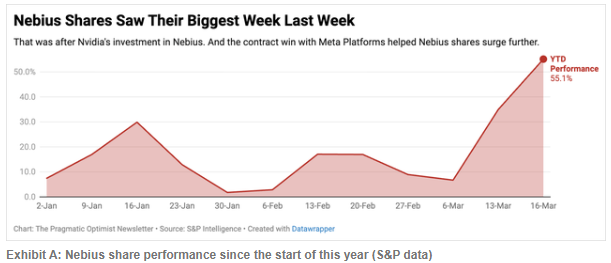
Core Insights - Nebius Group has secured a $2 billion investment from NVIDIA and a $27 billion GPU infrastructure order from Meta Platforms, significantly boosting market confidence [1][2] - The management of Nebius has demonstrated strong execution capabilities, meeting capacity commitments and setting realistic expectations for AI infrastructure growth [1][4] - Despite the recent bond issuance increasing risk, it is deemed necessary for Nebius to accelerate revenue growth to 250% by 2027, surpassing market expectations of 186% [1][4] Investment Logic - The recent week marked a significant performance for Nebius, with stock prices rising due to NVIDIA's $2 billion investment, indicating strong trust in Nebius and a diversification strategy in the cloud computing sector [2] - The $27 billion GPU infrastructure order from Meta Platforms reinforces Nebius's critical role in providing reliable GPU infrastructure to major cloud service providers [2][5] Revenue Growth Potential - Nebius's revenue growth potential is considered extremely strong, with projections indicating a significant increase in future revenues [4] - The recent contracts with Microsoft and Meta are expected to contribute approximately $3.5 billion in annual recurring revenue (ARR), with the Meta order potentially leading to a revenue increase of 3.5 to 3.6 times by 2027 [7][8] Valuation Insights - Currently, Nebius's stock is valued at approximately 10 times its projected revenue for 2026, which is near the lower end of its historical trading range, suggesting substantial upside potential [9] - Analysts predict that the valuation should reach at least 15 times projected revenue, indicating over 47% upside from current levels [10] Management and Execution - The management team of Nebius is characterized as pragmatic and reliable, focusing on achievable commitments and maintaining realistic expectations for future capacity [8][12] - The recent investment from NVIDIA is expected to provide critical support for Nebius, enhancing its ability to secure financing without diluting shareholder value [11][12] Conclusion - Analyst Uttam remains highly optimistic about Nebius, particularly following the significant investment from NVIDIA and the $27 billion contract with Meta Platforms, highlighting that the current valuation of 10 times projected revenue is significantly undervalued [13]
午后,直线拉升!阿里突然宣布!港股,再传大消息!
券商中国· 2026-03-18 07:13
Core Viewpoint - Alibaba's stock surge positively impacted the Hang Seng Tech Index, with significant gains in related stocks due to rising AI demand and price adjustments in cloud services [1][2]. Group 1: Alibaba's Price Adjustments - Alibaba Cloud announced price increases for AI computing and storage products, with adjustments up to 34% due to surging global AI demand and rising supply chain costs [2]. - Specific products like the PingTouGe ZhenWu 810E computing cards saw price hikes between 5% and 34%, while the CPFS (Intelligent Computing Version) storage products increased by 30% [2]. Group 2: Market Reactions - Following the announcement, Alibaba's stock rose over 4%, and A-share computing concept stocks also experienced a nearly 4% increase [2]. - Major international banks have raised their growth rate expectations for Alibaba's cloud business for the fiscal year 2027 to 45%, up from a previous estimate of 40% [2]. Group 3: Geopolitical Context - Hong Kong's Chief Executive, John Lee, indicated that the ongoing conflict in the Middle East could bring both short-term challenges and long-term opportunities for Hong Kong as a financial hub [4]. - He emphasized Hong Kong's stability and safety as a financial center, which could attract continued capital inflow despite geopolitical tensions [5].

中东资金大规模返港
投中网· 2026-03-18 07:11
Core Viewpoint - The article discusses the significant inflow of Middle Eastern capital into the Hong Kong stock market, indicating a shift in global capital dynamics and a potential long-term value reassessment of Hong Kong stocks [7][10][61]. Market Performance - On March 16, the Hong Kong stock market showed a strong performance, with the Hang Seng Index rising by 1.45% and the Hang Seng Tech Index increasing by 2.69%. Growth sectors such as semiconductors, energy storage, automotive, and pharmaceuticals saw notable gains [5][6]. Middle Eastern Capital Inflow - Reports indicate a more than 50% increase in inquiries from Middle Eastern clients regarding investments in Hong Kong, including stocks, bonds, and family office setups [8][34]. - Some Middle Eastern families that previously moved their assets to Singapore or Dubai are now considering reallocating a portion back to Hong Kong [9][34]. Reasons for Capital Return - The return of Middle Eastern capital to Hong Kong is attributed to the region's stability and the need for both risk aversion and asset appreciation amid rising geopolitical tensions in the Middle East [12][27]. - Hong Kong's legal framework, financial infrastructure, and its status as a safe haven for capital are highlighted as key factors attracting this influx [27][29]. Investment Preferences - Middle Eastern funds are focusing on three main areas: leading tech companies in the Hang Seng Index, high-dividend blue-chip stocks, and RMB-denominated bonds [58]. - The Hang Seng Tech Index is particularly appealing due to its alignment with AI and new economic growth, with top stocks expected to see significant profit growth [30][59]. Valuation and Market Dynamics - The current price-to-earnings (PE) ratio of the Hang Seng Tech Index is approximately 21 times, which is 13% below historical averages, while the underlying companies are projected to see a 15% increase in net profits by 2025 [33][56]. - The article notes a significant shift in capital flows, with net inflows from Southbound funds exceeding 180 billion HKD in 2026, indicating strong demand for Hong Kong stocks [50][51]. Long-term Outlook - The influx of Middle Eastern capital is seen as a long-term trend rather than a short-term speculative move, suggesting that the Hong Kong market is entering a phase of value reassessment [54][56]. - The article emphasizes that understanding the direction of capital flows can enhance investment success rates, particularly in the context of the ongoing global capital reallocation [66].