
房地产服务

Search documents
美股前瞻02.12:超预期非农打压降息预期,AI恐慌蔓延至房地产服务
East Money Securities· 2026-02-12 13:11
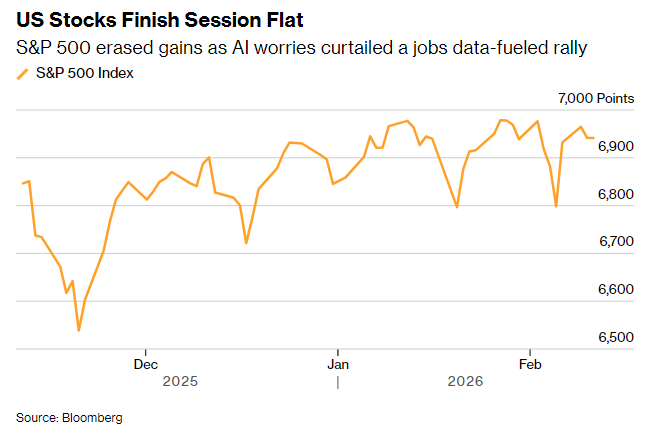
Market Overview - The U.S. non-farm payroll data for January showed an addition of 130,000 jobs, significantly exceeding the market expectation of 65,000, with the unemployment rate unexpectedly dropping to 4.3% [1] - The strong job growth, particularly in healthcare, has dampened market expectations for an early interest rate cut by the Federal Reserve, pushing the anticipated timing for the first rate cut of the year to July [1] - Following the data release, major indices experienced volatility, with the Nasdaq down 0.16% and the S&P 500 closing nearly flat [1] Economic Trends - The January employment rebound is viewed as a response to the previous year's significant slowdown in job growth, with the total employment growth for the previous year revised down from 584,000 to 181,000 [4] - The current strong data may not indicate a stable long-term trend, as concerns about the labor market's rapid weakening persist [4] - The probability of the Federal Reserve maintaining rates in March has risen to over 94%, indicating a shift in market sentiment regarding interest rate cuts [4] Sector Analysis - The technology sector, particularly AI-related stocks, is facing significant selling pressure, with concerns about "AI disruption" spreading from software to real estate and financial services [4] - Despite the overall market weakness, sectors such as energy, materials, and consumer staples have shown relative strength, indicating a rotation of funds from high-valuation growth stocks to value and hard asset stocks [4] - Micron's stock surged by 10% due to expectations of increased capacity for HBM4, highlighting a renewed focus on the certainty of AI hardware investments [4]

华尔街新交易逻辑:先卖了再说!
Xin Lang Cai Jing· 2026-02-12 08:42
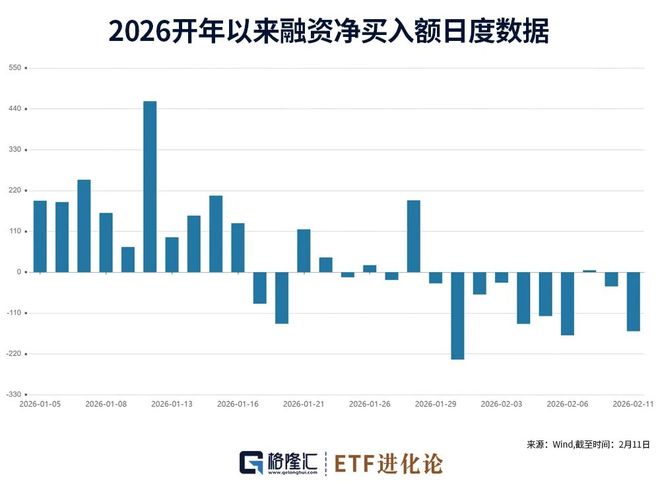
Group 1 - The core trading logic on Wall Street has shifted from identifying AI winners to indiscriminately selling potential AI losers, driven by fears of traditional business models being disrupted by AI advancements [1][2][3] - The recent sell-off has affected various sectors, including SaaS software, insurance brokerage, wealth management, and real estate services, with notable declines such as a 14% drop for JLL and a 12% drop for CBRE, marking their largest single-day declines since the pandemic [1][2] - Gabelli Funds' manager John Belton highlighted that any company with potential disruption risk is facing indiscriminate selling [3] Group 2 - In the A-share market, leveraged funds have begun to reduce their positions after a period of aggressive buying, with net selling occurring on 9 out of the last 10 trading days, totaling 974 billion yuan in sales [3][10] - Major companies experiencing net selling include Kweichow Moutai, Industrial Fulian, and Zhongji Xuchuang, with net selling amounts of -27.88 billion yuan, -23.49 billion yuan, and -23.27 billion yuan respectively [7][8] - Despite the reduction in positions in broad-based ETFs, there has been significant buying in specific ETFs such as Hai Futong Zhongzheng Short Bond ETF and E Fund Zhongzheng Overseas Internet ETF [10] Group 3 - The market is showing a strong interest in sectors related to economic recovery and domestic demand improvement, with significant inflows into the chemical sector and other related industries [17][18] - The recent price increases across various sectors, including upstream resources and consumer goods, indicate a potential inflationary trend, with PPI data showing a month-on-month increase of 0.4% and a narrowing year-on-year decline to -1.4% [21][22] - The upcoming Spring Festival is expected to boost consumer spending, with major companies launching significant promotional campaigns and government initiatives to stimulate the economy [26][27]

非农新增创逾一年新高难救市!AI恐慌交易主导美股,标普500错失历史新高
Zhi Tong Cai Jing· 2026-02-12 01:32
Group 1 - The U.S. stock market experienced a decline despite strong employment data, as concerns over the impact of artificial intelligence (AI) on various industries suppressed the rebound [1] - The S&P 500 index slightly fell, while the Nasdaq 100 index rose by 0.3%, indicating mixed performance in the tech sector [1] - A measure of the "seven giants" in the U.S. stock market dropped by 0.6%, and an ETF tracking software stocks plummeted by 2.6%, reflecting ongoing pressure on software stocks due to AI concerns [1][2] Group 2 - The real estate services sector also faced declines, with companies like CBRE falling by 12%, as the market assessed their vulnerability to AI technology [1] - The sector has been identified as part of the "AI panic trading" phenomenon, with investors selling off stocks in software, private credit, wealth management, and insurance brokerage [2] - Growth and momentum stocks are under significant pressure due to market expectations that interest rates will remain high for an extended period [5] Group 3 - The employment report showed a significant increase of 130,000 non-farm jobs, the largest gain in over a year, with the unemployment rate unexpectedly dropping to 4.3% [6] - Following the employment report, traders anticipated that the first interest rate cut of the year could occur in July, shifting from previous expectations of June [6] - Analysts suggest that the current U.S. market presents a complex scenario, with rising economic growth expectations juxtaposed against visible financial pressures on households [6]
非农新增创逾一年新高难救市!AI恐慌交易主导美股 标普500错失历史新高
Zhi Tong Cai Jing· 2026-02-12 00:43
Market Overview - The U.S. stock market retraced early gains and closed lower despite strong employment data, with concerns over AI's disruptive impact on multiple industries suppressing the rebound [1] - The S&P 500 index slightly declined, while the tech-heavy Nasdaq 100 index rose by 0.3%, reaching a peak increase of 1% during the session [1] - The Chicago Board Options Exchange Volatility Index (VIX) hovered around 18 [1] Employment Data Impact - The employment report showed an unexpected increase of 130,000 non-farm jobs in January, marking the largest gain in over a year, with the unemployment rate unexpectedly dropping to 4.3% [6] - Following the employment report, traders anticipated the first interest rate cut of the year to occur in July, shifting from previous expectations of June [6] - Analysts suggest that the Federal Reserve is likely to maintain current interest rates, despite pressures from the Trump administration for rate cuts [6] Sector Performance - The technology sector faced significant selling pressure, continuing a trend observed over the past few months, with international and value stocks leading the market [1] - An index tracking the "seven giants" of the U.S. stock market fell by 0.6%, and an ETF focused on software stocks dropped by 2.6% [1] - Real estate service stocks also declined, with CBRE Group falling by 12%, and both Jones Lang LaSalle and Cushman & Wakefield experiencing declines [1] AI Concerns - The software sector has been particularly affected by what analysts are calling "AI panic trading," leading to sell-offs in software, private credit, wealth management, and insurance brokerage stocks [2] - Investors are increasingly favoring companies whose business models are less likely to be disrupted by AI technology [1][2] Market Sentiment - The market is currently focused on the upcoming Consumer Price Index (CPI) report, with expectations that if the core CPI is close to or below forecasts, there is a 70% probability that the S&P 500 will rise [2] - Growth and momentum stocks are under the most pressure due to market expectations that interest rates will remain high for an extended period [5]
“AI输家交易”蔓延 !美国房地产服务类股票集体大跌!创疫情以来最大单日跌幅!
美股IPO· 2026-02-11 23:46
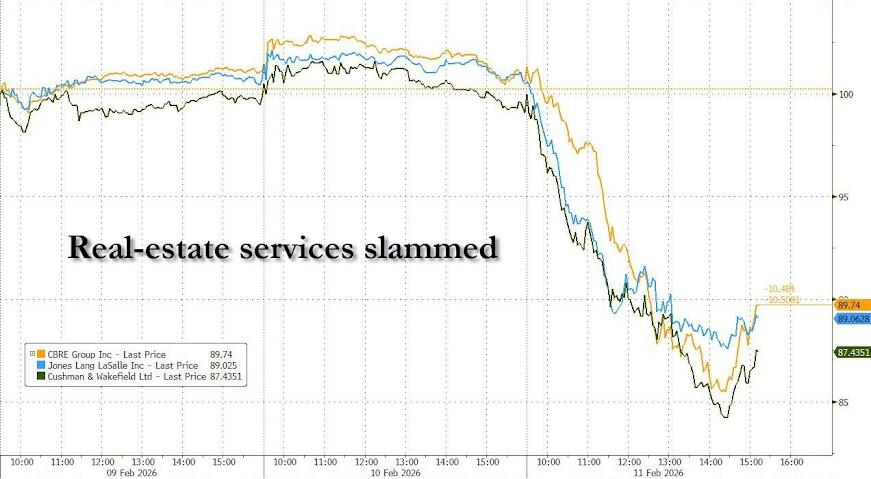
Group 1 - The core viewpoint of the article highlights the impact of AI-induced panic selling in the real estate services sector, with significant stock declines observed in companies like CBRE, Jones Lang LaSalle, and Cushman & Wakefield, which dropped 12% and 14% respectively, marking their largest declines since the pandemic began [1][3][4] - The article discusses the broader context of AI technology's rapid penetration across various industries, leading to fears that high-fee, labor-intensive business models in real estate may be vulnerable to disruption [3][4] - Analysts from Keefe, Bruyette & Woods and Jefferies express that the current sell-off may be an exaggerated emotional response, suggesting that the actual threat from AI to the real estate sector is limited in the short term due to the companies' established market positions and relationships [5][3] Group 2 - The article notes that the commercial real estate sector is already struggling to recover from the pandemic's impact on office demand and rising interest rates, which have hindered transaction volumes [4] - It mentions that companies like CBRE and Jones Lang LaSalle have been diversifying their business models into property management, asset valuation, and cross-industry investment sales to mitigate cyclical risks associated with traditional brokerage services [4][3] - The recent downturn in real estate stocks is characterized as part of a broader trend of "AI panic trading," which has also affected software companies, private credit firms, wealth management companies, and insurance brokers [4][1]




“下一个AI受害者”出现了,房地产服务股遭抛售,创疫情以来最大单日跌幅
Hua Er Jie Jian Wen· 2026-02-11 23:06
Core Viewpoint - The stock prices of real estate service companies have significantly declined as investors reassess the vulnerability of these firms to artificial intelligence applications and tools [1][3]. Group 1: Market Reaction - On Wednesday, CBRE Group and Jones Lang LaSalle saw their stock prices plummet by 12%, while Cushman & Wakefield dropped by 14%, marking the largest single-day declines since the market sell-off in 2020 [1]. - Analysts from Keefe, Bruyette & Woods noted that investors are withdrawing from high-fee, labor-intensive business models perceived as susceptible to AI-driven disruption [3]. - Barclays analyst Brendan Lynch described the stock price drop as "excessive," attributing part of the selling pressure to concerns over AI's potential disruption to the job market and commercial real estate demand [5]. Group 2: Industry Impact - The commercial real estate sector is facing additional challenges, having struggled to recover since the pandemic, with changes in office demand and high interest rates severely limiting transaction volumes [4]. - Despite the AI boom providing growth opportunities in certain segments, such as data centers and high-end office leasing, investors are weighing whether advancements in AI will ultimately pressure some business operations through automation and streamlined processes [4]. - CBRE and Jones Lang LaSalle have been attempting to mitigate the impact of market downturns by expanding their services into property management, valuation, and investment sales across various sectors, including hotels, warehousing, apartments, and life sciences laboratories [4]. Group 3: Long-term Perspectives - Analysts believe that the immediate concerns regarding AI's threat to leasing and capital markets are limited, as CBRE and its peers benefit from significant scale advantages, including data and industry relationships [6]. - While there is a consensus that the market's fears regarding immediate AI risks may be overstated, there remains a cautious outlook on the long-term implications of AI [6].
贝壳2026年初动态:平台规则调整、财报预期及股份回购
Jing Ji Guan Cha Wang· 2026-02-11 22:41
以上内容基于公开资料整理,不构成投资建议。 业绩经营情况 机构分析显示,贝壳2025年第四季度财报预计近期发布。美银证券等机构预测,受高基数影响,季度收 入可能同比下降,但通过成本优化和新业务改善,盈利有望复苏。 资金动向 贝壳自2022年启动的回购计划已扩大至50亿美元,截至2025年三季度末累计回购约23亿美元。2026年1 月披露显示,公司仍在进行股份购回并拟注销,彰显现金流实力。 经济观察网 贝壳在2026年初有多项动态值得关注,包括平台规则调整、2025年第四季度财报预期以及 股份回购计划的持续执行。 近期事件 贝壳计划于2026年3月1日起实施人才流转规则调整,取消经纪人在品牌、地域等方面的流动限制,以提 升平台灵活性。 ...
“AI输家交易”蔓延 美国房地产服务类股票集体大跌
Xin Lang Cai Jing· 2026-02-11 22:33
Group 1 - The core point of the article highlights a significant drop in U.S. real estate service stocks due to concerns over the impact of AI technology on high-labor and high-fee business models, with CBRE and JLL both falling over 12% and Cushman & Wakefield nearly 14% [1] - The decline is seen as part of a broader "AI panic trading," affecting various sectors including software and private equity, with real estate services being the latest to experience rapid capital withdrawal [2][3] - Analysts suggest that the current sell-off may be an exaggerated emotional response, as the direct threat of AI to real estate leasing and capital markets remains limited, with firms like CBRE maintaining significant advantages in data scale and industry relationships [3] Group 2 - The commercial real estate sector is struggling to recover from the pandemic's impact on office demand and rising interest rates, which have severely affected transaction volumes [2] - In response to industry challenges, companies like CBRE and JLL have diversified their business models into property management, asset valuation, and cross-industry investment sales to mitigate cyclical risks associated with traditional brokerage [2] - Some analysts argue that the market's reaction to AI-related risks is overblown, especially given the absence of significant new negative information on the day of the stock declines [2]
美股房地产服务公司大跌
Xin Lang Cai Jing· 2026-02-11 21:00
美股房地产服务公司周三纷纷大跌,投资者正在评估此类公司在面对最新一批人工智能应用和工具时的 脆弱性。CBRE Group一度暴跌15%,Jones LangLa Salle下跌13%,Cushman跌幅达15%。 来源:滚动播报 ...
Zillow Group(Z) - 2025 Q4 - Earnings Call Transcript
2026-02-10 23:02
Financial Data and Key Metrics Changes - In Q4 2025, total revenue increased by 18% year-over-year, reaching $654 million, near the top end of the outlook range [24][35] - Full-year 2025 total revenue grew by 16%, consistent with the mid-teens growth outlook [30] - EBITDA for Q4 was $149 million, with a margin of 23%, up 260 basis points year-over-year [24][30] - The company reported $23 million of GAAP net income for the full year, achieving full-year profitability [10][24] Business Line Data and Key Metrics Changes - For Sale revenue grew by 11% year-over-year in Q4 to $475 million, with residential revenue up 8% and mortgages revenue up 39% [10][25] - Rentals revenue in Q4 was $168 million, up 45% year-over-year, driven by a 63% increase in multifamily revenue [10][27] - For Sale revenue for the full year reached $1.9 billion, up 9% from 2024 [10][11] Market Data and Key Metrics Changes - Zillow Rentals had an average of 2.5 million monthly active rental listings in Q4, with a market share increase to 63% from 54% in 2024 [19][20] - The company attracted 31 million average monthly unique visitors in Q4, reinforcing its position as the preferred platform for renters [20] Company Strategy and Development Direction - Zillow is focused on integrating and digitizing the real estate transaction process, enhancing customer experiences and improving productivity for real estate professionals [6][11] - The company aims to achieve a $1 billion incremental revenue target in For Sale, supported by continuous improvements in customer experiences and growth in Enhanced Markets [12][21] - Zillow Pro, a new offering for agents, is expected to enhance lead conversion and agent adoption of CRM tools [16][67] Management's Comments on Operating Environment and Future Outlook - Management expressed confidence in the company's strategy and does not expect legal challenges to materially impact financial positions or long-term strategies [22][62] - The company anticipates continued growth across its business, with mid-teens revenue growth expected for 2026 and approximately 30% growth in rentals [35][37] - Management highlighted improvements in housing affordability as a positive indicator for future market recovery [38] Other Important Information - The company repurchased $670 million of shares throughout 2025, returning a total of $1.1 billion to shareholders [33][34] - Legal expenses were noted as a factor impacting EBITDA margins, with expectations of elevated legal costs in 2026 [36][70] Q&A Session Summary Question: Can you elaborate on rental trends and opportunities? - Management indicated that the growth in rentals is driven by a unique strategy focused on organizing various types of supply, leading to increased audience engagement and revenue growth [45][46] Question: How do you view the impact of recent industry consolidation? - Management does not expect any significant risk or impact from industry consolidation, as the majority of sellers and agents prefer broad exposure for listings [52][53] Question: Will legal challenges affect Zillow's business strategy? - Management confirmed that no meaningful changes to the business strategy are expected due to legal challenges, maintaining confidence in their approach [62][63] Question: What is the status of Zillow Pro and its impact on lead conversion? - Zillow Pro is currently in beta testing, with plans for nationwide expansion in the second half of the year, expected to enhance agent efficiency and conversion rates [66][67]
