
工业

Search documents
中证沪港深科技龙头指数上涨0.04%,前十大权重包含药明康德等
Jin Rong Jie· 2025-05-19 12:03
Core Viewpoint - The China Securities Index of Hong Kong and Shenzhen Technology Leaders (SHS Technology Leaders) shows mixed performance in the A-share market, with a slight increase of 0.04% on the latest trading day, reflecting a 6.87% increase over the past month and a 9.58% increase year-to-date [1][2]. Group 1: Index Performance - The SHS Technology Leaders Index closed at 2185.36 points with a trading volume of 76.457 billion yuan [1]. - Over the last three months, the index has decreased by 6.49% [1]. - The index was established on November 14, 2014, with a base point of 1000.0 [1]. Group 2: Index Composition - The index comprises 50 large-cap technology companies with significant market share and R&D investment [1]. - The top ten holdings in the index include Alibaba-W (12.91%), Tencent Holdings (11.03%), Xiaomi Group-W (10.43%), Meituan-W (6.96%), and SMIC (3.48%) [1]. - The market distribution of the index holdings shows that the Hong Kong Stock Exchange accounts for 54.65%, Shenzhen Stock Exchange for 29.20%, and Shanghai Stock Exchange for 16.15% [1]. Group 3: Sector Allocation - The sector allocation of the index includes Information Technology (45.15%), Consumer Discretionary (19.87%), Healthcare (17.49%), Communication Services (12.98%), and Industrials (4.51%) [2]. - The index samples are adjusted biannually, with adjustments occurring on the next trading day after the second Friday of June and December [2]. - Public funds tracking the SHS Technology Leaders include various funds from Penghua, GF, and Huatai-PineBridge [2].



世界铂金投资协会:铂金市场短缺加剧 2025年缺口预期扩大至30吨
智通财经网· 2025-05-19 06:17
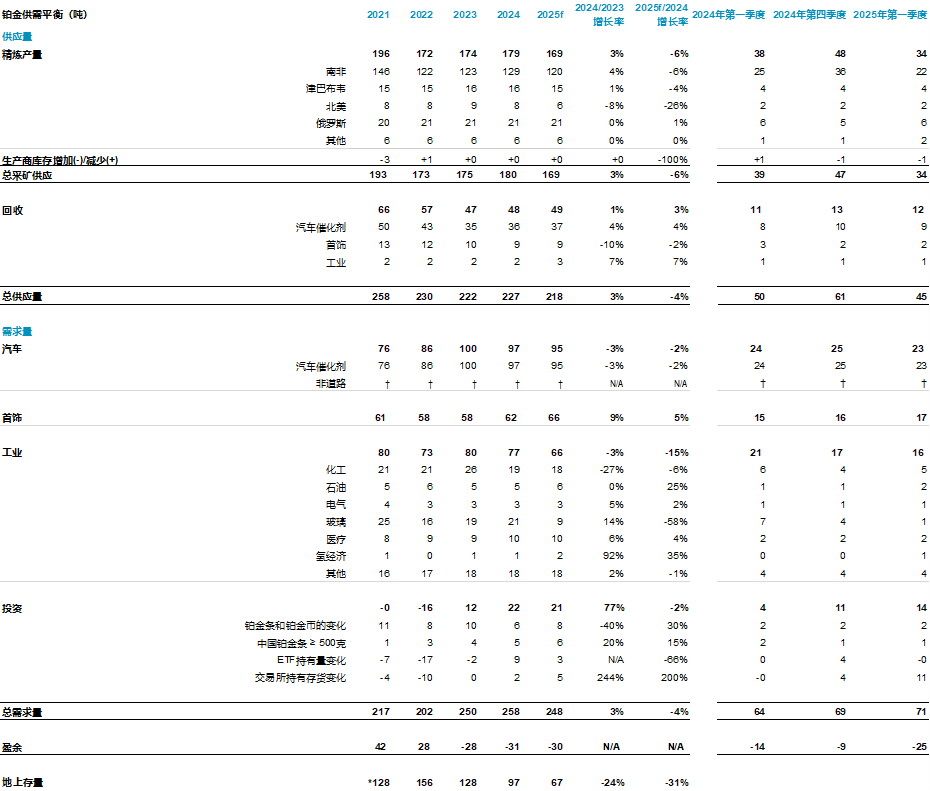
Core Insights - The World Platinum Investment Council forecasts a 4% year-on-year decline in total platinum supply for 2025, reaching 218 tons, marking the lowest level in five years. This supply contraction remains a core trend [1] - Total demand for platinum is expected to decrease by 4% to 248 tons in 2025, despite a 10% year-on-year increase in global platinum demand in Q1 2025, primarily driven by strong investment demand [1][6] - A projected shortfall of 30 tons in 2025 indicates a third consecutive year of supply deficit [1] Supply Dynamics - Platinum mine supply is anticipated to drop significantly, with Q1 2025 showing a 13% year-on-year decline to 34 tons, the lowest quarterly output since Q2 2020. South Africa's production was notably affected by heavy rainfall [2] - The total platinum supply for Q1 2025 is expected to decrease by 10% to 45 tons, with a full-year forecast of 169 tons (-6%) for mine supply, which is 22 tons (11%) lower than the pre-pandemic five-year average [2] - Global recycling supply is projected to increase slightly by 3% to 49 tons in 2025, mainly due to improved supply from used automotive catalysts [2] Demand Trends - Platinum jewelry demand is recovering, with a projected 5% increase in 2025, reaching 66 tons, driven by price advantages over gold. Notably, demand in China is expected to surge by 15% to 15 tons [4] - Despite uncertainties in the market, automotive demand for platinum is expected to remain resilient, with a slight decline of 2% to 95 tons in 2025, which is still 11% above the five-year average [5] - Investment demand for platinum is showing strong performance, with Q1 2025 demand rising by 28% to 14 tons, largely due to increased inflows into the U.S. market [6] Industrial Demand - Industrial platinum demand is projected to decline by 15% to 66 tons in 2025, primarily due to a significant drop in the glass sector, which is expected to see a 58% reduction in demand [7] - While some sectors like hydrogen and oil are experiencing growth, the overall industrial demand is being negatively impacted by cyclical slowdowns in specific industries [7] Market Commentary - The CEO of the World Platinum Investment Council, Trevor Raymond, noted that the platinum market is facing structural shortages despite geopolitical uncertainties. The diverse demand for platinum provides significant market resilience [8] - Concerns about the strategic importance of platinum for the U.S. automotive industry may prevent the imposition of new tariffs, although over 9 tons of surplus platinum remains in certified warehouses, indicating ongoing market apprehensions [8]

深圳11区经济一季报:多区工业保持两位数增长,“尖子生”名次不变
news flash· 2025-05-19 04:57
2025年一季度,深圳地区生产总值8950.49亿元,同比增长5.2%;其中,第二产业增加值2951.44亿元, 同比增长3.7%。综观深圳各区,各区基本保持第二产业正增长,共有五区二产增速跑赢深圳全市平均 水平(3.7%),分别是宝安区、光明区、坪山区、大鹏新区、深汕特别合作区。 ...
陕西发布节水倡议书
Shan Xi Ri Bao· 2025-05-18 22:48
Core Viewpoint - The water scarcity in Shaanxi province is a significant constraint on its economic and social development, prompting a call for enhanced water conservation efforts across various sectors [1][2]. Group 1: Agricultural Water Conservation - Agriculture accounts for approximately half of the total water usage in Shaanxi, necessitating a focus on reducing high water-consuming crop cultivation and promoting drought-resistant varieties [1]. - The implementation of water-saving irrigation techniques such as spray irrigation, drip irrigation, and micro-irrigation is essential, especially during critical periods for summer and autumn grain production [1]. Group 2: Industrial Water Conservation - Industries in water-scarce regions are urged to phase out high water-consuming outdated capacities and adhere to strict water resource assessment protocols for new projects [1]. - Industrial enterprises should enhance water-saving technology upgrades and promote practices like condensate water recovery and water recycling to improve water reuse rates [1]. Group 3: Urban Water Conservation - Municipal departments are encouraged to expand the use of recycled water in areas such as landscaping and road cleaning, while households should adopt habits of reusing water [2]. - Government and enterprises are called to lead by example in water-saving initiatives, fostering a culture of conservation among citizens [2]. Group 4: Community Engagement and Education - The initiative emphasizes the role of youth in advocating for water-saving principles and practices, promoting awareness and participation in conservation efforts [2]. - Local governments are tasked with integrating water conservation into performance assessments and developing comprehensive water-saving plans [2].
多轮驱动交出“开门红”答卷
Sou Hu Cai Jing· 2025-05-18 04:00
那么,西藏固定资产投资是如何在高基数的基础上保持持续增长的?其背后的"密钥"又有哪些? 自治区发展改革委相关负责人表示,固定资产投资的增长与国家对西藏的重大战略定位、决策部署,以 及全区上下一心落实重大项目建设密不可分。全区牢固树立"抓项目就是抓发展、抓发展必须抓项目"的 理念,印发了《2025年全区重点建设项目计划》和一季度攻坚行动方案,每月进行分析调度,持续在项 目储备、抓前期、抓进度上下功夫,努力形成更多的实物工作量。 主要经济指标增速位居全国前列,八项经济指标增速位居全国第一。全区经济发展态势持续向好,这些 成绩的取得实属不易。 纵观"首季报",2025年一季度西藏经济在全国舞台上表现亮眼,实现"开门红": 地区生产总值同比增长7.9%,超出全国平均水平2.5个百分点;规模以上工业增加值增速较全国平均水 平高出11.4个百分点;固定资产投资增速更是较全国平均水平高出23.5个百分点。 这份优异答卷的背后,是我区坚持稳中求进工作总基调,完整准确全面贯彻新发展理念,全区上下"拼 经济、抓发展"的不懈努力。 固投牵引,筑牢发展根基 西藏的发展离不开国家的大力支持。 2024年,西藏全社会固定资产投资增长19 ...
医疗业ETF收涨2%,和生物科技ETF领跑美股行业ETF
news flash· 2025-05-16 20:31
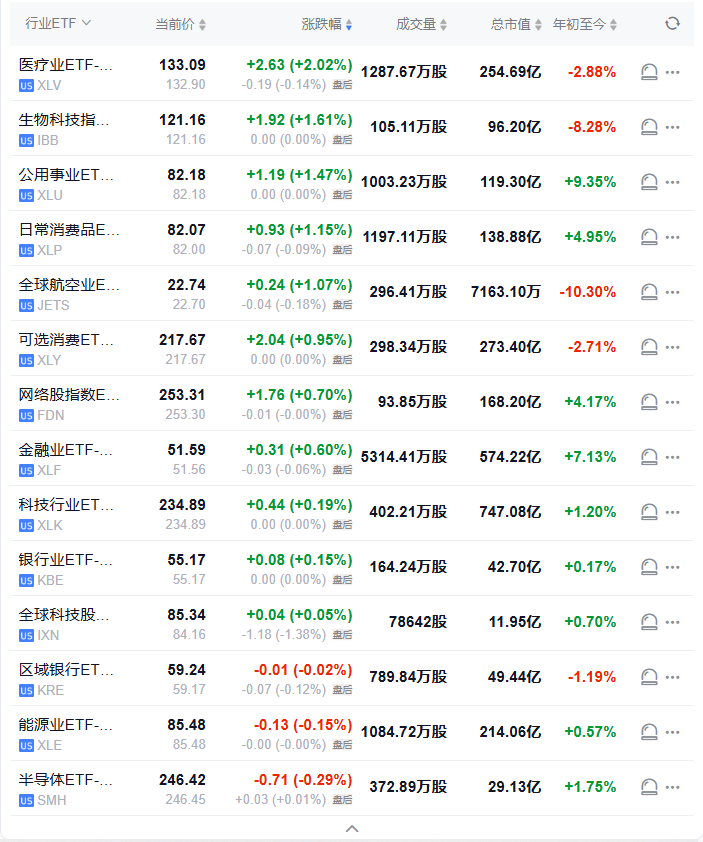
Group 1: Industry Performance - The healthcare ETF rose by 2.02%, while the biotechnology index ETF increased by 1.61% [1][3] - The global airline industry ETF saw a gain of 1.07%, and the consumer discretionary ETF rose by 0.95% [1][3] - The technology sector ETF and banking sector ETF had minimal increases, with gains of up to 0.19% [1][3] Group 2: ETF Specifics - The healthcare ETF closed at $133.09, with a change of +2.63 (+2.02%) and a total market value of $254.69 billion, down 2.88% year-to-date [3] - The biotechnology index ETF closed at $121.16, with a change of +1.92 (+1.61%) and a total market value of $96.20 billion, down 8.28% year-to-date [3] - The global airline ETF closed at $22.74, with a change of +0.24 (+1.07%) and a total market value of $716.31 million, down 10.30% year-to-date [3] Group 3: Sector Trends - The energy sector ETF decreased by 0.15%, while the semiconductor ETF fell by 0.29% [2][3] - The utilities sector ETF increased by 1.47%, closing at $82.18, with a total market value of $119.30 billion, up 9.35% year-to-date [3] - The consumer staples ETF rose by 1.15%, closing at $82.07, with a total market value of $138.88 billion, up 4.95% year-to-date [3]
David Tepper一季度:增持Uber、Meta,清仓AMD,减持阿里、微软
Hua Er Jie Jian Wen· 2025-05-16 01:15
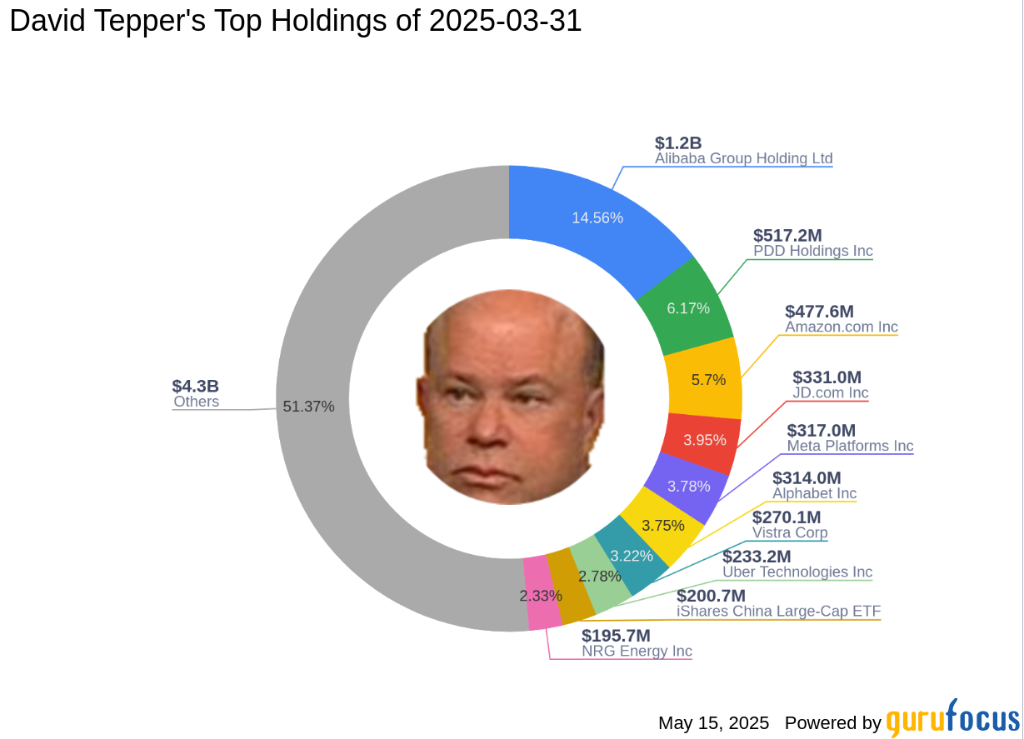
Group 1 - Hedge fund manager David Tepper has reduced his stake in Alibaba but still maintains significant exposure to Chinese tech stocks, with three out of his top five holdings being Chinese companies [1][2] - As of Q1 2025, Tepper's portfolio consists of 38 stocks, with Alibaba being the largest holding at 14.56%, followed by Pinduoduo at 6.17%, Amazon at 5.7%, JD.com at 3.95%, and Meta Platforms at 3.78% [2] Group 2 - Tepper has made notable reductions in his portfolio, including a decrease of 2.61 million shares in Alibaba, resulting in a 22.06% reduction and a portfolio impact of -3.43%. He also reduced his Microsoft holdings by 460,000 shares, leading to a 47.42% decrease and a portfolio impact of -3% [7] - The fund increased its positions in eight stocks, most significantly in Uber, acquiring an additional 1.7 million shares, which raised the total to 3.2 million shares, a 113.33% increase with a portfolio impact of 1.48% and a total value of $233 million [9] - Additionally, Tepper increased his Meta holdings by 60,000 shares to 550,000 shares, a 12.24% increase with a total value of $317 million [10] Group 3 - Tepper completely exited six stocks in Q1 2025, notably selling all 1.2 million shares of AMD, which had a portfolio impact of -2.24%, and also cleared out 350,000 shares of FedEx, impacting the portfolio by -1.52% [11] - The fund initiated positions in four new stocks, with Deutsche Bank being the most significant, acquiring 3.75 million shares, representing 1.07% of the portfolio with a total value of $89.36 million [12] - Other new positions include L3Harris Technologies with 300,000 shares (0.75% of the portfolio, valued at $62.79 million) and Broadcom with 130,000 shares (0.26% of the portfolio, valued at $21.77 million) [12]

实数融合助力制造业提质增效
Jing Ji Ri Bao· 2025-05-15 22:11
Core Insights - The integration of the real economy and digital economy is crucial for seizing opportunities from the new technological revolution and industrial transformation, fostering new productive forces, and building a modern industrial system [1][4] - The "real-number integration development index" in China has increased approximately threefold from 2012 to 2024, with an average annual growth rate of 12% [1] - The industrial sector is identified as the main battlefield for real-number integration, with data elements penetrating all aspects of the industrial field [1][2] Industry Developments - Real-number integration is driving a shift from isolated breakthroughs to systemic changes in innovation, particularly in pharmaceuticals and materials, with AI technology significantly reducing R&D cycles [1][2] - Manufacturing is leveraging real-number integration to create agile supply chain networks, enhancing management efficiency through digital technologies and machine learning [2] - The industrial internet is playing a key role in enabling digital transformation, with the core industry scale expected to exceed 1.5 trillion yuan in 2024, contributing nearly 3.5 trillion yuan to economic growth [3] Policy and Strategic Recommendations - The Ministry of Industry and Information Technology (MIIT) aims to accelerate the deep integration of industrial internet and artificial intelligence to support the digital transformation of industries [3] - Recommendations include enhancing digital infrastructure, promoting the digital transformation of manufacturing, and creating a favorable environment for real-number integration development [4]
出台指导意见构建三级产业空间布局体系 广州首次划设“工业集聚区”
Nan Fang Ri Bao Wang Luo Ban· 2025-05-15 07:41
近日,广州市规划和自然资源局出台《加强规划资源要素保障支撑广州"制造业立市"的指导意见》(下 称《指导意见》),重点在强化规划引领、加强规划支撑、支持多元供地、优化筹建服务四个方面,提 出系列针对性和前瞻性举措。 广州将构建"工业集聚区—工业产业区块—工业用地"的三级产业空间布局体系,全方位保障企业所需的 产业空间。 根据《指导意见》,广州将首次划设"工业集聚区",前瞻谋划18个"科创集聚区"。其中,每个集聚区聚 焦3—5个主导产业,全面覆盖15个战略性产业集群和6个未来产业,促进产业差异化布局和集群化发 展。 提升工业产业区块"纯度" 《指导意见》系统构建广州"工业集聚区—工业产业区块—工业用地"的三级产业空间布局体系,同时明 确用地指标、新增工业用地、新建重大产业项目等优先在集聚区和产业区块投放布局,全方位保障企业 所需的产业空间。 工业集聚区方面,首次提出划设"工业集聚区",单个集聚区用地规模约15—20平方公里。《指导意见》 要求集聚区内工业产业区块的规模原则上不低于辖区工业产业区块总规模的70%,引导工业集中"优布 局"。对应"工业集聚区"聚实体,前瞻谋划18个自然环境品质、产业发展条件兼备的"科创 ...
筑产业之“巢”引企业之“凤”
Guang Zhou Ri Bao· 2025-05-14 19:15
Core Viewpoint - The Guangzhou Municipal Planning and Natural Resources Bureau has issued the "Guiding Opinions on Strengthening Planning Resource Element Guarantee to Support Guangzhou's Manufacturing City," focusing on enhancing the business environment for enterprises through precise resource planning and support [1] Group 1: Industrial Cluster Development - The "Guiding Opinions" establish a three-tier industrial spatial layout system: "Industrial Cluster - Industrial Block - Industrial Land," emphasizing the need for increased quantity and quality of industrial land [2] - The introduction of "Industrial Clusters" with a land area of approximately 15-20 square kilometers aims to lead industrial land spatial aggregation and industry clustering [2][7] - Each cluster will focus on 3-5 leading industries and develop key industry layout plans to promote collaborative industrial development [2][9] Group 2: Industrial Land Management - The guiding principles for industrial land include protecting industrial land like arable land, ensuring that the total area only increases, and implementing measures to revitalize underutilized industrial land [3] - An annual supply of over 7 square kilometers of new industrial land is proposed, with a target to revitalize over 30 square kilometers of low-efficiency industrial land by 2035 [3] Group 3: Land Use Flexibility - The government will allow for an increase in the floor area ratio of industrial land to between 2.0 and 4.0, facilitating direct expansion for enterprises [4] - A "menu-style" approach to land acquisition will be introduced, allowing enterprises to choose from various options such as 50-year leases or long-term rentals based on their specific needs [5][10] Group 4: Cost Reduction Measures - The guiding opinions propose that the cost of acquiring industrial land can be calculated based on the average cost of land in the park or area, aiming to lower land prices for enterprises [6] - Support for phased payment of land transfer fees and the use of bank guarantees instead of bidding deposits is also included to alleviate financial pressure on enterprises [6] Group 5: Mixed-Use Development - The guidelines encourage the development of "Industrial Complexes" that integrate industrial, commercial, research, and office functions, with industrial use accounting for at least 50% of the complex [11]