航空航天

Search documents
工信部部署2026年工作:深入整治“内卷式”竞争 培育壮大新兴产业
Xin Lang Cai Jing· 2025-12-28 12:13
Core Insights - The national industrial and information technology work conference held on December 25-26 outlined key tasks for the "15th Five-Year Plan" period, emphasizing growth stabilization, innovation enhancement, integration promotion, governance optimization, and risk prevention [1] Group 1: Key Focus Areas for 2026 - The conference identified ten key areas for 2026, including consolidating the positive trend of the industrial economy, enhancing the resilience and security of industrial chains, and accelerating technological innovation capabilities [1] - The meeting emphasized the need to optimize traditional industries through standard leadership, equipment upgrades, process improvements, and management innovation [1] Group 2: Emerging and Future Industries - The Ministry of Industry and Information Technology (MIIT) aims to develop emerging pillar industries such as integrated circuits, new displays, new materials, aerospace, low-altitude economy, and biomedicine, while supporting AI advancements and satellite IoT commercial trials [2] - The MIIT plans to establish national emerging industry development demonstration bases and innovative industrial clusters, focusing on innovation tasks in future industry segments [2] Group 3: Industry Performance and Projections - Data from the conference indicated that from January to November 2025, the value added of high-tech manufacturing and equipment manufacturing industries grew by 9.2% and 9.3% year-on-year, respectively, with the core AI industry exceeding 1 trillion yuan and new energy vehicle exports surpassing 2 million units [2] - The MIIT projects that by 2025, the total telecommunications business volume and software business revenue will grow by approximately 9% and 12% year-on-year, respectively, with digital industry revenue also expected to increase by around 9% [2] Group 4: Governance and Competition - The 2025 Central Economic Work Conference highlighted the need to address "involution" competition, with the MIIT reporting steady progress in modernizing industry governance and implementing significant reform measures [3] - The MIIT aims to enhance the supply capacity of high-quality standard systems and promote coordinated policies between industry, finance, and taxation to foster industrial and financial cooperation [3]
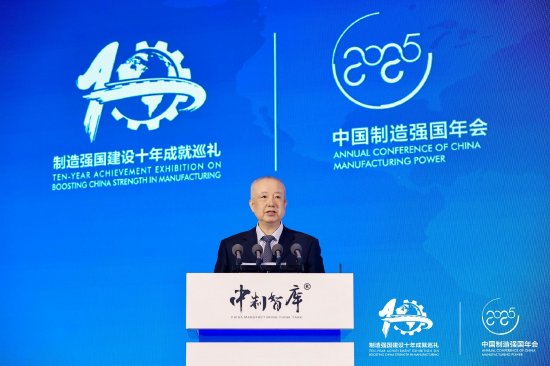
工信部原副部长刘利华:未来五年,推动制造业实现战略性跨越应聚焦四个方面
Xin Lang Cai Jing· 2025-12-28 02:39
Core Viewpoint - The 10th China Manufacturing Power Conference highlighted the significant achievements of China's manufacturing sector during the 14th Five-Year Plan, emphasizing the need for continued innovation and adaptation in a rapidly changing global environment [3][4][9]. Group 1: Achievements in Manufacturing - China's manufacturing value added has maintained a stable global share of around 30%, holding the top position for 15 consecutive years [3][8]. - Key industries such as new energy vehicles, information communication equipment, and advanced rail transit have reached world-leading status, while aerospace, automotive, steel, petrochemicals, and building materials have achieved advanced global levels [3][8]. - In the first 11 months of 2025, China's goods trade surplus exceeded $1.08 trillion, marking a historical high, with contributions shifting from labor-intensive sectors to technology-intensive sectors like electric vehicles and lithium batteries [3][8]. Group 2: Challenges and Strategic Focus - The international environment presents uncertainties, including major power competition and technological rivalry, which pose challenges to the manufacturing sector [4][9]. - The upcoming Five-Year Plan emphasizes the importance of building a modern industrial system, with manufacturing as a key focus, and aims to maintain a reasonable proportion of advanced manufacturing [4][9]. - Future strategies for manufacturing should focus on four areas: solidifying industrial foundations, accelerating technological self-reliance, nurturing new productive forces, and optimizing the development ecosystem [10][11].

一周26场会!商业航天赛道大火 相关公司被调研
Xin Lang Cai Jing· 2025-12-27 23:51
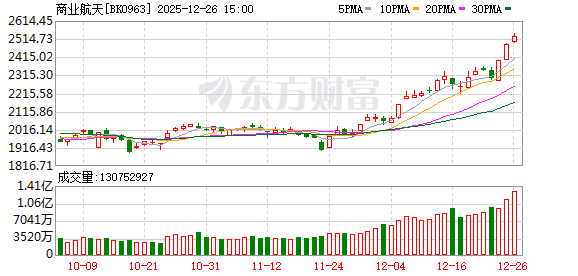
Core Insights - The commercial aerospace sector has gained significant attention in the capital markets and investment research circles, with a surge in related reports and conference calls in the past week [2][4] - Analysts from various sectors, including telecommunications, computer science, and mechanical engineering, are increasingly engaging in cross-disciplinary research on commercial aerospace, indicating a shift in focus from traditional defense and military analysis [4][5] - A total of 14 commercial aerospace-related companies have been investigated by institutions this month, with some companies receiving attention from over 50 institutions [7] Group 1: Research and Reports - There has been an explosion of deep-dive reports and conference calls focused on commercial aerospace, with 26 themed calls held in the past week, some attracting over 500 participants [5][4] - Notable reports include those from Zhongyou Securities and Guotai Junan, covering topics such as the evolution of space computing and investment perspectives in the new phase of commercial aerospace [4][5] - The research community is actively exploring the commercial aerospace supply chain, with multiple firms releasing series of reports on upcoming events and opportunities in the sector [5] Group 2: Institutional Interest - Institutions have shown heightened interest in commercial aerospace stocks, with companies like Guanglian Aviation and Chaojie Co. receiving significant attention from over 50 institutions [7][8] - Guanglian Aviation is collaborating with Wenchang International Aerospace City to integrate into the regional aerospace ecosystem, while Chaojie Co. focuses on manufacturing components for commercial rockets [7] - The data indicates that several companies have experienced substantial stock price increases, with Chaojie Co. rising by 106.39% in December [8] Group 3: Policy and Market Trends - The Shanghai Stock Exchange has introduced guidelines for commercial rocket companies to list on the Sci-Tech Innovation Board, facilitating market entry for these firms [9] - Analysts believe that the commercial aerospace industry is at a historic turning point, driven by national strategies and policies that position it as a new growth engine [10] - The focus is on two core areas: the commercial rocket supply chain and satellite manufacturing and application, which are expected to benefit from increased launch demand and technological advancements [10] Group 4: Future Outlook - The industry is anticipated to enter a rapid development phase as launch costs decrease, enabling commercial aerospace to transition from technology validation to market expansion [11] - Analysts are optimistic about the potential of space computing and the scalability of manufacturing, with significant infrastructure developments underway [11][10] - The investment focus is shifting towards space computing and reusable rockets, with low Earth orbit communication satellite chains emerging as a promising segment supported by fundamental logic and orders [11]
中国航发原董事长曹建国 被除名院士
Xin Lang Cai Jing· 2025-12-27 14:34
Core Viewpoint - The recent removal of Cao Jianguo from various prestigious positions, including the Chinese Academy of Engineering and the National Committee of the Chinese People's Political Consultative Conference, raises concerns about potential misconduct or violations of regulations within the aerospace industry [1][5]. Group 1: Background and Career - Cao Jianguo, born in August 1963, graduated from Beijing University of Aeronautics and Astronautics in 1985 and later obtained a master's degree in 1988 from the Third Research Institute of the Ministry of Aerospace [1][2]. - He has had a long career in the aerospace sector, starting as a member of the simulation testing group and progressively rising through the ranks to hold significant leadership positions [2][3]. - In 2016, he became the first chairman and party secretary of the China Aviation Engine Group, overseeing its establishment and operations until May 2025 [4]. Group 2: Achievements and Recognition - Throughout his career, Cao has received numerous accolades, including national and defense science and technology awards, and was recognized as a national model worker in 2005 [4][5]. - He was elected as a member of the Chinese Academy of Engineering in 2019 and served as a representative in the 20th National Congress of the Communist Party of China [5]. Group 3: Recent Developments - As of December 2023, Cao Jianguo's membership in the National Committee of the Chinese People's Political Consultative Conference was revoked, and he was removed from the Academy, indicating possible serious allegations against him [1][5]. - The specific reasons for these removals have not been officially disclosed, but they may relate to violations of party discipline or ethical standards [5].
第11000架,成功交付!
Ke Ji Ri Bao· 2025-12-27 13:15
Group 1 - The core point of the article is that the Aviation Industry Corporation of China announced the delivery of the 11,000th SR series aircraft by its subsidiary, Xi'an Aircraft Industrial Group [1] - The delivered aircraft is the new seventh generation plus (G7+) model of the SR series, which integrates the Safe Return emergency automatic landing system [2] - The Safe Return system allows anyone in the cabin, including passengers, to initiate an emergency landing by simply pressing a button, significantly enhancing flight safety [2]

工信部部署2026年重点工作,这些领域将迎利好
Xin Lang Cai Jing· 2025-12-27 12:40
Core Viewpoint - The national industrial and information technology conference emphasized the need to consolidate the positive momentum of the industrial economy as the primary task for 2026, focusing on ten key areas of work, including increasing the supply of green products, trendy products, and products for the elderly, while promoting the "Artificial Intelligence + Manufacturing" initiative [1][3][16]. Group 1: Industrial Economy - The conference highlighted the shift from "promoting stable growth" to "consolidating a positive momentum" in the industrial economy, indicating a focus on quality improvement rather than just stability [3][19]. - It was noted that the industrial economy has shown resilience and vitality, with expected growth rates of 9% for telecommunications business volume and 12% for software business revenue [3][19]. - The emphasis on "consolidation" suggests a long-term strategy to enhance quality and efficiency, moving away from temporary stimulus measures [20]. Group 2: Supply and Demand - The conference plans to increase the supply of green products, trendy products, and products for the elderly, responding to market demand trends [5][20]. - The focus on domestic demand as a priority reflects a policy shift towards building a strong domestic market [5][20]. Group 3: Traditional and Emerging Industries - The conference outlined plans to enhance traditional industries through "intelligent empowerment" and to develop emerging industries such as integrated circuits, new displays, new materials, aerospace, low-altitude economy, and biomedicine [6][9][24]. - The transition from "digital empowerment" to "intelligent empowerment" indicates a deeper integration of intelligent technologies to drive efficiency and innovation in traditional industries [22]. Group 4: Artificial Intelligence and Manufacturing - The "Artificial Intelligence +" initiative is a key focus, aiming to promote the digital transformation of manufacturing and cultivate key industry intelligent entities and original intelligent enterprises [21][24]. - The conference aims to support new-generation intelligent manufacturing systems and enhance the industrial internet platform ecosystem [21][24]. Group 5: Quality Enterprises and Innovation - The conference emphasized the cultivation of high-quality enterprises, including "little giant" enterprises and manufacturing champions, while addressing issues like overdue payments to businesses [28][29]. - It was reported that by 2025, over 60,000 technology and innovation-oriented SMEs and 50,400 high-tech enterprises are expected to be cultivated [28]. Group 6: Low-altitude Economy and Communication - The conference highlighted the importance of the low-altitude economy, with plans to establish frequency development guidelines to support its growth [29][15]. - The integration of 5G technology into various sectors is expected to enhance the service capabilities of the information and communication industry [28][29].

工信部部署2026年重点工作,这些领域将迎利好
21世纪经济报道· 2025-12-27 12:35
Core Viewpoint - The primary task for 2026 is to "fully consolidate the stable and positive trend of the industrial economy," reflecting a shift in policy focus from "stabilizing growth" to "improving quality" [3][4][5] Group 1: Industrial Economic Stability - The meeting emphasizes the need to support industrial provinces and stabilize effective investment in manufacturing [4][5] - There is a focus on increasing the supply of green products, trendy products, and products for the elderly, aligning with market demand trends [4][5] - The shift from "promoting stable growth" to "consolidating a stable and positive trend" indicates a deeper understanding of the current industrial economic situation [3][4] Group 2: Traditional and Emerging Industries - The meeting outlines plans to optimize and enhance traditional industries through "smart empowerment," which integrates digital and intelligent technologies [8][9] - Specific industries such as steel, non-ferrous metals, and light industry are highlighted for transformation and upgrading [9] - New emerging pillar industries include integrated circuits, new displays, new materials, aerospace, low-altitude economy, and biomedicine [11][12] Group 3: Artificial Intelligence and Smart Manufacturing - The "Artificial Intelligence+" initiative is crucial for promoting the digital transformation of manufacturing [7][11] - The goal is to cultivate key industry intelligent entities and support the integration of artificial intelligence with manufacturing [7][11] - The focus on "smart empowerment" aims to enhance efficiency and create new opportunities for traditional industries [8][9] Group 4: Quality and Innovation in Enterprises - The meeting stresses the importance of nurturing high-quality enterprises, including "little giant" companies and manufacturing champions [16] - There is a commitment to improving the innovation capabilities of industries and addressing core technological challenges [15][16] - The establishment of a national integrated technology market and the promotion of a "pay after use" model for technological achievements are part of the strategy [15][16] Group 5: Information and Communication Industry - The information and communication sector is directed to enhance its service capabilities, with a focus on 5G integration across various economic sectors [16][17] - The introduction of frequency development guidelines is aimed at supporting the low-altitude economy and addressing industry bottlenecks [17] - The meeting highlights the need for effective governance and the elimination of "involution" competition in the industry [17]

铂金暴涨172%远超白银,贵金属暴涨我们该怎么办?(周报327期)
Xin Lang Cai Jing· 2025-12-27 11:31
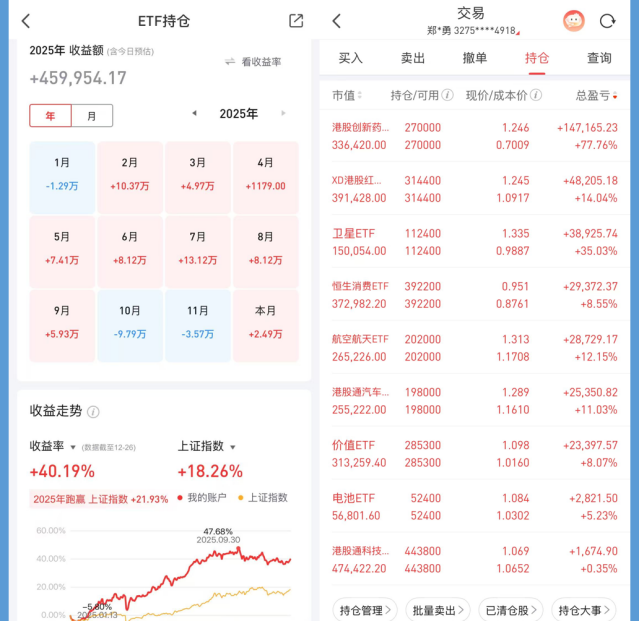
Core Viewpoint - The investment accounts managed by the company have shown a mixed performance this year, with a total profit of 1.9 million yuan, down from a peak of 2.3 million yuan earlier in the year, indicating a drawdown of 400,000 yuan [2][3]. Group 1: Account Performance - The total assets in the on-market ETF account amount to 2.6 million yuan, while the off-market fund account holds 5.4 million yuan, and the advisory portfolio has 1.2 million yuan [7]. - The on-market ETF account has a year-to-date profit of 460,000 yuan, with a current yield of 40.19% [5][6]. - The off-market fund account has a year-to-date profit of 1.338 million yuan, with a yield of 34.21% [15][16]. Group 2: Investment Strategy - The company has shifted its strategy by reducing its position in a value ETF by 100,000 yuan and reallocating that amount to the Hang Seng Consumer ETF, which has seen a decrease in floating profit from 11% to 8% [4]. - The rationale for this shift includes the belief that consumer valuations are at historical lows and that there will likely be consumption stimulus policies next year, which could improve industry sentiment [5]. - The core holdings in the on-market ETF account focus on Hong Kong stocks, with significant investments in sectors such as innovative pharmaceuticals, technology, and consumer goods [8][9]. Group 3: Market Trends - The recent downturn in the Hong Kong stock market has not changed the company's long-term investment logic, which emphasizes the valuation advantages of Hong Kong stocks compared to A-shares [10]. - The company has noted that the recent performance of aerospace and satellite ETFs has been strong, contributing significantly to this week's profits [11]. - The company adheres to a philosophy of avoiding high-risk investments and focusing on undervalued sectors for long-term gains [12]. Group 4: Precious Metals Market - The precious metals market has experienced significant price increases, with platinum prices rising over 172% year-to-date, driven by demand from the aerospace sector [24]. - The company had previously identified platinum as a valuable investment but missed the opportunity to invest heavily at lower prices [21][24]. - The company advises against chasing prices in the current market, emphasizing the importance of strategic investment rather than following trends [25].
国家统计局公布!高技术制造业利润,两位数增长
Xin Lang Cai Jing· 2025-12-27 11:21
Core Insights - The total profit of industrial enterprises above designated size in China reached 66,268.6 billion yuan from January to November, showing a year-on-year growth of 0.1%, marking four consecutive months of growth [1][7] - The profit growth rate of high-tech manufacturing increased by 10.0% year-on-year, accelerating by 2.0 percentage points compared to the previous month [1][8] High-Tech Manufacturing - High-tech manufacturing profits grew by 10.0% year-on-year, outpacing the overall industrial average by 9.9 percentage points [1][8] - The "Artificial Intelligence +" initiative significantly boosted profits in related sectors, with electronic industrial equipment manufacturing profits rising by 57.4% [2][8] - The semiconductor equipment manufacturing sector saw a remarkable profit increase of 97.2%, while electronic components and electromechanical equipment manufacturing profits grew by 46.0% [2][8] - The aerospace industry also experienced strong growth, with profits in aerospace equipment manufacturing increasing by 192.9% [2][8] Equipment Manufacturing - The equipment manufacturing sector demonstrated a profit growth of 7.7%, contributing 2.8 percentage points to the overall profit growth of industrial enterprises [3][9] - Among the eight major categories in equipment manufacturing, seven reported year-on-year profit growth, with rail, ship, and aerospace industries showing a profit increase of 27.8% [4][10] - The automotive sector also saw a steady profit increase of 7.5%, with an acceleration of 3.1 percentage points compared to the previous month [4][10] Raw Materials Manufacturing - The raw materials manufacturing sector experienced a profit growth of 16.6%, contributing 2.0 percentage points to the overall profit growth of industrial enterprises [5][11] - The steel industry showed significant improvement in profitability, with a notable year-on-year profit increase attributed to rising market demand and revenue growth [5][11] - The A-share steel companies reported a total revenue of 13,291.13 billion yuan, with a net profit of 174.9 billion yuan, reflecting a 351% year-on-year increase [6][11]
工信部部署2026年重点工作,集成电路、新型显示等产业被提及
2 1 Shi Ji Jing Ji Bao Dao· 2025-12-27 10:21
Core Insights - The primary focus of the national industrial and information technology conference is to "consolidate the stable and positive trend of the industrial economy" for 2026, marking a shift from "promoting stable growth" to a more quality-oriented approach [2][4] Group 1: Industrial Economic Strategy - The conference emphasizes the need to implement a new round of ten key industry growth plans, supporting major industrial provinces and increasing the supply of green products, trendy products, and products for the elderly [3][4] - The shift in focus from "promoting stable growth" to "consolidating a stable and positive trend" reflects a deeper policy transition from short-term stimulus to long-term quality improvement [2][4] Group 2: Emerging and Future Industries - The conference outlines plans to develop emerging pillar industries such as integrated circuits, new displays, new materials, aerospace, low-altitude economy, and biomedicine [9][10] - The emphasis on "artificial intelligence + manufacturing" aims to foster key industry intelligent entities and original intelligent enterprises, supporting the integration of AI and industrial internet [6][9] Group 3: Traditional Industry Upgrades - The term "smart empowerment" replaces "digital empowerment," indicating a deeper integration of intelligent technologies to enhance traditional industries [7] - The focus on service-oriented manufacturing aims to shift traditional industries from providing single products to offering comprehensive solutions, enhancing value chain positioning [8][10] Group 4: Quality Enterprise Cultivation - The conference highlights the importance of nurturing quality enterprises, including "little giant" companies and manufacturing champions, while addressing overdue payments to businesses [13][14] - The goal is to enhance the service capabilities of the information and communication industry, with significant growth in 5G infrastructure and its integration into various economic sectors [12][14]