
可再生能源

Search documents
“十四五”时期 我国构建起全球最大、发展最快的可再生能源体系
国家能源局· 2025-08-27 07:11
Core Viewpoint - The article highlights China's significant progress in energy security and green low-carbon development during the "14th Five-Year Plan" period, positioning the country as a key player in global energy transition [2][3]. Energy Supply and Consumption - During the first four years of the "14th Five-Year Plan," China's energy consumption increment reached 1.5 times that of the entire "13th Five-Year Plan" period, with projected new electricity consumption exceeding the annual electricity consumption of the European Union [2]. - In 2024, China's national power generation is expected to surpass 10 trillion kilowatt-hours, accounting for one-third of global power generation, with total energy production equivalent to approximately 5 billion tons of standard coal, representing over one-fifth of the global total [2]. Energy Resource Optimization - Energy resource allocation has been optimized, with 40% of energy consumption in eastern regions sourced from major energy transmission projects such as "West-to-East Electricity Transmission," "West-to-East Gas Transmission," and "North Coal to South" [2]. Green and Low-Carbon Transition - The "14th Five-Year Plan" marks the fastest period for green low-carbon transition, with China establishing the world's largest and fastest-growing renewable energy system. The share of renewable energy generation capacity increased from 40% to approximately 60% [2]. - Wind and solar power installations have seen significant annual increases, surpassing 100 million, 200 million, and 300 million kilowatts in successive years, demonstrating a stepwise development [2]. Contribution to Global Carbon Reduction - One-third of the total electricity consumed in society is now green electricity, with non-fossil energy's share in national energy consumption increasing by 1 percentage point annually, expected to exceed the "14th Five-Year Plan" target of 20% [3]. - During the "14th Five-Year Plan," China's exported wind and solar products have cumulatively reduced carbon emissions by approximately 4.1 billion tons for other countries [3].

摩洛哥成为非洲和中东地区绿地投资最多国家之一
Shang Wu Bu Wang Zhan· 2025-08-27 07:05
Core Insights - Morocco ranks first in the number of greenfield investment projects in Africa and the Middle East, with a total of 178 projects, according to the 2025 Foreign Direct Investment Report by the Financial Times [1] - Egypt leads the region in total foreign investment amounting to $47 billion, although its investment distribution is uneven, concentrated in a few large projects [1] - The report highlights that while South Africa has a large economy, it struggles to attract investments effectively [1] - Gulf countries dominate in investment amounts but are overly focused on oil and gas resources [1] Investment Distribution - Morocco's foreign investment is more evenly distributed across sectors, primarily in automotive, renewable energy, and information technology [1] - The Tangier Mediterranean Free Trade Zone and the automotive industry ecosystem developed with international car manufacturers continue to attract global investments [1] - Morocco's effective utilization of solar and wind energy positions it as a leader in the region's energy transition [1] - The growth of digital services and outsourcing in Casablanca and Rabat is transforming Morocco into a regional hub for information technology [1] Factors Attracting Investment - Morocco benefits from well-developed infrastructure, a high-quality labor force, and effective government regulation, which are significant factors in attracting foreign investment [1]
北京推进用户侧储电 储热/智能微电网/绿电直供等示范!数据中心2030年绿电占比100%
中关村储能产业技术联盟· 2025-08-27 06:23
Core Viewpoint - The article discusses the implementation plan for the "Beijing Renewable Energy Development and Utilization Regulations," emphasizing the integration of renewable energy into economic planning and the establishment of a new energy system to promote green and low-carbon transformation in the city [8][9]. Summary by Sections Overall Requirements - The plan aims to guide the development of renewable energy in Beijing, aligning with national policies and promoting sustainable development [9]. Main Tasks - Establish a comprehensive renewable energy planning system, integrating it into national and local economic plans [10]. - Accelerate the application of renewable energy, including increasing installed capacity for solar and wind energy [13]. - Enhance regional energy cooperation, particularly within the Beijing-Tianjin-Hebei area [13]. - Develop a new power system with a focus on smart grids and flexible power regulation [14]. Renewable Energy Promotion - Promote the establishment of a renewable energy consumption mechanism, including green certificate markets and green power consumption accounting [19]. - Encourage the use of renewable energy in public services and data centers, aiming for over 80% green power consumption by 2025 and 100% by 2030 [19]. Support for Technology and Industry Development - Support the establishment of innovation platforms in renewable energy, focusing on hydrogen, storage, and other key areas [21]. - Promote the development of a renewable energy standard system and enhance financial support for renewable energy projects [22]. Implementation Organization - Strengthen coordination among various departments and ensure the responsibilities of local governments and energy enterprises are clearly defined [24].
中国助力全球风电和光伏发电项目平均度电成本下降60%和80%
Zhong Guo Xin Wen Wang· 2025-08-27 03:30
Group 1 - The core viewpoint of the articles emphasizes the achievements in high-quality energy development during the "14th Five-Year Plan" period, particularly focusing on green and low-carbon energy cooperation as a key area of the Belt and Road Initiative [1][2] - Energy cooperation has entered a new phase of green and low-carbon transformation, with China collaborating with over 10 countries to establish ambitious renewable energy development goals and enhance energy security [1][2] - A total of 25 energy projects were signed at the Shanghai Cooperation Organization Energy Ministers' meeting, with a contract value of approximately 40 billion yuan, showcasing the potential and space for green energy cooperation [1][2] Group 2 - China is deepening technological cooperation in green and low-carbon energy, focusing on key areas such as hydrogen, energy storage, nuclear power, and smart energy, while promoting clean energy industry collaboration [2] - Over the past decade, the average cost of wind and solar power generation has decreased by 60% and 80% respectively, contributing significantly to global green transformation [2] - China has engaged in green energy project cooperation with over 100 countries and regions, providing practical solutions for energy transition in developing countries [2]
人民日报丨“量足价稳”,这是我国能源保障的底气
国家能源局· 2025-08-27 03:06
Core Viewpoint - The article discusses the achievements and developments in China's energy sector during the "14th Five-Year Plan" period, highlighting the significant growth in energy consumption, production, and renewable energy infrastructure. Group 1: Energy Consumption and Production - During the "14th Five-Year Plan," China's new electricity consumption is expected to exceed the annual electricity consumption of the European Union [5] - By 2024, China's total electricity generation is projected to surpass 10 trillion kilowatt-hours, accounting for one-third of global electricity generation [7] - The energy production during this period is estimated to reach approximately 5 billion tons of standard coal, representing a significant portion of global energy production [8] Group 2: Infrastructure Development - The energy infrastructure network has become more comprehensive, connecting eastern and western regions and facilitating energy transfer through major projects like "West-East Electricity Transmission" and "North Coal South Transport" [12] - As of July 2023, the number of charging infrastructure units in China reached 16.696 million, ten times the number at the end of the "13th Five-Year Plan," making it the largest in the world [15] Group 3: Renewable Energy Growth - The share of renewable energy generation capacity is expected to increase from 40% to around 60% during the "14th Five-Year Plan" [18] - Wind and solar power installations are projected to grow significantly, with annual additions of 10 million kilowatts and 20 million kilowatts, respectively, showcasing unprecedented development speed [18] - The number of new energy patents in China accounts for over 40% of the global total, indicating strong innovation in the sector [19] Group 4: Environmental Impact - China's exports of wind and solar products have contributed to a reduction of approximately 4.1 billion tons of carbon emissions in other countries [24]
“十四五”时期 我国构建起全球最大、发展最快的可再生能源体系
Yang Guang Wang· 2025-08-27 00:20
Core Insights - The Chinese government has effectively ensured energy security and promoted green low-carbon development during the "14th Five-Year Plan" period, positioning China as a key player in global energy transition [1][2] Group 1: Energy Supply and Consumption - During the first four years of the "14th Five-Year Plan," China's energy consumption increment reached 1.5 times that of the entire "13th Five-Year Plan" period, with projected new electricity consumption exceeding the annual electricity consumption of the European Union [1] - By 2024, national electricity generation is expected to surpass 10 trillion kilowatt-hours, accounting for one-third of global production, with total energy production equivalent to approximately 5 billion tons of standard coal, representing over one-fifth of global supply [1] - Energy resource allocation has been optimized, with 40% of energy consumption in eastern regions sourced from major energy transmission projects like "West-East Electricity Transmission" and "West-East Gas Transmission" [1] Group 2: Green and Low-Carbon Transition - The "14th Five-Year Plan" marks the fastest period for green low-carbon transformation, with China establishing the world's largest and fastest-growing renewable energy system [1] - The share of renewable energy generation capacity has increased from 40% to around 60%, with annual new installations of wind and solar power surpassing 100 million and 200 million kilowatts, respectively, achieving significant growth milestones [1] - One-third of the total electricity consumed in society is now green electricity, with non-fossil energy's share in national energy consumption increasing by 1 percentage point annually, expected to exceed the "14th Five-Year Plan" target of 20% [2]
“十四五”期间我国能源自给率保持在80%以上
Jing Ji Ri Bao· 2025-08-27 00:07
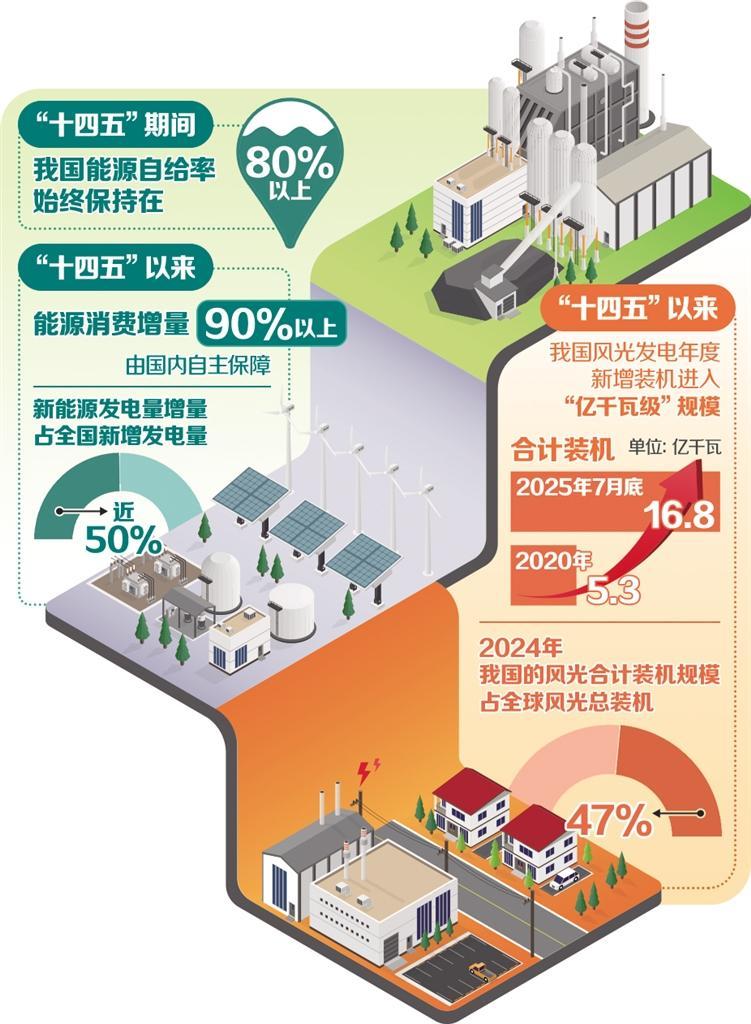
Core Insights - China's energy self-sufficiency rate has remained above 80% during the "14th Five-Year Plan" period, ensuring energy security for over 1.4 billion people [3][4][5] - The country has made significant strides in renewable energy, becoming a global leader in wind and solar power installations, contributing to a robust energy transition [6][7] Energy Production and Consumption - China's energy production accounts for over 20% of the global total, with the largest renewable energy system in the world and the largest electric vehicle charging network [3][5] - The energy consumption increased by 9.8 million tons of standard coal during the first four years of the "14th Five-Year Plan," with over 90% of this increase met by domestic supply [5] Renewable Energy Development - The installed capacity of wind and solar power has surged from 530 million kilowatts in 2020 to 1.68 billion kilowatts by July 2023, with an annual growth rate of 28% [6] - Wind and solar power accounted for 18.6% of total electricity consumption by 2024, up from 9.7% in 2020, with wind and solar generation reaching 1.15 trillion kilowatt-hours in the first half of 2023 [6] National Power Market System - The construction of a unified national electricity market has made significant progress, with trading volumes increasing from 10.7 trillion kilowatt-hours in the "13th Five-Year Plan" to 23.8 trillion kilowatt-hours [7] - The proportion of market transactions in total electricity consumption has risen from 40% in 2020 to over 60% for four consecutive years [7]
供应更足 韧性更强(锐财经)
Ren Min Ri Bao Hai Wai Ban· 2025-08-26 22:55
Core Insights - During the "14th Five-Year Plan" period, China has established the world's largest and fastest-growing renewable energy system, with the share of renewable energy generation capacity increasing from 40% to approximately 60% [2] Group 1: Energy Supply and Self-Sufficiency - China's energy self-sufficiency rate has remained above 80% throughout the "14th Five-Year Plan" period, demonstrating strong domestic energy production capabilities [3] - In July, China's monthly electricity consumption exceeded 1 trillion kilowatt-hours for the first time, equivalent to Japan's total annual consumption [3] - Over 90% of the increase in energy consumption has been met by domestic production, with renewable energy contributing significantly [3] Group 2: Energy Investment Growth - Energy industrial investment has shown a robust annual growth rate exceeding 16%, with total investments surpassing 4 trillion yuan, 5 trillion yuan, and 6 trillion yuan in consecutive years [5] - The energy sector's investment accounted for nearly 10% of total fixed asset investment in society, with significant contributions from the electricity and heat production sectors, which saw investment growth rates exceeding 20% [5] Group 3: Renewable Energy Development - China's renewable energy capacity has rapidly increased, with total installed capacity for wind and solar power rising from 530 million kilowatts in 2020 to 1.68 billion kilowatts by July 2023, reflecting an annual growth rate of 28% [7] - The share of wind and solar power generation in total electricity consumption has increased from 9.7% in 2020 to 18.6% in 2024, with wind and solar generation accounting for nearly 25% of total electricity consumption in the first half of this year [7] - China continues to lead globally in wind and solar power installations, with 2024 projections indicating that its combined capacity will account for 47% of the world's total [8]
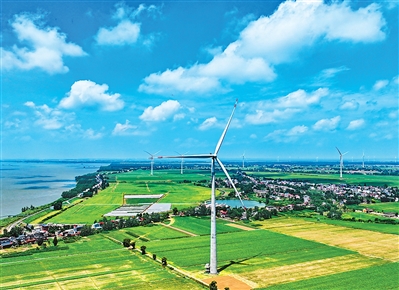
我国已建成全球门类最全规模最大的能源体系
Ren Min Ri Bao Hai Wai Ban· 2025-08-26 22:23
Core Insights - During the "14th Five-Year Plan" period, China has established the world's largest and fastest-growing renewable energy system, with the share of renewable energy generation capacity increasing from 40% to approximately 60% [1] Group 1: Energy Supply and Self-Sufficiency - China's energy self-sufficiency rate has consistently remained above 80% during the "14th Five-Year Plan" period, demonstrating strong energy supply capabilities [2] - In July, China's monthly electricity consumption exceeded 1 trillion kilowatt-hours for the first time, equivalent to Japan's total annual electricity consumption [2] - Domestic energy production has accelerated, with over 90% of the consumption increase being self-supplied, highlighting the significant role of renewable energy [2] Group 2: Investment Trends - Energy industry investment has shown robust growth, with annual investment exceeding 4 trillion, 5 trillion, and 6 trillion yuan, accounting for nearly 10% of total fixed asset investment [4] - The average annual growth rate of energy industrial investment has surpassed 16%, particularly in the electricity and heat production sectors, which have seen growth rates exceeding 20% [4] - Renewable energy investments are projected to account for over 80% of power investment in 2024, indicating a strong shift towards green energy [4] Group 3: New Energy Development - China's wind and solar power installed capacity increased from 530 million kilowatts in 2020 to 1.68 billion kilowatts by July 2023, with an annual growth rate of 28% [7] - The share of wind and solar power generation in total electricity consumption rose from 9.7% in 2020 to 18.6% in 2024, with a significant increase in the first half of 2023 [7] - China continues to lead globally in wind and solar power installations, with its combined capacity accounting for 47% of the world's total and 63% of new installations [7]
我国建成全球门类最全规模最大的能源体系(权威发布·高质量完成“十四五”规划)
Ren Min Ri Bao· 2025-08-26 21:45
Core Insights - The "14th Five-Year Plan" period has seen significant advancements in China's energy sector, with the country emerging as a key player in global energy transition [1][7] Group 1: Energy Supply and Demand - China's energy consumption increased by 9.8 million tons of standard coal in the first four years of the "14th Five-Year Plan," with projected new electricity consumption exceeding the annual consumption of the EU over five years [2] - Domestic energy production has met over 90% of the consumption increase, with total energy production equivalent to approximately 5 billion tons of standard coal, accounting for over 20% of global production [2] - The country has built the world's largest electric vehicle charging network, with 1.67 million charging points, and invested over 800 billion yuan in rural power grid improvements [2] Group 2: Green Transition - The share of renewable energy in total installed capacity has risen from 40% to around 60% during the "14th Five-Year Plan" [3] - Wind and solar power generation capacity increased from 530 million kilowatts in 2020 to 1.68 billion kilowatts by July 2023, with their share of total electricity consumption rising from 9.7% to 18.6% [3] - China's renewable energy projects have contributed to a 60% reduction in wind power costs and an 80% reduction in solar power costs globally over the past decade [3] Group 3: Technological Innovation and Investment - Significant breakthroughs in energy technology have been achieved, including advancements in oil and gas exploration and renewable energy efficiency [6] - The new energy storage capacity has grown nearly 30 times to approximately 95 million kilowatts during the "14th Five-Year Plan" [6] - Annual energy investment has consistently exceeded 4 trillion yuan, with private enterprises playing a crucial role, particularly in the power infrastructure sector where they account for over 85% of construction [6]