
服务业

Search documents
国家统计局:7月制造业采购经理指数有所回落 非制造业商务活动指数保持扩张
Di Yi Cai Jing· 2025-07-31 01:50
Core Viewpoint - In July, the manufacturing Purchasing Managers' Index (PMI) decreased to 49.3%, while the non-manufacturing business activity index and the composite PMI output index were 50.1% and 50.2%, respectively, indicating a continued expansion of the overall economic output in China despite a slight decline from the previous month [1][5]. Group 1: Manufacturing PMI Analysis - The manufacturing PMI fell to 49.3% in July, down 0.4 percentage points from the previous month, influenced by seasonal production slowdowns and adverse weather conditions [2]. - The production index remained in the expansion zone at 50.5%, while the new orders index decreased to 49.4%, indicating a slowdown in market demand [2]. - Large enterprises maintained expansion with a PMI of 50.3%, while medium-sized enterprises improved to 49.5%, and small enterprises saw a decline to 46.4% [3]. - New momentum in the manufacturing sector was observed, with the equipment manufacturing and high-tech manufacturing PMIs at 50.3% and 50.6%, respectively, both above the critical point [3]. Group 2: Non-Manufacturing PMI Analysis - The non-manufacturing business activity index was 50.1%, down 0.4 percentage points from the previous month, but still above the critical point [4]. - The service industry business activity index remained stable at 50.0%, with significant growth in sectors related to travel and consumption, such as railway and air transport [4]. - The construction industry business activity index fell to 50.6%, impacted by adverse weather conditions, with a corresponding decrease in the business activity expectation index to 51.6% [4]. Group 3: Composite PMI Output Index - The composite PMI output index was 50.2%, down 0.5 percentage points from the previous month, indicating overall expansion in production and business activities [5].
国家统计局:7月份制造业采购经理指数有所回落 非制造业商务活动指数保持扩张
Guo Jia Tong Ji Ju· 2025-07-31 01:46
Group 1: Manufacturing Sector - The manufacturing Purchasing Managers' Index (PMI) decreased to 49.3% in July, down 0.4 percentage points from the previous month, indicating a decline in manufacturing activity due to seasonal factors and adverse weather conditions [2][3] - The production index remained in expansion at 50.5%, while the new orders index fell to 49.4%, reflecting a slowdown in market demand [2] - Large enterprises maintained expansion with a PMI of 50.3%, while medium-sized enterprises improved to 49.5%, and small enterprises decreased to 46.4% [3] Group 2: Price Trends - The price index for major raw materials increased, with the purchasing price index at 51.5% and the factory price index at 48.3%, marking the first rise above the critical point since March [2] - Industries such as petroleum, coal, and black metal processing saw significant increases in their purchasing and factory price indices, indicating improved market prices [2] Group 3: Non-Manufacturing Sector - The non-manufacturing business activity index was at 50.1%, down 0.4 percentage points from the previous month, but still above the critical point [4] - The service sector's business activity index remained stable at 50.0%, with strong performance in transportation and tourism-related industries, while real estate and residential services lagged [4] - The construction business activity index fell to 50.6% due to adverse weather conditions, with a corresponding decrease in market expectations [4] Group 4: Overall Economic Outlook - The comprehensive PMI output index was at 50.2%, down 0.5 percentage points from the previous month, indicating overall economic expansion despite a slowdown [5][6] - The manufacturing production index and non-manufacturing business activity index were reported at 50.5% and 50.1%, respectively, contributing to the overall expansion [6]
国家统计局:7月官方制造业PMI为49.3% 比上月下降0.4个百分点
Guo Jia Tong Ji Ju· 2025-07-31 01:45
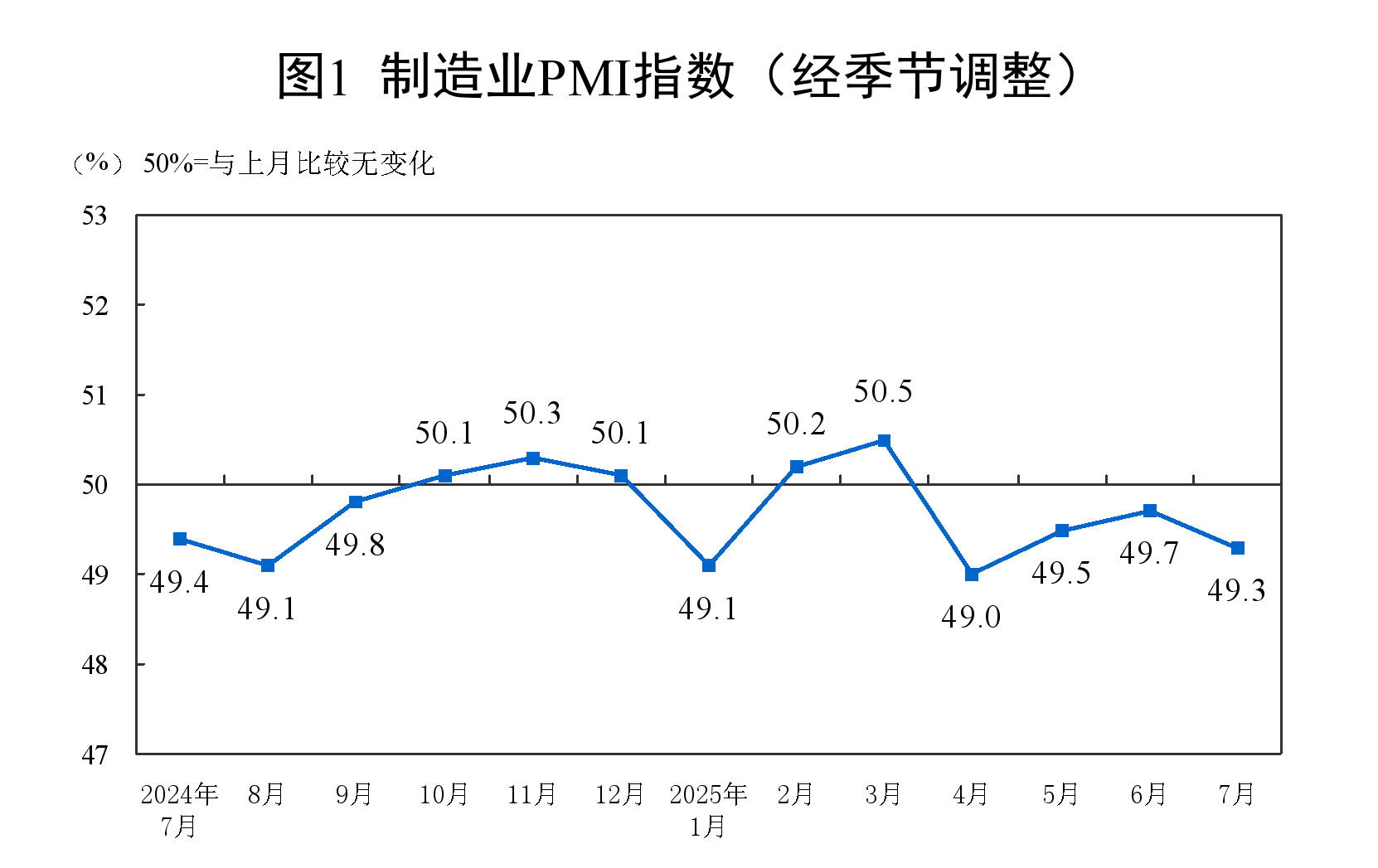
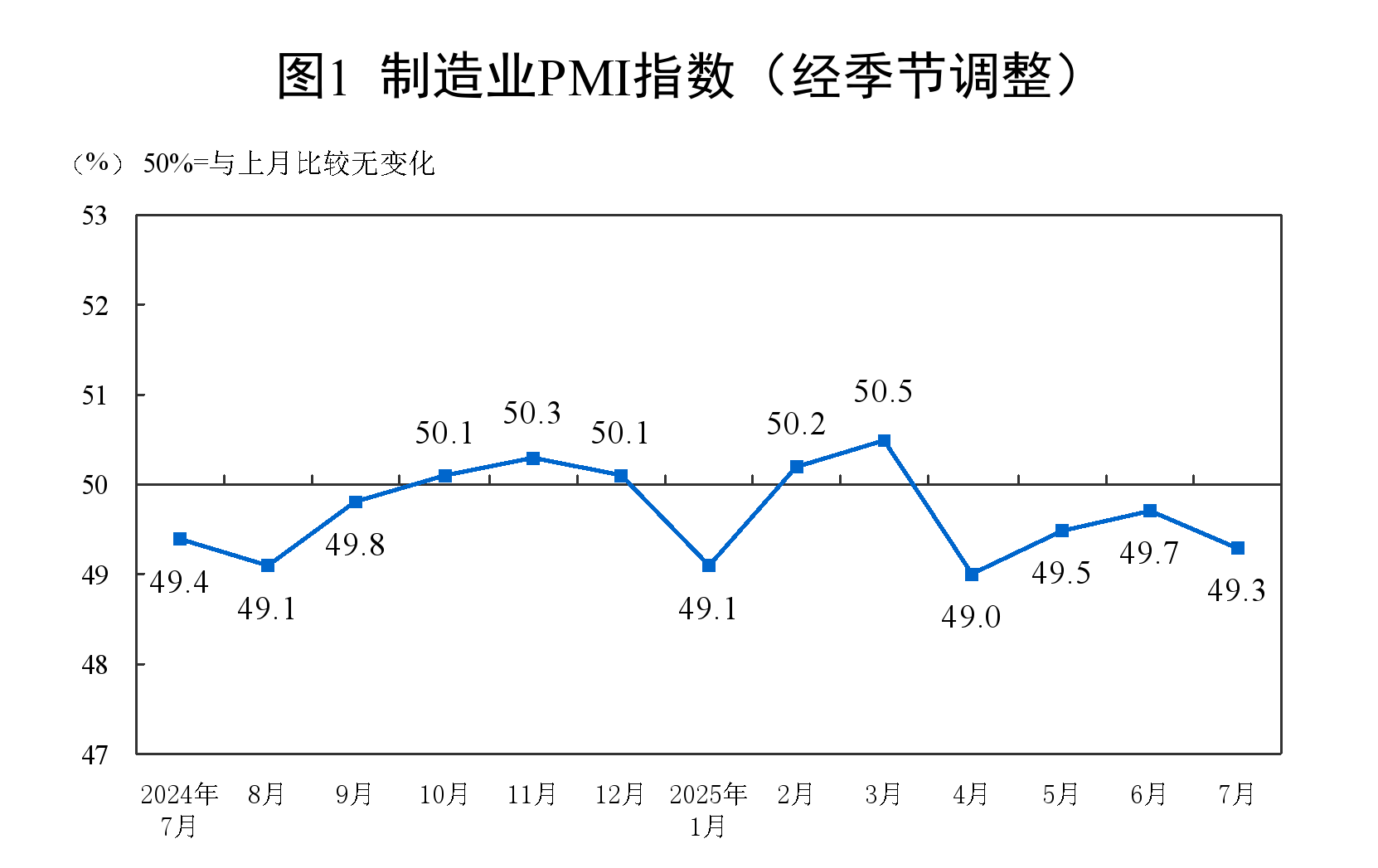
一、中国制造业采购经理指数运行情况 7月份,制造业采购经理指数(PMI)为49.3%,比上月下降0.4个百分点,制造业景气水平有所回落。 从企业规模看,大型企业PMI为50.3%,比上月下降0.9个百分点,高于临界点;中型企业PMI为49.5%, 比上月上升0.9个百分点,低于临界点;小型企业PMI为46.4%,比上月下降0.9个百分点,低于临界点。 从分类指数看,在构成制造业PMI的5个分类指数中,生产指数和供应商配送时间指数均高于临界点, 新订单指数、原材料库存指数和从业人员指数低于临界点。 生产指数为50.5%,比上月下降0.5个百分点,仍高于临界点,表明制造业生产延续扩张。 二、中国非制造业采购经理指数运行情况 7月份,非制造业商务活动指数为50.1%,比上月下降0.4个百分点,仍高于临界点。 分行业看,建筑业商务活动指数为50.6%,比上月下降2.2个百分点;服务业商务活动指数为50.0%,比 上月下降0.1个百分点。从行业看,铁路运输、航空运输、邮政、文化体育娱乐等行业商务活动指数位 于60.0%以上高位景气区间;房地产、居民服务等行业商务活动指数均低于临界点。 新订单指数为45.7%,比上月下降 ...
国家统计局:7月制造业PMI为49.3%
Guo Jia Tong Ji Ju· 2025-07-31 01:44
一、中国制造业采购经理指数运行情况 7月份,制造业采购经理指数(PMI)为49.3%,比上月下降0.4个百分点,制造业景气水平有所回落。 从企业规模看,大型企业PMI为50.3%,比上月下降0.9个百分点,高于临界点;中型企业PMI为49.5%,比上月上升0.9个百分点,低于临界点;小型企业PMI 为46.4%,比上月下降0.9个百分点,低于临界点。 从分类指数看,在构成制造业PMI的5个分类指数中,生产指数和供应商配送时间指数均高于临界点,新订单指数、原材料库存指数和从业人员指数低于临 界点。 生产指数为50.5%,比上月下降0.5个百分点,仍高于临界点,表明制造业生产延续扩张。 新订单指数为49.4%,比上月下降0.8个百分点,表明制造业市场需求有所放缓。 原材料库存指数为47.7%,比上月下降0.3个百分点,表明制造业主要原材料库存量继续减少。 从业人员指数为48.0%,比上月上升0.1个百分点,表明制造业企业用工景气度略有回升。 供应商配送时间指数为50.3%,比上月上升0.1个百分点,表明制造业原材料供应商交货时间继续加快。 二、中国非制造业采购经理指数运行情况 图3 建筑业商务活动指数(经 (%) ...

中国7月制造业PMI为49.3%,比上月下降0.4个百分点
Guo Jia Tong Ji Ju· 2025-07-31 01:39
一、中国制造业采购经理指数运行情况 7月份,制造业采购经理指数(PMI)为49.3%,比上月下降0.4个百分点,制造业景气水平有所回落。 | | PMI | | | | | | | --- | --- | --- | --- | --- | --- | --- | | | | 生产 | 新订单 | 原材料 | 从非人员 | 供应商 | | | | | | 年仔 | | 酉庆时间 | | 2024年7月 | 49.4 | 50.1 | 49.3 | 47.8 | 48.3 | 49.3 | | 2024年8月 | 49.1 | 49.8 | 48.9 | 47.6 | 48.1 | 49.6 | | 2024年9月 | 49.8 | 51.2 | 49 0 | 47.7 | 48.2 | વેત રે | | 2024年10月 | 50.1 | 52.0 | 50.0 | 48.2 | 48.4 | 49.6 | | 2024年11月 | 50.3 | 52.4 | 50.8 | 48.2 | 48.2 | 50.2 | | 2024年12月 | 50.1 | 52.1 | 51.0 | 48.3 | 48.1 ...
国家统计局:7月受制造业进入传统生产淡季等因素影响,制造业景气水平较上月回落
Guo Jia Tong Ji Ju· 2025-07-31 01:39
Manufacturing Sector - In July, the Manufacturing Purchasing Managers' Index (PMI) decreased to 49.3%, down 0.4 percentage points from the previous month, indicating a decline in manufacturing activity due to seasonal factors and adverse weather conditions [2][3] - The production index remained in expansion at 50.5%, while the new orders index fell to 49.4%, reflecting a slowdown in market demand [3] - Large enterprises maintained expansion with a PMI of 50.3%, while medium-sized enterprises improved to 49.5%, and small enterprises decreased to 46.4% [4] - The price index showed an upward trend, with the main raw materials purchasing price index rising to 51.5%, marking the first increase above the critical point since March [3][4] - New momentum in the manufacturing sector is evident, with the equipment manufacturing PMI at 50.3% and high-tech manufacturing PMI at 50.6%, both above the critical point [4] Non-Manufacturing Sector - The Non-Manufacturing Business Activity Index stood at 50.1%, down 0.4 percentage points from the previous month, but still above the critical point [5] - The service sector's business activity index was stable at 50.0%, with significant growth in transportation and tourism-related industries, while real estate and residential services lagged [5][6] - The construction sector's business activity index fell to 50.6%, influenced by adverse weather conditions, with a corresponding decrease in market expectations [6] Composite PMI - The Composite PMI Output Index decreased to 50.2%, down 0.5 percentage points from the previous month, indicating overall expansion in production and business activities [7] - The manufacturing production index and non-manufacturing business activity index were recorded at 50.5% and 50.1%, respectively, both indicating continued expansion [7]
特别策划丨崔卫杰:以更大力度推进高水平对外开放
Sou Hu Cai Jing· 2025-07-31 01:39
Core Viewpoint - The Chinese economy achieved a stable growth of 5.3% in the first half of the year, despite facing complex external and internal challenges. The focus for the second half will be on enhancing high-level opening-up to contribute to modernization [2][4]. Group 1: Economic Performance - In the first half of the year, China's foreign trade maintained growth despite high tariffs, with total imports and exports reaching 21.79 trillion yuan, a year-on-year increase of 2.9%, marking a historical high for the same period [5][15]. - The export of mechanical and electrical products grew by 9.5%, accounting for 60% of total exports, while high-end equipment exports surged over 20% [5][15]. - Foreign investment targets for the 14th Five-Year Plan were met six months ahead of schedule, with actual foreign investment reaching 423.23 billion yuan, a growth of 11.7% [5][16]. Group 2: Open Platform Development - The construction of free trade zones and pilot zones for service industry expansion has progressed significantly, with 77 new measures promoting international high-standard trade rules implemented [6][17]. - The Hainan Free Trade Port has made notable advancements, establishing a preliminary policy system [6][17]. - National-level economic and technological development zones are being developed to enhance high-level opening-up and quality growth [6][17]. Group 3: Bilateral and Multilateral Trade Cooperation - China has actively engaged in bilateral and multilateral trade cooperation, with trade with over 190 countries and regions increasing, and 61 trading partners exceeding 50 billion yuan in trade volume [7][18]. - The implementation of the Regional Comprehensive Economic Partnership (RCEP) has strengthened trade ties, with trade volume with RCEP partners reaching 986.99 billion USD, a year-on-year increase of 3.5% [7][18]. - Trade with Belt and Road Initiative countries reached 11.29 trillion yuan, growing by 4.7% and accounting for 51.8% of total trade [7][18]. Group 4: Future Outlook and Challenges - The second half of the year will see continued pressure on foreign trade due to global economic slowdown and geopolitical tensions, with increased uncertainty affecting international trade and investment [9][18]. - Despite challenges, China's comprehensive advantages, including a large market and complete industrial system, will support steady progress in high-level opening-up [11][19]. - New measures to enhance foreign investment and trade, including optimizing tax refund policies and expanding market access, are expected to yield positive results [10][19].

2025年7月中国采购经理指数运行情况
Guo Jia Tong Ji Ju· 2025-07-31 01:31
国家统计局服务业调查中心 中国物流与采购联合会 一、中国制造业采购经理指数运行情况 7月份,制造业采购经理指数(PMI)为49.3%,比上月下降0.4个百分点,制造业景气水平有所回落。 从企业规模看,大型企业PMI为50.3%,比上月下降0.9个百分点,高于临界点;中型企业PMI为49.5%,比上月上升0.9个百分点,低于临界点;小型企业PMI 为46.4%,比上月下降0.9个百分点,低于临界点。 从分类指数看,在构成制造业PMI的5个分类指数中,生产指数和供应商配送时间指数均高于临界点,新订单指数、原材料库存指数和从业人员指数低于临 界点。 新订单指数为49.4%,比上月下降0.8个百分点,表明制造业市场需求有所放缓。 原材料库存指数为47.7%,比上月下降0.3个百分点,表明制造业主要原材料库存量继续减少。 从业人员指数为48.0%,比上月上升0.1个百分点,表明制造业企业用工景气度略有回升。 供应商配送时间指数为50.3%,比上月上升0.1个百分点,表明制造业原材料供应商交货时间继续加快。 表1 中国制造业PMI及构成指数(经季节调整) 单位:% | | PMI | | | | | | | --- | ...
深圳上半年GDP同比增长5.1% 多个主要指标增速较一季度加快
Mei Ri Jing Ji Xin Wen· 2025-07-30 12:47
Economic Performance - In the first half of 2025, Shenzhen's GDP reached 1.83 trillion yuan, reflecting a year-on-year growth of 5.1% at constant prices [1] - Major economic indicators showed accelerated growth compared to the first quarter, indicating a stable and improving economic trend [1] Industrial and Service Sector - The added value of industrial enterprises above designated size increased by 4.3% year-on-year, with a slight acceleration of 0.1 percentage points from the first quarter [1] - The service sector's added value was 1.18 trillion yuan, growing by 6.1% year-on-year, also up by 0.1 percentage points from the first quarter [1] - Retail sales of consumer goods totaled 494.868 billion yuan, marking a year-on-year increase of 3.5%, with an acceleration of 0.4 percentage points from the first quarter [1] Investment Trends - Fixed asset investment in Shenzhen decreased by 10.9% year-on-year, primarily due to a decline in real estate development investment, which fell by 15.1% [1] - Excluding real estate, private investment grew by 3.6% year-on-year, with private industrial investment increasing by 10.6% [1] - Infrastructure investment rose by 7.7% year-on-year, while industrial technological transformation investment surged by 47.1% [1] Foreign Trade - In the first half of 2025, Shenzhen's total import and export volume was 2.17 trillion yuan, a year-on-year decrease of 1.1%, with the decline narrowing by 1.7 percentage points compared to the first quarter [2] - Exports amounted to 1.31 trillion yuan, down by 7.0% year-on-year, while imports increased by 9.5% to 858.864 billion yuan [2] - The decline in exports was attributed to a high base from the previous year when foreign trade growth was rapid [2]
ADP报告:服务业复苏带动了招聘人数的增长,但教育和卫生行业除外,今年迄今为止这两个行业的就业岗位出现了净流失。
news flash· 2025-07-30 12:21
Core Insights - The ADP report indicates that the recovery in the service sector has led to an increase in hiring numbers, although the education and healthcare sectors have experienced net job losses so far this year [1] Group 1 - The service sector's recovery is a significant driver of job growth [1] - Education and healthcare sectors have seen a net loss of jobs in 2023 [1]