
银行业

Search documents
周四(2月12日),美联储隔夜逆回购协议(RRP)使用规模为28.44亿美元(交易对手10家),上个交易日报10.48亿美元。
Sou Hu Cai Jing· 2026-02-12 18:27
Group 1 - The Federal Reserve's overnight reverse repurchase agreement (RRP) usage on February 12 was $28.44 billion, involving 10 counterparties [1] - This represents a decrease from the previous trading day's RRP usage of $10.48 billion [1]
金银暴跌真相揭秘!五大危机来袭,散户如何自保避免资金清零
Sou Hu Cai Jing· 2026-02-12 17:08
Core Viewpoint - The recent sharp decline in gold and silver prices, following a period of significant gains, has raised questions about market manipulation and the role of major financial institutions in precipitating this crash [1][3]. Group 1: Market Dynamics - Gold prices surged past $5,600 and silver reached $120, leading to widespread optimism among investors [1]. - A sudden market crash occurred from January 30 to February 2, with gold dropping over 20 points and silver experiencing a nearly 40% decline [3]. - The market was characterized by extreme overbuying, with gold and silver reaching relative strength index levels of 90 and 93.8, respectively, indicating a fragile market structure [7]. Group 2: Institutional Actions - Major banks raised gold price accumulation thresholds and restricted trading just before the crash, signaling potential market instability [3]. - The nomination of Kevin Warsh, a known hawk, to the Federal Reserve chair position shifted market expectations, leading to a spike in the dollar index and a rapid decline in gold and silver prices [5]. - Institutions like Morgan Stanley and Goldman Sachs began to withdraw from long positions as silver prices approached $100, indicating a strategic exit before the crash [13]. Group 3: Impact on Retail and Industry - The crash led to a significant drop in A-share gold stocks, with a market value loss of 50 billion yuan in a single day [11]. - Retail gold prices fell sharply, and many gold recycling businesses halted operations due to market chaos [11]. - The solar industry, heavily reliant on silver for production, faced substantial losses as silver prices plummeted, with companies like Tongwei Co. projected to incur losses of 15 billion yuan [11]. Group 4: Investor Behavior - Retail trading platforms saw a 30% increase in positions held by small investors, suggesting that while institutional players exited, retail investors remained heavily invested [13]. - The market's volatility and the subsequent forced liquidations of leveraged positions highlighted the risks associated with high leverage in trading [9]. Group 5: Lessons Learned - The recent events serve as a reminder that financial markets are not guaranteed profit machines, and the importance of heeding market signals and warnings is crucial for investors [15]. - The crash underscores the necessity for investors to remain vigilant and responsive to market changes rather than becoming complacent during periods of rising prices [15].

中国人民银行传递保持流动性充裕积极信号 2月份买断式逆回购净投放环比增加3000亿元
Zheng Quan Ri Bao· 2026-02-12 16:16
Group 1 - The People's Bank of China (PBOC) announced a reverse repurchase operation of 1 trillion yuan with a six-month term to maintain ample liquidity in the banking system, resulting in a net injection of 500 billion yuan after accounting for maturing operations [1] - In February, the net injection from reverse repos is expected to reach 600 billion yuan, an increase of 300 billion yuan compared to January, indicating a proactive approach to liquidity management [1] - Analysts suggest that the PBOC's actions signal a commitment to maintaining liquidity and stabilizing the financial market, especially during a month with increased credit demand and cash withdrawals due to the upcoming Spring Festival [1] Group 2 - The PBOC is expected to continue using both reverse repos and Medium-term Lending Facility (MLF) tools to inject liquidity, reflecting a sustained "moderately accommodative" monetary policy stance [2] - The PBOC's recent report emphasizes the importance of analyzing liquidity supply and demand, indicating a strategic approach to using various monetary policy tools to ensure liquidity remains ample [2] - Analysts believe that the urgency for a reserve requirement ratio (RRR) cut has decreased in the short term due to the large liquidity injections [2] Group 3 - The PBOC is focusing on improving the efficiency of existing policies rather than simply increasing them, suggesting a cautious approach to monetary policy adjustments [3] - While the possibility of an RRR cut remains, it is viewed as an important tool in the PBOC's policy arsenal, with potential for a more significant cut than the 0.5 percentage point reduction seen in 2025 [3] - The current average reserve requirement ratio stands at 6.3%, indicating room for future adjustments if necessary [3]
香港金管局最新发声
Zhong Guo Ji Jin Bao· 2026-02-12 15:59
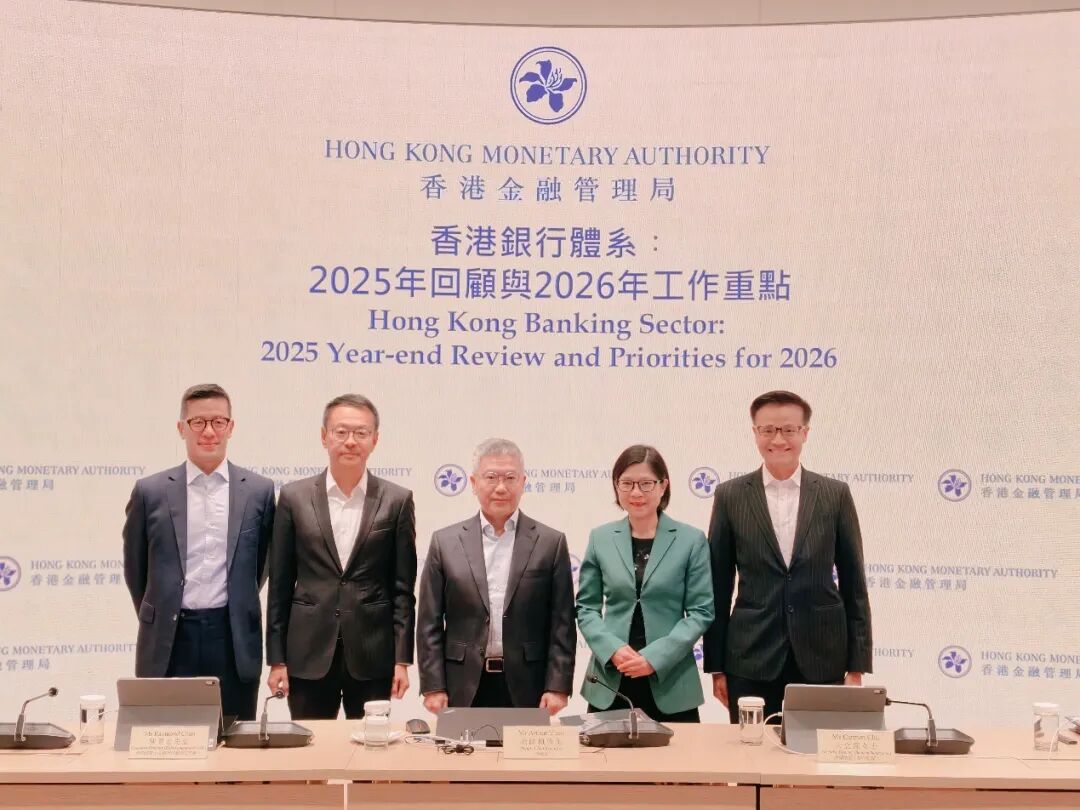
Group 1 - The core focus of the Hong Kong Monetary Authority (HKMA) for 2026 is managing credit risk and credit fund flows, emphasizing the need for vigilance in monitoring asset quality and proactively addressing potential risks [3][5] - HKMA plans to implement measures to support the real economy, particularly small and medium-sized enterprises (SMEs), by facilitating access to bank loans, supporting business transformation, and promoting intellectual property financing [5] - The pressure on asset quality primarily stems from the commercial real estate sector, with outstanding loans in this sector accounting for 14% of the total, and HKMA will continue to monitor loan quality and liquidity indicators [5] Group 2 - In a declining interest rate environment expected in the second half of 2025, banks are anticipated to see increased customer interest in investment products, with transaction volume through banks rising from HKD 819 billion in 2022 to HKD 2.3 trillion [6] - HKMA will focus on high-yield and complex products, including those related to private credit, and will support the sustainable and responsible development of the digital asset industry, with investment transactions in digital assets increasing from HKD 17.2 billion in 2024 to HKD 74.2 billion in 2025 [6] - HKMA will also pay attention to higher-risk insurance products and review banks' insurance referral businesses [7] Group 3 - A key initiative for HKMA in 2026 is combating fraud, highlighted by the release of an anti-fraud song and music video to raise public awareness [8] - HKMA has supported the smooth operation of the cross-border wealth management connect business, enhancing banks' sales services to mainland customers and increasing the client limit for non-local registered banks [9] - Continuous monitoring of banks' asset quality and credit risk management effectiveness is essential to ensure the stability of the banking system while supporting the real economy [10]
2025年11月沙特国内货币流动性增长6.6%
Shang Wu Bu Wang Zhan· 2026-02-12 15:46
Core Insights - The total domestic liquidity (money supply) in Saudi Arabia exceeded 3.138 trillion Saudi Riyals as of November 2025, reflecting a year-on-year growth of 6.6% [1] Group 1: Money Supply Composition - Demand deposits accounted for the largest share at 45.2%, amounting to approximately 1.418 trillion Saudi Riyals [1] - Time deposits and savings deposits totaled around 1.170 trillion Saudi Riyals, representing 37.3% of the total [1] - Other quasi-cash deposits reached approximately 310.31 billion Saudi Riyals, making up nearly 10% [1] Group 2: Currency in Circulation - Currency in circulation outside banks was 239.52 billion Saudi Riyals, which is about 8% of the total money supply [1]
英国央行副行长Breeden预计英国在4月底前降息25个基点
Sou Hu Cai Jing· 2026-02-12 14:53
英国央行政策制定者Sarah Breeden表示,"有理由预计"央行在4月底前将再降息25个基点。这位负责金 融稳定事务的副行长在接受采访时表示,现在是"松开货币刹车"的时候,通过降低借贷成本为经济提供 更多支持。本月早些时候,英国央行以微弱投票优势将利率维持在3.75%。货币政策委员会以5比4的结 果决定按兵不动,行长安德鲁·贝利投下决定性的一票。Breeden是主张降息的四名委员之一。她表示, 她更关注增长放缓和失业率上升的下行风险。她说:"我并不确信我们会看到经济活动回升。因此,我 认为适度松开货币刹车、为经济提供更多支持是合适的。" ...
10000亿元!央行明起大动作
Jing Ji Ri Bao· 2026-02-12 14:46
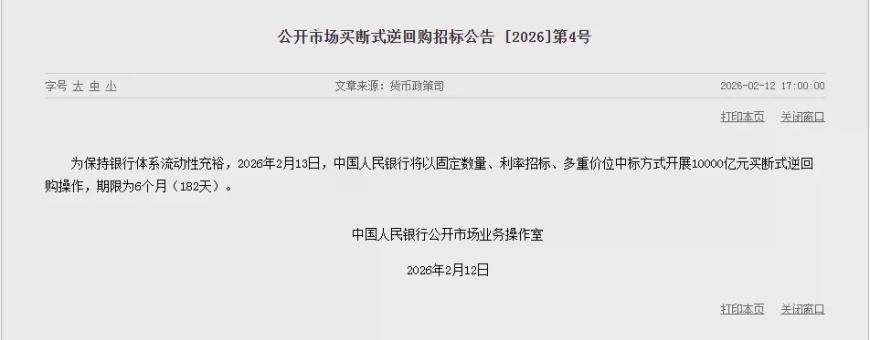
Core Viewpoint - The People's Bank of China (PBOC) is conducting a reverse repurchase operation of 1 trillion yuan to maintain liquidity in the banking system, with a term of 6 months [1]. Group 1 - On February 12, the PBOC announced a reverse repurchase operation to ensure ample liquidity in the banking system [1]. - The operation will be conducted on February 13, with a fixed amount and interest rate bidding, using a multi-price bidding method [1]. - The total amount for the reverse repurchase operation is set at 1 trillion yuan (approximately 154 billion USD) [1].
美股三大指数集体高开,存储概念股延续涨势
Feng Huang Wang Cai Jing· 2026-02-12 14:45
【退出英伟达HBM4供应名单?美光否认传闻:已量产出货】 【壳牌或调整Sprng可再生能源业务战略】 此前有传言称美光可能被排除在英伟达的HBM4供应商名单之外,美光首席财务官马克·墨菲(Mark Murphy)回应称:"关于第六代高带宽内存(HBM4)有一些不准确的报道,但美光已经开始量产 HBM4。"他强调,美光已经开始向客户交付HBM4,预计第一季度出货量将大幅提升。 壳牌公司周四表示,正在为旗下可再生能源业务单元Sprng评估战略选项,以期释放其长期价值。壳牌 于2022年达成协议,以15.5亿美元收购了总部位于印度的可再生能源平台Sprng Energy。 凤凰网财经讯 2月12日,美股三大指数集体高开,纳指涨0.33%,道指涨0.37%,标普500指数涨0.32%。 存储概念股延续涨势,美光科技涨超3%,闪迪涨超6%,西部数据涨超4%。 【摩根士丹利将CEO泰德·皮克2025年薪酬上调32%至4500万美元】 公司消息 摩根士丹利当地时间2月11日向美国证监会提交文件称,将首席执行官泰德·皮克(Ted Pick)2025年薪 酬提高至4500万美元。文件显示,皮克四分之三的奖金将分三年递延发放,所 ...
10000亿元!央行最新预告
Zhong Guo Zheng Quan Bao· 2026-02-12 14:17
Core Viewpoint - The People's Bank of China (PBOC) is conducting a 1 trillion yuan reverse repurchase operation to maintain liquidity in the banking system, indicating a proactive approach to ensure financial market stability and support credit growth during a period of increased liquidity demand [1][3][4]. Group 1: Reverse Repo Operations - On February 13, the PBOC will conduct a 1 trillion yuan reverse repurchase operation with a term of 6 months, marking an increase of 500 billion yuan compared to the previous month [1][3]. - This operation represents the sixth consecutive month of increased reverse repurchase operations, with the scale of increase being 200 billion yuan compared to last month [3][4]. - The total net injection from reverse repurchase operations in February is 600 billion yuan, which is an increase of 300 billion yuan from the previous month [4]. Group 2: Market Implications - February is typically a month with concentrated bank credit issuance, and the PBOC's actions are aimed at addressing the increased liquidity demand due to factors such as cash withdrawals before the Spring Festival [4]. - Analysts suggest that the PBOC's reverse repurchase operations are intended to stabilize the funding environment ahead of the Spring Festival, supporting government bond issuance and financial institutions' credit activities [4][5]. - There is an expectation of further liquidity support through medium-term lending facilities (MLF) as 300 billion yuan of MLF is set to mature in February, with potential for equal or slightly increased renewal [4].
欧洲央行或将维持2%利率至2027年,通胀降温难撼中性立场
Hua Er Jie Jian Wen· 2026-02-12 13:47
Core Viewpoint - The European Central Bank (ECB) is expected to maintain the deposit rate at 2%, marking the longest period of policy stability since the end of the negative interest rate era, with most economists predicting this will continue at least until the end of 2026 [1][2] Group 1: Policy Stability - The current pause in interest rate adjustments has officially become the longest period of policy stability since the ECB abandoned negative interest rates, indicating a balance between supporting economic recovery and achieving the 2% inflation target [2] - The ECB reiterated its commitment to a data-driven approach for future policy decisions, without pre-committing to specific interest rate directions [1][2] Group 2: Economic Indicators - Eurozone inflation dropped to 1.7% in January, the lowest in 16 months, prompting some policymakers to warn against excessive caution regarding price stability, although the overall economy remains resilient [1] - The extended period of stable interest rates is expected to provide a stable monetary environment for the Eurozone economy, highlighting the ECB's challenges in navigating a complex economic landscape [1][2] Group 3: Market Reactions - The market has fully priced in the ECB's expectations for maintaining the current interest rate, as evidenced by recent trends in Eurozone bond yields and foreign exchange markets [3] - The prolonged period of rate stability suggests that the financing environment will remain stable in the foreseeable future, aiding financial decision-making for businesses and households [3] - Market focus is shifting from "whether to pause" to "when to shift," with any incremental signals regarding future policy paths, particularly concerning economic growth and inflation outlooks, likely to trigger market volatility [3]