
汽车制造与服务

Search documents
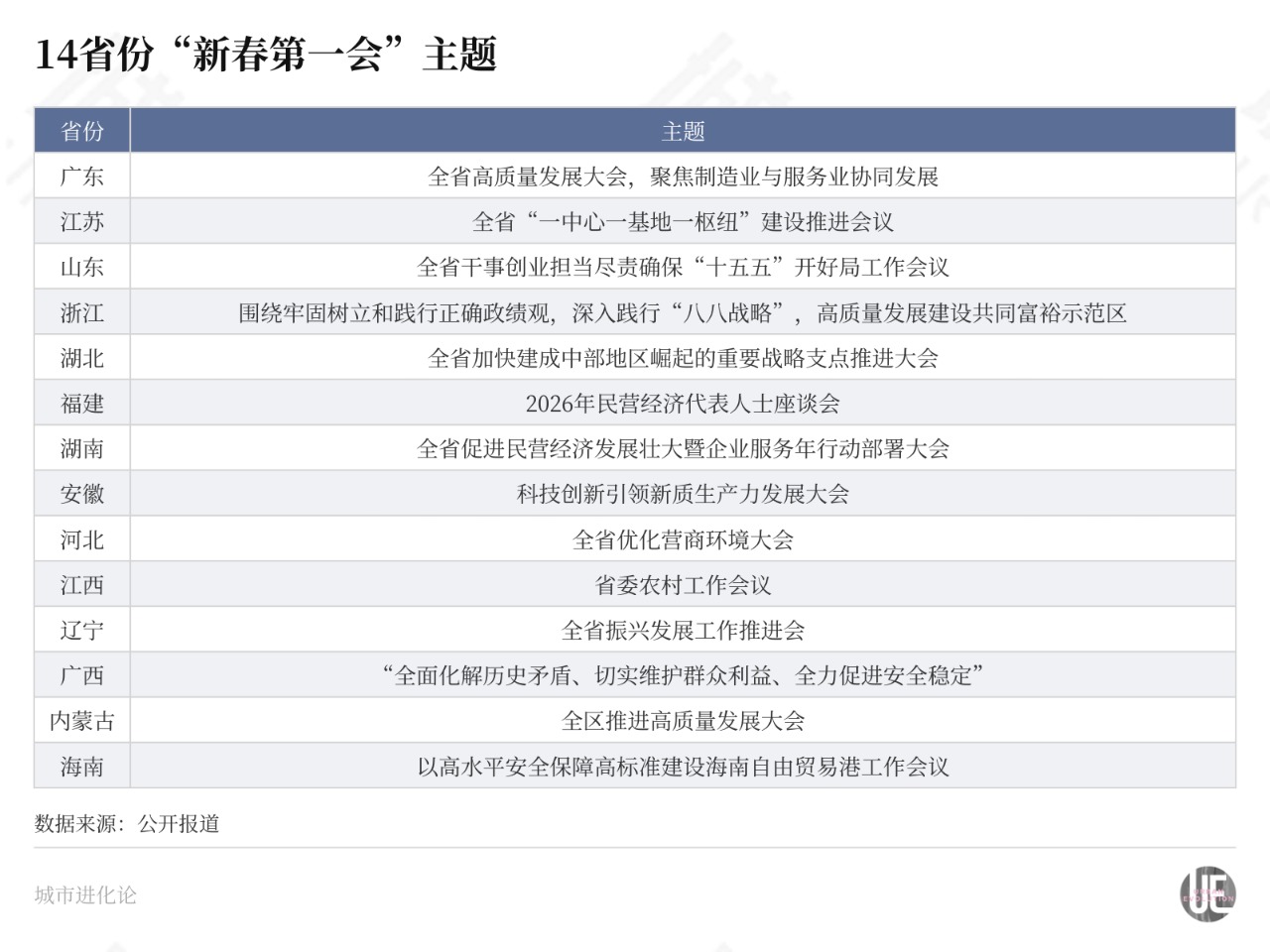
14省份“新春第一会” 传递出哪些信号?
Mei Ri Jing Ji Xin Wen· 2026-02-24 14:32
Core Insights - The "New Spring First Meeting" held across various provinces serves as a significant indicator for observing development trends and setting strategic directions for the year, particularly at the start of the "14th Five-Year Plan" [1] Group 1: Industry Upgrades - Guangdong's focus on the synergy between manufacturing and service industries highlights the importance of a modern industrial system as a foundation for China's modernization, with a GDP of 14.58 trillion yuan, maintaining the top economic position for 37 consecutive years [3][4] - The need for Guangdong to ascend the "smile curve" of industry, emphasizing advanced R&D and precise brand marketing, is crucial for overcoming current challenges in high-quality development [4][5] - Other provinces like Anhui and Hubei are also prioritizing technological innovation and new industries, with Anhui targeting quantum technology and biomanufacturing as future growth points [6][7] Group 2: Strategic Implementation - Hubei's strategic focus on becoming a key support point for central region development emphasizes specific goals such as increasing the number of large enterprises and enhancing infrastructure [7][8] - Liaoning's emphasis on project-driven growth aims to address investment declines and stimulate economic activity through effective project management and collaboration across industries [9] Group 3: Private Economy - The importance of a favorable business environment is underscored as a core competitive advantage for regional high-quality development, particularly in older industrial bases [10] - Provinces like Hebei and Hunan are actively working to improve their business environments, with Hebei aiming for a significant increase in private sector contributions to GDP by 2025 [12][13] - Fujian's initiatives to enhance the business environment have led to substantial growth in private enterprises, contributing significantly to innovation and economic activity [14]

湖北加快构建现代化产业体系 五大支柱产业均突破万亿
Chang Jiang Shang Bao· 2026-02-10 00:01
Core Insights - Hubei's industrial added value is projected to grow by 6.9% in 2025, surpassing the national average by 1 percentage point, ranking fourth among major industrial provinces [1][2] - The province aims to establish a modern industrial system with Hubei characteristics by 2026, injecting strong industrial momentum into its strategic development [1][5] Industrial Growth and Performance - In 2025, five pillar industries, including optoelectronic information and automotive manufacturing, are expected to exceed 1 trillion yuan, while six advantageous industries will surpass 500 billion yuan [2] - Ten characteristic industries are entering the billion-yuan club, and the "51020" advanced manufacturing industry cluster is undergoing a comprehensive upgrade [2][3] Policy and Investment Initiatives - Hubei is implementing a series of growth-stabilizing policies across various sectors, including automotive, steel, chemicals, and artificial intelligence, with key industries experiencing growth rates exceeding 16% [2] - The province has approved 223 national bond projects and is rolling out 4,082 technological transformation projects, with industrial investment expected to grow by 6.6% [2] Structural Optimization and Innovation - Traditional industries are revitalizing, with automobile and new energy vehicle production reaching 1.836 million and 824,000 units respectively, and new energy vehicles growing at a rate of 43.9% [3] - High-tech manufacturing's added value now accounts for 17.4% of the industrial total, contributing 35.6% to the growth of regulated industries [3] Digital Economy and Infrastructure - Hubei is advancing its digital economy, having built 188,000 5G base stations and achieving a computing power scale exceeding 18,000 P, ranking third nationally [4] - The province has achieved full coverage of provincial-level digital transformation pilot cities for small and medium-sized enterprises, with 101 companies listed as national 5G factories [4] Future Development Plans - For the "14th Five-Year Plan," Hubei aims for a 6.5% growth in industrial added value and an 8% increase in industrial investment by fast-tracking over 4,700 technological transformation projects [5] - The province plans to produce 1 million new energy vehicles and increase the proportion of high-tech manufacturing's added value to over 18% [5] Green Development Initiatives - Hubei is implementing six major green development projects, aiming for a 3% reduction in energy consumption per unit of industrial added value [7] - The province plans to establish 30 green factories and five zero-carbon factories, promoting sustainable industrial practices [7]
湖北官宣:超常规打造广域武汉大都市圈
第一财经· 2026-01-27 03:27
Core Viewpoint - The Hubei provincial government aims to achieve a GDP of 62.661 trillion yuan by 2025, with a growth target of around 5.5% for 2026, emphasizing synchronized growth in residents' income and economic development [2][4]. Economic Growth and Structure - Hubei's economy has shown resilience against the pandemic and other unexpected factors, with a multi-polar development pattern emerging. Wuhan has entered the 2 trillion yuan GDP club, while cities like Xiangyang and Yichang have risen in the rankings of non-provincial capital cities [4]. - The province has added three cities with GDPs exceeding 300 billion yuan and four counties exceeding 100 billion yuan [4]. Infrastructure and Transportation - Hubei's transportation network has significantly improved, with a comprehensive highway system and high-speed rail connections, ranking fifth in the country for high-speed rail mileage [4]. - The province has established itself as a central hub for shipping and logistics, with the Huahu International Airport becoming a major inland air export point [4]. Technological Innovation - Hubei has built eight major technological infrastructures and 45 national key laboratories, leading in various advanced technologies. The number of high-tech enterprises is expected to reach 35,000 by 2025 [4][5]. - The contribution of high-tech manufacturing to industrial growth is projected to be 35.6%, with significant advancements in sectors like storage chips and artificial intelligence [5]. Domestic Demand and Investment - Retail sales of consumer goods are expected to reach 2.79 trillion yuan, with a notable increase in service consumption [5]. - The province has initiated over 30,000 projects with investments exceeding 100 million yuan, enhancing infrastructure and industrial capacity [5]. Foreign Trade and Economic Openness - Hubei's total import and export volume grew by 18.2%, ranking third in the country, with significant increases in trade with ASEAN and the EU [5]. - The province is focusing on high-end equipment and cross-border e-commerce as new growth points in trade [5]. Financial Innovation and Support - Hubei has established 24 provincial-level guiding funds with a total scale of 93.4 billion yuan, supporting over 22,000 enterprises with credit loans [6]. - The province aims to revitalize state-owned assets exceeding 300 billion yuan by 2025, enhancing the financial ecosystem for innovation [6]. Strategic Focus for 2026 - Hubei's key tasks for 2026 include promoting consumption, investment, and exports, while enhancing supply-demand balance and economic stability [8]. - The province plans to explore new consumption growth points in health, culture, and technology, and to expand investment in strategic infrastructure projects [8]. Innovation and Industry Development - Hubei is focusing on integrating financial resources to support innovation, with plans to establish a comprehensive investment fund system [9]. - The province aims to upgrade traditional industries and develop emerging sectors like integrated circuits and aerospace [9][10]. Urban Development and Regional Cooperation - Hubei plans to create a metropolitan area around Wuhan and enhance regional collaboration to boost overall development efficiency [10]. - The province is exploring new models for real estate development, focusing on urban renewal and sustainable practices [10].
湖北省国资委党委书记、主任陈忠:以改革之笔,绘国资国企新蓝图
Xin Lang Cai Jing· 2025-12-04 11:25
Core Insights - The article discusses the ongoing reforms and development strategies for state-owned enterprises (SOEs) in Hubei province, emphasizing their role as a pillar of economic development and market stability as they approach the "14th Five-Year Plan" [2][12]. Group 1: Achievements During the 14th Five-Year Plan - Hubei's state-owned enterprises have significantly improved their scale and strength, with total assets reaching 3.25 trillion yuan, moving up 10 places in national rankings. Revenue is expected to exceed 600 billion yuan by 2025, tripling from the end of the 13th Five-Year Plan, maintaining the highest growth rate in Central China for three consecutive years [3][13]. - The functional role of these enterprises has been effectively demonstrated, with over 1 trillion yuan invested in various infrastructure projects, including 85% of the province's highways and 30% of its railways. They have also built nearly 40,000 units of affordable housing and enhanced grain storage capacity to 1.5 million tons [3][13]. - The restructuring of state-owned enterprises has led to a more rational layout, consolidating 28 enterprises into 10 and forming two new first-level enterprises. Investments in emerging industries have seen growth rates exceeding 50% for three consecutive years [3][13][14]. Group 2: Reform and Innovation - The reform and innovation vitality of Hubei's SOEs has been notably enhanced, with a continuous increase in R&D investment of over 20% annually for five years. The number of high-tech enterprises has risen to 148, and 62 innovation joint ventures have been established [4][14]. - The 20th National Congress of the Communist Party of China has set new missions for SOEs, emphasizing the need to strengthen, optimize, and expand state-owned enterprises, focusing on innovation, effective governance, and market-driven mechanisms [5][16]. Group 3: Future Strategies - Hubei's SOEs will implement three major actions to support the construction of a modern industrial system: enhancing industrial competitiveness through strategic mergers and acquisitions, improving the quality of modern service industries, and upgrading core infrastructure capabilities with an investment of over 1.5 trillion yuan in the next five years [7][17]. - Specific measures for deepening reforms include optimizing the layout and structure of SOEs, fostering collaborative innovation mechanisms, and establishing a flexible market-oriented operational framework [8][18].

湖北省国资委:强化资本运作 以战略性并购重组为手段加快省属实体产业转型升级
Zheng Quan Shi Bao Wang· 2025-12-04 02:46
Core Viewpoint - The Hubei Provincial State-owned Assets Supervision and Administration Commission aims to enhance the competitiveness of modern industries through the "Industry Foundation Strengthening Chain" initiative, focusing on strategic mergers and acquisitions for the transformation and upgrading of state-owned enterprises [1] Group 1: Strategic Initiatives - The initiative will be implemented over the next five years, targeting a revenue share of over 50% from pillar industries such as automotive manufacturing and modern chemical industries [1] - The plan emphasizes a "three-line advance" strategy, which includes strengthening capital operations [1] Group 2: Emerging Industries - The focus will also be on emerging industries like low-altitude economy and artificial intelligence, aiming to create a cohesive industrial chain [1] - Future-oriented industries, such as humanoid robotics, will be strategically positioned within Hubei's unique modern industrial system [1]
金融活水浇灌科创沃土,中国银行湖北省分行科技金融贷款余额突破千亿
Zhong Guo Jin Rong Xin Xi Wang· 2025-09-16 07:29
Core Viewpoint - The article emphasizes the role of technology finance in enhancing financial services for the real economy and supporting emerging industries in Hubei province, China [1] Group 1: Financial Support and Growth - As of August 2025, the technology finance loan balance of Bank of China Hubei Branch reached 100.712 billion yuan, with an increase of 13.487 billion yuan, representing a growth of 15.37% since the beginning of the year [1] - Key industries such as optoelectronic information, automotive manufacturing, and health care have reached a scale of over one trillion yuan, while energy conservation, high-end equipment, and new materials have surpassed five hundred billion yuan [1] Group 2: Innovative Financial Services - The bank has established a technology finance center at the primary department level and set up 11 specialized technology finance outlets in high-tech parks and development zones [2] - The bank has tailored financial products like "knowledge value credit loans" for technology companies, allowing them to secure funding without traditional collateral [4] Group 3: Comprehensive Financial Ecosystem - The bank has launched a comprehensive financial product matrix to support technology enterprises throughout their lifecycle, including products for seed, growth, and mature stages [5] - A total of 100 billion yuan AIC equity investment fund was established to focus on new-generation electronic information, new energy, artificial intelligence, and new materials [6] Group 4: Collaborative Efforts and Partnerships - The bank has collaborated with various government departments and investment institutions to enhance support for specialized and innovative small and medium-sized enterprises, achieving a credit coverage rate of 30.50% for provincial-level specialized enterprises [7] - The bank has actively engaged in partnerships with venture capital firms and other financial institutions, facilitating equity financing of 1.155 billion yuan for sectors like biomedicine and new energy vehicles [7]

湖北聚焦产业倍增战略“三线并进” 五大支柱产业2025年有望全部迈入万亿级
Chang Jiang Shang Bao· 2025-09-02 23:55
Core Insights - Hubei Province is committed to enhancing its industrial economy during the "14th Five-Year Plan" period, aiming for significant growth in industrial output and modernization of its industrial structure [1][2][7] Industrial Growth and Structure - By 2024, Hubei's industrial enterprises are projected to generate revenues of 4.7 trillion yuan, ranking second in Central China, with a manufacturing value added of 1.76 trillion yuan [1] - The province has over 20,000 industrial enterprises, with 19 industries expected to reach a scale of 100 billion yuan [2] - Hubei's strategic focus includes upgrading traditional industries, nurturing emerging sectors, and planning for future industries [2][9] Technological Innovation - Hubei has been recognized as one of five provinces in the "National Action to Stimulate Industrial Innovation" initiative, with significant advancements in manufacturing innovation centers and R&D capabilities [3][8] - The province's R&D investment is expected to grow by 12.2% in 2024, with a strong emphasis on patent generation and technology breakthroughs [8] Digital Transformation - The number of 5G base stations in Hubei has increased from 31,000 at the end of the "13th Five-Year Plan" to 176,000, marking a 4.6-fold increase [4] - Over 58,000 industrial enterprises have adopted cloud computing, representing nearly 60% of the total, with significant growth in the digital economy [4] Green Manufacturing - Hubei has achieved an 11.8% reduction in energy consumption per unit of industrial value added, with a strong focus on green manufacturing practices [5] - The province has created 268 national-level green factories, contributing to 24.72% of the total industrial output [5] Emerging Industries - Strategic emerging industries are expected to play a crucial role in Hubei's economic future, with high-tech manufacturing value added growing at an annual rate of 19.7% [7] - By 2024, the value added from the digital economy is projected to exceed 50% of the total, maintaining Hubei's leading position in Central China [7] Investment and Support - Hubei plans to continue its support for strategic emerging industries during the "15th Five-Year Plan," focusing on enhancing innovation capabilities and promoting the integration of technology and industry [9]
湖北高新技术企业近五年增长2.9倍
Zhong Guo Xin Wen Wang· 2025-09-02 15:28
Group 1 - Hubei Province's high-tech enterprises have increased by 2.9 times since the beginning of the 14th Five-Year Plan, with projections to exceed 30,000 by 2024, ranking first in Central China [1] - The province's focus on emerging industries, represented by "light, chip, screen, terminal, and network," is seen as a new competitive advantage, with key clusters continuously developing [1] - By 2024, three major industries in Hubei—optoelectronics information, automotive manufacturing and services, and health—are expected to surpass 1 trillion yuan in scale, while several advantageous industries will exceed 500 billion yuan [1] Group 2 - The biopharmaceutical manufacturing revenue in Hubei is projected to reach 123.5 billion yuan in 2024, reflecting a year-on-year growth of 3.5% [1] - China Information Communication Technology Group is focusing on AI and computing infrastructure opportunities, aiming to enhance development scale and strengthen collaboration with leading enterprises in Hubei [2] - Hubei will continue to increase support for strategic emerging industries, emphasizing the construction of innovation platforms led by national laboratories and research institutions [2]
湖北五大支柱产业有望全面突破万亿级
Zhong Guo Chan Ye Jing Ji Xin Xi Wang· 2025-08-29 00:26
Core Viewpoint - Hubei province is set to achieve significant breakthroughs in five major pillar industries by the end of the 14th Five-Year Plan, with a focus on technological innovation and industrial upgrades [1] Group 1: Industry Development - By the end of the 14th Five-Year Plan, Hubei's five pillar industries, including optoelectronic information, automotive manufacturing and services, modern chemicals, health care, and modern agricultural product processing, are expected to exceed 1 trillion yuan each [1] - Hubei is advancing traditional industry upgrades, emerging industry growth, and future industry cultivation simultaneously, with a structured approach to its advanced manufacturing industry clusters [1] - Wuhan has become the world's largest production base for optical fibers and cables, as well as the largest base for optical devices and small-sized display panels in China [1] Group 2: Innovation and Enterprise Development - Hubei has over 20,000 industrial enterprises above designated size, with 11 key enterprises in national manufacturing chains, ranking 5th in the country [2] - The province has 7,187 specialized and innovative small and medium-sized enterprises, with 722 recognized as national "little giant" enterprises, ranking 7th nationally [2] - The coverage rate of R&D institutions in large-scale industrial enterprises has increased from 12.96% in 2020 to 31.8% currently [2] Group 3: Innovation Network and Platforms - Hubei has established 12 provincial manufacturing innovation centers, with 2 upgraded to national level, enhancing the innovation ecosystem [3] - The National Information Optoelectronic Innovation Center has achieved a significant technological breakthrough in silicon photonics, marking a milestone in the field [3] - Hubei has initiated the construction of provincial-level manufacturing pilot platforms, with 40 platforms recognized for their contributions to industry [3] Group 4: Technology Transfer and Talent Development - Since 2021, Hubei has allocated approximately 150 million yuan annually for industry technology breakthroughs, facilitating the selection of key technologies for innovation [3] - The province has dispatched 1,476 technology talents to assist enterprises in solving technical challenges, resulting in significant technology transfer and collaboration [3] - Hubei supports enterprises with low-cost funding through interest subsidies to promote R&D innovation and technological upgrades [3]
湖北五大支柱产业有望全面突破万亿级 加快建设具有全国影响力的科技创新高地
Chang Jiang Shang Bao· 2025-08-20 23:55
Core Viewpoint - Hubei Province is focusing on high-quality planning for the "15th Five-Year Plan" in technology innovation, aiming to establish itself as a significant strategic support for the rise of the central region of China through enhanced technological capabilities [1] Group 1: Achievements in Technology Innovation - During the "14th Five-Year Plan," Hubei's technology innovation has significantly contributed to high-quality economic and social development, with a notable increase in innovation capabilities [2] - Hubei's ranking in global technology clusters improved from 29th in 2020 to 13th, while its research city ranking rose from 13th to 9th [2] - The number of high-tech enterprises in Hubei increased from 10,404 at the end of the "13th Five-Year Plan" to nearly 30,000, nearly doubling [4] Group 2: Systematic Restructuring of Technological Forces - Hubei achieved a breakthrough with the establishment of national laboratories, reaching a total of 8 "national key laboratories" and 45 national key laboratories after optimization, ranking 4th in the country [3] - The number of new research institutions reached 545, covering all cities and counties in Hubei [3] - The total research and development expenditure increased from 1,005.28 billion to 1,408.17 billion, a growth of 40.08% [4] Group 3: Integration of Technological and Industrial Innovation - The total value of technology contracts increased from 168.7 billion to 550 billion, ranking third in the country [4] - The core industry value added of the digital economy rose from 240.2 billion to 574.3 billion, a growth of 139% [4] - The number of national-level specialized and innovative "little giant" enterprises reached 722, ranking 7th nationwide [5][6] Group 4: Building an Innovation Network - Hubei has established 12 provincial manufacturing innovation centers, with 2 upgraded to national level [7] - The province has initiated a technology innovation special loan program, with over 2,300 enterprises included in the "white list" and loans exceeding 14 billion issued [7] - A total of 1,476 technology talents have been dispatched to assist enterprises in solving technical problems, resulting in 2,789 technology achievements being transformed [7]