
电气工程

Search documents
Non-Union Project Managers Wanted The Same Wage As Union Engineers. Dave Ramsey Replied, 'I'm Not Trying To Bust A Union, But…'
Yahoo Finance· 2026-02-18 18:31
Core Insights - The podcast discusses the pay disparity between project managers and union field engineers, highlighting that project managers now earn less than the engineers they supervise [1][5]. Group 1: Pay Structure and Market Dynamics - Historically, office staff, including project managers, earned more than field crews, but this has now reversed, with union field engineers earning higher salaries [2][4]. - The difference in pay is attributed to the distinct roles and market values of the positions rather than fairness, as emphasized by the personal finance expert [4][5]. - The labor market analysis indicates that project managers cannot significantly increase their income by switching jobs, while union engineers also face similar limitations in salary growth at non-union competitors [6][7].
德国经济信心逆势回升,关税阴影下欧洲复苏拐点临近
Sou Hu Cai Jing· 2026-01-20 20:46
Group 1 - The latest changes in Germany's economic outlook are breaking previous pessimistic expectations surrounding external risks, with market sentiment showing significant improvement at the beginning of the year [2] - In January, Germany's economic confidence saw a substantial increase, with the economic climate index rising sharply, reaching its highest point since summer 2021, significantly exceeding cautious market expectations [2] - The overall sentiment in the Eurozone is also recovering, with economic climate indicators reaching a six-month high, indicating a clear improvement in the assessment of the current economic situation [2] Group 2 - Export-related sectors are the main drivers of the sentiment rebound, with significant increases in the economic indices for traditional industries such as machinery manufacturing, steel, and metal processing [3] - The automotive industry, while still at a relatively low level, has established a trend of improvement, alongside stronger expectations in the chemical, pharmaceutical, and electrical engineering sectors [3] - The recent confidence recovery is closely linked to better-than-expected industrial output and new order data from late last year, as well as the advancement of the EU's free trade agreement with the Southern Common Market, which opens new growth opportunities for German exporters [3] Group 3 - Political statements at the European level are crucial, with the European Commission President emphasizing that current geopolitical tensions present both challenges and opportunities for Europe's strategic transformation [4] - The EU will firmly support Denmark and Greenland, enhancing stability in the Arctic region through investment, infrastructure development, and defense cooperation [4] - Warnings have been issued that tariff escalations against allies do not align with long-term interests and could exacerbate divisions, providing opportunities for external adversaries [4]


出口下滑似“自由落体”,德国经济复苏靠谁?
Huan Qiu Shi Bao· 2026-01-12 22:41
Core Insights - Germany's export data for November 2025 shows a significant decline of 2.5% month-on-month, raising concerns about the country's economic recovery in 2026 [1][2] - The decline in exports is attributed to multiple pressures, including weak overseas demand, geopolitical risks, and increasing competitive pressures [2][3] - Despite some positive signals in domestic production, the overall economic recovery remains uncertain, with industrial production expected to decline for the fourth consecutive time [3][4] Export Performance - In November 2025, Germany's exports to the United States fell by 4.2% to €10.8 billion, with a year-on-year decrease of nearly 23% [2] - Exports to EU countries also decreased by 4.2%, totaling approximately €73.1 billion, with specific declines of 3.9% to Eurozone countries and 4.8% to non-Eurozone EU members [2] - The trade surplus of Germany is narrowing, indicating that the export sector may have passed its peak [2] Economic Outlook - The German economy is facing a slow recovery, with growth forecasts for 2026 being revised down to 0.6% by the Deutsche Bundesbank and 0.8% by the Ifo Institute [4] - Structural transformation is occurring at a high cost, with challenges in unemployment, productivity, and growth persisting [4] - Some economists remain cautiously optimistic, citing government investments in defense and infrastructure as potential growth drivers [3][4] Trade Relations with China - In November 2025, Germany's exports to China increased by 3.4% to €6.5 billion, while imports from China rose by 8.0% to €14.9 billion [5][6] - China has regained its status as Germany's most important trading partner, providing a glimmer of hope amid declining exports to other markets [5][6] - Future trade prospects between Germany and China are viewed positively, with expectations for continued demand in various industrial sectors and expanding technological cooperation [6]
2025年德国企业破产数量升至20年来最高水平
Sou Hu Cai Jing· 2026-01-09 00:10
Core Insights - The number of corporate bankruptcies in Germany is projected to reach its highest level in 20 years by 2025, indicating significant economic challenges faced by the country [1][2] Group 1: Bankruptcy Statistics - In 2025, Germany recorded 17,604 corporate bankruptcies, which is approximately 5% higher than the peak during the global financial crisis in 2009 [1] - December 2025 alone saw 1,519 companies declare bankruptcy, representing a 75% increase compared to the average from 2016 to 2019, prior to the pandemic [1] - The hospitality and restaurant sectors experienced a notable rise in bankruptcies, alongside significant failures in the construction industry and project developers [1] Group 2: Large Enterprises - The number of bankruptcies among large enterprises, defined as those with annual revenues exceeding 10 million euros, increased by about 25% in 2025, totaling 471 bankruptcies [1] - Affected industries for large enterprises include metal products manufacturing, automotive parts, electrical engineering, and interior decoration [1] - Since 2021, the number of bankruptcies among large enterprises has nearly doubled [1] Group 3: Economic Implications - The high number of bankruptcies cannot be solely attributed to post-pandemic recovery effects or changes in interest rate policies, but rather reflects the ongoing economic challenges in Germany [2] - Corporate bankruptcies may facilitate necessary market clearing, allowing space for more competitive businesses to emerge [2]
2026光博会观众组团福利打包向您发来,火速邀请伙伴参与!
半导体行业观察· 2025-12-06 03:06
Group 1 - The 2026 Munich Shanghai Optical Expo will take place from March 18-20, 2026, at the Shanghai New International Expo Center, inviting attendees to join the audience group plan with enhanced benefits [2] - The event aims to attract participants from various sectors including electrical engineering, electronics, telecommunications, chemical/pharmaceutical, medical technology/biotechnology, automotive, agriculture, semiconductor, energy, precision machinery, aerospace/aviation, materials processing, transportation, tool manufacturing, industrial robotics, lighting/displays, environmental and safety technology, defense industry, trade, textile, food industry, academia, non-university research institutions, and government/public services [5] - The registration process for the audience group involves several steps including scanning a QR code, verifying personal mobile numbers, selecting group registration, filling in personal information, and completing the registration [6][8][10][14][15] Group 2 - Participants can invite team members through three methods: adding members directly, sharing with colleagues, or importing members via an Excel template [18][20][22][24] - The event organizers will review group applications promptly and send a team visit guide before the event, which includes details on how to receive group benefits [26] - Contact information for group inquiries is provided, including a phone number and email address for further assistance [27]

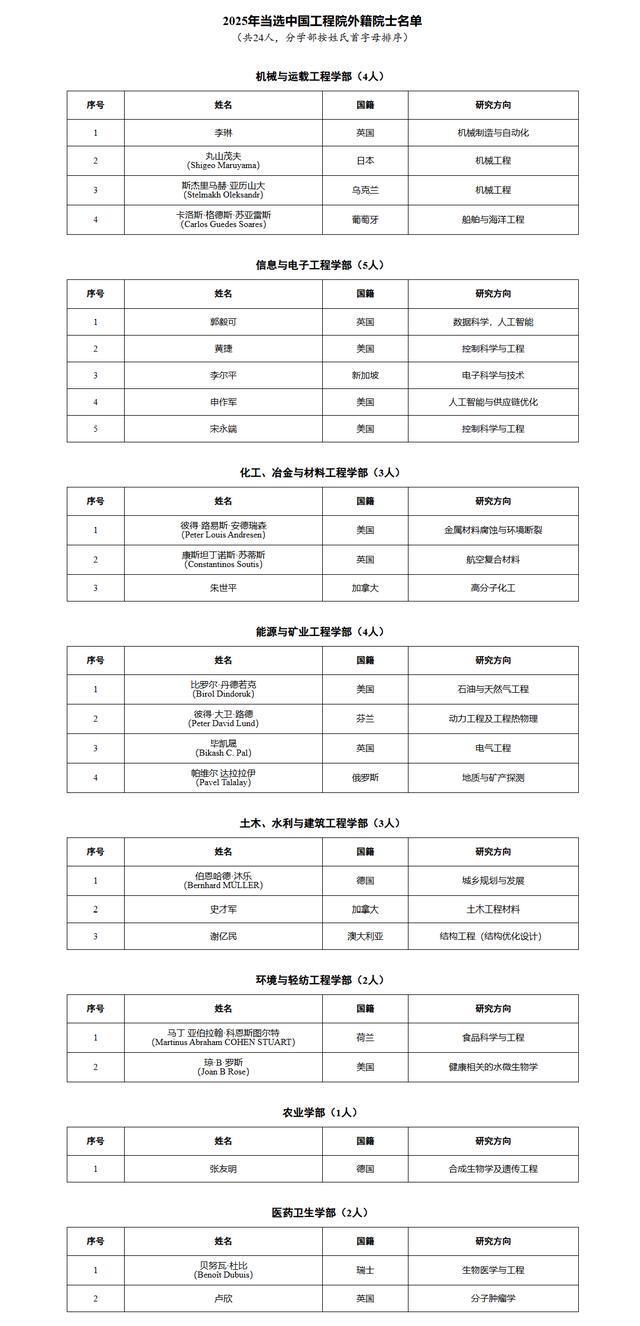
关于公布中国工程院2025年院士增选当选外籍院士名单的公告
Huan Qiu Wang Zi Xun· 2025-11-21 01:36
Core Points - The Chinese Academy of Engineering has elected 24 foreign academicians for the year 2025 [1][2][3] Group 1: Elected Academicians - The list includes academicians from various countries and their respective research fields, such as mechanical manufacturing and automation from the UK, and marine engineering from Portugal [4][6][10] - Notable names include Shigeo Maruyama from Japan specializing in mechanical engineering and Carlos Guedes Soares from Portugal focusing on shipbuilding and ocean engineering [4][10] - The elected academicians represent a diverse range of disciplines, including data science, artificial intelligence, and biomedical engineering [6][19]
调查显示德国工业企业持续受困于关税冲击
Xin Hua She· 2025-10-23 15:36
Core Insights - The latest survey by the German Metalworkers' Union indicates that high energy costs, declining orders, and protectionist tariffs are putting continuous pressure on German industrial companies, with over half of employees expressing concerns about job stability [1] Group 1: Economic Conditions - The survey, conducted in September, included over 2,600 industrial companies across sectors such as machinery, automotive, metals, electrical engineering, and information technology, representing more than 1.3 million employees, which is over half of the union's membership [1] - The report highlights that the sluggish economic situation is a significant factor contributing to uncertainty, with nearly no improvement in the industrial outlook in recent months [1] Group 2: Employee Concerns - 47% of industry representatives surveyed believe the outlook for the next three months is poor, and 51% of respondents are worried about job stability, particularly in the automotive and metal industries [1] Group 3: Competitive Threats - High energy costs, low order volumes, and the impact of U.S. tariff policies are identified as major challenges for German companies, with 43% of industrial firms feeling that their competitiveness is severely or very severely threatened, especially in energy-intensive sectors [1] Group 4: Operational Adjustments - Due to a lack of orders, nearly one-fifth of surveyed industrial companies have had to implement short-time work arrangements [1] Group 5: Strategic Recommendations - The German Metalworkers' Union urges companies to actively pursue strategic transformation and innovation, accelerating development in sustainable areas such as artificial intelligence, circular economy, and battery technology [1]
人民日报看新疆 | 科创企业在这里拔节生长(砥砺奋进七十载 天山南北谱华章)
Ren Min Ri Bao· 2025-10-10 02:14
Core Viewpoint - Xinjiang is focusing on developing characteristic advantageous industrial clusters and implementing an innovation-driven development strategy, leading to significant advancements in technology and productivity in the region's agricultural machinery sector [1][2]. Group 1: Technological Advancements - The automated workshop of Boshiran Intelligent Agricultural Machinery Company showcases the efficient production of various agricultural machinery, including cotton pickers, which are crucial for agricultural productivity [1]. - The introduction of six-row self-propelled cotton pickers allows for the harvesting of 500 acres of cotton in a single day, equivalent to the work of over a thousand laborers [2]. - The domestic production rate of six-row cotton pickers has exceeded 90%, achieving international advanced levels [4]. Group 2: Policy Support and Financial Assistance - The local government is actively supporting innovation through funding and project approvals, which are essential for the sustainable development of small and medium-sized enterprises [2][3]. - Companies can now use technology patents, intellectual property, and research contracts as collateral to secure funding for product development, alleviating financial pressures [3]. - The implementation of policies such as "innovation points system" and "white list" mechanisms has led to the establishment of a robust ecosystem for high-tech enterprises, with the number of high-tech companies in Urumqi High-tech Zone reaching 306 by 2024 [3]. Group 3: Investment in Research and Development - Xinjiang has committed to an annual investment of 2 billion yuan in local fiscal science and technology funding and has established a talent development fund of 10 billion yuan to enhance the region's innovation capabilities [5]. - The total expenditure on research and development (R&D) in the region is projected to reach 11.55 billion yuan in 2024, marking a 27% increase [5]. - The number of high-tech enterprises in Xinjiang has grown by 32%, reaching a total of 2,529 [5].
新疆:科创企业在这里拔节生长
Ren Min Ri Bao· 2025-10-09 03:36
Group 1 - The core viewpoint of the articles highlights the significant advancements in technology and innovation within the agricultural and technology sectors in Xinjiang, particularly through the development of automated machinery and support from local government policies [1][2][3][4] Group 2 - The company Boshiran has developed a fully automated workshop for manufacturing agricultural machinery, achieving a series of technological breakthroughs and holding 246 patents, positioning itself as a leading domestic cotton picker manufacturer [1] - The introduction of advanced cotton-picking machines has drastically increased efficiency, with one machine capable of harvesting 500 acres of cotton in a day, equivalent to the work of over a thousand manual laborers [1] - The Xinjiang region is projected to produce approximately 92% of China's cotton in 2024, with a mechanization rate exceeding 85%, supported by strong technological advancements [1] Group 3 - The local government in Urumqi High-tech Zone is actively supporting innovation through funding and project recommendations, which has enabled companies like Beidou Tongchuang to secure loans for research and development [2] - Beidou Tongchuang's AI operation management platform has reduced fault detection time by 83% and operational costs by 30%, showcasing the impact of technological innovation on efficiency [2] Group 4 - Xinjiang Tianceng Luyuan Electric Engineering Co., Ltd. benefited from the high-tech zone's credit policies, receiving a loan of 4.6 million yuan, which significantly alleviated their R&D funding pressure and doubled their revenue in the first quarter [3] - The Urumqi High-tech Zone has implemented various supportive policies, resulting in a total of 306 high-tech enterprises by 2024, making it one of the regions with the highest number of high-tech companies in the autonomous region [3] Group 5 - Significant scientific achievements in Xinjiang include the domestic production of six-row cotton-picking machines with over 90% localization, advancements in deep earth drilling capabilities, and improvements in the purity of polysilicon [4] - The Xinjiang government has committed to an annual investment of 2 billion yuan in scientific research and established a talent development fund of 10 billion yuan, enhancing the region's innovation capacity [4] - By 2024, R&D expenditure in Xinjiang is expected to reach 11.55 billion yuan, reflecting a 27% increase, with the number of high-tech enterprises growing by 32% to 2,529 [4]
砥砺奋进七十载 天山南北谱华章丨科创企业在这里拔节生长
Ren Min Ri Bao· 2025-10-09 02:56
Core Viewpoint - The development of intelligent agricultural machinery in Xinjiang, particularly by the company Boshiran, showcases significant advancements in technology and innovation, leading to increased efficiency in cotton harvesting and overall agricultural productivity [1][2][4]. Group 1: Company Innovations - Boshiran has developed a fully automated workshop capable of efficiently producing various agricultural machinery, including cotton pickers and fertilization machines, demonstrating a commitment to research and innovation [1]. - The company has achieved 246 patents with complete independent intellectual property rights, positioning itself as a leading domestic manufacturer of cotton pickers [1][2]. - The introduction of a six-row self-propelled cotton picker allows for the harvesting of 500 acres of cotton in a single day, equivalent to the work of over a thousand manual laborers [2]. Group 2: Policy Support and Financial Assistance - The company has received support from local government initiatives, including recommendations for two regional-level technology projects that will provide financial backing upon approval [2]. - The innovation credit policy in Urumqi High-tech Zone allows technology companies to use patents and awards as collateral for loans, facilitating funding for research and development [3]. - The establishment of a "white list" for technology enterprises has enabled companies like Xinjiang Tiancheng Luyuan Electric Engineering to secure significant loans, alleviating financial pressures and doubling revenue in the first quarter compared to the previous year [3]. Group 3: Regional Technological Advancements - Xinjiang has seen a surge in technological innovations, with the domestic production rate of six-row cotton pickers exceeding 90%, reaching international advanced levels [4]. - The region has committed to investing 20 billion yuan annually in scientific research and has established a 100 billion yuan talent development fund to enhance its technological capabilities [4]. - By 2024, Xinjiang's R&D expenditure is projected to reach 11.55 billion yuan, marking a 27% increase, with the number of high-tech enterprises growing by 32% to a total of 2,529 [4].