《开心消消乐》

Search documents
发展论坛:4大报告发布,未保、AI有何新发展?
Sou Hu Cai Jing· 2026-01-26 13:42
Core Insights - The 2024 China Game Industry Annual Conference highlighted significant trends and developments in the gaming sector, including the release of multiple key reports on market trends, youth protection, and mobile gaming [1][3][6] Group 1: Global Console Game Market - The global console game market is experiencing a slowdown in growth, yet the domestic market shows significant improvement with substantial growth [4] - The increase in "free + in-app purchase" model games indicates a potential for further development in the console gaming sector [4] - The exploration of user payment potential is crucial for industry growth, with emotional connections driving the prosperity of peripheral markets [4] - Emerging channels like live streaming and short videos are stimulating potential consumption in console gaming, suggesting room for expansion [4] Group 2: Youth Protection in Gaming - Recent measures to prevent gaming addiction among minors have shown effectiveness, with 24.9% of minors playing more than three hours per week in 2024, a 37.2% decrease from 2021 [4] - A significant 59.04% of minor gamers have not engaged in any in-game purchases over the past year, with over 80% either not paying or spending 30 yuan or less monthly [4] - 75.09% of minor gamers meet anti-addiction standards, with 49.83% not exceeding the time limits and 25.26% stopping play upon receiving anti-addiction prompts [4] Group 3: Trends in the Gaming Industry - Six major trends are identified to drive a new wave of growth in the gaming industry, including the casualization of heavy games and the shift towards emotional value in user demand [6] - The potential for small program games to expand internationally and the rise of original Chinese game IPs are highlighted as significant opportunities [6] - Global simultaneous releases are expected to generate additional revenue and alleviate competitive pressures [6] - Multi-channel payment options are anticipated to enhance user willingness to pay [6] Group 4: Regional Development and Industry Support - The Shijingshan District is undergoing a transformation, focusing on modern finance and information services while actively investing in AI, virtual reality, and other future industries [8] - The district aims to create a sci-fi gaming industry cluster and enhance the business environment to promote high-quality regional development [8] Group 5: Corporate Strategies and Innovations - SNK emphasizes the importance of long-term commitment to quality games and adapting to player needs while expanding its global presence [10] - The focus on mini-games is driven by short return cycles and significant market potential, with innovation being key to success [12] - Tencent has implemented various measures for youth protection, including enhanced facial recognition strategies and educational initiatives for parents [14][15] - The gaming industry is witnessing a resurgence in PC marketing value, with a focus on enhancing user experience and leveraging AI technology for game development [23][30]


2025游戏公益盛典:游戏赋能公益行动,探索新模式
Cai Jing Wang· 2025-12-19 10:15
Core Viewpoint - The gaming industry in China is evolving into a significant force for cultural innovation and social welfare, with a focus on integrating public welfare into its development strategy [1][2]. Group 1: Industry Trends and Initiatives - The "2025 Game Public Welfare Festival" highlights the gaming industry's role in social responsibility and cultural transmission, emphasizing the need for continuous innovation in public welfare content [1]. - The "2024-2025 Social Responsibility Report" suggests that gaming companies should collaborate with regulatory bodies and media to enhance social governance and promote cultural dissemination [2]. - Companies like Shengqu Games and Boke Technology are leveraging their creative and technological strengths to foster a culture of social responsibility and community engagement through various projects [2][3]. Group 2: Cross-Industry Collaborations - Boke Technology's "Game+" initiative integrates gaming with sectors like healthcare and education, demonstrating the potential of games to contribute positively to society [3]. - Companies such as Haoying Network are exploring new cultural dissemination paths by linking gaming IP with intangible cultural heritage projects, aiming to create educational content [3]. - Le Element's approach to public welfare focuses on connection and action, utilizing gaming to support various charitable initiatives and educational projects [3]. Group 3: Digital Asset Discussion - The roundtable discussion on digital asset circulation in the gaming industry emphasizes the importance of establishing a secure and transparent framework for collaboration among operators, platforms, and players [5][6]. - Experts highlight that digital assets represent a core element of user engagement and monetization strategies, necessitating a cooperative governance model to address existing challenges [6].
这份“00后”用户报告,藏着游戏厂商最想了解的新生代秘密
Sou Hu Cai Jing· 2025-12-16 16:14
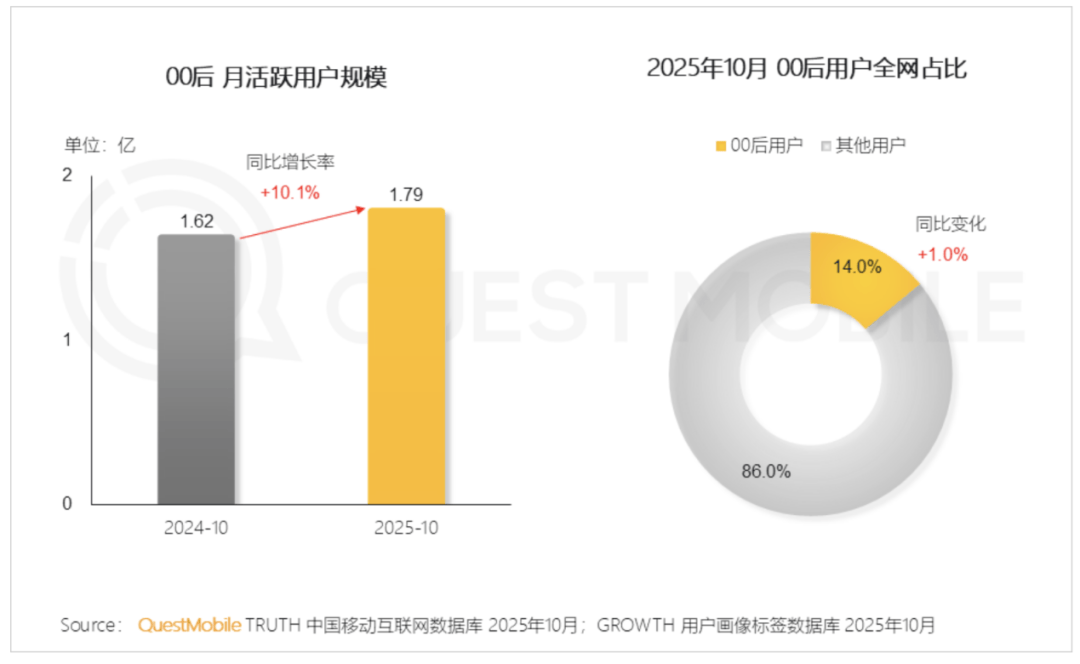
Group 1 - The core viewpoint of the report is that the "post-00s" generation in China, numbering 179 million, is characterized by strong social interaction, a preference for entertainment experiences, and rapid adoption of new technologies, particularly AI [1][6][19] - The "post-00s" users spend an average of 217.6 hours online monthly, with a usage frequency of 3296.7 times, which is significantly higher than the average for all internet users [1][4] - This generation shows a notable preference for mobile video content, accounting for 37.1% of their online activity, followed by social media and gaming at 25.2% and 9.7% respectively [7][11] Group 2 - The report highlights that "post-00s" users are not just gamers but have evolved into deep participants in the esports ecosystem, with significant engagement in events like the League of Legends S15 and KPL finals [13] - Popular games among this demographic include "Honor of Kings" with 42.5 million monthly active users and "Happy Elimination" with 25.2 million, indicating a strong preference for MOBA, strategy, and shooting games [11] - The report emphasizes the importance of emotional value in consumption behavior, where experiences and content serve to enhance their social identity and community engagement [19][21] Group 3 - The "post-00s" generation is increasingly engaging with AI-generated content (AIGC), with active user participation rising by 20.1% over the past year, indicating a strong trend towards innovative content and interactive experiences [6][9] - Platforms like Douyin and Kuaishou dominate their video entertainment preferences, while Bilibili, Tencent Video, Mango TV, and iQIYI each have over 50 million monthly active users among this demographic [15][17] - The report notes that the "post-00s" are driving trends in the "Guzi economy," particularly in collectible toys like blind boxes from Pop Mart, where they represent 43.7% of the user base, showcasing their interest in IP culture [21][24]
QuestMobile 2025“00后”用户消费洞察报告:三线及以上活跃占比近八成,高城市化、高黏性与大纵深特性悄然撬动大变局
3 6 Ke· 2025-12-10 06:28
Core Insights - The "post-00s" demographic in mobile internet has reached 179 million monthly active users, accounting for 14% of the total online user base, with a year-on-year growth of 10.1% [1][7] User Engagement and Behavior - The average monthly usage time for "post-00s" users is 217.6 hours, and the average number of uses is 3296.7 times, both significantly higher than the overall user average by 18.7% and 24.0% respectively [9][12] - "Post-00s" users show a strong preference for mobile video, social interaction, and gaming, with mobile video usage time accounting for 37.1% of their total usage, reflecting a 1.3 percentage point increase year-on-year [14][18] Application Preferences - In the AIGC sector, the monthly active user numbers for Doubao, DeepSeek, and Tencent Yuanbao are 42.72 million, 26.97 million, and 6.785 million respectively, indicating a strong engagement with these platforms [23][24] - The gaming preferences of "post-00s" users are concentrated in MOBA, strategy, and shooting games, with popular titles like "Honor of Kings" and "Happy Elimination" leading in user numbers [27][26] Consumption Patterns - "Post-00s" exhibit stable online consumption willingness and capability, with over 90% showing medium to high consumption intent, and nearly 80% of users having a spending capacity between 1000-2999 yuan [20][22] - The e-commerce landscape is dominated by major platforms like Taobao, JD, and Pinduoduo, each with over 100 million monthly active users from the "post-00s" demographic, reflecting a double-digit growth trend [33] Urbanization and Demographics - High urbanization rates among "post-00s" are evident, with significant concentrations in first-tier and new first-tier cities, driven by advantages in education, employment, and digital infrastructure [16] Social and Emotional Consumption - "Post-00s" display a dual-track emotional consumption pattern, seeking both personal fulfillment and social capital accumulation, which shapes their overall value satisfaction [39][41] - The interest in live events and high-interaction entertainment activities is notable, with a significant proportion of "post-00s" engaging in esports and offline performances [44]

AGF亚洲游戏博览会盛大开幕!国庆来广州看世界顶级游戏展
2 1 Shi Ji Jing Ji Bao Dao· 2025-10-03 03:25
Group 1 - The AGF Asia Game Expo held in Guangzhou from October 2 to 5 serves as a significant platform for promoting cultural tourism consumption during the National Day holiday and advancing the "game dimension economy" [1] - The main venue covers an area of 82,000 square meters, featuring over 1,000 global brands and more than 7,000 IP peripheral products, along with over 100 special events [1] - Major gaming companies such as Tencent Games, NetEase Games, and Ubisoft participated, showcasing popular game IPs and hosting exclusive offline trial events [1] Group 2 - The Hong Kong Animation and Game Pavilion made its debut with 28 local brands, including 3MindWave and Tianming Entertainment, featuring interactive sessions with cosplay characters [2] - High-profile esports events such as the League of Legends Challenge Cup and the Capcom Street Fighter 6 World Tour are scheduled to take place during the expo [2]
十年前的装机必备手游们,如今过得怎么样?| 玩点好的
3 6 Ke· 2025-09-27 08:56
Core Insights - The article discusses the evolution of mobile games from their early days to the current landscape, highlighting the shift in player expectations and technological advancements that have transformed the industry [1][46]. Group 1: Early Mobile Games - Early mobile games were characterized by simple gameplay, instant feedback, and low entry barriers, appealing to a wide audience including children and non-gamers [15][46]. - Popular genres included endless runner games like "Temple Run" and "Subway Surfers," which achieved significant download milestones, with "Temple Run" surpassing 1 billion downloads by 2014 [4][20]. - Puzzle games like "Angry Birds" and "Cut the Rope" also gained immense popularity, with "Angry Birds" reaching over 1 billion downloads early on [12][14]. Group 2: Challenges and Market Changes - The mobile gaming industry has faced challenges due to technological advancements and changing player demands, with players now seeking deeper, more immersive experiences [17][46]. - Casual games are increasingly competing with other forms of entertainment, such as short videos, which have begun to occupy the market space previously held by mobile games [17][18]. - Many early successful games struggle with monetization, facing issues like high user activity but low spending, leading to a need for sustainable business models [18][19]. Group 3: Success Stories and Longevity - Some games, like "Subway Surfers," have adapted successfully by continuously updating content and engaging with trends, achieving over 4 billion downloads by 2025 [19][20]. - "Happy Match" has maintained its relevance through consistent content updates and a focus on player experience, remaining in the top ranks of app stores for over a decade [24][27]. - The success of these games illustrates the importance of evolving beyond simple gameplay to become cultural symbols and ongoing services for players [19][24]. Group 4: Decline of Certain Titles - Games like "Temple Run" and "Endless Run" have seen declines due to a lack of innovation and failure to adapt to market changes, leading to reduced player engagement [29][31]. - Titles that relied heavily on monetization strategies, such as "天天酷跑," have lost their player base due to perceived unfairness in gameplay [29][31]. - Some games have exited the mainstream market entirely, unable to sustain player interest or innovate beyond their initial concepts [31][33]. Group 5: Future Opportunities - The rise of user-generated content (UGC) and community co-creation is becoming crucial for revitalizing classic IPs, as seen with "Plants vs. Zombies" [47][50]. - New technologies, such as AI-generated content, offer opportunities for smaller teams to create engaging experiences without high costs, addressing traditional challenges in content production [46][50]. - The industry is witnessing a trend towards lighter, more accessible games that cater to the fragmented attention spans of modern users, allowing classic gameplay to find new life [50][51].

未成年人充值限制均落实;内容筛选机制仍待普及丨20款手游未保测评2025③
2 1 Shi Ji Jing Ji Bao Dao· 2025-05-30 00:21
Core Viewpoint - The article discusses the implementation and effectiveness of anti-addiction mechanisms in mobile games for minors, highlighting the compliance of major game developers with regulations aimed at protecting young players from excessive gaming and inappropriate content. Group 1: Time Restrictions - All 20 evaluated mobile games have implemented time restrictions as mandated by the regulations, allowing minors to play only on weekends and holidays for a limited time [3] - Upon entering minor identity information, users receive pop-up notifications indicating the restricted playtime, and non-compliance results in forced log-off or inability to log in [3] Group 2: Recharge Limitations - The regulations specify that minors under 8 years old cannot make in-game purchases, while those aged 8 to under 16 are limited to a maximum of 50 RMB per transaction and 200 RMB per month; for those aged 16 to under 18, the limits are 100 RMB per transaction and 400 RMB per month [2] - All evaluated games strictly enforce these recharge limits, with some games only displaying restrictions at the payment interface, which may inadvertently encourage spending [5][6] Group 3: Content Filtering - The evaluation indicates that 7 games have implemented content filtering mechanisms to protect minors from inappropriate content, with improvements noted from previous assessments [12] - Major developers like Tencent and NetEase have established youth modes that restrict access to certain content based on age, demonstrating progress in content protection measures [12][13] Group 4: Parental Monitoring - Companies like Tencent, NetEase, and miHoYo have introduced external platforms for parents to monitor their children's gaming activities, including time and spending management [13] - These platforms allow parents to set custom restrictions and request refunds for unauthorized charges, enhancing parental control over minors' gaming experiences [13]