一体成型电感

Search documents
2025年中国一体成型电感行业概览从算力基建到电动化浪潮,一体成型电感重塑高端应用边界(精华版)
Tou Bao Yan Jiu Yuan· 2026-03-16 15:10
Investment Rating - The report indicates that the integrated inductor industry is currently in a "golden development period" characterized by simultaneous growth in both volume and price [2]. Core Insights - The demand for integrated inductors is being driven by strong growth in AI servers, automotive electronics, and high-end consumer electronics, leading to a significant increase in market volume [2]. - The product structure is evolving towards high current, high frequency, and miniaturization, which is pushing up the average price of integrated inductors [2]. - Chinese manufacturers, represented by companies like MPS and SLL, are accelerating their entry into the high-end supply chain, achieving mass production in AI servers and 800V electric drive systems, thus speeding up the process of domestic substitution [2]. - Advanced manufacturing techniques such as copper-iron co-sintering are emerging as important directions for the next generation of high power density inductors, although they are still in the early stages of development [2]. Summary by Sections Industry Overview - The integrated inductor industry is experiencing a significant transformation, with a focus on high-performance applications in AI servers, new energy vehicles, and 5G technology [2][5]. - The market for integrated inductors is expected to expand rapidly, driven by the increasing demand for high-performance, compact inductors in these sectors [5]. Material Selection - Metal magnetic powder cores are the mainstream choice for soft magnetic materials in integrated inductors, accounting for 60%-70% of the raw material cost [19][26]. - The performance characteristics of metal magnetic powder cores, such as high saturation magnetic induction and good high-frequency properties, make them suitable for high power density applications [19][26]. Manufacturing Processes - The main manufacturing processes for integrated inductors include cold pressing and hot pressing, with copper-iron co-sintering being a promising but niche technique [3][39]. - Cold pressing is currently the most mature and efficient manufacturing method, achieving a high level of automation and low production costs [31][34]. - Hot pressing, particularly the two-step method, is becoming the mainstream choice for mid-to-high-end applications due to its advantages in performance and reliability [36][38]. Market Segmentation - The market for integrated inductors in 5G smartphones is projected to grow significantly, with a compound annual growth rate (CAGR) of 21.06% from 2021 to 2024 [52]. - The integrated inductor market for new energy vehicles is expected to see explosive growth, with a CAGR of 149.95% from 2021 to 2024, driven by increasing vehicle sales and penetration rates [59]. - The AI server market is also experiencing rapid growth, with a projected CAGR of 50.49% from 2021 to 2024, fueled by the expansion of AI computing infrastructure [68].
顺络电子(002138):应用结构迈向复合化,AI算力产品进入加速兑现期
Guoxin Securities· 2026-03-16 13:02
Investment Rating - The investment rating for the company is "Outperform the Market" [5] Core Views - The company is experiencing strong growth in its server and AIoT segments, with a diversified product structure that mitigates quarterly fluctuations. It is projected to achieve revenue of 6.754 billion yuan in 2025, representing a year-over-year increase of 14.39%, and a net profit of 1.021 billion yuan, reflecting a year-over-year increase of 22.71% [1][2] - The emerging fields of data centers and AI-related businesses are transitioning from a layout phase to a realization phase, with the data center segment expected to generate over 200 million yuan in revenue in 2025, making it one of the fastest-growing segments [2] - The demand for tantalum capacitors is outpacing supply, driven by rising raw material prices, which is leading to price increases for products. The overall market for tantalum capacitors is expected to grow by over 20% in 2026, primarily due to high-end demand [3] Financial Forecasts and Indicators - Revenue projections for the company are as follows: - 2024: 5.897 billion yuan - 2025: 6.745 billion yuan - 2026: 8.270 billion yuan - 2027: 10.261 billion yuan - 2028: 12.513 billion yuan - Net profit projections are as follows: - 2024: 832 million yuan - 2025: 1.021 billion yuan - 2026: 1.301 billion yuan - 2027: 1.655 billion yuan - 2028: 2.057 billion yuan - The company is expected to maintain a PE ratio of 24, 19, and 15 for the years 2026, 2027, and 2028 respectively [4][19]

2025年中国一体成型电感行业概览:从算力基建到电动化浪潮,一体成型电感重塑高端应用边界(精华版)
Tou Bao Yan Jiu Yuan· 2026-03-16 12:24
Investment Rating - The report indicates that the integrated inductor industry is currently in a "golden development period" characterized by simultaneous growth in both volume and price [2]. Core Insights - The demand for integrated inductors is being driven by strong growth in AI servers, automotive electronics, and high-end consumer electronics, leading to a significant increase in market volume [2]. - The product structure is evolving towards high current, high frequency, and miniaturization, which is pushing up average prices [2]. - Chinese manufacturers, represented by companies like MPS and SLL, are accelerating their entry into the high-end supply chain, achieving mass supply in AI servers and 800V electric drive systems, thus speeding up the process of domestic substitution [2]. - Advanced manufacturing techniques such as copper-iron co-sintering are still in the early stages but are becoming important exploration directions for the next generation of high power density inductors [2]. Summary by Sections Industry Overview - The integrated inductor is defined as a type of inductor that uses magnetic powder to encapsulate the coil completely, offering significant advantages in terms of high current capacity, low DC resistance, EMI shielding, and high reliability compared to other inductor types [7][19]. Key Raw Materials - Soft magnetic materials account for 60%-70% of the cost structure of integrated inductors, with metal magnetic powder cores being the mainstream choice due to their high saturation magnetic induction and good high-frequency characteristics [19][26]. Manufacturing Processes - The main manufacturing processes for integrated inductors are cold pressing and hot pressing, with copper-iron co-sintering being a notable emerging technique that offers significant performance and structural advantages [39]. Market Dynamics - The rapid penetration of 5G smartphones, electric vehicles, and AI servers is significantly increasing the demand for integrated inductors, driving market expansion and continuous performance upgrades [5][53][60]. - The market for integrated inductors used in 5G smartphones is projected to grow from 2.085 billion CNY in 2021 to 3.699 billion CNY in 2024, with a compound annual growth rate (CAGR) of 21.06% [52]. - The market for integrated inductors in the electric vehicle sector is expected to grow from 0.169 billion CNY in 2021 to 2.639 billion CNY in 2024, with a staggering CAGR of 149.95% [59]. - The AI server market for integrated inductors is anticipated to grow from 0.049 billion CNY in 2021 to 1.674 billion CNY in 2024, with a CAGR of 50.49% [68].
顺络电子(002138):应用结构迈向复合化,AI 算力产品进入加速兑现期
Guoxin Securities· 2026-03-16 08:50
Investment Rating - The investment rating for the company is "Outperform the Market" [5] Core Views - The company is experiencing strong growth in its server and AIoT segments, with a diversified product structure that mitigates quarterly fluctuations. It is projected to achieve revenue of 6.754 billion yuan in 2025, representing a year-over-year increase of 14.39%, and a net profit of 1.021 billion yuan, reflecting a year-over-year growth of 22.71% [1][2] - The emerging fields of data centers and AI-related businesses are transitioning from a layout phase to a realization phase, with the data center segment expected to generate over 200 million yuan in revenue in 2025, making it one of the fastest-growing segments [2] - The demand for tantalum capacitors is outpacing supply, driven by rising raw material prices, with the overall market for tantalum capacitors expected to grow over 20% by 2026, primarily due to high-end demand [3] Financial Projections - Revenue and net profit forecasts for the company from 2024 to 2028 are as follows: - Revenue (in million yuan): 5,897 (2024), 6,745 (2025), 8,270 (2026), 10,261 (2027), 12,513 (2028) - Net Profit (in million yuan): 832 (2024), 1,021 (2025), 1,301 (2026), 1,655 (2027), 2,057 (2028) - The projected growth rates for net profit are 29.9% (2024), 22.7% (2025), 27.5% (2026), 27.2% (2027), and 24.3% (2028) [4][21]
顺络电子(002138):年赚10亿,分红率63%,电感“一哥”顺络电子发钱了
市值风云· 2026-03-12 11:14
Investment Rating - The report indicates a strong investment rating for the company, highlighting its significant growth and market position [2][4]. Core Insights - The company is projected to achieve a revenue of 6.745 billion yuan and a net profit of 1.021 billion yuan in 2025, marking historical highs with year-on-year growth rates of 14.39% and 22.71% respectively [10][11]. - The company has transitioned from being a follower in the market to being among the global leaders in the electronic components sector, particularly in high-end products [5][9]. - The automotive electronics segment has shown remarkable growth, with revenues reaching 1.525 billion yuan in 2025, accounting for 22.6% of total revenue and growing by 38.1% year-on-year [15][16]. - The data center business is emerging as another growth driver, with revenues of 2.322 billion yuan in 2025, reflecting a nearly 20% increase [16][17]. - The company has improved its cash flow significantly, generating 1.7 billion yuan in net cash flow from operating activities, a year-on-year increase of 18.71% [19][20]. - The cash dividend payout ratio has increased to 62.6%, with a proposed cash dividend of 8 yuan per share, indicating a shift from a large investment phase to a return phase for investors [23][24]. Summary by Sections Company Overview - The company has established itself as a leader in the electronic components industry, particularly in inductors, overcoming initial challenges posed by Japanese competitors [6][9]. Financial Performance - In 2025, the company reported a revenue of 6.745 billion yuan and a net profit of 1.021 billion yuan, with significant year-on-year growth [10][11]. Market Segments - The automotive electronics segment has become a key growth area, with revenues of 1.525 billion yuan, driven by the increasing demand for inductors in electric vehicles [15][16]. - The data center segment is also growing rapidly, with revenues of 2.322 billion yuan, supported by the rising demand for power management solutions [16][17]. Cash Flow and Dividends - The company has shown a strong improvement in cash flow, with net cash flow from operating activities reaching 1.7 billion yuan [19][20]. - The dividend payout ratio has increased significantly, reflecting the company's transition to a phase of returning value to shareholders [23][24].
年赚10亿,分红率63%,电感“一哥”顺络电子发钱了!
市值风云· 2026-03-12 10:14
Core Viewpoint - The article highlights the transformation of Shunluo Electronics from a follower to a leader in the electronic components industry, showcasing its significant growth in revenue and profit, particularly in the automotive and data center sectors [4][5][7]. Group 1: Company Performance - In 2025, Shunluo Electronics achieved a revenue of 6.745 billion yuan, a year-on-year increase of 14.39%, and a net profit of 1.021 billion yuan, up 22.71% from the previous year [6]. - The company has established itself as a leader in the production of chip inductors, ranking first in China and among the top three globally, particularly excelling in high-end products [5][8]. Group 2: Market Segments - The automotive electronics segment showed remarkable growth, with revenue reaching 1.525 billion yuan in 2025, accounting for 22.6% of total revenue and growing by 38.1% year-on-year [8][9]. - The data center business is emerging as another growth driver, with revenue from power management reaching 2.322 billion yuan, a nearly 20% increase, driven by rising demand for AI servers [10]. Group 3: Financial Health - The company reported a significant improvement in cash flow, generating 1.7 billion yuan in net cash flow from operating activities, an 18.71% increase year-on-year [12]. - The free cash flow reached 970 million yuan in 2025, marking a nearly 60% increase compared to the previous year, indicating enhanced financial stability [12][13].

顺络电子20260228
2026-03-01 17:22
Summary of Conference Call for Shunluo Electronics Industry Overview - The inductor market is experiencing price increases primarily driven by cost transmission rather than demand, differing from previous cycles driven by demand [2][4] - The MLCC (Multi-layer Ceramic Capacitor) market does not currently show clear signs of large-scale price increases [2][4] - Consumer electronics demand is impacted by rising storage prices, with weak demand in mid-to-low-end smartphones, while high-end smartphones are less affected [2][4] - AI-related demand is strong, displacing traditional demand, presenting opportunities for domestic companies to adapt to shifting demand structures [2][5] Company Performance and Financials - Overall operational capacity is normal, with some product series potentially facing shortages, requiring dynamic observation of demand fluctuations in 2026 [2][5] - Gross margin for Q4 2026 is expected to exceed that of Q4 2024, primarily due to one-time factors affecting 2024 [2][5] - The company has initiated price negotiations due to cost pressures from rising precious metal prices, but transmission to downstream customers will take time [2][5] Product and Market Insights - The AIoT (Artificial Intelligence of Things) segment is expected to grow, driven by applications in low-value products like toys and robots, positively impacting consumer electronics demand [2][7] - The inductor business is anticipated to accelerate in 2026, contingent on the rollout pace of module customers in CSP (Chip Scale Package) projects [2][8] - Demand for tantalum capacitors is increasing due to AI servers, GPUs, CPUs, and storage ESSD (Enterprise Solid State Drive) requirements, leading to a phase of supply shortages in the industry [2][8] Customer and Market Dynamics - The company has made progress with major North American consumer electronics clients, expecting to enter mass delivery in the second half of 2026 [3][8] - Domestic computing clients are projected to see significant demand growth, with one major server client expected to triple its demand [4][24] - The company is focusing on new product introductions and enhancing the value of supplied materials to mitigate demand fluctuations caused by rising storage prices [6][24] Competitive Landscape - TDK is a major competitor in the automotive sector, and recent customs scrutiny may create opportunities for domestic alternatives [4][10] - The automotive business is expected to maintain double-digit growth, driven by new customer acquisitions and product readiness [11][12] Challenges and Strategic Responses - The company has not engaged in hedging for precious metals due to unpredictable price fluctuations, focusing instead on cost transmission and internal measures to mitigate impacts on profit margins [13][21] - Inventory levels have risen due to proactive material procurement in response to cost trends and anticipated product line demands [22] Future Outlook - The tantalum capacitor market is expected to see accelerated adoption in 2026, with potential for better-than-expected growth due to industry shortages [9][21] - The company is cautious in its capacity expansion plans, aligning production with actual customer demand while ensuring readiness for future orders [20][21] - The overall growth outlook for AI server and data center businesses remains strong, with expectations at least matching industry growth rates [23]
中光防雷(300414) - 2026年1月23日投资者关系活动记录表
2026-01-23 10:06
Group 1: Company Overview and Market Position - Sichuan Zhongguang Lightning Protection Technology Co., Ltd. is a leading enterprise in the lightning protection sector in China, supplying products to major global communication equipment manufacturers such as Ericsson, ZTE, Nokia, and Samsung [2]. - The company reported a revenue of CNY 111.23 million in the communication sector for the first half of 2025, marking a year-on-year growth of 12.43% [2]. - The company holds a unique position in the market, being the only publicly listed company in the Shanghai and Shenzhen stock exchanges with over 50% of its main business revenue derived from lightning protection [4]. Group 2: Product Development and Revenue Growth - The company's electronic components, including magnetic components and RF devices, achieved a revenue of CNY 57.31 million in the first half of 2025, reflecting a significant year-on-year increase of 70.73% [2]. - In the energy sector, the company reported a revenue of CNY 82.35 million in the first half of 2025, which is a 35.84% increase compared to the previous year, driven by rising customer demand [3]. Group 3: Technological Advancements and R&D - The company has developed EMP protection products capable of shielding against nuclear electromagnetic pulses and high-power microwave radiation, although these products have not yet reached mass production [3]. - The company is actively involved in the development of 6G technology, maintaining close technical ties with clients and adapting to their customized product needs [3]. Group 4: Industry Applications and Projects - The company has participated in numerous lightning protection engineering projects, including those for high-speed rail, nuclear power plants, and military applications, covering complex scenarios such as the Qinghai-Tibet Railway and the CCTV headquarters [3]. - In the renewable energy sector, the company provides tailored SPD products for traditional power, wind, solar energy, and charging stations, enhancing its market share through innovative product offerings [3].

全球及中国一体成型电感行业头部企业市场占有率及排名调研报告
QYResearch· 2026-01-13 02:44
Core Viewpoint - The integrated molding inductor market is experiencing steady growth, driven by advancements in technology and increasing demand in various sectors such as 5G communication, electric vehicles, and consumer electronics [4][11]. Market Size and Forecast - The global integrated molding inductor market is projected to reach approximately $4.186 billion by 2024, with a compound annual growth rate (CAGR) of about 9.83% from 2020 to 2024. By 2031, the market size is expected to approach $8.538 billion, with a future six-year CAGR of 10.23% [4]. - In China, the market holds about 46.81% of the global share, with a projected market size of approximately $1.960 billion by 2024 and a CAGR of 11.63% from 2020 to 2024. By 2031, it is expected to grow to $4.505 billion, with a CAGR of 11.97% from 2025 to 2031 [8]. Industry Concentration Analysis - The integrated molding inductor industry is dominated by leading passive component manufacturers such as QianKun Technology, TDK, Walsin, and Yageo. These companies maintain a strong position due to large-scale production and comprehensive product lines, particularly in the automotive and communication markets. Some manufacturers from mainland China and Taiwan are also entering the market, focusing on mid-range and cost-effective products [9]. Driving Factors and Opportunities - The demand for integrated molding inductors is expanding due to the rapid development of 5G communication, electric vehicles, consumer electronics, the Internet of Things, and industrial automation. Compared to traditional inductors, integrated molding inductors offer advantages such as compact size, high power density, reliability, and excellent EMI performance, making them suitable for high-frequency and high-current applications [11]. - Key applications include smartphones, wearable devices, servers, high-performance computing chips, and DC-DC converters in electric vehicles. The adoption of new power semiconductors like SiC and GaN will further accelerate the penetration of integrated molding inductors [11]. Challenges and Obstacles - The industry faces challenges such as technical barriers and the need for significant R&D investment, as the production of integrated molding inductors involves complex processes and materials. Manufacturers must continuously innovate materials and improve processes to meet the increasing demand for high-frequency and high-efficiency products [12]. - Cost control and challenges in scaling production are significant, as the production equipment is expensive, and material costs are high. The overall price competition is intense, with customers demanding high performance at lower costs [12]. - The market is also sensitive to fluctuations in downstream application cycles and economic conditions, particularly in sectors like consumer electronics and electric vehicles, which can directly impact inductor demand [12]. Policy Analysis in China - The Chinese government has been actively supporting the electronic components industry, encouraging industrialization and providing a favorable environment for high-tech developments. The electronic information industry is a strategic pillar of the economy, and policies under the 14th Five-Year Plan are expected to stimulate demand for inductors in automotive electronics and consumer electronics [14][15].
盘点2025磁性材料/器件上市企业扩产投资动向
Sou Hu Cai Jing· 2025-12-30 07:22
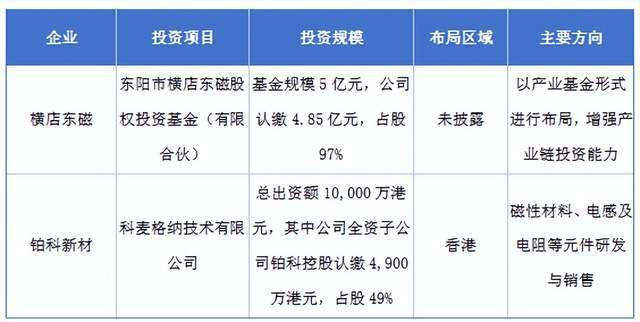
Core Insights - In 2025, companies in the magnetic materials/devices sector are shifting their capital actions from mergers and acquisitions to more targeted factory and subsidiary setups, reflecting changes in end-user demand, customer collaboration, and supply chain security considerations [1][2][3] Group 1: Investment Logic - The investment and capacity layout of global magnetic materials/devices companies are accelerating around three strategic pillars: proximity to core markets, avoidance of trade barriers, and optimization of supply chains and costs [2] - Companies are establishing production bases or subsidiaries near major customers to achieve just-in-time supply and collaborative R&D, significantly reducing delivery times and logistics costs [2][3] - In response to changing trade environments, companies are adjusting their production and sales layouts based on regional tariff policies and origin rules, as seen with companies like Keliqi in Vietnam and Jingquan in the Philippines [2] Group 2: Shift from Production to Platform - Compared to downstream device companies, magnetic materials companies are focusing more on capital and organizational expansion rather than solely on new manufacturing capacity [4][5] - By establishing subsidiaries, industrial funds, or overseas platforms, these companies aim to enhance their reach in new materials, high-end applications, and international business while maintaining stability in their core operations [4][5] Group 3: Factory Establishment Trends - Magnetic components companies are increasingly intensifying their factory and subsidiary establishment activities, focusing on automotive electronics, overseas manufacturing bases, and intelligent production line construction [6][7] - Key projects include multiple industrial parks and R&D centers by companies like Shunluo Electronics, which are aimed at expanding production and R&D capabilities in automotive electronics [7][8] - The trend indicates a clear focus on three main industry trajectories: automotive electronics, overseas capacity layout, and high-end product R&D, reflecting a shift towards more refined and strategic factory establishment [8]