一级能效冰箱

Search documents
625亿“国补”落地春节市场,以旧换新激活新春消费热潮
Sou Hu Cai Jing· 2026-02-16 02:47
Core Insights - The "Happy Shopping Spring Festival" special event initiated by the Ministry of Commerce and nine other departments has officially started, with 625 billion yuan in national subsidy funds allocated to boost consumer spending during the holiday season [1][3][6] - The event has led to a surge in consumer interest in upgrading household appliances, with many consumers taking advantage of government subsidies and promotional offers to replace old appliances [1][4] Group 1: Consumer Behavior - Consumers are actively participating in the "trade-in" program, with a significant portion of sales coming from customers replacing old appliances, as seen in various regions like Hebei and Shaanxi [1][2] - The trend of upgrading to energy-efficient and smart appliances is becoming a priority for consumers, with many opting for products that meet green and intelligent standards [2][4] Group 2: Government Initiatives - The government is encouraging the trade-in program by providing substantial subsidies and ensuring that consumers can easily claim these benefits [3][6] - The "three major packages" offered to consumers include trade-in subsidies, a lottery for invoices, and financial support from banks and financial institutions to promote spending across various sectors [3][6] Group 3: Market Trends - The demand for smart and energy-efficient products is rising, with items like smart glasses and electric vehicles becoming popular choices among consumers during the Spring Festival [2][4] - The integration of various subsidies (national, factory, and store) is leading to significant savings for consumers, further driving the trend of upgrading household and personal electronics [2][4]
惠民补贴进社区,金鹰家电携“国补”政策亮相“海棠花开”
Qi Lu Wan Bao· 2026-02-09 05:34
Core Insights - The event "Haitang Blossoms, Beautiful Society" organized by Jin Ying Home Appliances in the Hedong District successfully promoted green and smart home appliances while providing information on the national appliance recycling subsidy policy [1][2] - The initiative aims to enhance consumer awareness of energy-efficient products and government subsidies, thereby stimulating market activity and supporting families in achieving a low-carbon, smart lifestyle upgrade [2] Group 1: Event Overview - The event featured a "Green Smart Home Appliance Exhibition" alongside consultations on the national recycling subsidy policy, attracting significant interest from local residents [1] - Jin Ying Home Appliances showcased various energy-efficient and smart home appliance products, encouraging residents to experience and inquire about new appliances [1] Group 2: Consumer Engagement - Sales representatives highlighted the benefits of energy-efficient appliances, such as a refrigerator with first-level energy efficiency that offers substantial subsidies through the recycling program [1] - The company set up a policy interpretation area to explain the subsidy scope, application process, and discount amounts in an accessible manner, helping residents understand the financial benefits [1] Group 3: Company Objectives - Jin Ying Home Appliances aims to act as a promoter of green living and a communicator of welfare policies, leveraging the event to directly connect high-quality, low-energy products with community needs [2] - The company plans to continue engaging with residents in future activities to ensure broader awareness and access to the benefits of consumption upgrades [2]
政经1号丨超4.6万亿元!江苏社零总额首次跃居全国第一
Sou Hu Cai Jing· 2026-02-03 13:55
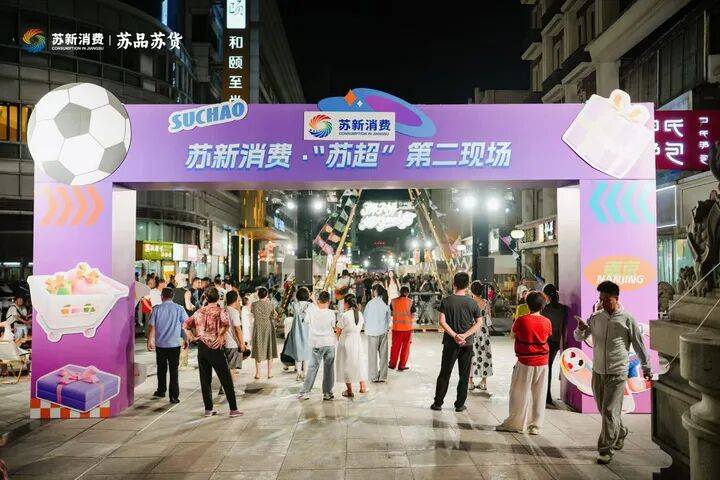
Group 1 - Jiangsu's total retail sales of consumer goods reached 46,394.2 billion yuan in 2025, marking a 3.3% year-on-year growth and ranking first in the nation for the first time in 45 years [1] - The "Su Super" event significantly contributed to this achievement, with over 243 million on-site spectators and 2.8 million average attendees per event, generating over 26 billion yuan in retail, dining, and accommodation transactions during the finals [1] - The event demonstrated a leverage effect of 1 yuan ticket leading to 7.3 yuan in surrounding consumption, showcasing its role in driving economic growth [1] Group 2 - Jiangsu has expanded 573 "Su Super second venues" that integrate viewing, shopping, dining, and entertainment, effectively converting event traffic into consumption growth [3] - The province has launched various brand activities like "Su Products" and "Three Up" actions to meet diverse consumer needs, while also enhancing the night economy with 50 designated night consumption hubs [3] - The "first store" phenomenon has proven impactful, with over 800 new stores established in 2025, including 2 global first stores and 17 national first stores, enhancing consumer engagement [4] Group 3 - Nanjing's Xinjiekou shopping district maintained its leading position in East China, with Deji Plaza achieving sales of 26.24 billion yuan in 2025, averaging over 71.78 million yuan in daily sales [6] - The first store economy has created a dynamic shopping environment, encouraging consumers to explore new offerings and driving sustained consumption [7] - Nighttime economic activities have transformed consumer experiences, with events like immersive night tours and cultural experiences attracting significant foot traffic [7] Group 4 - The "old for new" policy has stimulated consumer goods sales, with significant growth in green and smart products, including a 21.2% increase in new energy vehicles and a 39.5% increase in energy-efficient appliances [8] - Jiangsu has implemented innovative policies for the "old for new" program, expanding eligible products and simplifying application processes, resulting in over 1.96 billion yuan in government subsidies and 15.2 billion yuan in sales [8][9] - The province aims to enhance the "old for new" policy further in 2026, focusing on key sectors and promoting cultural and sports consumption to boost economic vitality [9]

超4.6万亿元!江苏社零总额首次跃居全国第一
Xin Hua Ri Bao· 2026-02-03 13:47
Core Insights - Jiangsu Province achieved a GDP of 14.23515 trillion yuan in 2025, marking a 5.3% year-on-year growth, becoming the second province in China to surpass the 14 trillion yuan mark [1] - The province's total retail sales of consumer goods reached 4.63942 trillion yuan, with a year-on-year increase of 3.3%, ranking first in the nation for the first time in 45 years [1] Group 1: Economic Growth and Consumer Trends - The "Su Super" event significantly boosted local consumption, with over 2.43 million attendees and online viewership exceeding 2.2 billion, demonstrating a strong economic impact [2] - The event generated over 2.6 billion yuan in retail, dining, and accommodation transactions in Nanjing, reflecting a 20% increase [2] - Jiangsu's initiatives to enhance service quality and create consumption opportunities have led to a 10.4% increase in tourist numbers and a 10.2% rise in total spending [2] Group 2: Innovative Consumption Strategies - Jiangsu has launched various brand activities like "Su Products" and "Three Up" actions to cater to diverse consumer needs, enhancing the night economy with 50 designated night consumption hubs [3][4] - The introduction of new stores has proven effective, with over 800 new stores established in 2025, including 17 national first stores and 245 restaurant first stores [5] - The Nanjing Deji Plaza achieved sales of 26.24 billion yuan in 2025, averaging over 71.78 million yuan in daily sales [5] Group 3: Green and Quality Consumption - The "trade-in for new" policy has stimulated consumer spending, with significant growth in retail sales of green and smart products, including a 21.2% increase in new energy vehicles [8] - Jiangsu's innovative policies have led to over 1.96 billion yuan in government subsidies, driving sales of 1.52 billion yuan through trade-in programs [8][9] - The province aims to enhance its consumption policies further in 2026, focusing on optimizing trade-in programs and promoting cultural and sports-related consumption [9]
消费市场暖意浓
Xin Lang Cai Jing· 2026-01-23 17:51
Core Insights - The article highlights the significant impact of the "old-for-new" policy in Qinghai, which has stimulated consumer spending and contributed to economic growth in 2025, with total consumption reaching over 19.7 billion yuan [4][5][10] Group 1: Old-for-New Policy - The "old-for-new" policy has provided substantial benefits to consumers and businesses, with a total fiscal subsidy of 1.69 billion yuan, covering over 1.52 million people and driving consumption of 19.7 billion yuan [5] - The policy has facilitated the purchase of 92,000 new vehicles, 496,000 home appliances, 615,000 digital products, and 31,900 home renovation items [5][6] - The design of the policy has been tailored to meet the needs of various consumer groups, including those affected by natural disasters and low-income households, enhancing its effectiveness [5][6] Group 2: Consumption Growth and Economic Impact - From January to November 2025, retail sales of new energy vehicles increased by 23.4%, while smart home appliances and audio-visual equipment saw a growth of 28.6% [6] - The policy has created a virtuous cycle of "consumption growth - business development - employment increase," contributing to job stability [6][10] Group 3: Launch Economy - Qinghai has positioned the launch economy as a key driver for market vitality and urban consumer branding, with policies supporting the establishment of new stores and product launches [7][8] - The introduction of 16 supportive measures for brand entry and development has encouraged numerous well-known brands to enter the Qinghai market, enhancing consumer experience [8][9] Group 4: Innovative Consumption Scenarios - The integration of cultural and ecological elements into consumption scenarios, such as the "noodle + cycling" model, has attracted tourists and boosted local businesses [11] - The collaboration between urban and rural markets has created a new landscape for consumption, with significant growth in retail sales across various sectors [11][12] Group 5: Future Outlook - The Qinghai Provincial Department of Commerce aims to expand domestic demand and boost consumption in 2026, launching a series of promotional activities to stimulate the market [12] - The ongoing release of policy benefits and innovative consumption scenarios is expected to sustain market vitality and support high-quality economic development in Qinghai [12]


新一轮“以旧换新”精准发力消费升温 智能眼镜首入补贴,绿色消费唱起主角
Zhen Jiang Ri Bao· 2026-01-22 23:32
Group 1 - The consumer market is experiencing a "renewal" trend, driven by new government subsidies for smart devices, including smart glasses, which have seen increased customer interest and sales [1][2] - The new subsidy policy includes a 15% discount on traditional digital products and introduces smart glasses into the subsidy list, aligning with the trend of AI wearable devices [2] - Online and offline sales data indicate a positive impact from the subsidy, with brands like Huawei and Xiaomi selling over 4,000 units of subsidized smart glasses [2] Group 2 - The new subsidy policy emphasizes green and energy-efficient products, with only first-class energy efficiency appliances eligible for a 15% subsidy, signaling a shift towards sustainable consumption [3] - The automotive sector is also responding positively to the new vehicle replacement subsidy policy, particularly in the electric vehicle market, with significant customer engagement and interest [4] - Retailers are enhancing customer experience by offering one-stop services for old product recycling and new product delivery, reflecting a comprehensive approach to the new subsidy policy [5]

新一轮国补落地首周带动消费4.5亿元 消费市场“焕新”提速
Yang Guang Wang· 2026-01-17 09:48
Core Insights - The new round of appliance trade-in policy in Guangxi has shown significant results in its first week, with 114,000 subsidies issued and a total subsidy amount of 64.99 million yuan, directly boosting appliance and digital product sales by 450 million yuan [1][4] Group 1: Policy Impact - The policy has led to a notable increase in the sales of energy-efficient appliances, with 80% of sales in a major store being of first-class energy efficiency products, reflecting a 56.18% month-on-month growth [4] - The implementation of the trade-in policy has resulted in a 46.8% year-on-year increase in sales of green smart appliances, with first-class energy efficiency products accounting for 62% of total subsidy applications [4][5] Group 2: Consumer Behavior - Consumers are increasingly prioritizing energy efficiency and smart features over price, indicating a shift in purchasing behavior towards quality [4][5] - The demographic of consumers engaging in the trade-in program is diverse, with 50% of subsidy applications for digital products coming from the 25-35 age group, and older consumers also showing significant interest in smart and health-oriented products [6] Group 3: Service Enhancements - Retailers are enhancing service offerings to ensure consumers can easily access policy benefits, including dedicated support for subsidy applications and integrated old product recycling services [7] - The online and offline service model has expanded, with 27% of subsidy applications coming from online channels, facilitating a seamless process for consumers [7] Group 4: Economic Implications - The trade-in policy is viewed as a practical measure to stabilize growth and promote consumption, while also serving as a long-term strategy for industrial upgrading and green development [9]
京东家电销售占比51%行业领先 超八成消费者618买家电首选京东
Sou Hu Wang· 2025-06-17 03:23
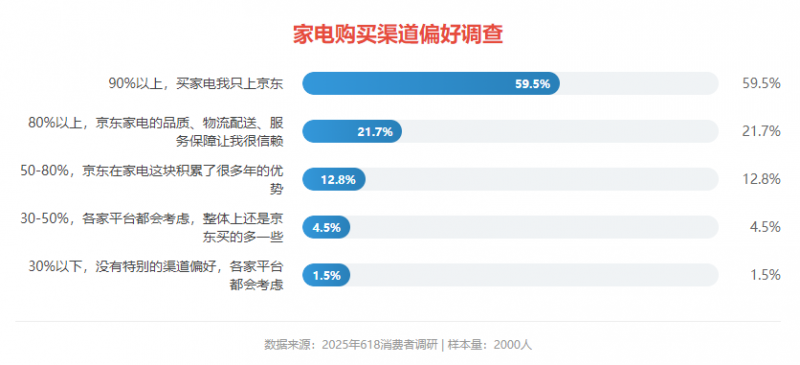
Core Insights - The 618 home appliance market is experiencing significant growth driven by national subsidies and promotional discounts, with JD.com leading the market with a 51% share of total sales since May 30, achieving over 50% sales growth [1][3][18] - Consumer preferences are shifting towards green, smart, and health-oriented appliances, indicating a trend from simply upgrading to enhancing quality [7][18] Market Performance - JD.com maintains a strong position in the home appliance sector, with 59.5% of consumers stating they purchase over 90% of their appliances from JD.com, and 21.7% purchasing over 80% [6][16] - The most popular categories during the 618 event include air conditioners, personal care appliances, and kitchen small appliances, with air conditioners being the top choice at 51.2% [2][3] Consumer Behavior - A significant portion of consumers (52.7%) budget between 3000-10000 yuan for major appliances, while 47.8% budget between 300-1500 yuan for small appliances [5] - The decision-making process is increasingly rational, with 52.8% prioritizing product quality and 49.5% valuing efficient delivery services [5][18] Trends in Product Preferences - Consumers are increasingly opting for energy-efficient and smart appliances, with 48.3% purchasing energy-saving products and 33.6% choosing smart devices [7][9] - In the television segment, 48.4% of consumers seek high-quality displays, while 39.8% prioritize energy efficiency [9] Impact of National Subsidies - The combination of promotional discounts and national subsidies has made high-end appliances more accessible, with 38.7% of consumers using subsidies for planned upgrades and 45.0% being motivated to upgrade due to the attractive offers [13][15] - Consumers report significant savings when using subsidies, with 25.2% saving between 500-1000 yuan and 18.9% saving between 1000-2000 yuan [15] JD.com's Competitive Advantage - JD.com is favored for its comprehensive pre-sale and post-sale services, with 93.9% of consumers choosing it for subsidy purchases due to its service quality and product guarantees [16][18] - The platform's ability to meet consumer demands for quality, price, and service reinforces its leading position in the home appliance market [18]