中证500ETF(510500)

Search documents
ETF午评 | 船舶制造走强, 法国CAC40ETF(513080)上涨3.11%,A500ETF基金(512050)成交额居首
Sou Hu Cai Jing· 2026-02-13 05:22
Market Performance - The Shanghai Composite Index decreased by 0.70%, the Shenzhen Component Index fell by 0.67%, and the ChiNext Index dropped by 0.96% [1] - Shipbuilding, aerospace, and semiconductors showed the highest gains, while small metals, photovoltaic equipment, and shipping ports collectively retreated [1] ETF Performance - The top five ETFs by increase were: - France CAC40 ETF (513080) up 3.11% - China-Korea Semiconductor ETF (513310) up 2.35% - Sci-Tech Semiconductor Equipment ETF (589020) up 2.32% - Sci-Tech Semiconductor ETF (588170) up 2.21% - Sci-Tech Semiconductor Equipment ETF (588710) up 2.14% [1] - The top five ETFs by decrease were: - Oil and Gas ETF (561760) down 3.63% - Oil ETF (561360) down 3.60% - Oil and Gas ETF (159309) down 3.58% - Oil and Gas ETF (561570) down 3.50% - Oil ETF (159697) down 3.30% [1] ETF Trading Volume - The top ten ETFs by trading volume included: - A500 ETF Fund (512050) with a volume of 9.776 billion - A500 ETF Huatai-PB (563360) with 7.270 billion - CSI A500 ETF (159338) with 5.846 billion - A500 ETF Southern (159352) with 5.665 billion - Gold ETF (518880) with 4.225 billion - A500 ETF E Fund (159361) with 3.106 billion - Hang Seng Technology ETF (513130) with 3.105 billion - Hong Kong Securities ETF E Fund (513090) with 2.785 billion - CSI 500 ETF (510500) with 2.601 billion - Hang Seng Technology Index ETF (513180) with 2.303 billion [2]
大喘气 | 谈股论金
水皮More· 2026-01-15 09:22
Market Overview - The A-share market showed mixed performance today, with the Shanghai Composite Index down by 0.33%, while the Shenzhen Component Index and the ChiNext Index rose by 0.41% and 0.56% respectively [3] - The trading volume in the Shanghai and Shenzhen markets approached 3 trillion yuan, significantly decreasing by over 1 trillion yuan compared to the previous day [3] Policy Implications - The regulatory intent is clear, aiming to cool down the market due to rapid index increases and high trading volumes, particularly in speculative sectors, by adjusting margin financing ratios [4] - The market's response was evident, with the Shanghai Composite Index declining as expected, and the Shenzhen market showing a higher number of declining stocks compared to advancing ones, approximately 1700 to 1200 [4] Market Sentiment - The trading volume dropped to 2.9 trillion yuan, reflecting a cooling market sentiment and reduced willingness to buy, while selling pressure remained moderate [4] - Notably, previously popular sectors such as commercial aerospace and AI applications experienced significant corrections, with 71 stocks hitting the daily limit down compared to only 63 stocks hitting the limit up [4] Stock Performance - The targeted regulatory approach is evident, with specific stocks under investigation and others suspended for review, avoiding a blanket policy [5] - At the close, the trading volumes for major ETFs like the CSI 500 ETF and the CSI 300 ETF surged to historical highs of 25.6 billion yuan and 26.3 billion yuan respectively, indicating a clear intent to stabilize the market [5] Future Outlook - The market is expected to continue cooling, particularly in overhyped sectors, as the current state of speculative trading is deemed unhealthy [5] - Large-cap stocks remain undervalued and have not completed their valuation recovery, while speculative stocks are experiencing intense trading, increasing the risk of market pullbacks [6] Monetary Policy - The new spokesperson for the central bank announced a targeted interest rate cut of 0.25 percentage points on various credit tools to enhance liquidity and reduce financing costs for enterprises [6] - However, this policy does not include a reduction in deposit rates, which negatively impacts bank stocks, reflecting a policy direction that prioritizes broader economic benefits over individual sector performance [6]


持续加仓!资金流向分化
Zhong Guo Zheng Quan Bao· 2025-11-20 12:44
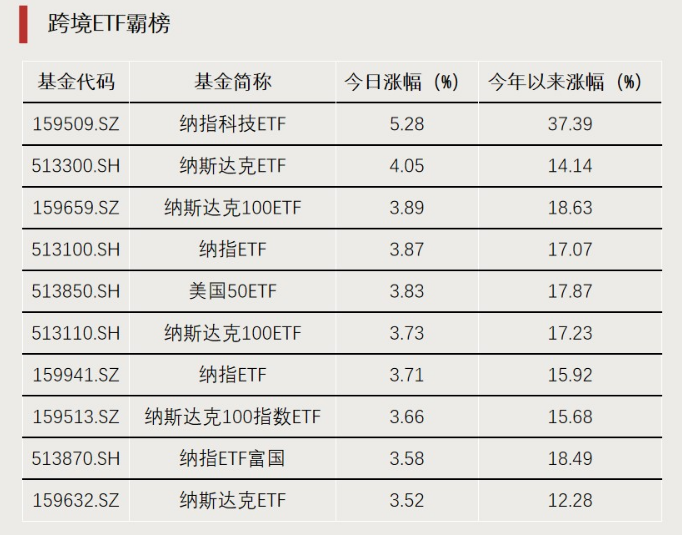
Market Overview - On November 20, over 1,300 ETFs in the market saw more than 200 ETFs closing higher, with 35 ETFs increasing by more than 1% [1] - The top-performing ETFs were all cross-border ETFs, each rising over 2%, particularly those targeting A-share assets in sectors like construction materials, real estate, and banking [2] Fund Flows - On November 19, the ETF market experienced a net inflow of approximately 8 billion yuan, with cumulative net inflows exceeding 50 billion yuan from November 14 to November 19 [3] - There was a notable divergence in fund flows on November 19, with large-cap broad-based ETFs experiencing net outflows while small- and mid-cap broad-based ETFs attracted investments [3][9] Top Performing ETFs - The top ten ETFs by performance on November 20 were all linked to overseas markets, primarily the US stock market, with eight of them tracking the Nasdaq 100 index [4] - The Nasdaq Technology ETF (159509) led the market with a 5.28% increase and a trading volume of 1.572 billion yuan, showing a premium rate of 20.06% [4][5] Underperforming ETFs - ETFs related to new energy and semiconductors on the Sci-Tech Innovation Board saw significant declines, with the top losers experiencing drops of over 3% [6] Fund Flow Analysis - The top ten ETFs by net inflow included several broad-based ETFs, with the CSI 500 ETF (510500) leading with a net inflow of over 1.06 billion yuan [8] - Conversely, large-cap broad-based ETFs like the CSI 300 ETF and the SSE 50 ETF faced substantial net outflows exceeding 1.2 billion yuan each [10] Investment Trends - There is a growing interest in dividend-paying assets as the year-end approaches, with discussions around high-dividend strategies becoming more prevalent [11] - Fund managers suggest that the current market conditions may lead to a balanced allocation between high-dividend stocks and growth sectors [11]
南方基金侯利鹏:以ETF为纽带,共建高质量财富管理生态
券商中国· 2025-10-23 03:45
Core Viewpoint - The wealth management market is transitioning from "scale expansion to quality cultivation," with ETFs playing a crucial role in injecting long-term capital into the stock market [1][2]. Group 1: ETF Market Insights - The Chinese capital market has achieved significant growth, with the technology sector now accounting for over 25% of the A-share market capitalization, enhancing the market's capacity to support technological innovation [2]. - As of the end of August, the total scale of ETFs in the Shanghai and Shenzhen markets has surpassed 5.1 trillion yuan, highlighting their critical role in guiding long-term capital into the market and supporting stable operations [2]. - South Fund has established a comprehensive ETF product matrix, including leading products like the CSI 500 ETF (510500) and CSI 1000 ETF (512100), covering various sectors and themes [2][3]. Group 2: South Fund's ETF Strategy - South Fund has been a pioneer in the ETF space since launching its first deep ETF in 2009, now managing 62 equity ETF products with a total scale of 312.5 billion yuan, maintaining a leading position in the industry [3]. - The firm emphasizes its core capabilities across the entire ETF business chain, including research, investment operations, risk management, and product sales, with a focus on innovation and collaboration with market makers [4]. Group 3: Future Collaboration Plans - South Fund plans to enhance cooperation with securities firms by providing more precise product support, sharing professional investment advisory resources, and building more efficient collaboration platforms [6][7]. - The company aims to optimize its ETF product offerings based on the diverse needs of different client groups, including institutions and retail investors, while also providing customized services to enhance client understanding and service efficiency [6]. - South Fund will open more research results to securities firms and conduct diversified investor education activities to improve investor trust and engagement [7].

A股反弹,A50直线上涨!
21世纪经济报道· 2025-04-08 04:14
Core Viewpoint - The article highlights a significant rebound in the A-share market, with various ETFs experiencing increased trading volumes and the ChiNext index leading the gains, indicating a positive market sentiment and potential investment opportunities. Group 1: Market Performance - On April 8, the A-share market showed a rebound, with the Shanghai Composite Index rising by 0.91% and the ChiNext Index increasing by 1.78%, with a total of 3,294 stocks advancing [3] - The trading volume for the CSI 500 ETF exceeded 6.3 billion, with several other ETFs also surpassing 1 billion in trading volume, indicating strong investor interest [1][2] - The CSI 500 ETF's shares increased by 141 million to reach a historical high of 700.7 million shares as of April 7, with net inflows leading among similar products [2] Group 2: Sector Performance - Agricultural stocks continued to surge, with over ten stocks, including Beidahuang, hitting the daily limit [4] - Consumer stocks showed a volatile rebound, particularly in the retail sector, with companies like Yonghui Supermarket also reaching the daily limit [4] - The Hong Kong stock market also performed well, with the Hang Seng Index rising by 1.58% and the Hang Seng Tech Index increasing by 3.57% [5] Group 3: Corporate Responses to Tariffs - Over 30 listed companies in A-shares have publicly responded to the impact of U.S. tariff policy adjustments, with many indicating that their export business to the U.S. is minimal and thus the impact is limited [10] - Companies like Yunnan Zhenye and Yiyuan Communication reported that their exposure to U.S. exports is low, minimizing the potential impact [10] - Some companies have proactively communicated with clients and adjusted their operations to mitigate risks, with firms like Dongpeng Beverage achieving 100% domestic sourcing for key materials [13] Group 4: Industry-Specific Insights - In the semiconductor sector, companies noted that the impact of tariffs is limited due to low export ratios to the U.S., with many firms focusing on domestic supply chain improvements [19] - The automotive industry reported that only a small fraction of vehicles are exported to the U.S., with adjustments already made to reduce exposure to potential tariffs [20] - Leading home appliance companies indicated that their products sold in the U.S. are primarily sourced from Mexico, thus remaining unaffected by the new tariff policies [20]