
二甲醚

Search documents
广发宏观:高频数据下的3月经济:价格篇
GF SECURITIES· 2026-04-01 07:54
Price Index Trends - The Business Price Index (BPI) rose significantly in March, reaching 1103 points, a month-on-month increase of 16.4% compared to the end of February[3] - The energy index increased by 25.3%, while the chemical index surged by 32.4%, but the non-ferrous index fell by 9.5% month-on-month[4] Commodity Price Movements - In the week of March 16-20, five energy commodities saw price increases of over 5%, accounting for 35.7% of the monitored items[4] - The average price of coal in the Bohai Rim region increased by 1.7%, while the chemical price index surged by 33.8% month-on-month[5] Real Estate Market - As of March 23, the second-hand housing price indices in Beijing, Shanghai, Guangzhou, and Shenzhen decreased by 1.0%, 1.8%, 1.4%, and 0.8% respectively[5] - The second-hand housing prices in these cities have seen significant highs over the past year, with peaks recorded at 159.44, 192.67, 181.71, and 251.13 points[6] Emerging Industries - The photovoltaic industry composite index fell by 13.2% in March, with significant declines in prices for battery cells and polysilicon[6] - Lithium carbonate futures prices decreased by 4.9% month-on-month, while DRAM spot prices fell between 5.3% and 8.9%[9] Shipping and Logistics - The China Container Freight Index (CCFI) rose by 9.0% in the fourth week of March, with significant increases in shipping rates to Los Angeles and New York[7] - The Baltic Dry Index (BDI) decreased by 5.1% month-on-month, indicating a mixed outlook for shipping costs[8] Food Prices - The average wholesale price of pork fell by 12.7% in March, while key vegetable prices dropped by 10.9%[9] - The price index for non-food items, represented by the ICPI, decreased slightly to 99.67, reflecting a month-on-month decline of 0.2%[10]
霍尔木兹海峡无法通行 巴斯夫化工产品再度涨价(附概念股)
Zhi Tong Cai Jing· 2026-03-26 01:31
Group 1: BASF Price Increase Announcement - BASF announced a price increase for its commodity amines portfolio in Europe, with increases up to 30% and some products potentially higher, effective immediately [1] - Morgan Stanley highlighted that raw material availability is a critical bottleneck, and if the conflict continues, operational rates in the Middle East and Asia may decline further, impacting global chemical supply chains [1] - As of March 15, approximately 60% of chemical products in China saw price increases, with notable rises in acrylic acid (90.7%), p-nitrochlorobenzene (80.3%), and methionine (56.3%) [1] Group 2: Chemical Sector Companies in Hong Kong - Shanghai Petrochemical Company (00338) is a major integrated refining and chemical enterprise in China, listed in Shanghai, Hong Kong, and New York, focusing on synthetic fibers, resins, plastics, and petroleum products [2] - China Xuyang Group (01907) is the largest producer of methanol from coke oven gas in China, with an annual production capacity of 600,000 tons, and is a key player in the "alcohol-ammonia" industry chain [2] - China Heartland Fertilizer (01866) has diversified its business, with a growing share of revenue from the chemical sector, primarily focusing on methanol, with expectations of significant revenue and profit growth in Q1 2026 due to rising prices and supply disruptions from Iran [2]

港股概念追踪|霍尔木兹海峡无法通行 巴斯夫化工产品再度涨价(附概念股)
智通财经网· 2026-03-26 01:27
Group 1 - BASF announced a price increase for its commodity amines portfolio in Europe, with increases up to 30% and some products potentially higher, effective immediately [1] - Morgan Stanley highlighted that raw material availability is a critical bottleneck, and if the conflict continues, operational rates in the Middle East and Asia may decline further, impacting global chemical supply chains [1] - As of March 15, approximately 60% of chemical products in China saw price increases, with notable rises in acrylic acid (90.7%), p-nitrochlorobenzene (80.3%), and methionine (56.3%) [1] Group 2 - Shanghai Petrochemical Company is a major integrated refining and chemical enterprise in China, listed in Shanghai, Hong Kong, and New York, focusing on producing synthetic fibers, resins, plastics, and petrochemical products [2] - China Xuyang Group is the largest producer of methanol from coke oven gas in China, with an annual production capacity of 600,000 tons, and is a key player in the "alcohol-ammonia" industry chain [2] - Xinlianxin Fertilizer has diversified its business, with a growing share of revenue from the chemical sector, primarily focusing on methanol, which is expected to see significant sales growth due to supply disruptions from Iran [2]
甲醇数据日报-20260324
Guo Mao Qi Huo· 2026-03-24 06:21
Report Industry Investment Rating - Not provided in the report Core View - The spot price of methanol increased slightly in many places yesterday. The inventory of enterprises in the main production areas in the northwest was at a low level, and the willingness of downstream and traders to replenish at low prices increased. The auction transaction price of enterprises rose. The positive sentiment in the futures market drove the smooth transaction of new domestic orders in the afternoon. Some enterprises stopped selling and supported prices, pushing up the spot price. The downstream was mainly on the sidelines. After replenishing at low prices in the early stage, procurement became more rational. The market trend needs to pay attention to the downstream procurement transaction on Tuesday. In the short term, the methanol price will fluctuate within a range. In the medium and long term, the methanol spot market may change from strong to weak and fluctuate [1]. Summary According to Relevant Catalogs Spot Price - The price of Jincheng anthracite increased from 920.00 to 950.00, with an increase of 30.00. The price of Inner Mongolia steam coal remained unchanged at 630.00. The price of Sichuan and Chongqing liquefied gas increased from 4435.00 to 4530.00, with an increase of 95.00. The price of international natural gas decreased from 21.19 to 20.18, with a decrease of 1.01. The price of methanol in Taicang increased from 2990.00 to 3230.00, with an increase of 240.00. The price of methanol in Inner Mongolia increased from 2255.00 to 2440.00, with an increase of 185.00. The price of methanol in Shandong increased from 2690.00 to 2870.00, with an increase of 180.00. The price of methanol in China, Southeast Asia, Northwest Europe, and the United States remained unchanged [1]. Supply - Domestic methanol production decreased from 298525.00 to 298255.00, with a decrease of 270.00. Domestic methanol start - up rate decreased from 93.54 to 93.45, with a decrease of 0.08. International methanol start - up rate remained unchanged at 46.14. The arrival weight at the port remained unchanged at 12.27 [1]. Inventory - Enterprise inventory and port inventory remained unchanged at 523210.00 and 1312817.00 respectively [1]. Demand - The order backlog remained unchanged at 264840.00. The prices of Hebei coke oven gas, Inner Mongolia coal - to - methanol, Shandong coal - to - methanol, and Shanxi coal - to - methanol increased by 0.00, 21.00, 21.00, and 23.00 respectively. The prices of Sichuan natural gas - to - methanol remained unchanged. The start - up rates of MTO, dimethyl ether, formaldehyde, acetic acid, chloride, and MTBE remained unchanged [1]. Associated Product Prices - The prices of formaldehyde (Shandong), dimethyl ether, acetic acid, methane chloride, and MTBE increased by 135.00, 250.00, 100.00, 100.00, and 630.00 respectively [1]. Operation Strategy - The basis strengthened, and the trading volume was average. In the short term, the methanol price will fluctuate within a range. In the medium and long term, the methanol spot market may change from strong to weak and fluctuate [1].
金牛化工:公司甲醇主要是作为化工原材料,下游主要为醋酸、二甲醚等
Mei Ri Jing Ji Xin Wen· 2026-02-10 13:52
Group 1 - The company produces methanol primarily as a chemical raw material [2] - The main downstream applications of methanol include acetic acid and dimethyl ether [2]


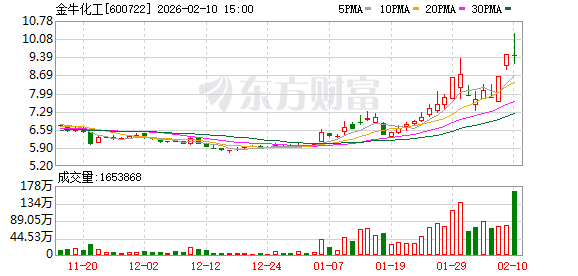
金牛化工:甲醇主要是作为化工原材料,下游主要为醋酸,二甲醚等
Zheng Quan Ri Bao· 2026-02-10 13:37
Group 1 - The core viewpoint of the article is that Jinniu Chemical primarily uses methanol as a raw material for chemical production, with its main downstream products being acetic acid and dimethyl ether [2] Group 2 - Jinniu Chemical responded to investor inquiries on February 10, indicating its focus on methanol as a key input in its operations [2] - The company highlights the significance of acetic acid and dimethyl ether as major products derived from methanol [2]
大越期货甲醇周报-20260209
Da Yue Qi Huo· 2026-02-09 05:25
1. Report Industry Investment Rating - No relevant information provided 2. Core Viewpoints - As the holiday approaches, the domestic methanol market is expected to fluctuate within a range next week. The inland methanol market is gradually entering the pre - holiday adjustment period. On the demand side, traditional downstream devices such as formaldehyde have successively shut down for holidays, and some downstream players have completed pre - holiday stockpiling, leading to a gradual decline in terminal demand. On the supply side, domestic methanol plants have continued to increase their sales efforts, with enterprise inventory levels running at a low level. Some enterprises have adopted a limited - sales strategy, and the overall supply side remains sufficient without obvious pressure. As the Spring Festival holiday approaches, market trading activity has significantly decreased, and it is expected that the inland methanol market will maintain a light consolidation pattern in the short term. In the port area, methanol futures followed the non - ferrous metals sector through a round of sharp rises and falls and then fell into range - bound fluctuations again. Currently, the capital sentiment has dissipated, the geopolitical risk between the US and Iran is uncertain, and the fundamental weakness remains unchanged. It is expected that the port market will fluctuate within the bottom range before the holiday. The operation is recommended to focus on reducing risk exposure. Keep an eye on whether and when US President Trump will launch a real military action against Iran [7] 3. Summary by Directory 3.1 Weekly Review - The report predicts that the domestic methanol market will be range - bound next week due to the approaching holiday. The inland market is in a pre - holiday adjustment, with demand shrinking and supply sufficient. The port market is affected by factors such as capital sentiment and geopolitical risks, and is expected to fluctuate at the bottom [7] 3.2 Fundamental Data 3.2.1 Domestic Methanol Spot Price - The domestic methanol prices in different regions showed different trends from January 30th to February 6th. Prices in Jiangsu decreased by 2.78%, those in Hebei increased by 1.24%, those in Inner Mongolia increased by 1.12%, and those in Fujian decreased by 4.11%, while prices in Lunan remained unchanged [8] 3.2.2 Methanol Basis - From January 30th to February 6th, the spot price decreased by 2.78%, the futures price decreased by 3.28%, and the basis increased by 13 [11] 3.2.3 Methanol Production Profits by Different Processes - From January 30th to February 6th, the profit of coal - to - methanol increased by 76, that of natural - gas - to - methanol remained unchanged, and that of coke - oven - gas - to - methanol increased by 324 [13] 3.2.4 Domestic Methanol Enterprise Load - The national methanol load this week was 74.90%, a decrease of 3.81% compared with last week; the load in the northwest was 81.54%, a decrease of 3.55% compared with last week [15] 3.2.5 Foreign Methanol Prices and Spreads - From January 30th to February 6th, the CFR China price decreased by 2.24%, the CFR Southeast Asia price remained unchanged, and the spread decreased by 6 [18] 3.2.6 Methanol Import Spreads - From January 30th to February 6th, the spot price decreased by 2.78%, the import cost decreased by 2.26%, and the import spread decreased by 11 [21] 3.2.7 Methanol Traditional Downstream Product Prices - The prices of formaldehyde, dimethyl ether, and acetic acid remained unchanged from January 30th to February 6th [27] 3.2.8 Formaldehyde Production Profit and Load - From January 30th to February 6th, the formaldehyde production profit decreased by 11, and the load increased by 0.01% [28] 3.2.9 Dimethyl Ether Production Profit and Load - From January 30th to February 6th, the dimethyl ether production profit decreased by 36, and the load increased by 1.45% [30] 3.2.10 Acetic Acid Production Profit and Load - From January 30th to February 6th, the acetic acid production profit increased by 35, and the load decreased by 1.29% [35] 3.2.11 MTO Production Profit and Load - The MTO production profit increased from - 1264 on January 30th to - 1062 on February 6th, and the load decreased by 0.18% [39] 3.2.12 Methanol Port Inventory - This week, the inventory in East China was 56.36, a decrease of 3.22 compared with last week; the inventory in South China was 39.78, a decrease of 0.02 compared with last week [41] 3.2.13 Methanol Warehouse Receipts and Effective Forecasts - From January 30th to February 6th, the warehouse receipts decreased by 0.99%, and the effective forecasts remained unchanged [42] 3.3检修状况 3.3.1 Domestic Methanol Device Maintenance - Many domestic methanol enterprises are in maintenance, planned maintenance, or have production problems in various regions such as the Northwest, East, Southwest, and Northeast. For example, Shaanxi Black Cat's 100,000 - ton/year coke - oven - gas - based methanol device has been under maintenance since early November 2024 [44] 3.3.2 Foreign Methanol Device Operation - Foreign methanol enterprises in countries such as Iran, Saudi Arabia, Malaysia, and the US have different operating conditions. Some are in normal operation, some are restarting and recovering, and some are under maintenance. For example, ZPC in Iran is reported to have one set restored, but it needs to be verified [45] 3.3.3 Olefin Device Operation - Olefin devices in different regions have different operating conditions. Some are running smoothly, some are under maintenance, and some are expected to be put into production. For example, Shaanxi Qingcheng Clean Energy's methanol and olefin devices will be shut down for maintenance on March 15th for about 45 days [46]
石油与化工指数多数上涨(1月19日至23日)
Zhong Guo Hua Gong Bao· 2026-01-27 01:28
Group 1: Industry Performance - The chemical raw materials index increased by 6.24%, and the chemical machinery index rose by 3.49%, while the chemical pharmaceuticals index decreased by 1.54% and the pesticide and fertilizer index increased by 8.32% [1] - In the oil sector, the oil processing index rose by 6.74%, the oil extraction index increased by 1.77%, and the oil trading index went up by 5.97% [1] Group 2: Oil Prices - International crude oil prices showed an upward trend, with the NYMEX West Texas Intermediate crude oil futures closing at $61.07 per barrel, up 2.74% from January 16, and the ICE Brent crude oil futures closing at $65.88 per barrel, up 2.73% from January 16 [1] Group 3: Petrochemical Products - The top five petrochemical products with the highest price increases were battery-grade lithium carbonate (up 17.62%), industrial-grade lithium carbonate (up 10.24%), niacinamide (up 8.96%), styrene (up 7.96%), and tetrachloroethylene (up 7.86%) [1] - The top five petrochemical products with the largest price decreases were propylene oxide (down 6.15%), soft foam polyether (down 3.10%), dimethyl ether (down 2.67%), calcium pantothenate (down 2.63%), and POP-type polyether (down 2.59%) [1] Group 4: Capital Market Performance - The top five listed chemical companies with the highest stock price increases were Jianghua Micro (up 46.41%), Jiangtian Chemical (up 38.09%), Runbei Hangke (up 33.40%), Intercontinental Oil and Gas (up 30.95%), and Jiuding New Materials (up 28.47%) [2] - The top five listed chemical companies with the largest stock price decreases were Bofei Electric (down 24.16%), Shenjian Co. (down 15.12%), *ST Yatai (down 9.47%), Shanghai Xinyang (down 6.66%), and Baomo Co. (down 6.33%) [2]
港口基差有所反弹
Hua Tai Qi Huo· 2026-01-21 05:28
Report Industry Investment Rating - Unilateral: Neutral; No rating for inter - period and cross - variety [4] Core Viewpoints - After the situation in Iran eased, the methanol futures price on the port has continuously corrected. The port inventory has started to decline, and the port basis has rebounded. However, attention should be paid to the downstream MTO maintenance situation. Overseas, Iranian methanol plants are still undergoing winter maintenance [3]. - In the inland areas, coal - based methanol plants maintain high - pressure operation, and southwest gas - based plants are gradually restarting. Inland factories are in a period of continuous inventory increase, and the traditional downstream is in the seasonal off - season [3]. Summary by Directory I. Methanol Basis & Inter - period Structure - This section includes multiple figures showing the basis between methanol in different regions (such as Taicang, Lunan, Inner Mongolia North Line, etc.) and the main futures contract, as well as the price differences between different methanol futures contracts (e.g., 01 - 05, 05 - 09, 09 - 01) [6][7][22] II. Methanol Production Profit, MTO Profit, and Import Profit - Figures in this part display the production profit of coal - based methanol in Inner Mongolia, the MTO profit in East China (PP&EG type), and the import price differences between Taicang methanol and CFR China, as well as the price differences between CFR Southeast Asia, FOB US Gulf, FOB Rotterdam and CFR China [6][26][27] III. Methanol Start - up and Inventory - It shows the total port inventory of methanol, the start - up rate of MTO/P (including integrated plants), the sample inventory of inland factories, and the start - up rate of methanol in China [6][33][39] IV. Regional Price Differences - The section presents the price differences between different regions, such as the price difference between northern Shandong and the northwest, the price difference between Taicang and Inner Mongolia, and the price differences between other regions [2][6][36] V. Traditional Downstream Profits - Figures show the production gross profit of formaldehyde in Shandong, acetic acid in Jiangsu, MTBE isomerization etherification in Shandong, and dimethyl ether in Henan [6][49][52]
甲醇供需格局改善 市场压力来自进口
Qi Huo Ri Bao· 2026-01-15 23:47
Supply and Demand Dynamics - In 2026, new production capacity will largely have supporting downstream projects, leading to a slowdown in domestic production pressure. Seasonal maintenance will impact operating rates and output [1][18] - The demand for methanol will see significant growth from external purchases of methanol-to-olefins (MTO) units, with traditional downstream new capacity providing a certain demand increment for methanol [1][18] - The overall supply-demand balance for methanol may improve to some extent in 2026, despite facing import pressures in the second half of the year [1][18] Production Capacity Growth - As of November 2025, domestic methanol production capacity reached 108.045 million tons, an increase of approximately 5.18 million tons from the end of 2024, with a year-on-year growth rate of 5% [2] - Integrated projects are the main contributors to new capacity, with about 70% of the new capacity in 2025 being integrated projects supporting downstream applications like MTO and BDO [2] - The dominance of coal-based methanol production is expected to strengthen, with coal-based capacity projected to reach 85.97 million tons by 2025, accounting for 81.8% of total capacity [2] Production Trends - Methanol production in 2025 is expected to reach 101.83 million tons, reflecting a year-on-year increase of 10.8% [6] - The average operating rate for coal-based methanol units is around 80%, showing a gradual increase, while natural gas-based units remain stable at approximately 49% [7] - The overall operating rate for the methanol industry was 85.74% as of November 2025, an increase of 2.10 percentage points compared to the same period in 2024 [7] Import Market Dynamics - China's methanol import market experienced a "V" shaped trend in 2025, with total imports expected to reach 14.28 million tons, a year-on-year increase of 5.9% [8] - The growth in imports is influenced by multiple factors, including overseas supply and international logistics [8] - In 2026, methanol imports from Iran are expected to increase, while imports from Russia may also rise due to geopolitical factors [9] Downstream Demand - In 2025, the average weighted operating rate for downstream methanol industries was approximately 76%, a 3 percentage point increase from 2024 [10] - The methanol-to-olefins (MTO) sector remains the primary downstream consumer, accounting for about 50% of methanol demand [10] - The MTO industry is projected to continue its rapid growth in 2026, with an expected annual increase in capacity of 320,000 tons [12] Price Trends - Methanol prices are expected to exhibit seasonal fluctuations in 2026, with potential price recovery in the first half of the year due to lower import pressures, followed by a possible decline in the second half [1][18] - The overall price trend for 2026 is anticipated to show a stronger performance in the first half and a weaker performance in the second half, influenced by seasonal maintenance and import dynamics [18]
